


xAI’s product lineup has recently accelerated its expansion, from the Grok chat model and image generation to a more complete developer API ecosystem, and now the voice interface has officially been added. xAI has launched Grok’s Voice API, covering both Speech to Text (STT) and Text to Speech (TTS) capabilities, with pricing significantly lower than existing mainstream services on the market—nearly 10 times cheaper than ElevenLabs.
Did xAI just mass-murder the entire voice AI industry? 🤯
Grok just launched two voice APIs. Speech-to-Text and Text-to-Speech.
Built on the same stack powering Tesla cars and Starlink support.
And priced at 10x cheaper than ElevenLabs.
Speech-to-Text: $0.10/hr batch.… pic.twitter.com/hoEFybkwkC
— Vaibhav Sisinty (@VaibhavSisinty) April 18, 2026
What xAI rolled out this time isn’t just a simple TTS, but a complete voice API.
According to xAI’s official Voice APIs DocumentThe voice capabilities launched this time aren’t limited to just the text-to-speech that’s easiest for most people to understand. Overall, xAI has broken down its voice-related capabilities into three parts. The first is the Voice Agent API, which can be used for real-time voice conversations, through /v1/realtime provides speech-to-speech interaction capabilities; the second is Text to Speech API, through /v1/tts Convert text to speech; the third is Speech to Text API, through /v1/stt Speech-to-text capabilities. This means xAI isn’t just building a text-to-speech service that reads text aloud for you—it’s looking to integrate voice input, voice output, and real-time voice agents into a complete platform that developers can directly plug into.
Previously, most people’s perception of large language models was largely limited to text-based chatbots or web-style Q&A. However, real-time voice responses have become the next competitive battleground, because once AI is liberated from text interfaces into an agent system that can listen, speak, and respond in real time, it can naturally enter customer service, automotive, telephony, education, personal assistance, and enterprise workflow scenarios. xAI has also explicitly stated in its official documentation that its Voice Agent API supports tool calling and can integrate with capabilities like web search. The voice system itself supports multilingual capabilities, telephony encoding, and enterprise integration requirements—all of which indicate it’s targeting not merely a flashy demo but real-world deployment scenarios.
The most eye-catching point is the really aggressive pricing.
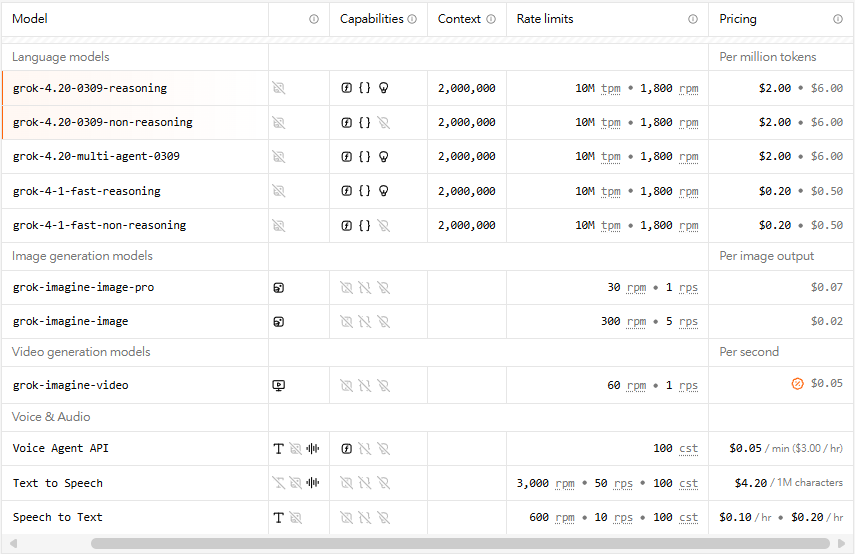
According to xAI’s official Models and Pricing documentThe Speech to Text API is priced at $0.10 per hour for batch transcription and $0.20 per hour for real-time streaming, while the Text to Speech API costs $4.20 per million characters. The official news pages and community discussions have all centered around this pricing, as this rate clearly represents a price war targeting the existing voice API market.

Estimating in New Taiwan Dollars, batch STT runs about NT$3 per hour, real-time STT around NT$6 per hour, and TTS is roughly NT$136 per million characters. This pricing is highly attractive to developers because voice products, once scaled, tend to face more direct cost pressure than text-based services. Especially in use cases like customer service, outbound calls, meeting transcription, and AI phone assistants, costs can quickly balloon due to extended audio processing—so even a noticeable price gap can directly sway developers’ technology choices. This is why Vaibhav Sisinty directly points the competition at ElevenLabs, because in today’s developer community, voice model comparison is no longer just about naturalness, but a comprehensive battle of naturalness, latency, stability, features, and price.
Not only is it affordable, but it also offers multilingual support, real-time streaming, and tone control.
Apart from the price, what also caught attention this time is that xAI didn’t enter the market with a “cheap but basic” approach. Official documentation shows the Speech to Text API supports 25 languages with both batch and streaming modes; Text to Speech offers multiple voice options, streaming and batch output, plus support for MP3, WAV, PCM, μ-law, and A-law formats. For those building phone systems or voice agents, these specs aren’t minor features but important thresholds for actual deployment.
What’s more interesting is that xAI also emphasized “Expressive Speech Tags” in the documentation, which allows inserting like [pause]、[laugh]、<whisper> These markers make the output speech more expressive, rather than just flatly reading words aloud. This is precisely one of the key competitive focuses for current high-end TTS services, because making AI voices closer to real humans depends not only on voice quality itself, but also on rhythm, pauses, emotion, and emphasis patterns. From a product strategy perspective, xAI clearly doesn’t want to just be a “cheap alternative,” but hopes to simultaneously capture both the basic voice service market and applications requiring higher interactivity.
xAI clearly wants to evolve Grok from a chat model into a directly deployable voice agent platform
Based on official documentation, xAI’s vision for voice goes far beyond single-point APIs like STT and TTS. Their bigger ambition appears to be turning Grok into a complete agent platform that can directly connect to voice interfaces, execute tool calls, and even handle phone and real-time customer service tasks. The Voice Agent API documentation mentions it can combine tool calling, WebSocket, real-time events, and multiple integration methods—it even lists examples like Web Voice Agent, Twilio Phone Agent, WebRTC, LiveKit, Voximplant, and Pipecat. This approach clearly isn’t selling “single model capability” but rather “here’s something you can directly use to build products.”
Based on xAI’s current product direction, it is indeed moving toward enterprise voice, phone agents, and large-scale service scenarios. For the Musk camp, this is a very logical path, because if they want Grok to extend beyond X or chat windows into more physical services and enterprise workflows, a voice API is almost an essential piece to fill in.
For players like ElevenLabs, Deepgram, and AssemblyAI, the real pressure comes from price wars and integration battles hitting at the same time.
The AI voice market isn’t empty right now — it’s already quite crowded. In TTS, you have services like ElevenLabs that excel in naturalness and voice performance. In STT, there are established API providers like Deepgram and AssemblyAI. If you look further into enterprise communications and real-time agents, you’ll encounter even more players in calling, customer service, video/audio, and infrastructure. What makes xAI’s entry so formidable isn’t just its model capabilities — it’s that it can bundle voice functionality with its own chat model, search tools, and real-time agent abilities, then use low pricing to directly compress the market.
For developers, this integrated platform would be quite attractive. They don’t necessarily want to build their own STT, TTS, LLM, tool calling, and real-time communication infrastructure from scratch. If a single vendor can provide all these capabilities at a low enough price point, the barrier to adoption drops significantly, making this type of AI voice service much more widespread. (Editor’s note: Grok also offers a free monthly voice API quota—those interested can try it out themselves.)
Source: KOCPC Chinese