


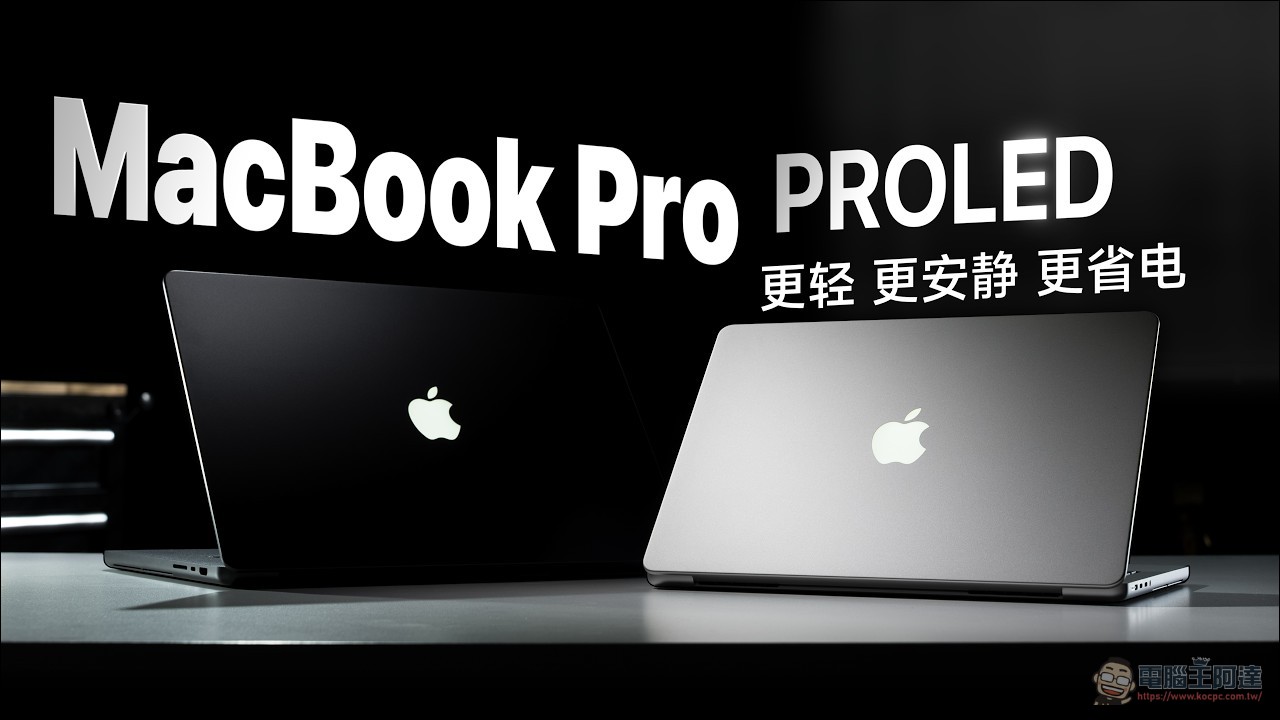
Apple announced its first touch-enabled PROLED XDR MacBook Pro on October 28, officially named MacBook Pro with PROLED XDR Display, and also switched to a dual-layer tandem OLED screen and Dynamic Island. The touchscreen is the most eye-catching change in this generation of machines, but in a hands-on test published on November 6 by Chinese tech channel Geekerwan, the least important upgrade on this machine is actually the touchscreen. Geekerwan’s test results show that the laptop’s highlights are: after shedding more than 200 grams, performance output has not regressed, noise is even lower, and sustained performance when the lid is closed and an external display is connected is greatly improved.
Weight: The 300 grams lost are the most direct tangible change.
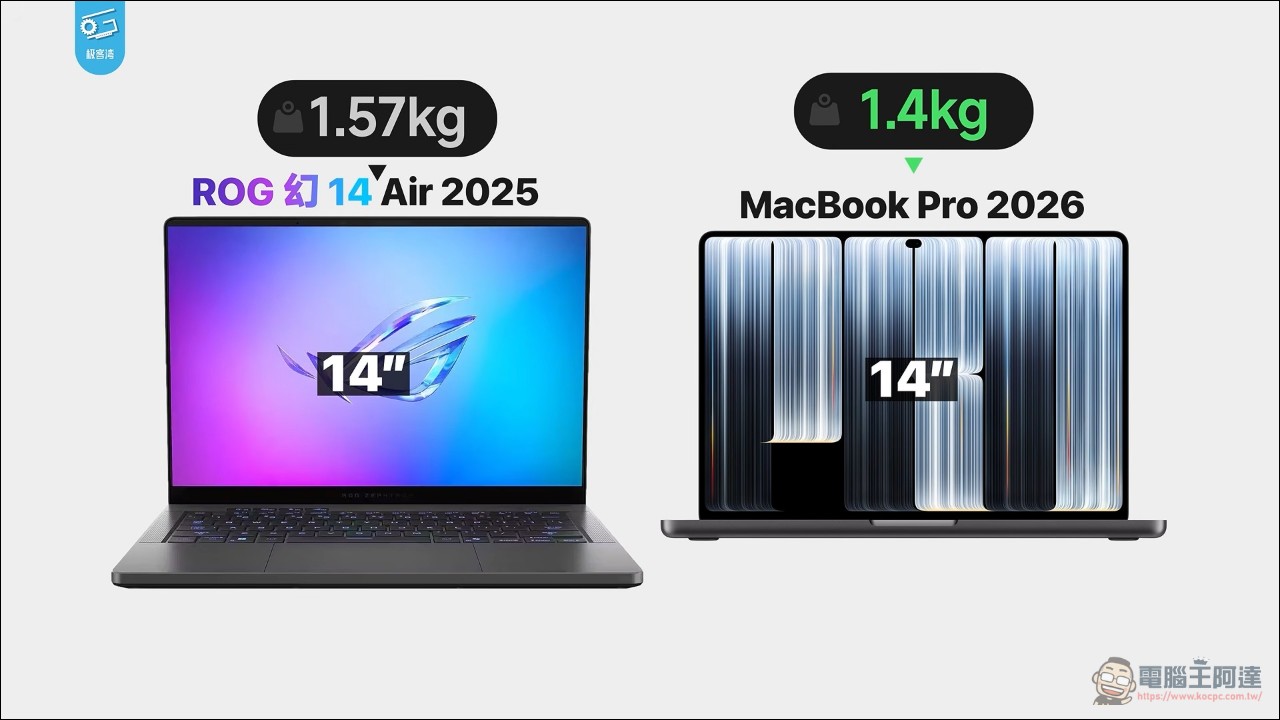
The first thing Piao mentioned was weight. Since the previous-generation MacBook Pro was released in 2021, weight has consistently been a key complaint among users, especially the 14-inch configuration at 1.6 kg, which deterred many users who wanted to upgrade from the MacBook Air. This time, the 14-inch model has shed more than 200 grams, coming in at 1.4 kg—almost back to the level of the old 13-inch MacBook Pro, less than 200 grams heavier than the MacBook Air, and lighter than the similarly 14-inch high-performance ROG 幻14 Air.
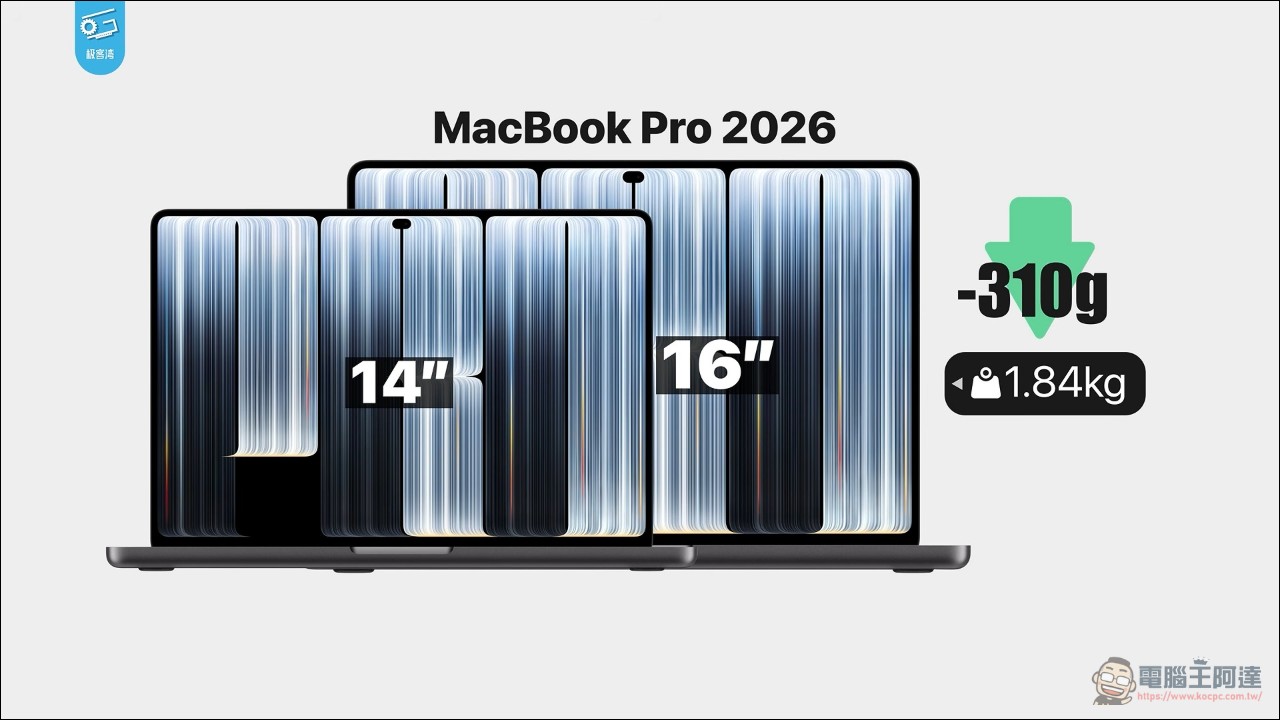
The 16-inch version dropped from 2.15 kg to 1.84 kg, shedding 300 grams and returning to the weight of the 2016 15-inch model. Apple officially says the 14-inch is 3 pounds and the 16-inch is 4 pounds, half a pound and 0.7 pounds lighter than the previous generation.
Apple attributes the weight reduction to a more streamlined OLED display stack, and also mentions a redesigned cooling architecture so hot air no longer blows toward the screen. Piao Ge also points out that this generation of machines hasn’t lost any ports and doesn’t have that butterfly keyboard design.
Battery life: the advantage of dual-layer OLED
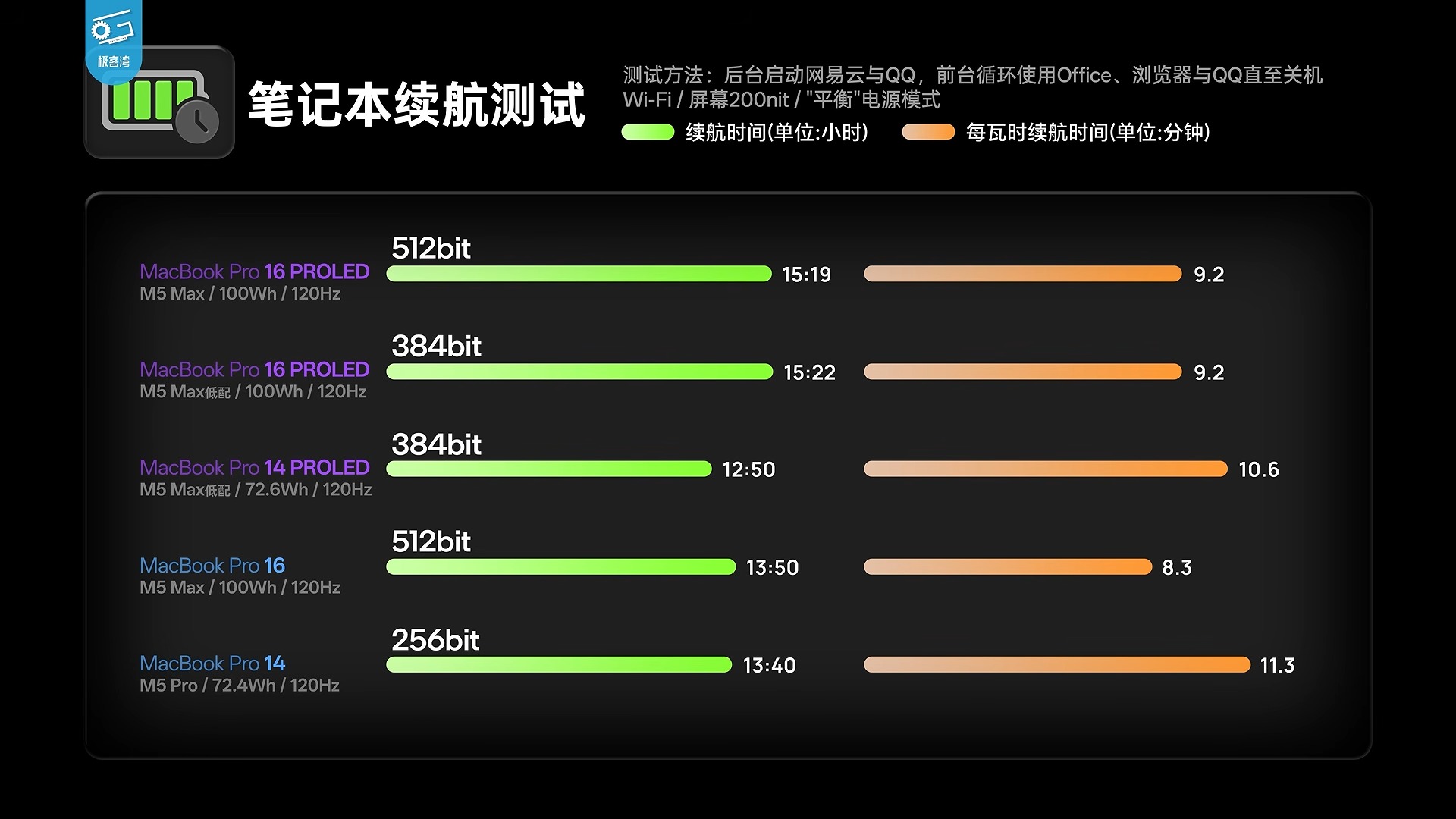
After the weight reduction, the most immediate concern is whether performance and battery life will suffer. Piao Ge first addressed battery life: according to Geekerwan’s self-built laptop battery-life model test, the results were excellent. Numerically, the 16-inch M5 Max lasted more than an hour longer than the previous generation (15:19); the 14-inch M5 Max came close to the previous-generation M5 Pro’s level (12:50). Piao Ge specifically explained that because the M5 Max has a much wider memory bus, its battery life is naturally lower than that of M5 Pro models, and new models with the same processor are certain to be better than older ones. The battery-life results above were measured by Geekerwan using its own workflow; Apple’s official figure is up to 24 hours.
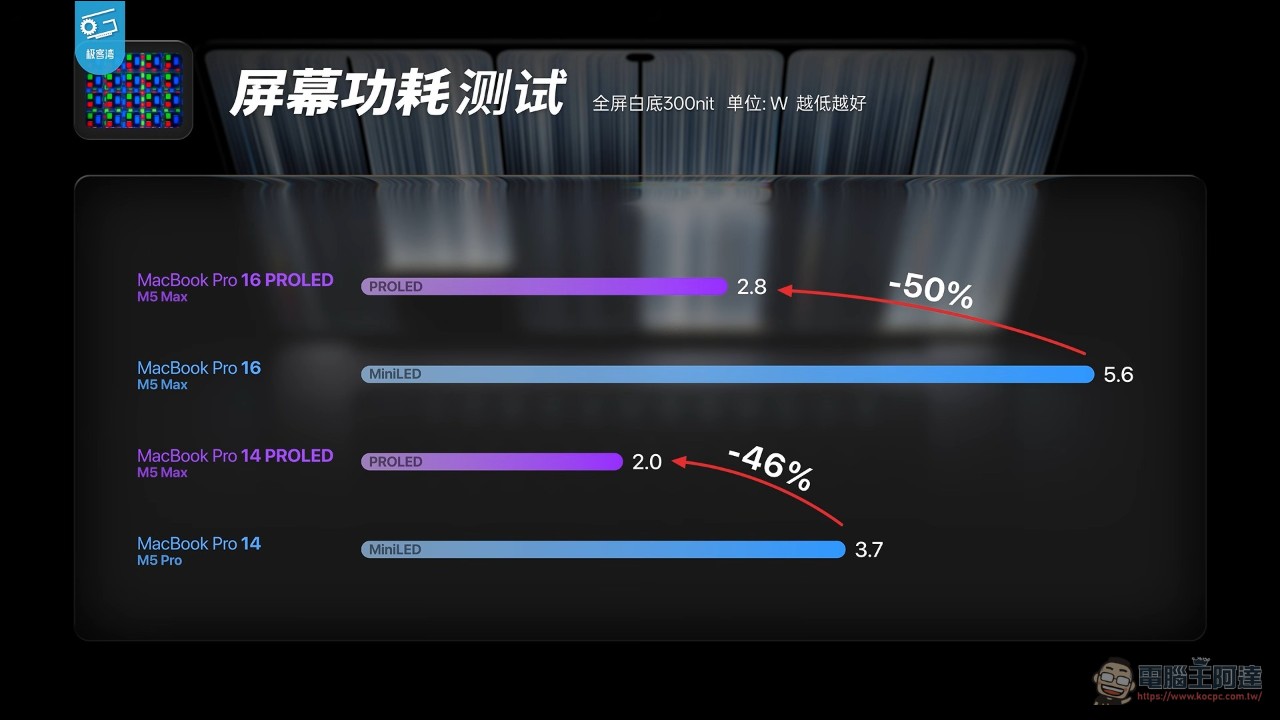
The reason for the increased battery life lies in the display. Piao Ge measured display power consumption on the same M5 Max model at 300 nits full-screen white brightness, and the new model’s figures were significantly lower than the old model’s. In the video, he mentioned that dual-layer OLED has a huge advantage over miniLED in this respect, which has already been verified on the iPad Pro. Apple’s specifications state that PROLED XDR uses dual-layer self-emissive pixel layers, with peak brightness up to 2,000 nits, a contrast ratio of 10,000,000:1, a variable refresh rate from 10Hz to 120Hz, and support for P3 and Adobe RGB color gamuts.
Performance Unleashed: Lighter Without Slowing Down
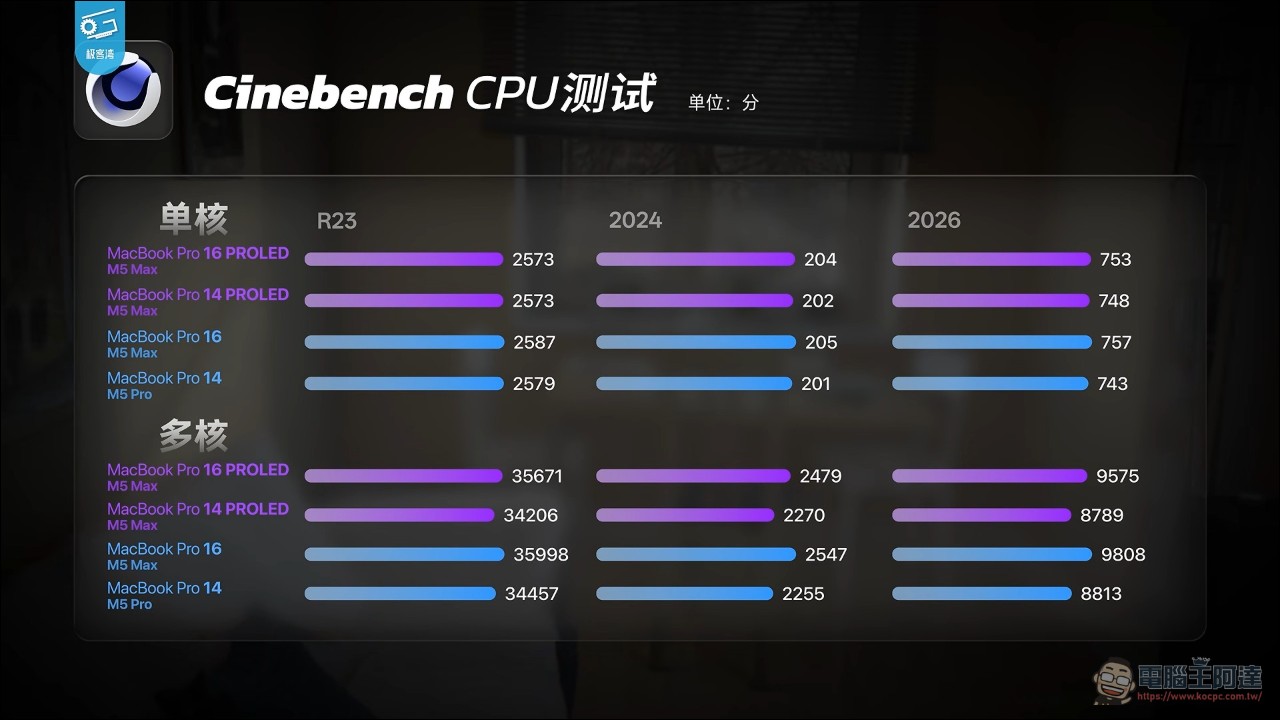
As for performance, Piao Ge’s conclusion is “not at all”—there is no sacrifice for being lighter. This time, the performance release level is even slightly stronger than the previous generation. In the Cinebench third-generation test, the peak performance of the new model and the old model is almost identical. Then, in a 15-round Cinebench R23 loop test, also with high power mode enabled, both the new 16-inch and the old 16-inch can maintain performance close to peak. The new 14-inch is a bit stronger than the old one, with performance closer to the 16-inch models.
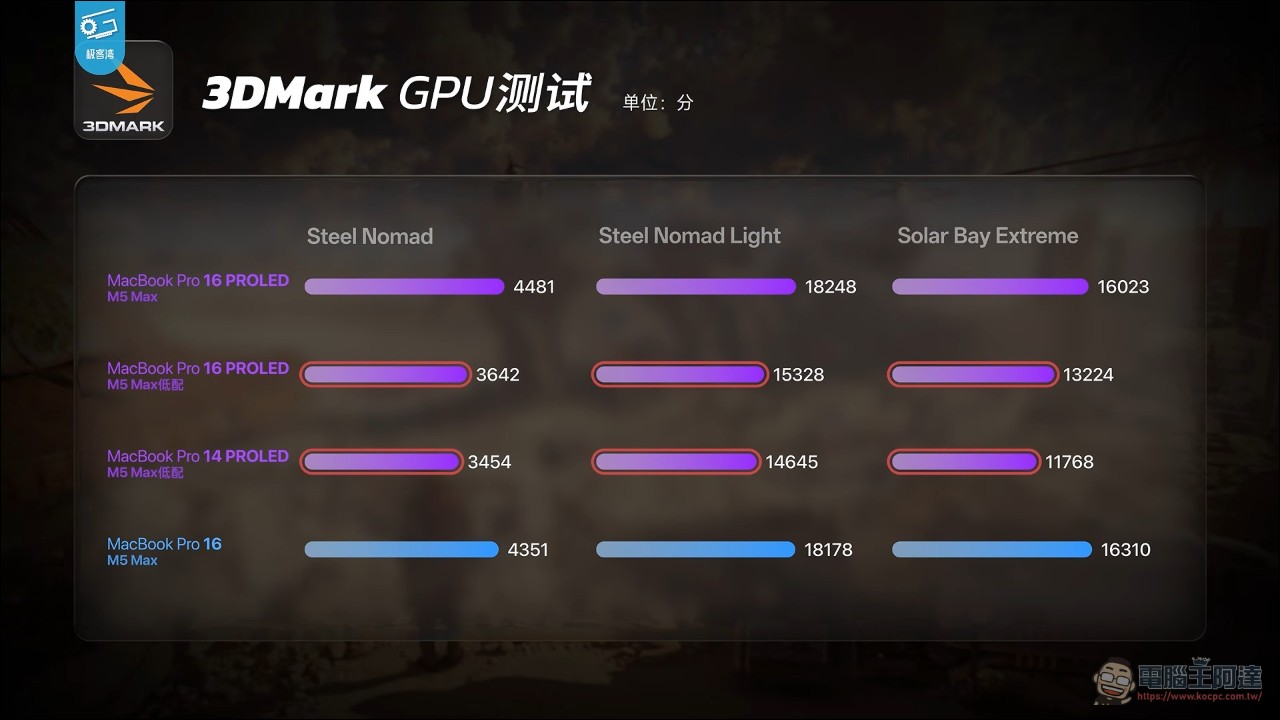
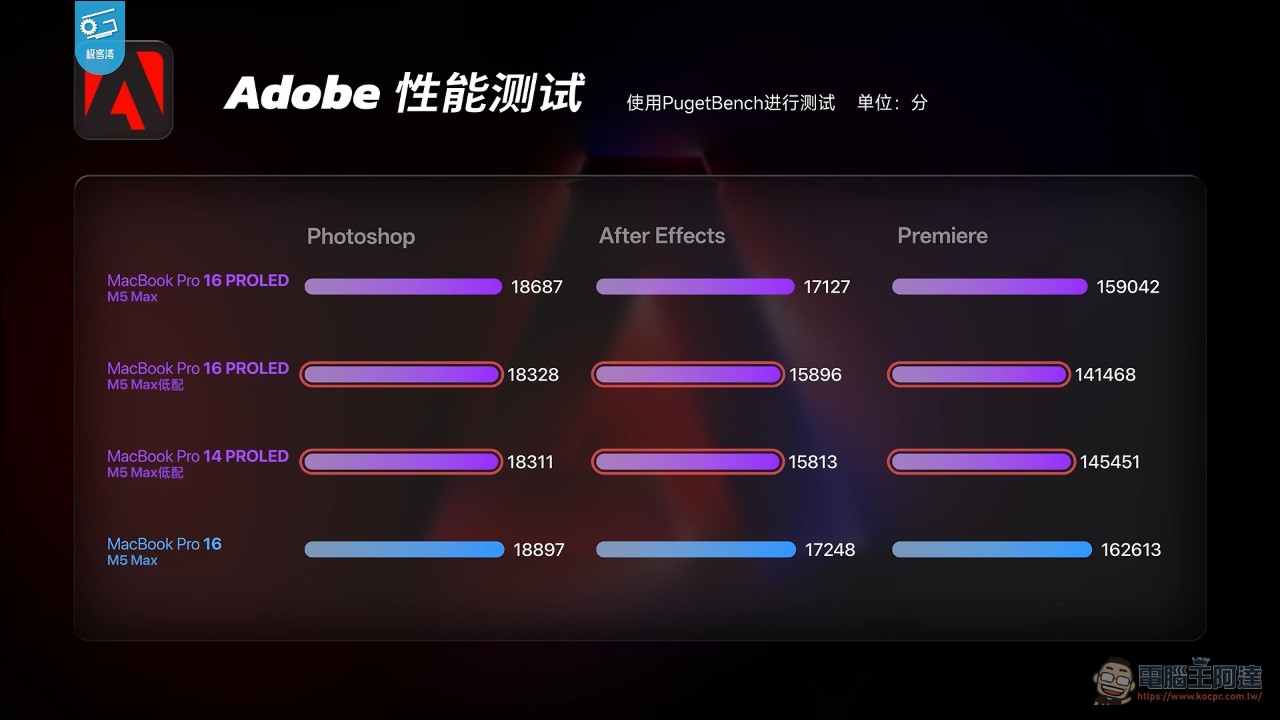
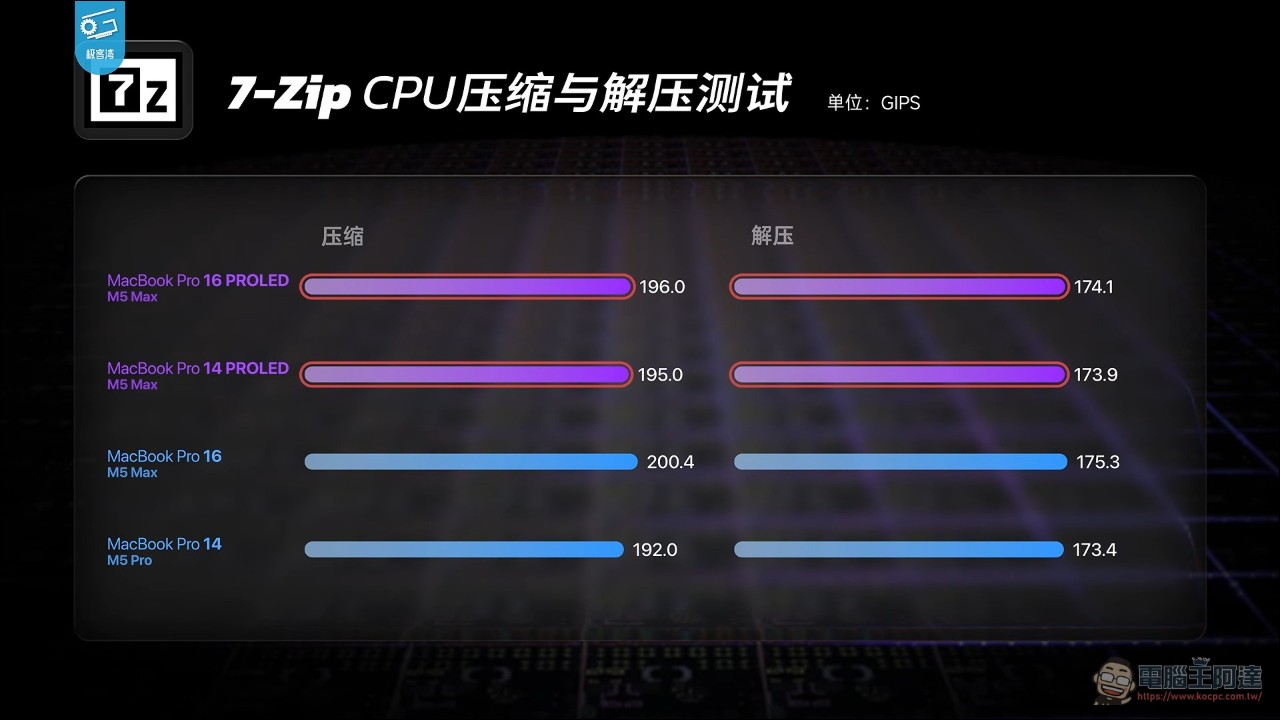
The conclusions from the other application tests are consistent. In 3DMark, the 16-inch model with the same configuration is still somewhat stronger than the 14-inch, but there is no performance gap between the new and old top-spec models; in Blender, the new and old top-spec models likewise show no difference; several new 7Zip models achieve the same level and all outperform the old 14-inch; in the Adobe three-app tests, the 14-inch and 16-inch with the same configuration are basically no different, and the 16-inch top spec is no different from the previous generation top spec.
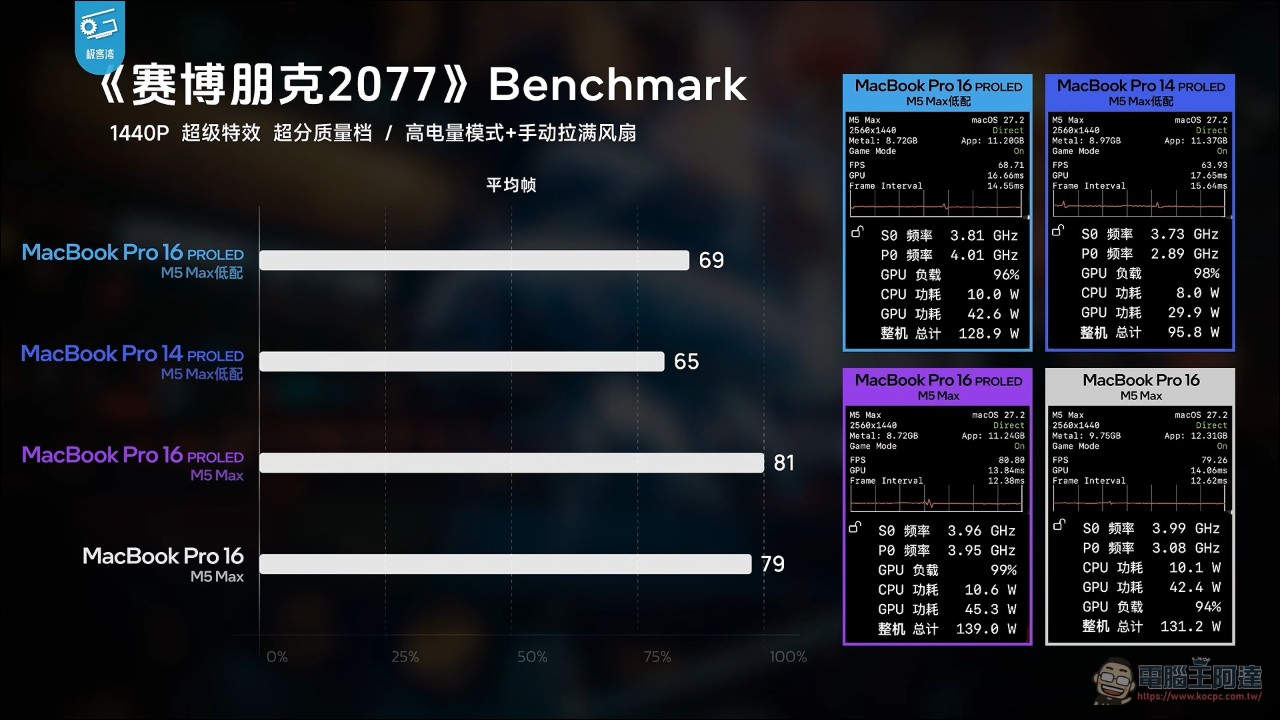
In the gaming section, I tested Cyberpunk 2077 under two conditions: fans at maximum and fans on auto, running three rounds and taking the fourth round’s result to show performance after heat soak and downclocking. With fans at maximum, the 14-inch model with the same configuration is still slightly weaker than the 16-inch model and has lower total system power, but the previous and current generations with the same top spec show basically no difference in scores. With fans on auto, the 14-inch model’s sustained performance is clearly outpaced by the 16-inch model, while the new lower-spec 16-inch version with a 32-core GPU is already close to the frame rate of the old top-spec version.
Local AI benchmarks: another selling point of the M5 Max
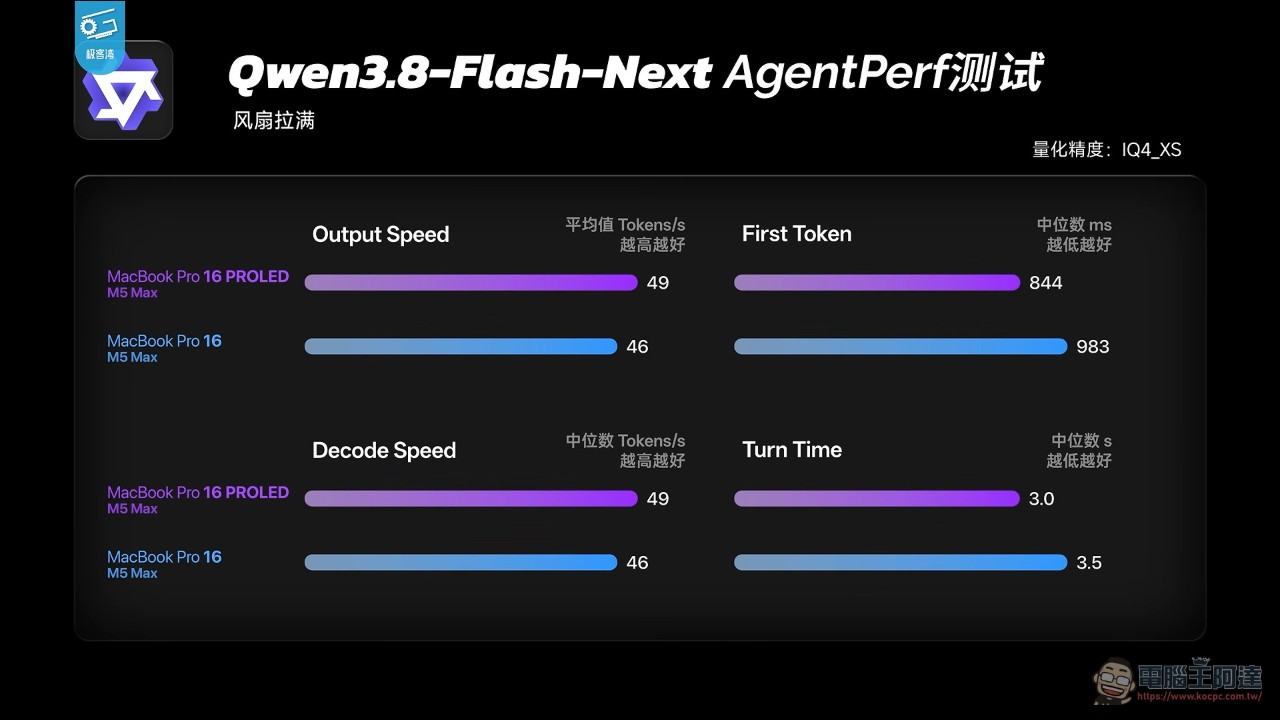
Piao specifically highlighted the MacBook Pro’s appeal to local AI users and used a top-spec 128GB memory model to run the IQ4-quantized Qwen3.8-Flash-Next model. Even with the fans maxed out, the new model still has some performance advantage, which he attributes to improved cooling.
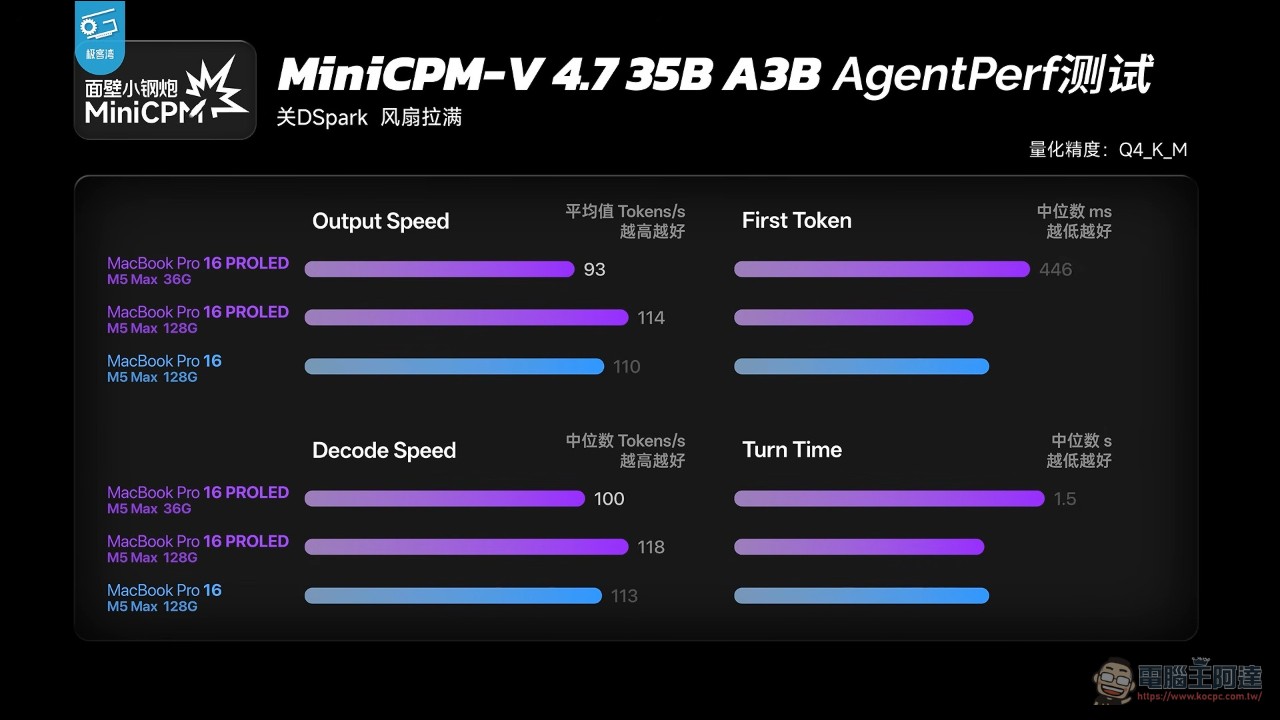
The 36GB memory model was tested with the Q4 quantized version of the MiniCPM-v4.7-35B-A3B model. The result is that the 36GB version of the M5 Max performs slightly lower than the full-spec version, because both the GPU scale and video memory bandwidth have been reduced, resulting in a difference in Prefill and Decode speeds. In automatic fan mode, the 16-inch model maintains the same performance level as with the fans at full speed, while the 14-inch model is slightly weaker but the difference is limited. Fan noise on both models is very slight.
Cooling and Noise: Fans Spin Faster Yet Are Quieter
The dual stress test is the toughest part of the entire article. The workload consists of a Cinebench R23 loop plus the 3DMark SNL stress test, testing performance output and noise under three conditions: fans manually set to maximum, high-performance power mode, and auto mode.
With the fans maxed out, the new 14-inch model’s SoC power consumption stabilizes at 69W, comparable to the old model, but the fans spin faster than on the old model, with one of them even exceeding 9,000 rpm. However, noise at full speed is actually lower than the previous generation, dropping from 50dB to around 48dB. The 16-inch model’s SoC power consumption stabilizes at 87W, with total system input power at 135W, nearly maxing out the 140W adapter; the ultra-large core runs at 2.6GHz, the big cores at 3.6GHz, and the GPU at 1.48GHz, while the two fans run at 6,250 rpm and 6,750 rpm respectively.
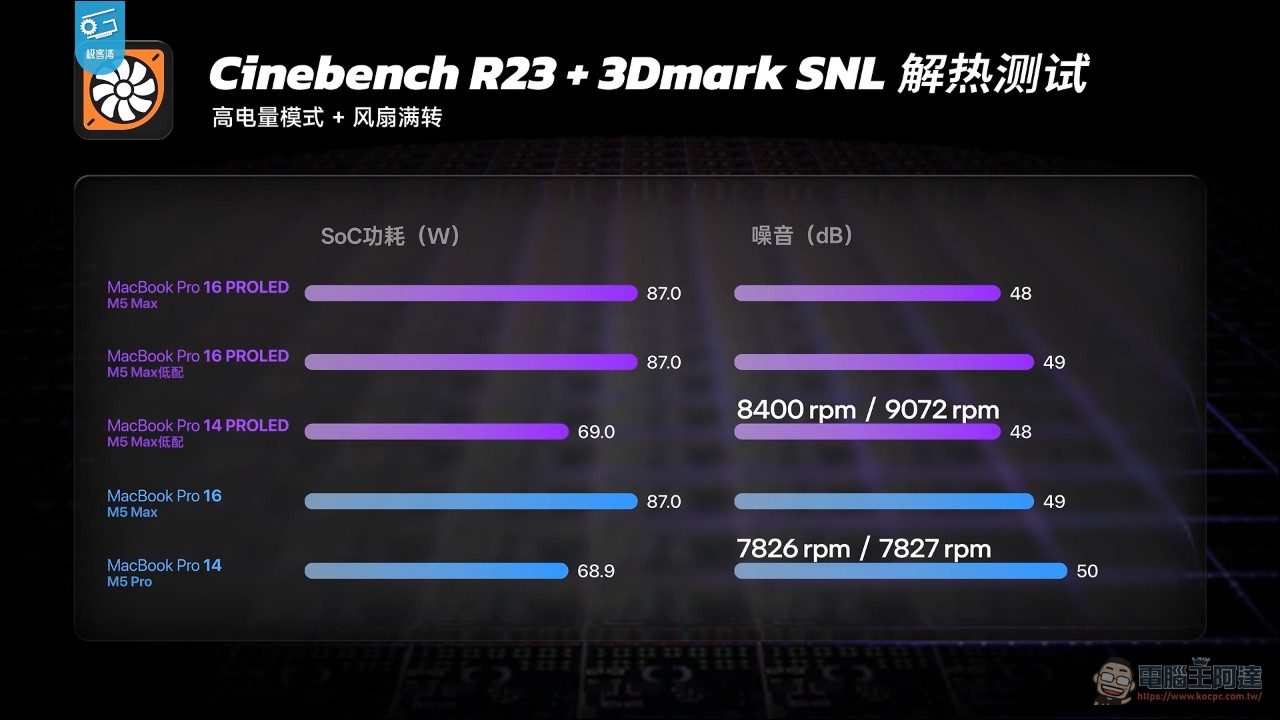
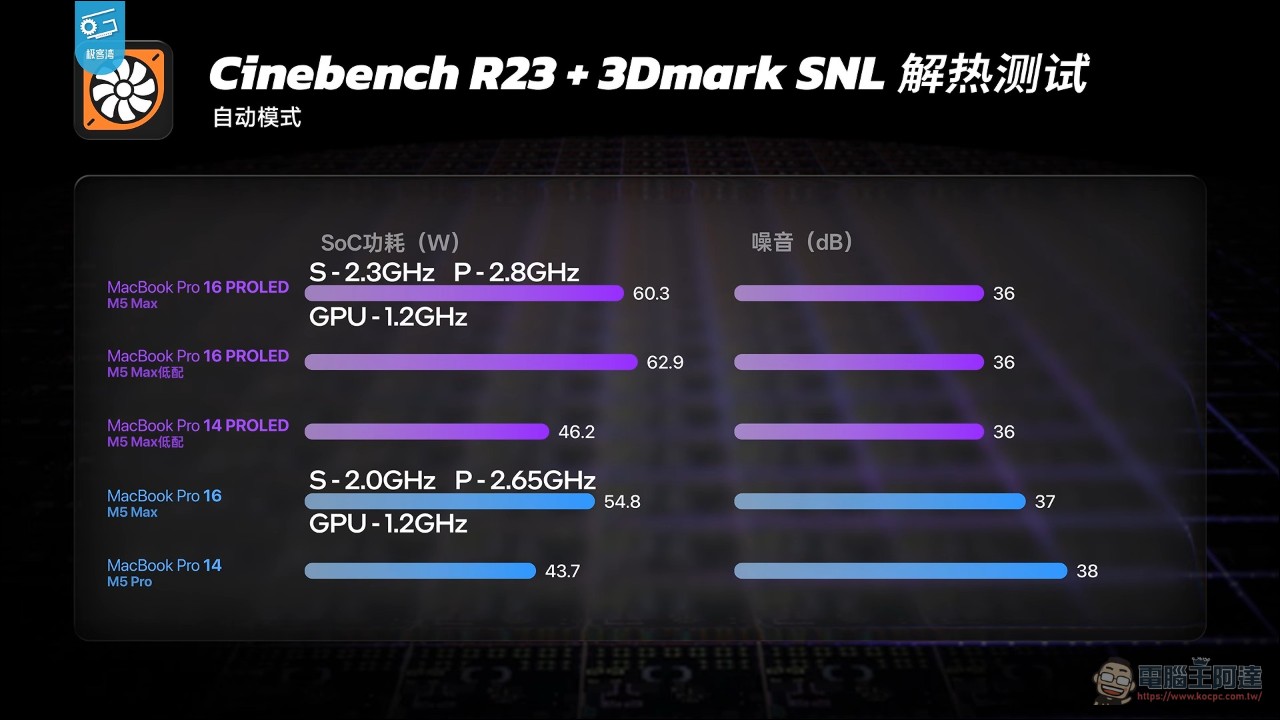
In automatic mode, the gap widens. The new 14-inch model reaches near-maximum fan speed after about 8 minutes and maintains 69W, while the old model’s sustained power draw is only 60W, yet its noise is actually higher at around 49dB. The 16-inch model’s two fans run at 5,800 rpm and 6,300 rpm, maintaining 87W with 46.2dB noise, quieter than the 14-inch. Switching to full auto mode, the new 14-inch model’s performance output at 46W beats the old model’s 43W, and noise drops from around 38dB to around 36dB; the 16-inch model’s performance output reaches 60W, higher than the old model’s 54W.
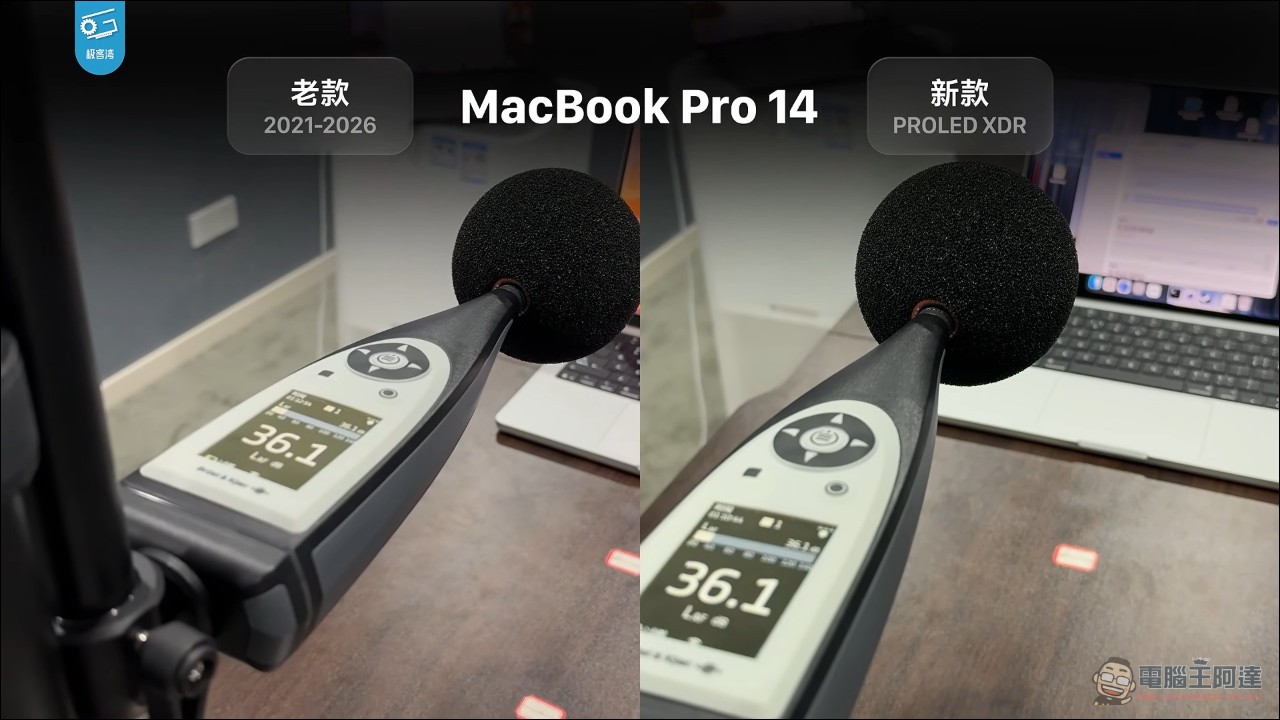
Piao Ge also ran a fixed-noise comparison, locking both machines at 36 dB. The new fan can reach just over 5,500 rpm, while the old model only reaches a little over 4,700 rpm, and the new model has better heat dissipation and sustained power draw. Because it is a first-launch model lent by Apple to the media, Piao Ge cannot disassemble it, so the internal structure of the airflow channel and fan remains unknown.
Lid-closing performance improvement from the air duct redesign
The airflow path is key to this generation’s cooling improvements. For more than a decade, the MacBook Pro has used side intake and rear exhaust, but previously the exhaust vents were split into two directions—toward the screen and toward the rear of the chassis. This time, it exhausts only toward the rear of the chassis.
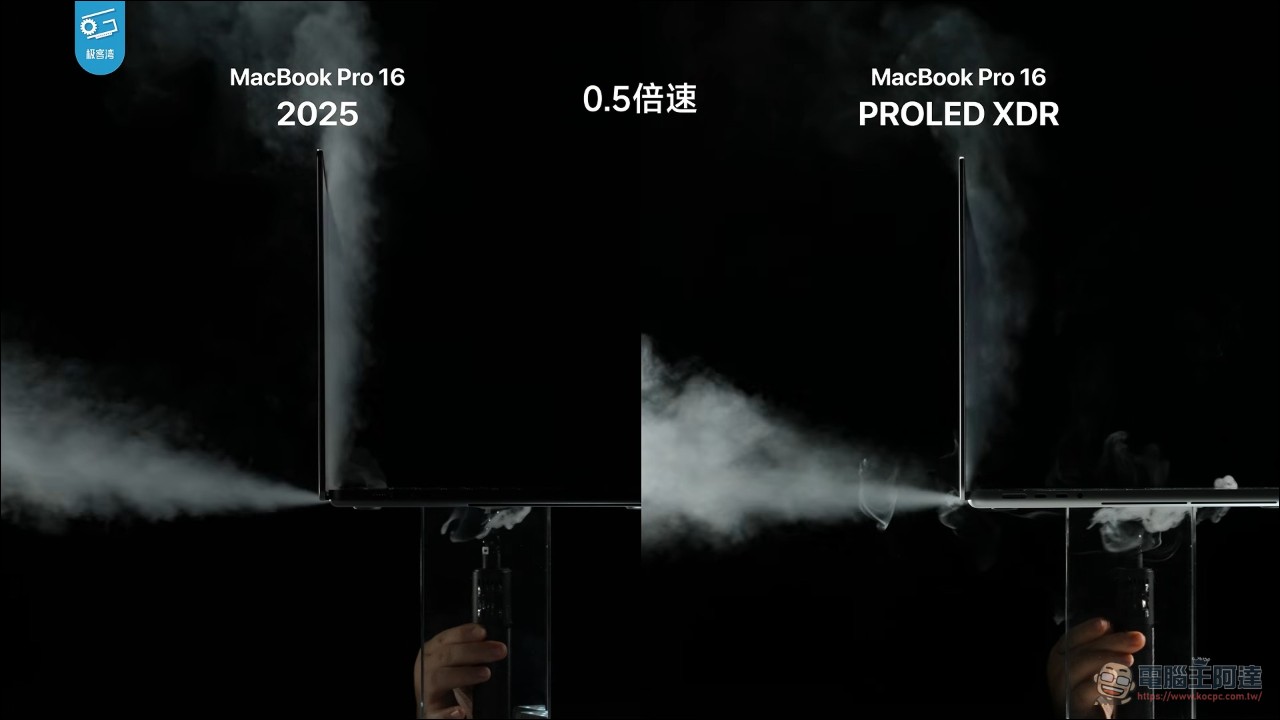
Piao also noticed that the previous generation’s hinge would block the rear exhaust vent when opened at a wide angle. This time, the screen hinge has been specifically designed to always leave space for the vent. The sharp feeling from the side intake vents has finally been improved as well.
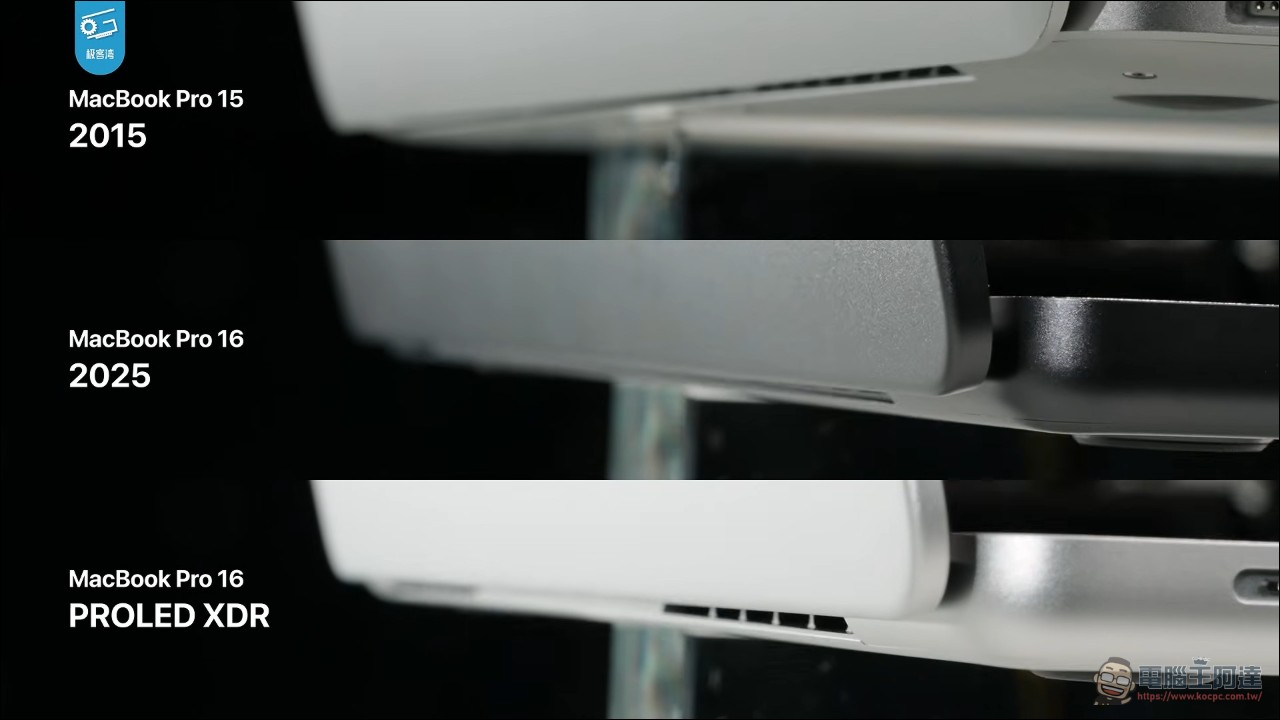
The practical significance of this improvement lies in clamshell use. Compared with making the cooling system’s maximum capability stronger, ensuring that performance is unaffected when using an external display is more practical. Piaoge used the new and old top-spec 16-inch M5 Max models to conduct a dual stress test comparison.
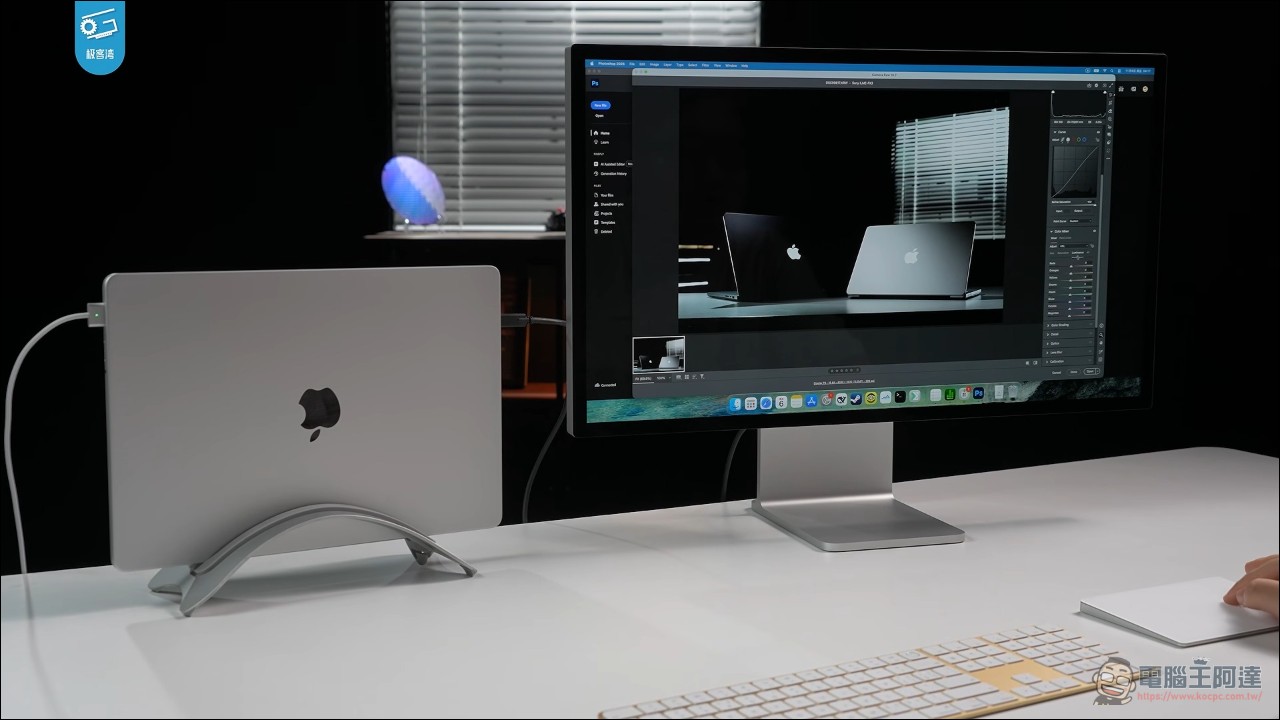
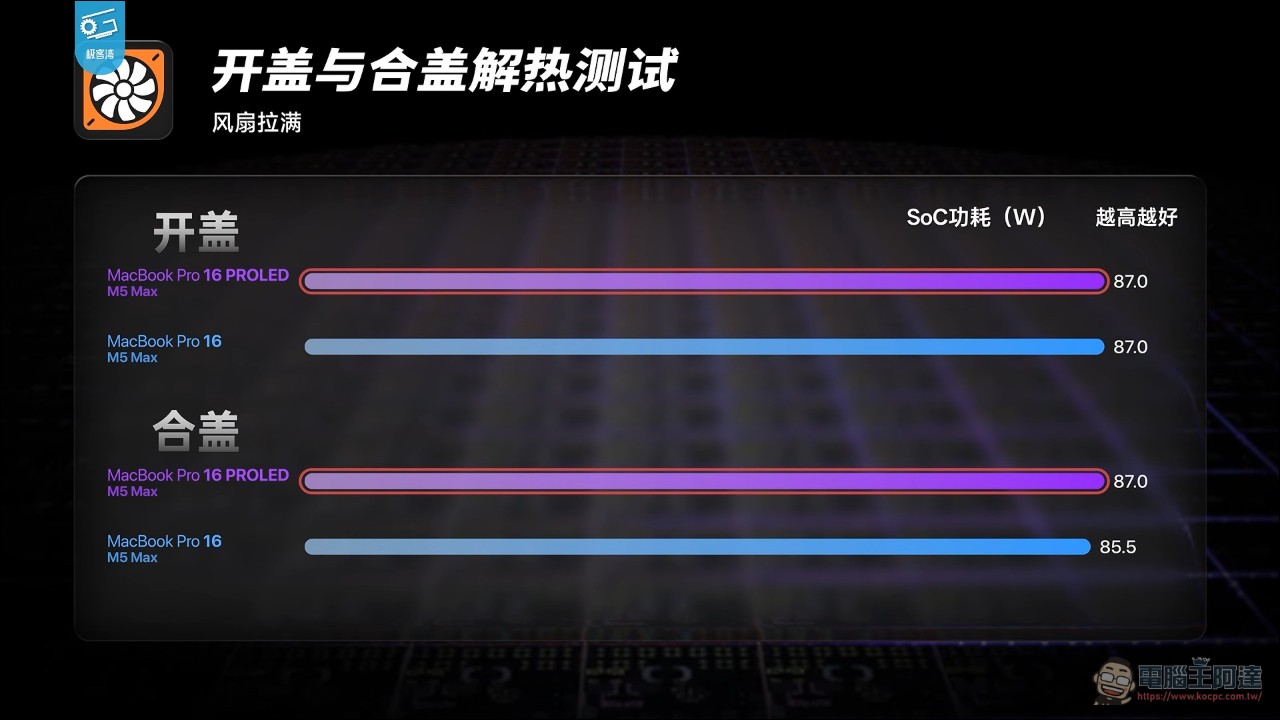
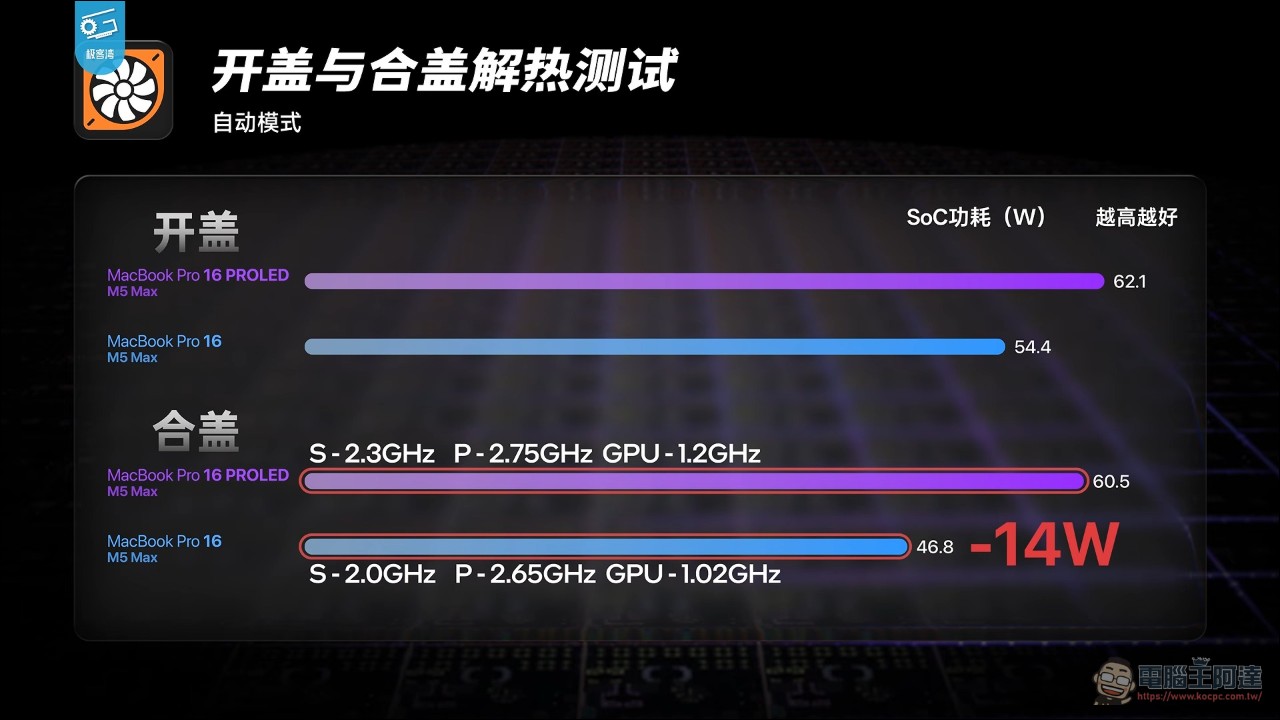
With the fans maxed out, there is little difference: the new model can reach around 87W with the lid open or closed, while the old model also reaches 87W with the lid open and drops slightly to 85W with the lid closed. The difference appears in the automatic power mode targeting 36dB noise. The new model delivers 62W with the lid open and still maintains 60W with the lid closed; the old model delivers only 54W with the lid open and drops straight to 46W when closed. In the lid-closed automatic power mode, their sustained power consumption differs by 14W, which translates into a frequency gap of over 10%—a fairly obvious performance difference.
Touch: the most eye-catching yet least perceptible change
Piao Ge was not kind in his assessment of touch. He said that even though Windows laptops have had touch designs for so long, he himself still rarely uses laptop touch, because using touch while upright has never appealed to him. He also admitted that touch brings some new interactions—for example, some of the operation logic from iPad can be applied—but at the same time pointed out that Launchpad, which is currently best suited to touch, has been removed in the new macOS.
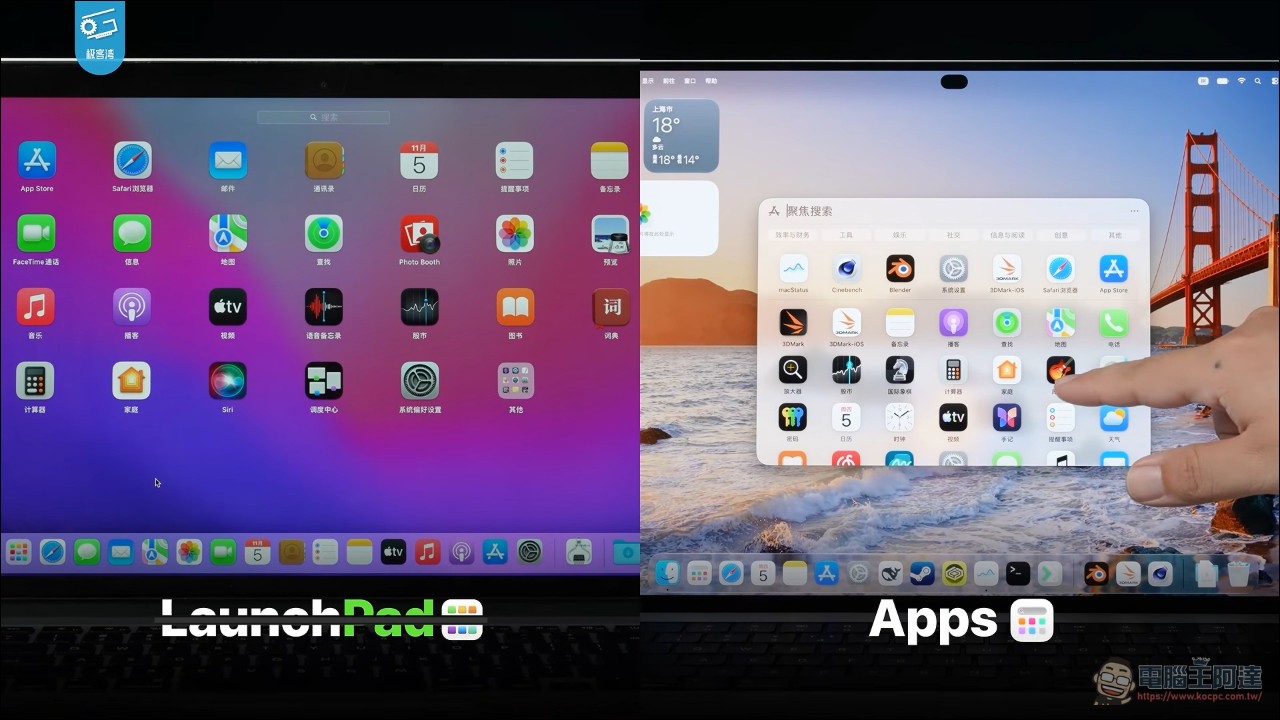
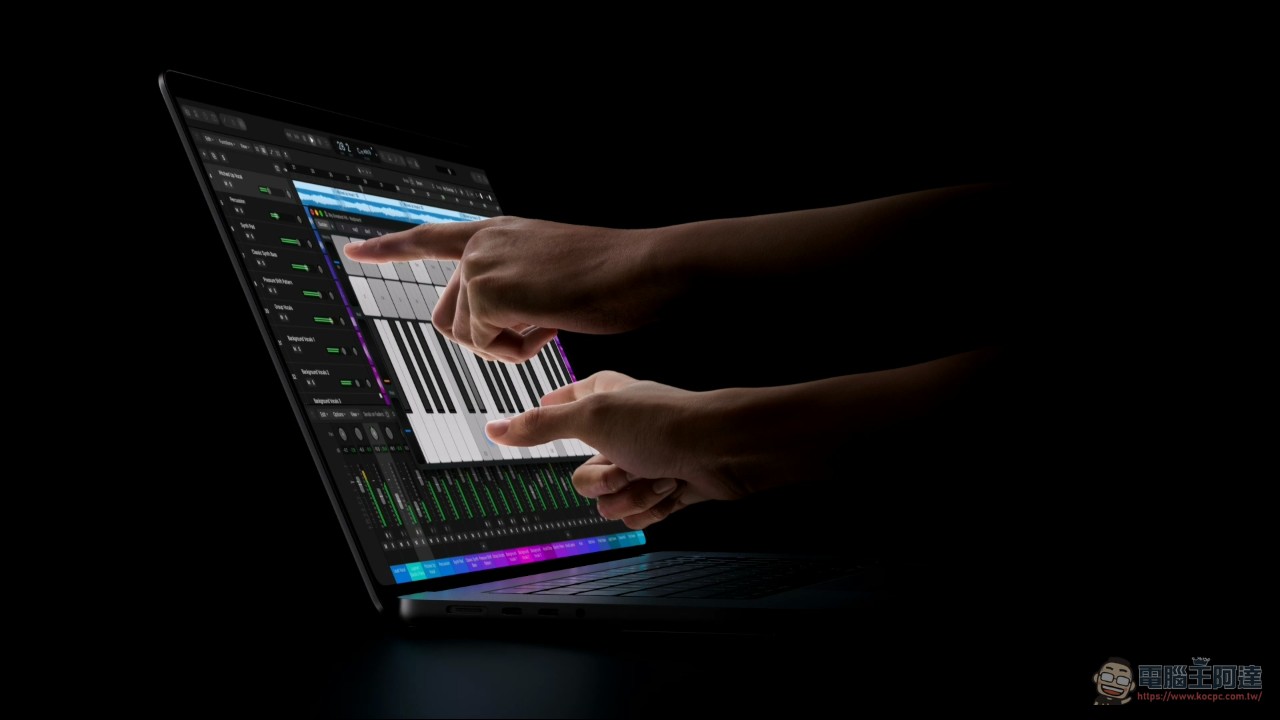
Apple’s official description of touch focuses on professional scenarios: designers can use the entire screen as a canvas and are no longer limited by the size of the trackpad; musicians can play software instruments on the screen; app developers can directly test the touch performance of iOS and iPadOS apps on MacBook Pro. On the hardware side, the touch sensors are built directly into the display panel rather than layered on top to reduce latency, and are paired with a newly designed hinge to improve stability. Existing apps work without rewriting because macOS automatically converts touch into clicks.
There’s actually a lot more content on other test items, so everyone can just watch the video below,Bilibili versionThere’s also a sound test (the YouTube version may have been hit with a copyright strike), and it’s longer too; I personally recommend watching the Bilibili version:
PROLED XDR display MacBook Pro official website
PROLED XDR MacBook Pro Summary
Piao Ge’s final summary was that, with the chip unchanged, this machine has upgraded almost everything else that could be upgraded: epic weight reduction, a glowing Apple logo, lower-power and better-performing dual-layer OLED, a non-cutting air intake, plus touch support, along with a cooling airflow design and fan improvements for lower noise and higher airflow—especially a major boost in sustained performance with the lid closed. He believes this machine combines the strengths of the previous three generations of MacBook Pro, and the only issue is that, as an all-new model, it has not yet used a newer processor. This is also the cliffhanger left at the end of the video: he looks forward to what surprises this new chassis paired with a newer processor could bring.
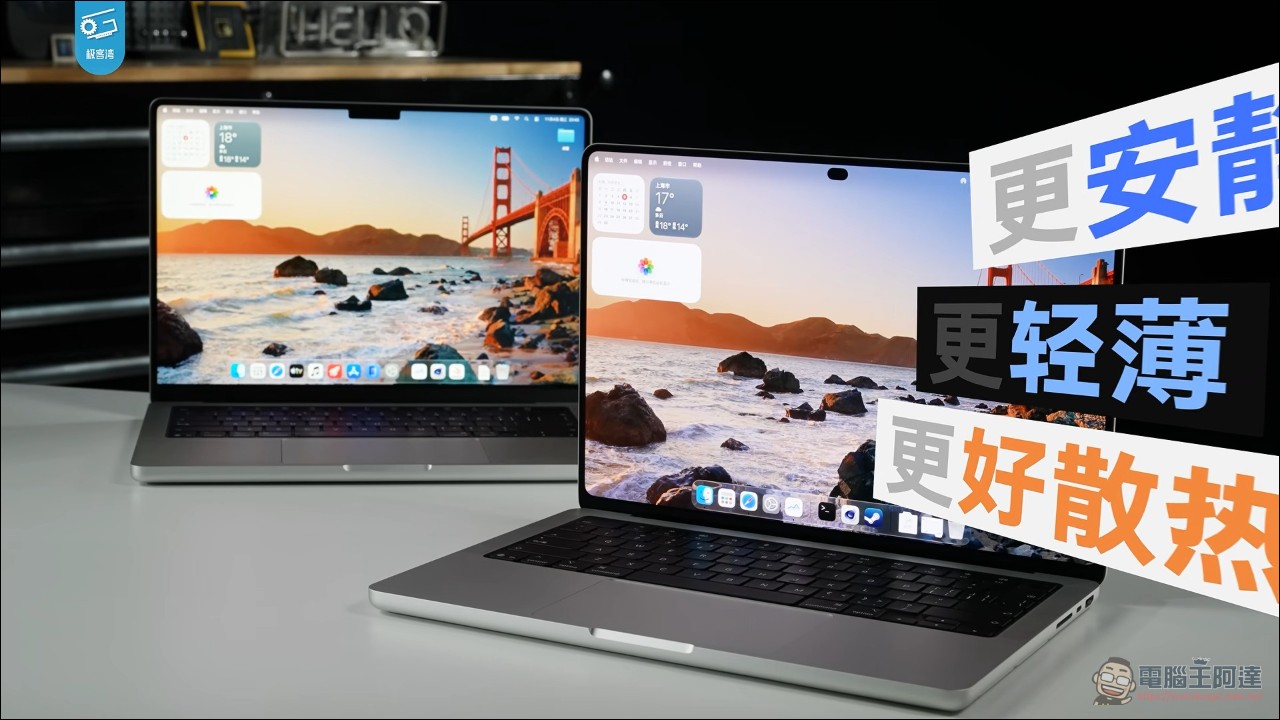
Based on hands-on test results, touch really isn’t the most noticeable part of this generation. Shedding more than 200 grams, lower noise, sustained performance on par with the same chip, and 14W more sustained power draw when the lid is closed—these are what change the everyday experience. As for how much practical value touch can deliver, Apple and the media are still framing it around “professional creators’ workflows”; how it actually feels in use will require more long-term testing.
Source: KOCPC Chinese