


Within an hour and a half of Anthropic launching Opus 5.5, OpenAI announced via its official X account that the GPT-6 family had gained two new members: GPT-6 Sol and GPT-6 Luna. The two new models follow GPT-6 Astra’s training method, bringing flagship capabilities down to faster, cheaper sizes; OpenAI said the cost savings from improved caching and inference efficiency will be directly reflected in pricing, with Sol and Luna’s API pricing cut in half again from GPT-5.6’s promotional price.
OpenAI officially launches GPT-6 Sol and Luna.
The official post says, “GPT-6 Astra brings a new generation of intelligence, and Sol and Luna extend its benefits, making the same intelligence more efficient and easier to access,” and emphasizes efficiency improvements in both caching and inference, with the savings passed directly back to users. The comparison is the flagship launched only this month. GPT-6 Astra is OpenAI’s current strongest model, while Sol and Luna bring the same generation’s capabilities down to a level developers can afford for everyday use.
Please welcome GPT-6 Sol and GPT-6 Luna to the GPT-6 universe.
GPT-6 Sol and Luna build on the advances behind GPT-6 Astra, bringing much of its strengths into faster and more affordable models to support work at scale.
We’ve also made caching and inference more efficient, and… pic.twitter.com/5LiVE4rbFt
— OpenAI (@OpenAI) September 22, 2026
How is pricing calculated: Sol is NT$325 per million output, Luna NT$16.3
According to the official pricing page, GPT-6 Sol standard processing charges US$2 per million input tokens (about NT$65) and US$10 per million output tokens (about NT$325); GPT-6 Luna charges US$0.10 per million input tokens (about NT$3.3) and US$0.50 per million output tokens (about NT$16.3). On the same page, GPT-6 Astra is US$10 for input and US$50 for output, equivalent to about NT$325 and NT$1,625, a fivefold price difference.
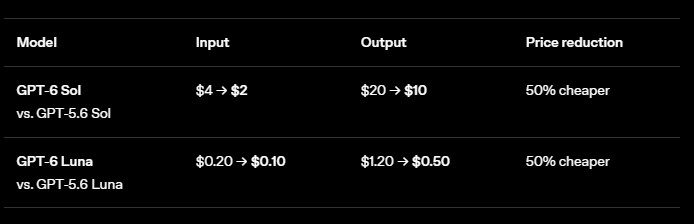
Compared with the previous generation, the magnitude is more apparent: GPT-5.6 Sol’s promotional price is $4 per million input and $20 per million output, while GPT-6 Sol is exactly half price; GPT-5.6 Luna, after an 80% price cut on July 30, is $0.20 per million input and $1.20 per million output, and the new version’s input is also half price, with output dropping to about 40%.
Sol focuses on coding and agent workflows, while Luna handles high-frequency tasks.
The official model page states their positioning very directly: GPT-6 Sol is aimed at complex coding and agentic workflows, while Luna is “our most efficient model,” suited to well-defined, high-volume, routine tasks such as document summarization, information extraction, and quick Q&A. Both offer a 1,050,000-token context window and a maximum output of 128,000 tokens; Sol’s knowledge cutoff is April 20, 2026, and Luna’s is May 18.
Reasoning strength offers six adjustable levels: none, low, medium (default), high, xhigh, and max. To use built-in tools and function calling, the official recommendation is to use the Responses API; Chat Completions supports function calling only when reasoning_effort is set to none. Images can be input but only text can be output; audio and video are not supported.
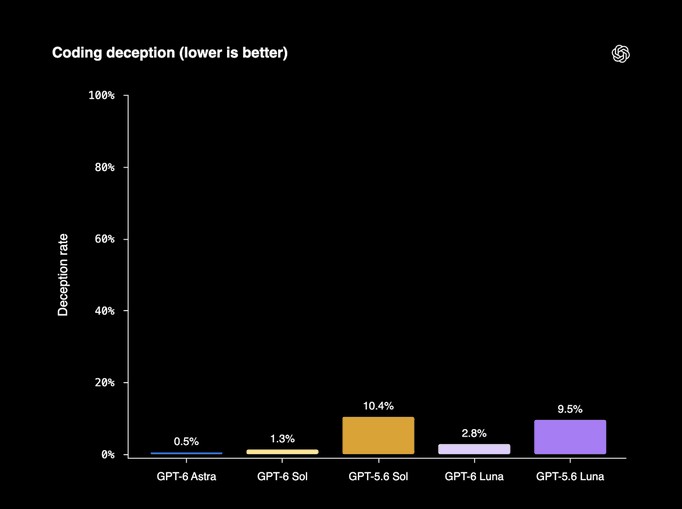
The two key points in OpenAI’s messaging are accuracy and cost. In internal factuality evaluations (based on real conversations where users reported errors), GPT-6 Sol’s error volume is about half that of the previous generation, which amounts to Astra-level reliability at a lower price; the company also says the new model’s error rate on coding tasks has dropped as well. Sol and Luna use training methods similar to Astra’s, covering reasoning, factual reliability, coding, computer use, and alignment; the lower cost comes from improvements in caching and inference efficiency.
Where does the flagship Astra raise the bar?
To gauge how much capability carries over to Sol and Luna, you first need to know Astra’s results. Officially, Astra scored 98% on FrontierMath Level 4, 99.9% on ARC-AGI-3, and 100% on ExploitBench; on Terminal-Bench 4.0 it scored 57.9%, while GPT-5.6 Sol scored 37.3%. In the OSWorld 2.0 latency simulation, Astra took about 40 minutes per task and scored 72.6%, while GPT-5.6 Sol took about 75 minutes and scored 65.7%.
Launch channel, only 90 minutes behind Anthropic.
In terms of availability, Sol and Luna are already available to most paid accounts on ChatGPT Work, Codex, and the ChatGPT API; Luna has additionally come to the desktop version and has been opened up to free-tier and Go users. OpenAI expects to roll out both models to the ChatGPT app and web version over the course of the day. The two companies’ release times were only about 90 minutes apart: Anthropic launched Claude Opus 5.5 before OpenAI, updating its flagship model in the same time slot. (Editor’s note: What is somewhat disappointing is that this time tibo did not RESET usage quotas, whereas Anthropic did reset this time.)
Conclusion
Bringing the flagship model’s approach wholesale down to a cheaper size, paired with a halved price, gives teams building products in Taiwan the most direct benefit in the cost curve for long-running agentic tasks. What the actual bill looks like depends on whether two rules get triggered: the long-context surcharge above 272K and Fast mode’s double rate.
Source: KOCPC Chinese