


Anthropic today (9/22) officially announced Claude Opus 5.5, the first model in the new Claude 5.5 family. It is officially positioned as “performing comparably to Claude Fable 5.1 on most tasks, but with a 40% lower execution cost than Opus 5.” In short, this is a new option that delivers top-tier performance at a lower price. Work that previously required the budget of Fable 5.1 can now be accomplished with Opus 5.5 at 40% of the cost.
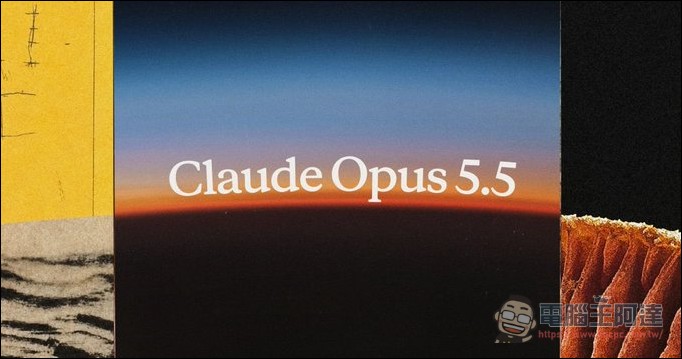
The model ID for Opus 5.5 is claude-opus-5-5Targeting long-running agentic coding and knowledge work scenarios, with support for the Claude API, Amazon Bedrock, Google Cloud Vertex AI, and Microsoft Foundry platforms.
Pricing comparison: 60% cheaper than Fable 5.1
Opus 5.5’s API pricing is $4 per million tokens for input (about NT$128) and $20 per million tokens for output (about NT$640). Compared with Claude Fable 5.1’s $10/$50, Opus 5.5 is 60% cheaper on input and 60% cheaper on output.

Pricing comparison with other models in the same family:
- Claude Fable 5.1: $10 / $50 per MTok (flagship reasoning)
- Claude Opus 5.5: $4 / $20 per MTok (the main subject this time)
- Claude Sonnet 5: $2 / $10 per MTok (Balanced)
- Claude Haiku 4.5: $1 / $5 per MTok (lightweight model)
Batch API Additional 50% offFor Prompt Caching, 5-minute cache writes are $5/MTok, 1-hour cache writes are $8/MTok, and cache reads are $0.20/MTok.
Specification Highlights
- context window:1M Token
- Maximum output:128K Token(Batch API 300K)
- Reasoning modeAdaptive (always on), default effort is medium
- Knowledge cutoff: June 2026
- Input typeText + Image
- Delay: Medium (faster than Fable 5.1)
The default effort for Opus 5.5 is medium, than Fable 5.1’s high One level lower. This means it may not be as good as Fable 5.1 in scenarios requiring deep reasoning, but its performance is comparable on general tasks, and it is faster and cheaper.
Four breaking changes: what to watch out for when upgrading from Opus 5
Anthropic’s official documentation lists four breaking changes that affect existing code: First, thinking mode cannot be turned off and is always on; second, forced tool use returns an error; third, thinking blocks are bound to the model and conversation that generated them and cannot be reused across models; fourth, the old version’s computer_20251124 Computer operation tools are no longer accepted. The first three changes also apply to Claude Fable 5.1.
Additionally, text between tool calls is now returned in thinking in the block, and the default display Set the text below to empty. If the application relies on streaming these texts as progress updates, configuration is required. display Only the value can see the content.
Promotion: Five-hour usage limit increased
To celebrate the launch of Opus 5.5, Anthropic announced that it is increasing the five-hour usage limits for Pro, Max, and Team plans, giving users more room to experience the new model.

Differences in positioning from Fable 5.1
The main difference between Fable 5.1 and Opus 5.5 is the trade-off between reasoning depth and cost. Fable 5.1’s default effort is high, making it suitable for complex tasks that require deep reasoning, but it is slower and more expensive. Opus 5.5’s default effort is medium, and it performs comparably to Fable 5.1 on most tasks, but responds faster, delivers better Agent performance, and costs only 40% of Fable 5.1. For everyday development work that doesn’t require extreme reasoning depth, Opus 5.5 is the more practical choice.
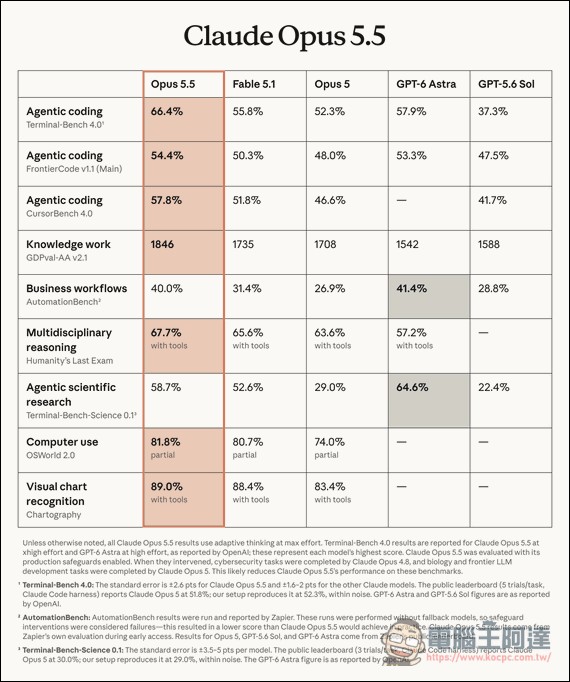
In terms of knowledge cutoff, both models are June 2026, and both have a 1M Token context window and a 128K Token maximum output. The only specification differences are the default effort and latency performance. In other words, if your workload does not often trigger Fable 5.1’s deep reasoning advantages, switching to Opus 5.5 can save 60% on API costs with almost no sacrifice in quality.
Developer Notes
Developers migrating from Opus 5 to Opus 5.5 need to re-examine the control logic for thinking mode in their code. Previously, thinking could be disabled via a parameter to reduce latency and cost, but after Opus 5.5 this option disappeared, and thinking mode is always on. This means every API call includes the cost of thinking, though because overall pricing dropped 40%, actual costs may not necessarily increase.
Changes to forced tool use also require special attention. In the past, some developers would force the model to call a specific tool, but this approach will directly return an error on Opus 5.5. It is recommended to use guiding prompts in the tool description instead to achieve the same effect.
Claude Model Family Overview
The Claude model family currently has four main products, each with a clear positioning. Fable 5.1 is the flagship reasoning model, built for complex tasks requiring the deepest level of thought, with a knowledge cutoff of June 2026. Opus 5.5 is the new release, emphasizing value for money by offering near-comparable performance at 40% of Fable 5.1’s price. Sonnet 5 is the balanced option, with the same default effort level of high but a lower price, making it suitable for general development work. Haiku 4.5 is the lightweight option, suited to simple tasks requiring high speed and low latency.
From a product-line strategy perspective, Anthropic appears to be splitting the positioning of the original Opus series: the former Opus 5 was “the most powerful but most expensive,” while Fable 5.1 now takes over as the flagship and Opus 5.5 is downgraded to the “efficient but cheap” workhorse tier. This tiered strategy allows developers to allocate resources more precisely based on task complexity and budget constraints, rather than always using the most expensive model.
Additionally, Opus 5.5’s Adaptive Thinking is always on, which differs from Sonnet 5’s Adaptive mode, which can be turned off. This design difference suggests that Anthropic believes models at the Opus 5.5 level should always engage in some degree of reasoning, rather than letting developers decide whether they think.
Launch Timeline and Availability
Claude Opus 5.5 is available starting today on the Claude API, Amazon Bedrock, Google Cloud Vertex AI, and Microsoft Foundry platforms. Pro, Max, and Team plan users on Claude.ai web and mobile can also access it directly. Free plan users do not currently have access to Opus 5.5, but the increase to the five-hour usage limit applies to all paid plan users.
Source: KOCPC Chinese