


American robotics startup Figure’s F.03 recently set an impressive record by working continuously for nine days (200 hours total) in logistics sorting, and Chinese robots seem unwilling to be left out. A video recently shared on X shows eight humanoid robots standing beside conveyor belts at the Jianggao Mail Processing Center of China Post’s Guangzhou Mail District, grabbing packages, scanning barcodes, and dropping them into the corresponding sorting channels around the clock. This is an actual deployment that began trial operations in March 2026 and was officially unveiled on May 29, around the same time.
Stardust M7: A “humanoid” sorter at a fixed workstation
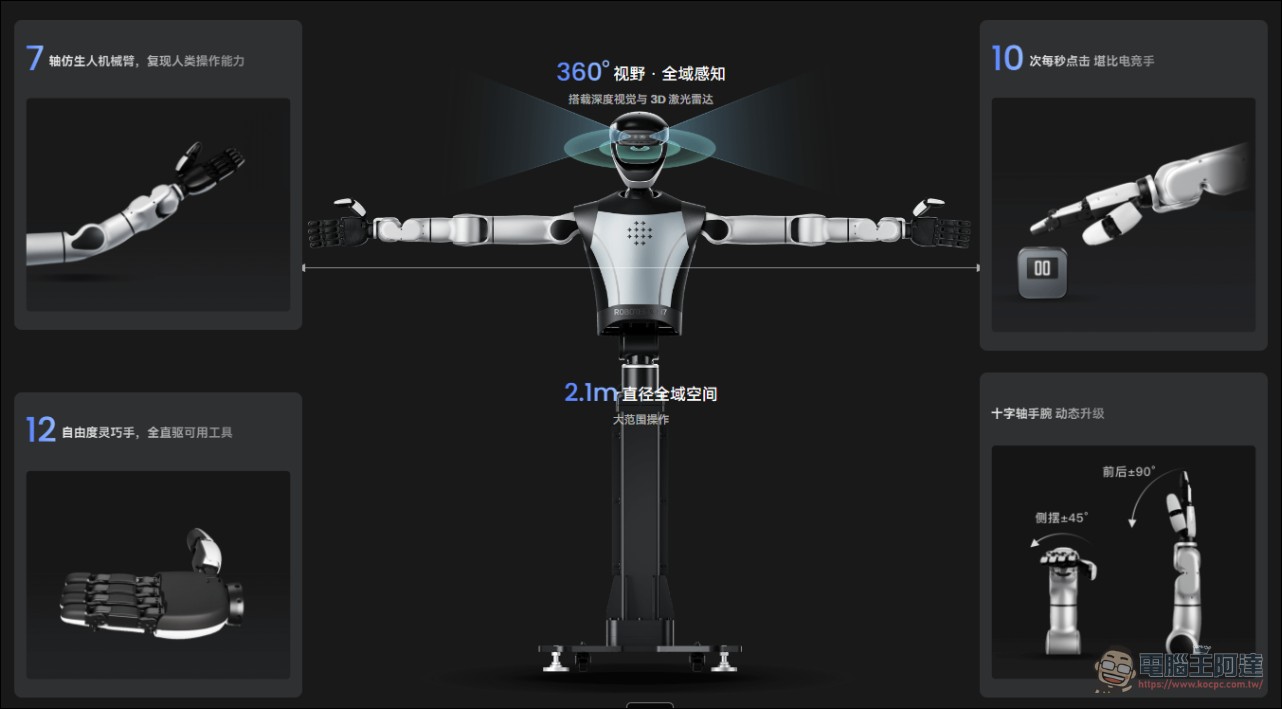
The robots deployed at the Guangzhou Jianggao Processing Center areStar Motion M7(Xingdong M7), manufactured by Beijing startup RobotEra (Xingdong Era). The M7 has a humanoid upper body, but operates at a fixed workstation beside a conveyor belt rather than moving around a warehouse. In terms of hardware specifications, the M7 is equipped with a 7-degree-of-freedom arm and a 12-degree-of-freedom palm (self-developed XHAND1 dexterous hand, totaling 20 degrees of freedom), along with 360-degree vision and a 3D LiDAR sensing system, capable of handling packages weighing 0.5 to 20 kilograms. On the software side, it runs the self-developed ERA-42 embodied brain, which is claimed to continuously self-evolve through real-world scene data.
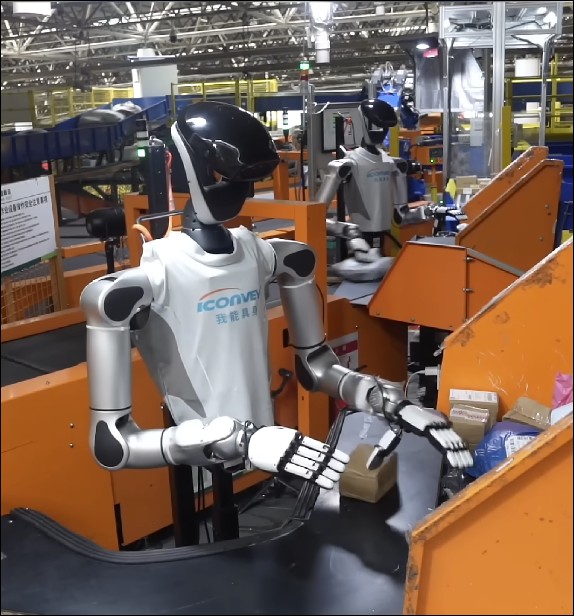
M7’s workflow is: grab packages from containers, scan barcodes, flip packages so the label faces up, then place them on the correct downstream conveyor belt. Eight units are currently in testing, with five more arriving soon.
Efficiency Numbers: The Gap Between Official Figures and Third-Party Assessments
According to reports from Chinese media Xinhua and People’s Daily, the M7 can process up to 1,200 packages per hour. China Daily, however, noted that the current stable operating speed is 800 packages per hour, with a target of raising it to 1,600 packages per hour in the second quarter of 2027, matching the efficiency of human workers. RobotEra’s own benchmark testing acknowledged that the robots in deployment are about 85% as efficient as humans.
By comparison, sorting workers in China’s express delivery industry are assessed against a benchmark of roughly 1,500 items per hour, with skilled workers reaching up to 1,800. This means that even at the officially claimed peak of 1,200 items, the robots’ efficiency still falls short of the human average—though their advantage is that they can work without rest.
Not Just China: Figure AI’s 200-Hour Live Stream Challenge
Recently, American company Figure AI launched an “unedited, uninfluenced” livestream test of logistics sorting on platform X. Three Figure 03 robots worked continuously for 200 hours, sorting a total of 249,558 packages, processing one package every 3 seconds on average. During the livestream, Figure AI invited human interns to compete with the robots for 10 hours. The humans ultimately narrowly won by 192 packages, but were overtaken by the robots during break periods. Figure AI CEO Brett Adcock then declared: “This may be the last time humans defeat robots in sorting tasks.”
However, industry insiders are reserved about the practical reference value of this live broadcast. The robotics experts interviewed pointed out that the packages in the broadcast were highly standardized, with soft packages differing only in color and being completely identical in size and thickness, while the cartons came in just two standard specifications. But in real logistics scenarios, package shapes, weights, and materials vary enormously, and there are also many irregular, fragile, and liquid packages that require manual identification and handling.
Does a fixed workstation require both feet?
A comparison of American and Chinese robots in logistics sorting also raises another controversy: if robots are simply fixed at workstations beside conveyor belts, why make them humanoid? An industry expert said bluntly: “While bipedal design offers better mobility and versatility, it is completely unnecessary for fixed workstation operations—the cost is simply too high.”
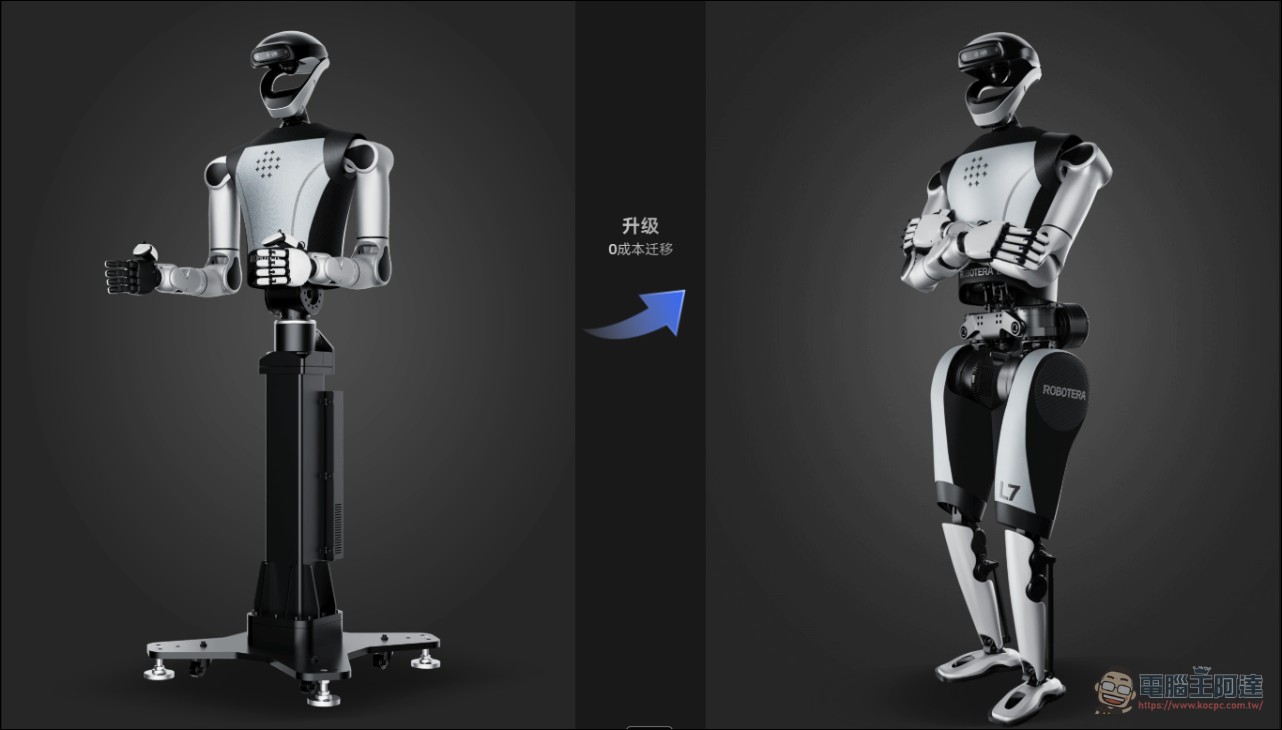
In fact, before humanoid robots were introduced, the China Post Jianggao Processing Center had already been using traditional automation equipment such as robotic arms and automated guided forklifts for years. Mature automation solutions are also available on the market: Wayzim’s 10K single-piece separation system has a processing capacity of 10,000 pieces per hour, with clients covering mainstream express delivery companies such as ZTO, STO, and JD Logistics. In a pure comparison of sorting efficiency, humanoid robots currently have no advantage.
However, the value of humanoid robots may lie more in “filling the gaps in automation.” In the package feeding stage at current express sorting centers, traditional automated equipment struggles to handle the wide variety of package shapes and complex stacking—this is precisely why humanoid robots are the first to enter the scene.
Conclusion
Humanoid robots entering logistics sorting scenarios: their technical feasibility has already been verified. But being able to do something and being cost-effective are two different things. Currently, humanoid robots are still less efficient than skilled workers, cost far more than mature automated equipment, and can only handle relatively standardized packages. Their core value lies in filling the “flexible operations” segments that traditional automation cannot cover, as well as addressing the increasingly severe labor shortage in China’s express delivery industry.
Industry forecasts indicate that 2026 will be a critical leap year for the large-scale application of logistics robots, with widespread adoption across the industry expected as early as next year. But before that day arrives, humanoid robots still need to pass more real-world tests in efficiency, cost, and environmental adaptability.
Source: KOCPC Chinese