


On November 11, Google launched its first Pixel Tag Bluetooth item tracker (smart tracker) in Taiwan, offering multiple purchase options including single packs and four-packs. Pixel Tag features a unique “reverse find my phone” function and can use the vast Android device finding network and map features, allowing users to easily keep track of their belongings.
What are the features of the Google Pixel Tag Bluetooth tracker? What are the differences among the four major Bluetooth trackers—Google Pixel Tag, Apple AirTag, Samsung SmartTag, and Xiaomi Tag? Here is a summary and analysis:
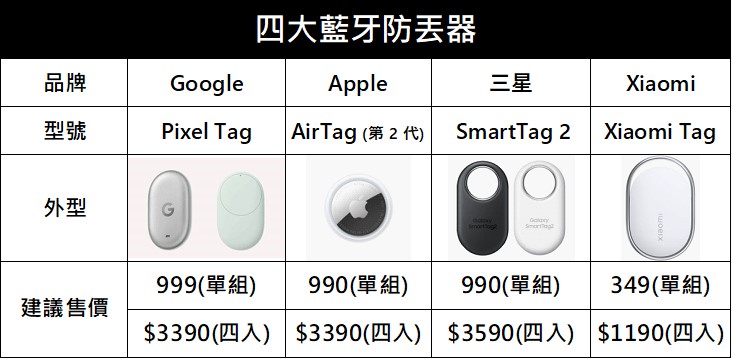
Bluetooth trackers are characterized by being “cheap, lightweight, and suitable for finding items over short distances.” As the application ecosystem expands and newer versions support UWB precise directional guidance, major platforms have all launched their own Bluetooth smart trackers. Below is a summary video and detailed explanation comparing the features and differences of four major Bluetooth trackers:
1. Main feature specifications of Google Pixel Tag:
Google’s first Bluetooth tracker, the Pixel Tag, officially went on sale in Taiwan on the evening of November 11, 2026. In addition to the Google Store, it is also available through channels including Chunghwa Telecom, Taiwan Mobile, the myfone online store, Senao International, Senao Life Shopping, momo Shopping, PChome 24h Shopping, Shopee, and Landtop, which launched it simultaneously. The Pixel Tag is priced at NT$999 for a single pack and NT$3,390 for a four-pack.
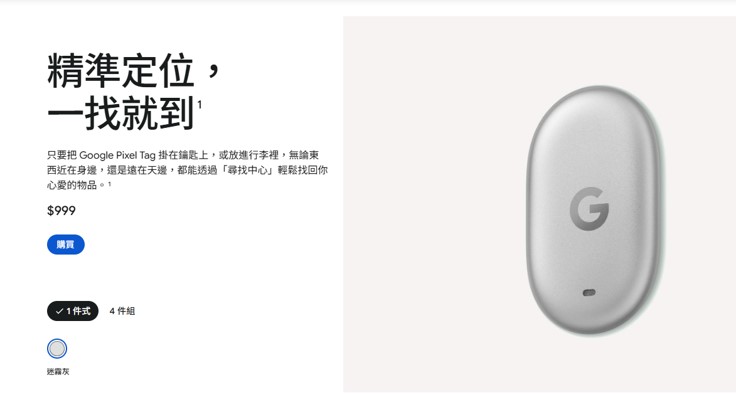
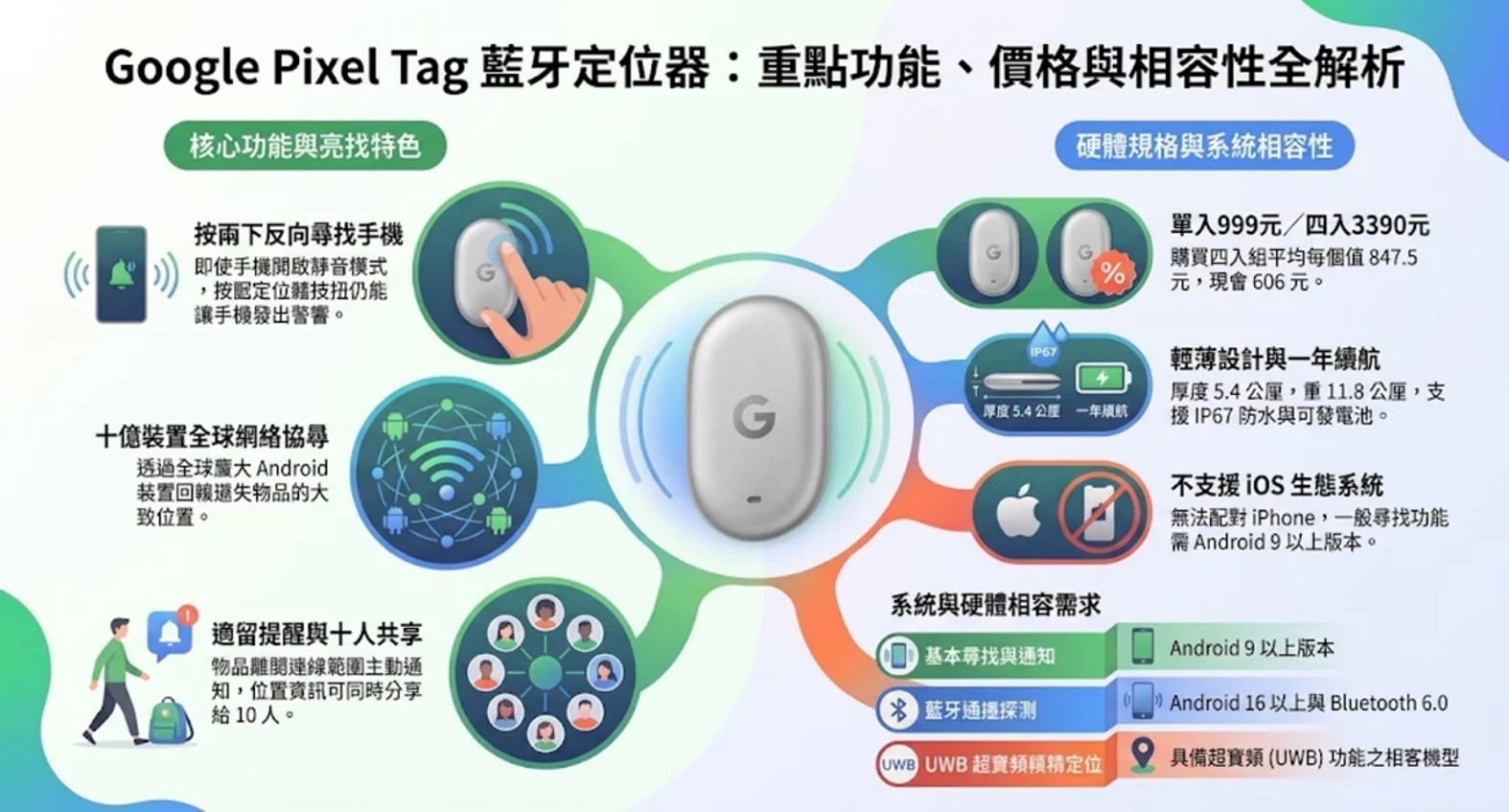
The biggest feature of Google Pixel Tag is that it can “find your phone in reverse”: just double-press the button on the tracker, and even if the phone is in silent mode, it can make the phone ring. It also has native integration with Google Find Hub, with 1 billion Android devices helping with location; it supports UWB ultra-wideband and Bluetooth channel sounding technology, and when paired with compatible phones, it can provide more precise distance information. Compatible Android phones with UWB can also display directional guidance, so finding items does not have to rely only on sound. Google Pixel Tag has an oval design with no lanyard hole and an extremely slim body, only 5.4 mm thick and 11.8 grams; it has a built-in user-replaceable CR2032 coin battery and supports IP67 water and dust resistance. Google Pixel Tag is only compatible with compatible phones running Android 9 or later, cannot pair directly with iPhone, and cannot be added to Apple’s Find My app; in addition, Bluetooth channel sounding requires compatible devices running Android 16 or later and Bluetooth 6.0 or later, while UWB precise finding requires a compatible Android phone with ultra-wideband capability.
2. What are the differences among the four major Bluetooth trackers:
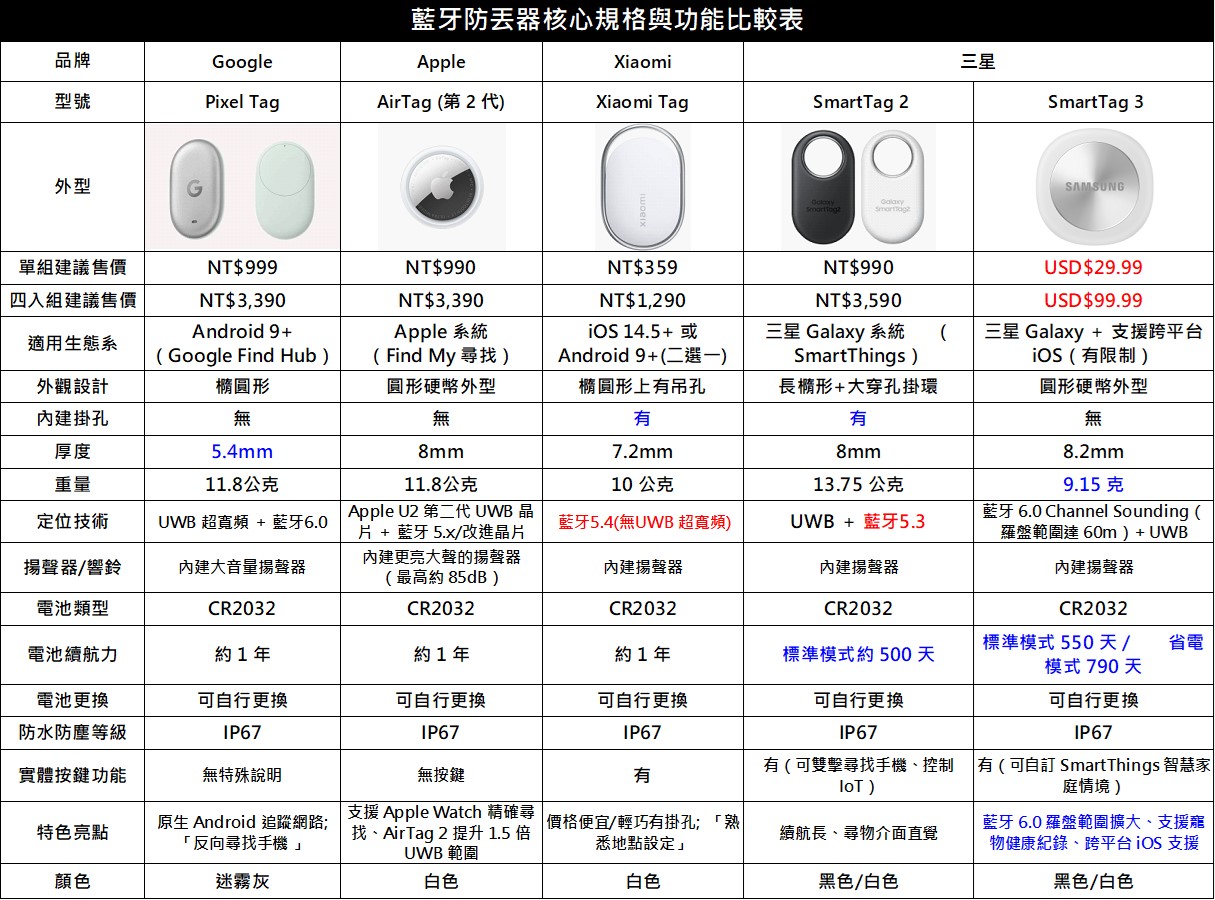
Currently, mainstream Bluetooth trackers on the market include not only Google Pixel Tag but also Apple AirTag (1st/2nd generation), Xiaomi Tag, and Samsung SmartTag 2/3.The biggest differences among these four major Bluetooth trackers lie in the smartphone ecosystems they support and whether they have UWB precise directional guidance. The main pros and cons of the products are as follows:
A.APPLE Air Tag Second Generation:
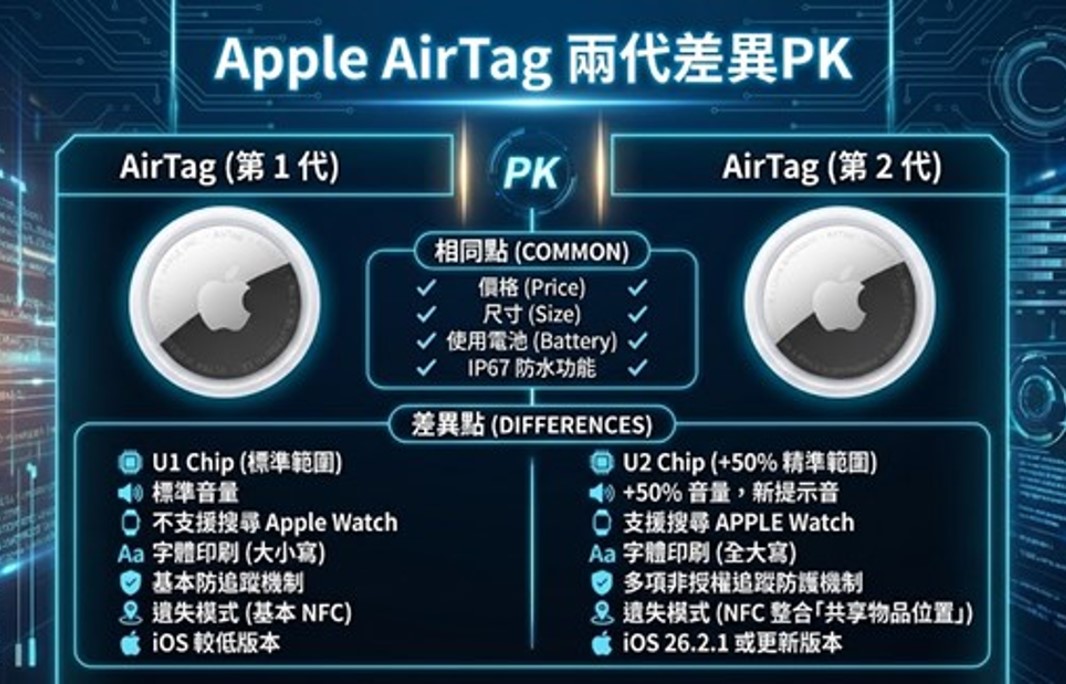
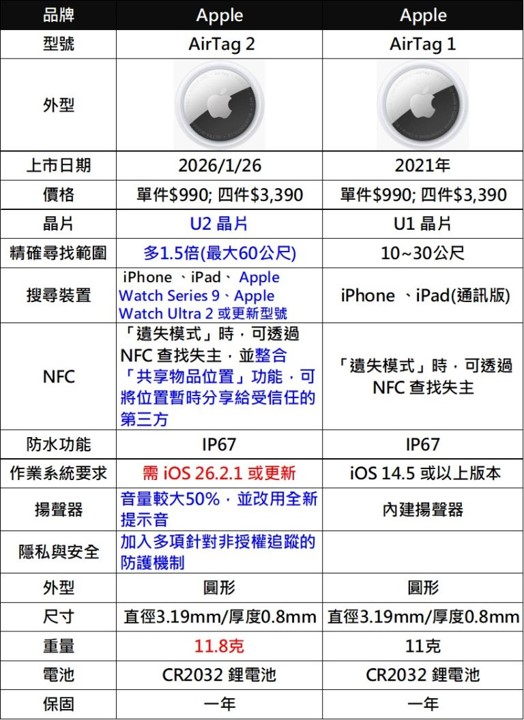
Apple Bluetooth trackerAirTag (2nd generation)Single pack suggested retail price $990, four-pack $3,390. It uses second-generation Ultra Wideband (UWB) technology (U2 chip), allowing Precision Finding to start showing direction and distance guidance at greater distances, with range expanded 1.5 times to about 60 meters. Bluetooth connectivity performance has also improved, giving the device a chance to be detected by nearby Apple devices at longer distances and report its location; compatible devices now include iPhone and iPad, with added support for Apple Watch; the built-in speaker volume is increased by 50%; multiple protections against unauthorized tracking have been added for tracking risk; Lost Mode adds integrated sharing of item location; it has an oval design without a lanyard hole, a diameter of 19 mm, thickness of 0.8 mm, weight of 11.8 grams, a built-in user-replaceable CR2032 coin battery, and IP67 water and dust resistance.
AirTag 2 can only be used with an iPhone and iPad running iOS 26.2.1/iPadOS 26.2,1 or later, or an Apple Watch running watchOS 26.2.1 or later, and you must be signed in to your Apple Account and have Find My turned on.
B. Samsung SmartTag 2 and Samsung SmartTag 3:
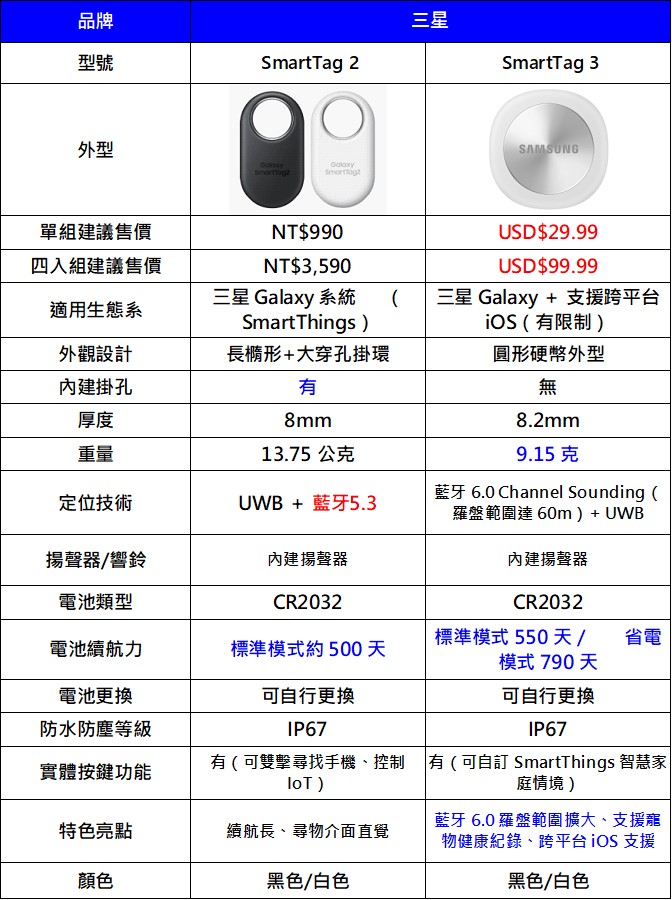
Samsung Galaxy SmartTag is a Bluetooth smart tracker designed specifically for the Samsung Galaxy ecosystem. The version currently sold in Taiwan is SmartTag 2, and the latest SmartTag 3 is not yet available for sale in Taiwan.
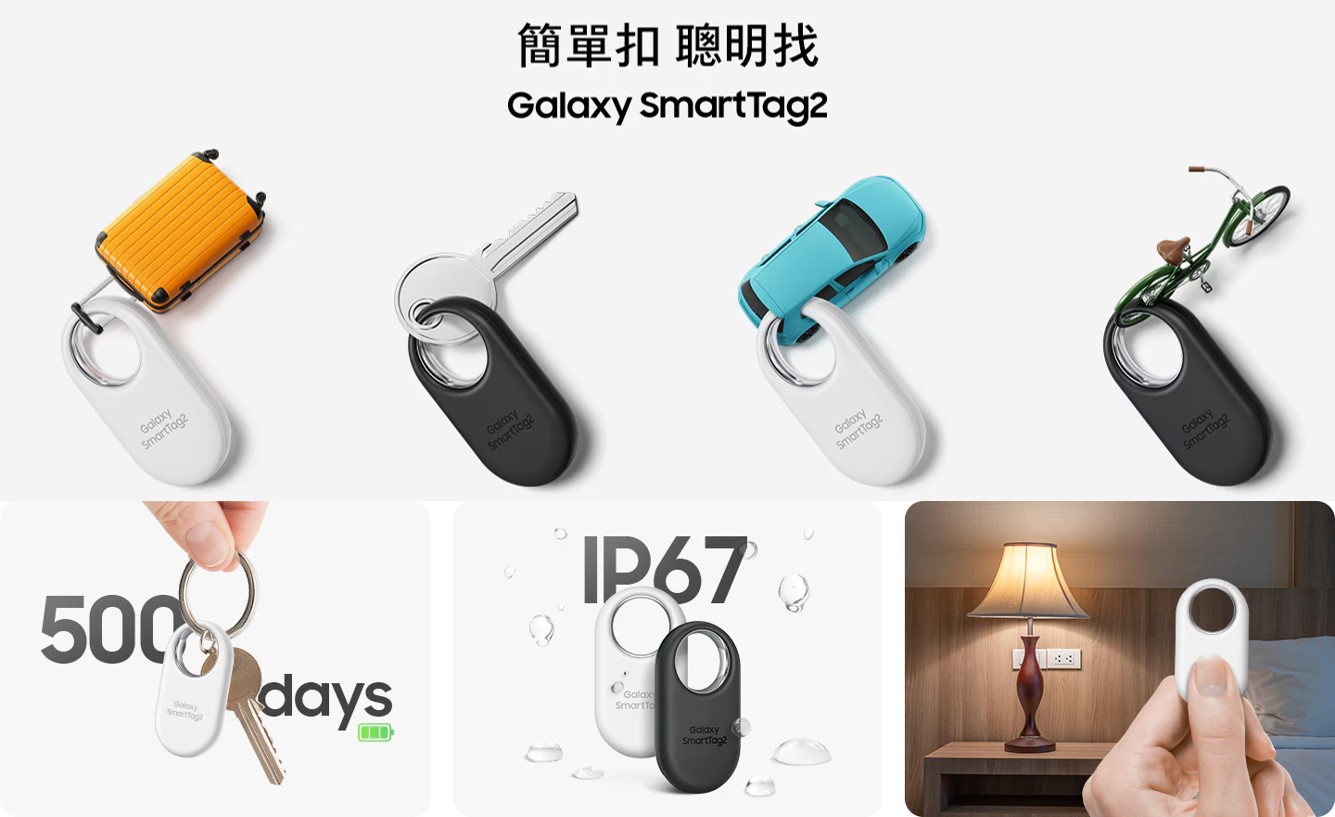
Samsung Galaxy SmartTag 2 is $990 for a single pack and $3,590 for a 4-pack. Its biggest advantage is its extremely long battery life: although it uses the same CR2032 battery, it can last up to 500 days in normal mode, and if Power Saving Mode is enabled, it can be extended to more than 700 days. It has an oval design with a large lanyard hole and supports IP67 water and dust resistance, so there is no need to buy an additional keychain case. It supports UWB (Ultra-Wideband) and BLE 5.3, and features Compass View and AR real-world arrow functionality, enabling precise directional guidance at close range. It features Lost Mode and supports NFC, so when someone finds it, they can tap it with an Android or iOS phone to read the owner’s contact information and message. It has a two-way finding function, allowing you to press the button on the Tag to ring your phone in reverse. The built-in button can link with SmartThings smart home devices and provides simple remote control. The biggest drawback of the Galaxy SmartTag 2 is that it can only be used with Samsung Galaxy phones and the SmartThings Find network; offline reporting is prone to delays or blind spots, and if Extreme Power Saving Mode is enabled, although it greatly extends battery life, it disables some core tracking features.
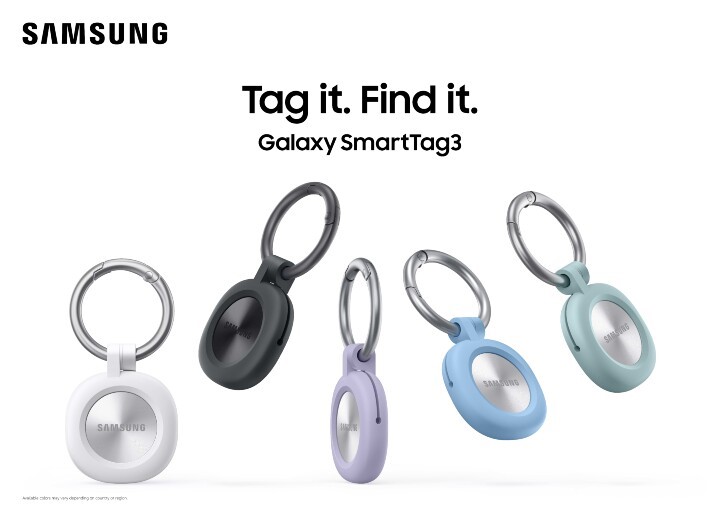
Samsung officially announced its third-generation Bluetooth tracker, Galaxy SmartTag 3, in October this year, but it has not yet launched in Taiwan, and pricing is unknown (speculated to be similar to the second generation). SmartTag 3 adopts a round design without a lanyard hole, reducing volume by 35% and weight by 33%. Its main feature is cross-operating-system compatibility with the Galaxy ecosystem + iOS (with limitations), supporting Android 12 and above and iPhone; through SmartThings Find, users can view and share locations and use Search Nearby; through the latest Bluetooth technology and sensors, it extends item-tracker use cases to pet health monitoring; it uses Bluetooth 6.0 Channel Sounding technology + UWB, and the new “Compass View” can at a maximum distance of 60 metersAdditionally provides directional guidance, with 3 times the accuracy of the previous generation; Extreme Power Saving mode has been further upgraded and can reach in normal mode 550 days, and enabling power-saving mode can further extend it to 790 days。
The biggest drawback of the SmartTag 3 is its limited ecosystem features and lack of integration with Google’s network. Although it supports non-Samsung phones for basic tracking, some core features (such as compass view, ringing your phone, and left-behind alerts) remain exclusive to Galaxy phones;Currently, cross-platform collaboration does not yet support integration into Google’s Android Find Hub finding network.
C.Xiaomi Tag:
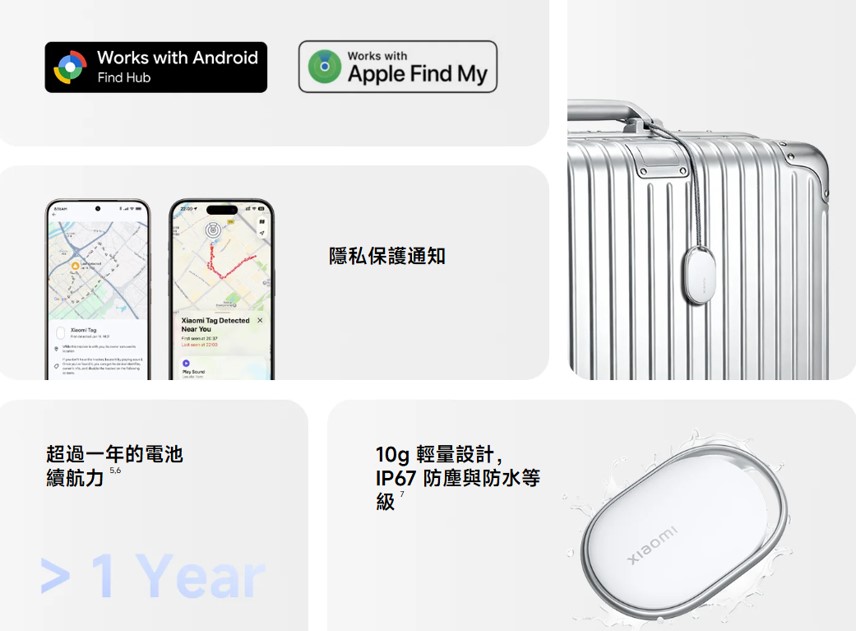
Xiaomi Tag is a cost-effective Bluetooth tracker launched by Xiaomi. Its advantages are a low price—only $359 for a single pack and $1,299 for a four-pack; cross-platform dual-system (Android & iOS) compatibility (choose one); a 10g lightweight design with a built-in metal lanyard hole; a built-in user-replaceable CR2032 coin battery and IP67 support; and support for setting “Familiar Places” proactive prevention reminders. However, its drawbacks are that it only provides basic Bluetooth location and ringtone guidance, does not support UWB (ultra-wideband) precise navigation, and has a smaller detection range and slower location update speed.
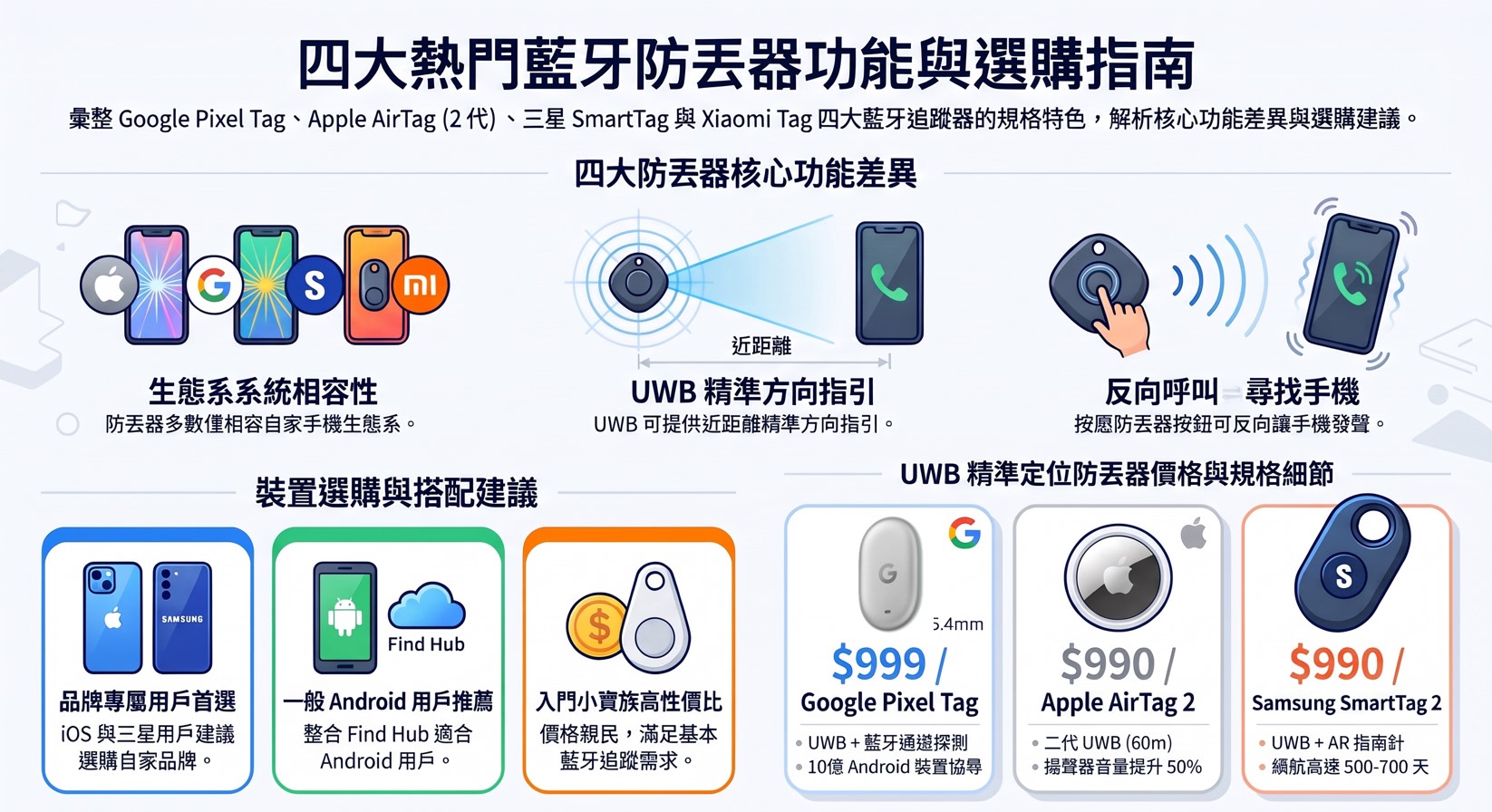
Google Pixel Tag, Apple AirTag, Samsung SmartTag, and Xiaomi Tag—the four major Bluetooth trackers—each have their own pros, cons, and features. However, because they support different phone ecosystems and the latest generation supports UWB precise directional guidance, the moderator recommends that Apple and Samsung users choose their own brand’s Bluetooth tracker; other Android users are advised to use Google Pixel Tag, while those with a limited budget who only need basic Bluetooth tracking can buy the inexpensive Xiaomi Tag.
Source: KOCPC Chinese