


It is well known that Windows 11 is a memory hog. Although early budget models also came with 8GB RAM variants, their smoothness and user experience were generally poor. It is generally recommended to have at least 16GB RAM for better performance, and the official guide even suggests 32GB RAM for gaming machines. However, Microsoft recently quietly removed these two articles from the Windows Learning Center that advised players to use 32GB of memory. The main reason is hardly surprising: memory is too expensive. Even Microsoft’s own Surface Pro 12 and Surface Laptop 13, launched this June, only come with 8GB RAM in their entry-level models, starting at $849 (about NT$27,593) and $949 (about NT$30,843), respectively.
What did the two deleted articles say?
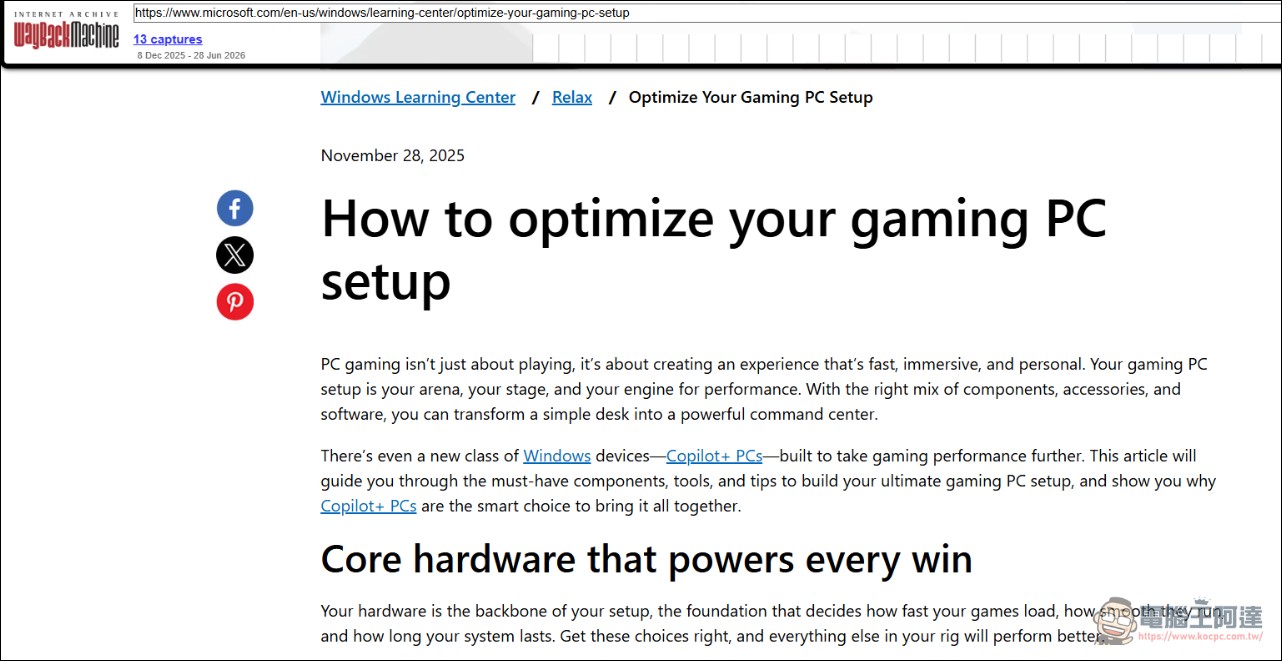
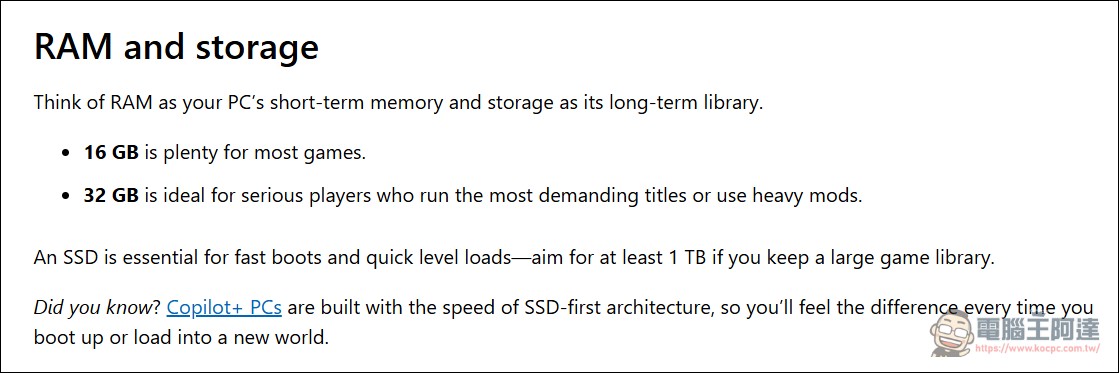
The title of the first deleted article was “How to optimize your gaming PC setup,” published on November 28, 2025The article points out that 16GB of memory is “more than enough” for most gamers, but 32GB is “the ideal choice for serious gamers running the most demanding games or using lots of mods.” The article also promotes Copilot+ PC as the easiest way to achieve a 32GB configuration.
The second article was titled “Gaming features: What the best Windows PC gaming systems have in common,” in which Microsoft referred to 32GB as the “no-worries zone,” stating that 32GB gives newer games more memory headroom, as games’ memory demands continue to rise. This article was deleted shortly after being reported on in May 2026. The article doesn’t even have a snapshot saved on the Wayback Machine. The original URLs of both articles now redirect to the Windows Learning Center homepage.
The awkward part is that the Surface Pro 12 and Surface Laptop 13, released in June this year, come with only 8GB of memory in their entry-level configurations. The problem is that Microsoft’s own Copilot+ PC certification standard requires at least 16GB of memory, and now Microsoft’s own Surface product line doesn’t even meet its own AI PC specifications. Even earlier, Microsoft launched the Surface Laptop for Business at $1,299 (approximately NT$42,218), which also only came with 8GB of memory (Taiwan only sells the 16GB RAM version).
By June 25, the Surface Laptop purchase page began describing 8GB of memory as “suitable for everyday use such as browsing the web, streaming videos, school assignments, and productivity applications.” This is a 180-degree shift from Microsoft’s emphasis over the past year that serious users need 32GB of memory.
The AI Factors Behind the Surge in Memory Prices
The fundamental reason for Microsoft’s abrupt reversal was the surge in memory prices. Soaring demand for DRAM and HBM memory from AI data centers drove up consumer-grade memory prices as well. This wave of price increases affected not only Microsoft. Apple also raised the price of its cheapest MacBook Neo by $100 shortly after the product launched. IDC analyst Jitesh Ubrani noted in a June report that in the face of memory shortages, manufacturers would respond by pairing “new chips with Microsoft’s more efficient operating system.” Global PC shipments fell 4.9% year over year in the second quarter, marking the first decline in nine quarters.
The memory industry is not expected to recover from the current supply shortage until 2027, or even 2028. In the foreseeable future, PCs equipped with less memory will become the new normal.
Windows 11’s Memory Usage Problem
The reason 8GB of memory feels insufficient is largely the fault of Windows 11’s design. A large portion of Windows 11’s interface is built with WebView2 and web technologies, and many popular Windows apps are Electron web wrappers rather than native code—both of which consume a lot of memory. To use an analogy, many Windows apps are as resource-hungry as tabs in Chrome. This approach worked in an era when memory was cheap, because previously 16GB of RAM was just a small line item on the parts BOM, but that’s no longer the case.
Microsoft CEO Satya Nadella recently stated that the company is working to win back Windows users through native Windows 11 apps and better coding practices. On July 31, Microsoft officially announced that it would bring memory optimization to Windows 11, aiming to deliver a fast and smooth experience even on machines with 8GB or more of RAM. In the announcement, Microsoft wrote: “Memory optimization for configurations with 8GB or more, reducing Windows memory footprint to deliver a fast and smooth Windows experience on a wide range of everyday PCs.” The target timeline is the end of 2026. As for whether they can pull it off? Let’s just wait and see—after all, the code accumulated in Microsoft Windows over all these years isn’t so easy to fix.
Source: KOCPC Chinese