


Although the GLM open-source model family created by Zhipu AI isn’t as well-known as Gemma, Llama, DeepSeek, and others, it has consistently performed quite well, especially the GLM-4-9B released last year. Recently, they’ve been promoting a brand-new GLM-4-32B open-source model with larger parameters, positioned as high-performance and general-purpose, and claiming that its comprehensive capabilities can rival OpenAI GPT-4o and DeepSeek-V3-0324 (671B).
However, with 32B parameters, not everyone’s computer hardware can deploy it. The good news is that Zhipu AI has also launched a Z.ai website, where you can experience the GLM-4-32B open-source model online for free, complete with web search functionality.
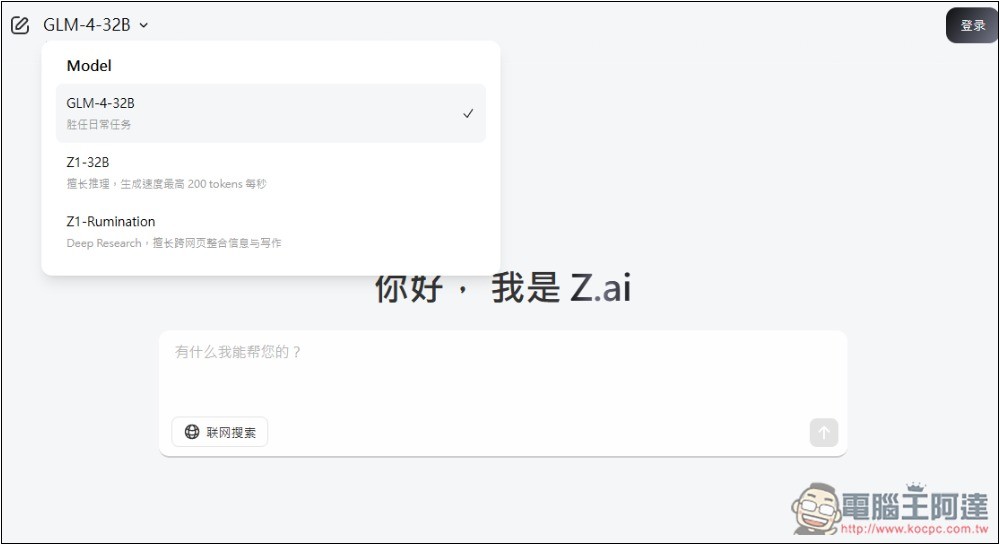
Z.ai: Free Online Experience of the Latest Open-Source Model GLM-4-32B
GLM-4-32B is an open-source model with 32 billion parameters, available for download on sites like Hugging Face. If your hardware is powerful enough, you can deploy it locally. However, if your hardware can’t handle it, you can try it on Z.ai, which is completely free and unlimited.
The chart below shows test data shared by Zhipu AI. The competing models are all well-known models today, such as Qwen2.5-Max, GPT-4o-1120, DeepSeek-V3-0324, and DeepSeek-R1. GLM-4-32B outperformed all of its competitors in the vast majority of tests.
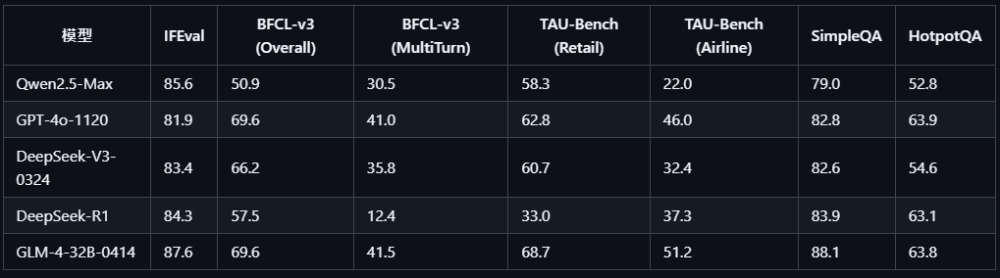
Although developers will inevitably pick test data that favors themselves, that doesn’t mean real-world usage will really be like that. But at least we can be certain that GLM-4-32B won’t be too bad, and it’s completely free.
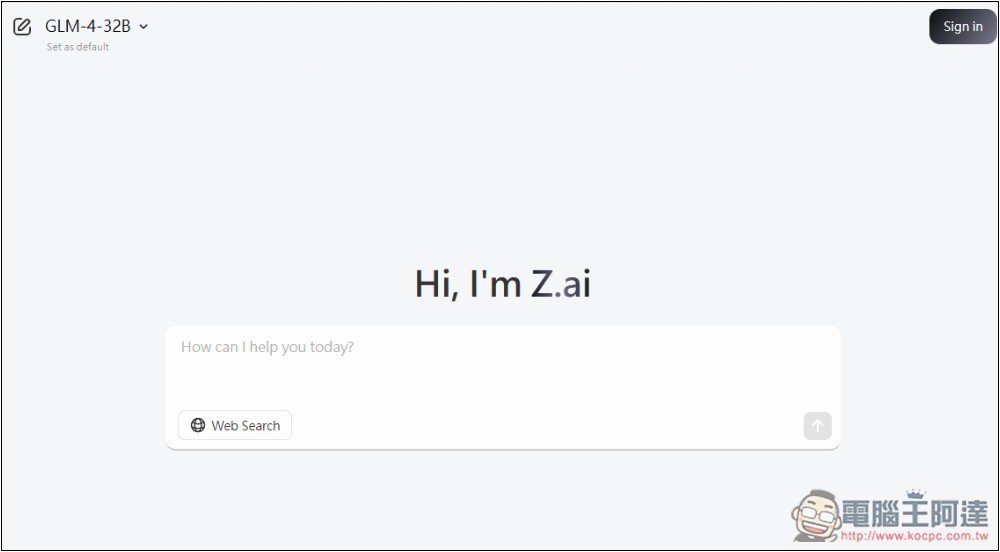
After clicking the link above to go to the Z.ai website, the default model is GLM-4-32B, and you can start chatting right away. If you want to search the web, remember to turn on the Web Search feature. There’s also a login button in the top right corner. Registering an account unlocks all features, including chat history, changing the interface language (supports Simplified Chinese), data management settings, and some personalization options. It’s up to you whether you want to do that:
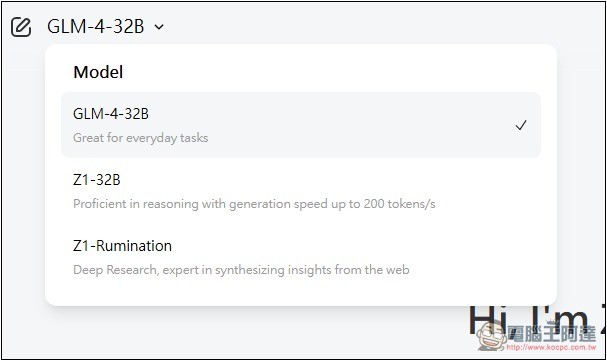
Besides GLM-4-32B, Z.ai also offers two other models, including Z1-32B and Z1-Rumination. The latter is for deep search, while the former, according to the official description, Z1-32B is a reasoning model with deep thinking capabilities, built on GLM-4-32B through cold start, extended reinforcement learning, and training on tasks such as math and logic. Simply put, it has stronger mathematical and complex problem-solving abilities. If you’re interested, you can also give it a try.
Unsurprisingly, GLM-4-32B also supports Traditional Chinese responses, but sometimes it still makes mistakes and turns into Simplified Chinese:

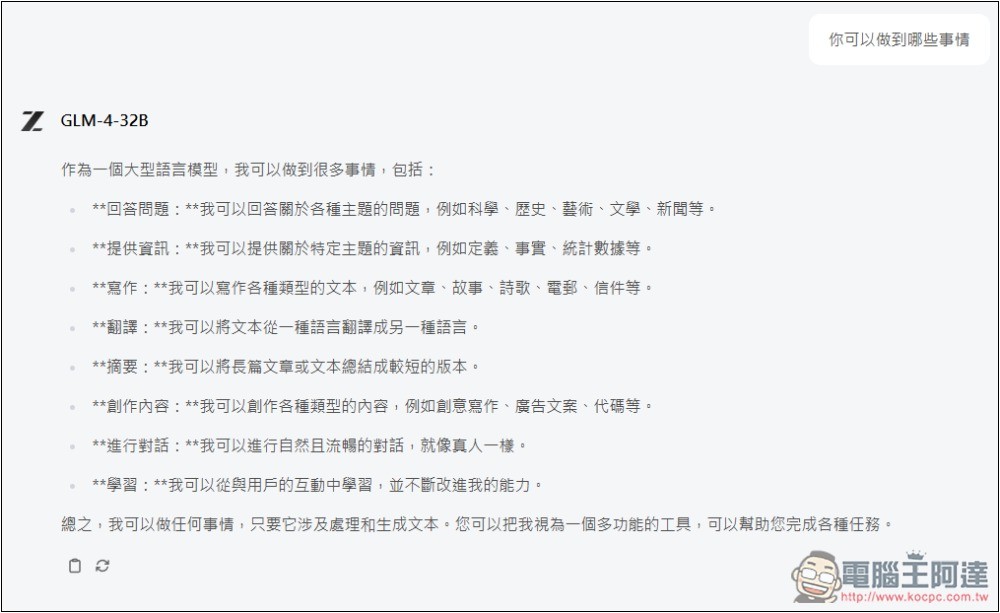
What it can do is just like other AI chatbots:
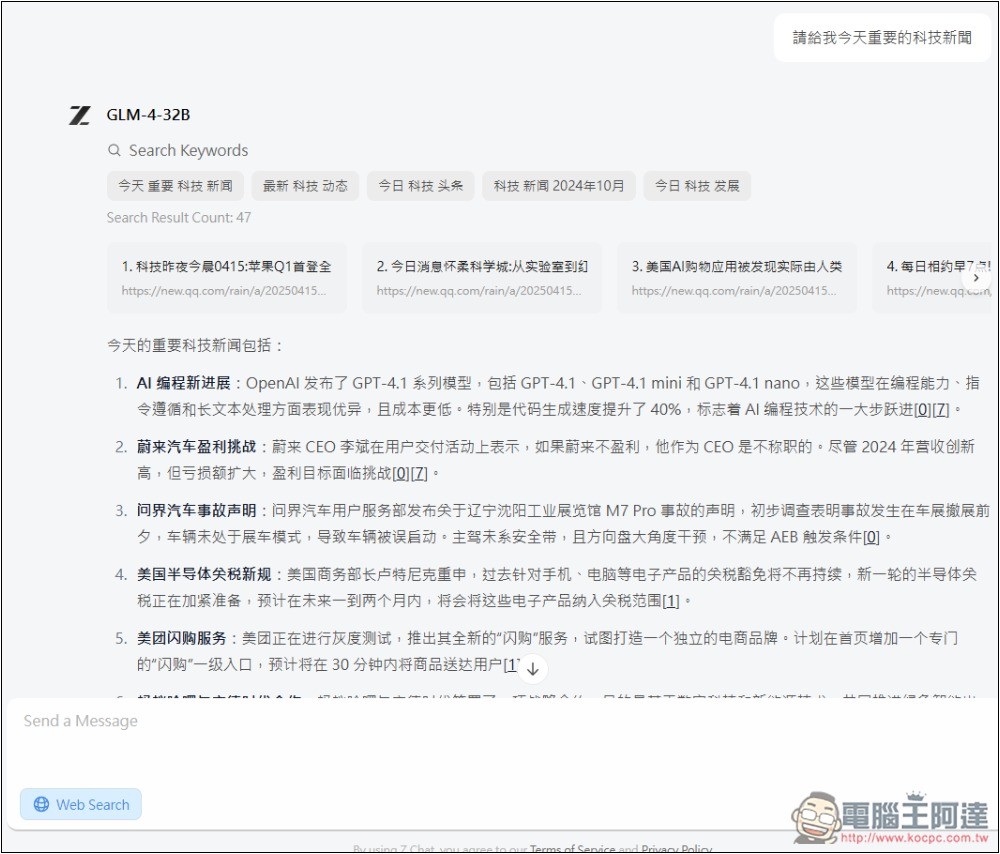
The web search function was successfully tested in practice—it really does search online and give me answers. However, since this is a service developed by a Chinese company, almost all the websites it searches are in Simplified Chinese.
You can also use it for translation, and I think the translation quality is pretty decent:
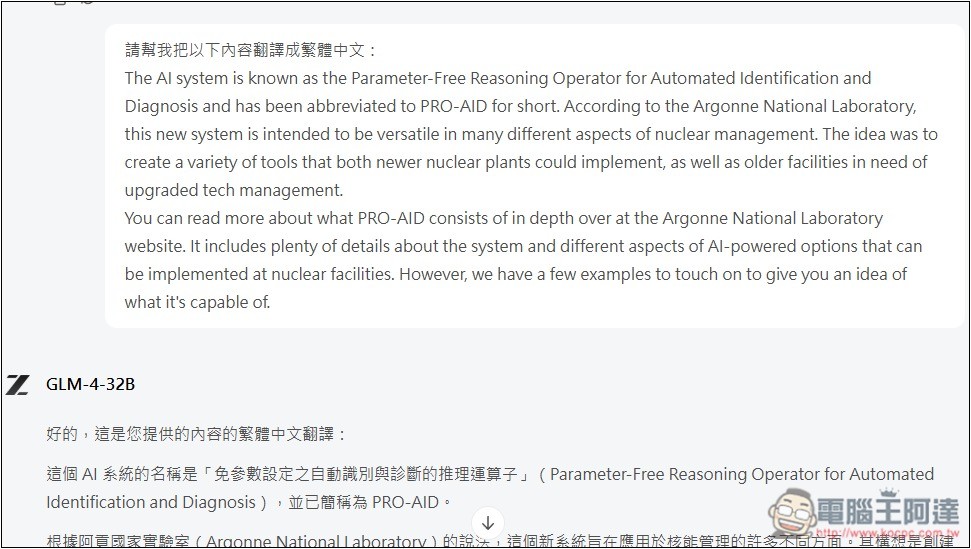
Here’s also for everyone’s reference.
Original text (from Tom’s Hardware):
The AI system is known as the Parameter-Free Reasoning Operator for Automated Identification and Diagnosis and has been abbreviated to PRO-AID for short. According to the Argonne National Laboratory, this new system is intended to be versatile in many different aspects of nuclear management. The idea was to create a variety of tools that both newer nuclear plants could implement, as well as older facilities in need of upgraded tech management.
You can read more about what PRO-AID consists of in depth over at the Argonne National Laboratory website. It includes plenty of details about the system and different aspects of AI-powered options that can be implemented at nuclear facilities. However, we have a few examples to touch on to give you an idea of what it’s capable of.
GLM-4-32B response:
The AI system is named “Parameter-Free Reasoning Operator for Automated Identification and Diagnosis” (Parameter-Free Reasoning Operator for Automated Identification and Diagnosis), abbreviated as PRO-AID.
According to Argonne National Laboratory, the new system is designed to be flexibly applied across many different aspects of nuclear energy management. Its design philosophy is to create a suite of tools that can be adopted by newer nuclear power plants and also help older facilities that need to upgrade their technical management.
You can learn more about the composition of PRO-AID through Argonne National Laboratory’s website. The site contains extensive information on system details and various aspects of AI-powered options that can be implemented in nuclear facilities. However, we will provide a few examples to give you an initial idea of its capabilities.
ChatGPT GPT-4o’s answer:
This AI system is named “Parameter-Free Reasoning Operator for Automated Identification and Diagnosis,” abbreviated as PRO-AID. According to Argonne National Laboratory, the new system is designed to demonstrate diverse applicability across various aspects of nuclear energy management. Its core concept is to build a toolkit that can be applied not only to new nuclear power plants but also to provide solutions for older facilities that need to upgrade their technical management.
If you want to learn more about the composition and content of PRO-AID, you can visit the official website of Argonne National Laboratory, which provides a detailed explanation of the system and its various AI-driven application options, as well as how these technologies are implemented in nuclear facilities. That said, we will also give a few examples here to help you understand the system’s actual capabilities.
Source: KOCPC Chinese