


Recently, Google can be said to be accelerating the development of AI models. After releasing Gemini 4 Hydrogen last week, it launched the new “Gemini 4 Neo” model a little earlier, positioned against Claude Opus 5.5 and GPT-6.2 Sol. It features flagship-class reasoning capabilities while keeping speed and cost in a relatively accessible range, making it a mid-tier model that is “strong enough but not too expensive.” Of course, as usual, Gemini 4 Neo beats its competitors in many official tests. GPT-6.2 Sol is rather pitiful—it was surpassed immediately after launching (laughs).
Google launches Gemini 4 Neon: winning 16 of 19 tests, directly challenging Opus 5.5 and GPT-6.2 Sol, with API pricing 25% cheaper than Opus.
Google earlier announced the launch of Gemini 4 Neon, becoming a new member of the Gemini 4 series.
Currently, the division of roles in this series is: Carbon is responsible for the most difficult, longest-running complex projects. Hydrogen is responsible for fast day-to-day execution. The newly launched Neon sits between Carbon and Hydrogen, focusing on complex software engineering, knowledge work, and scientific research workflows that balance performance and efficiency, with support for a 1 million token context:
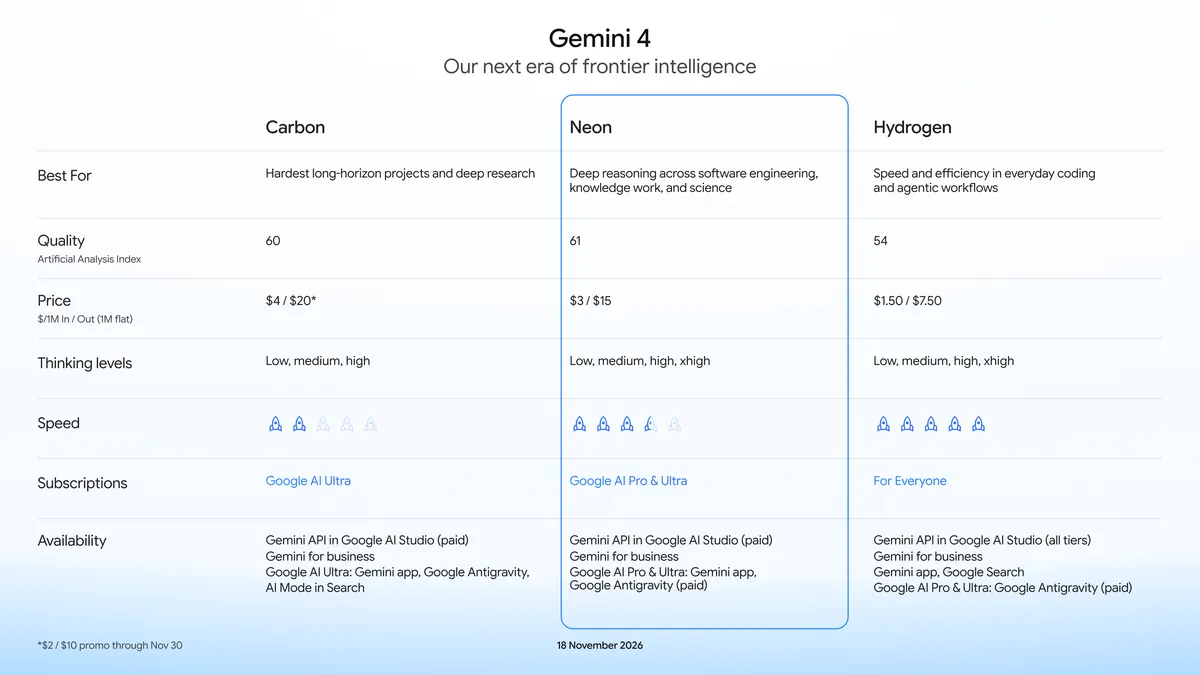
As for Argon, which was released first, it is the flagship reasoning model and is suitable for most software engineering and knowledge work.
Below are the Neon benchmark results published by Google DeepMind, compared alongside Opus 5.5 and GPT-6.2 Sol:
| Test item | Gemini 4 Neon | Claude Opus 5.5 | GPT-6.2 Sol |
|---|---|---|---|
| Comprehensive ability | |||
| AA Index v5.0.1 | 61 | 59 | 57 |
| Vals Index v2.2 | 70.9% | 70.1% | 66.1% |
| AI Agents and Software Development | |||
| CursorBench 4.1 | 65.4% | 58.1% | — |
| Terminal-Bench 4.1 | 65.2% | 65.8% | 61.5% |
| FrontierCode 2.0 | 46.2% | 47.3% | 43.8% |
| SWE-sweep(Provider harness) | 39.0% | 10.1% | 8.3% |
| SWE-sweep(Mini-SWE harness) | 12.8% | 3.6% | 11.6% |
| Knowledge Work and Automation | |||
| AutomationBench | 56.3% | 42.5% | 41.3% |
| Agents’ Last Exam v1.1 | 75.8% | 71.6% | 73.0% |
| Science and Mathematics | |||
| RiemannBench | 84.0% | 80.0% | 80.0% |
| Terminal-Bench-Science 0.1 | 70.5% | 63.3% | 68.0% |
| Reasoning ability | |||
| HLE-Diamond | 71.3% | 67.9% | 64.0% |
| Multimodal understanding | |||
| MKA(Climb WSR) | 56.5% | 53.0% | 52.7% |
| Chartography | 73.5% | 66.3% | 75.1% |
| LVBench | 89.0% | 83.7% | 87.6% |
| Long context capability | |||
| GraphWalks(256K–1M,BFS F1) | 95.2% | 66.8% | 80.1% |
| Cybersecurity | |||
| CWE-Bench v2 | 70.7% | 67.1% | 66.0% |
| SEC-bench Pro | 90.5% | — | 88.3% |
| WebExploitBench v1.2 | 51.3% | 37.1% | — |
Note: Bold indicates the highest score listed for that item in the table; “—” indicates that the result has not been published. Different tests use different scoring standards, so they should not be compared directly. SWE-sweep’s Provider harness and Mini-SWE harness use different testing environments.
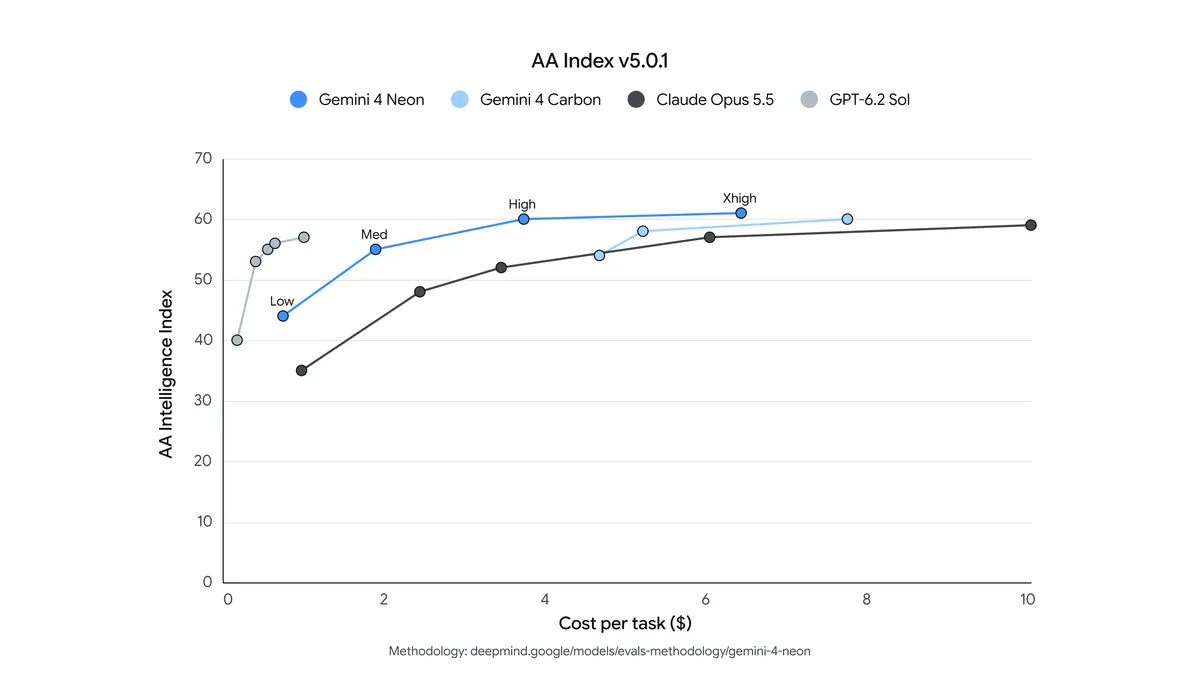
The AA Composite Capability Index is the “AI IQ Score” from third-party organization Artificial Analysis. Neon scored 61 at the highest xhigh thinking level, higher than Opus 5.5’s 59 and GPT-6.2 Sol’s 57. The Vals Index measures professional work such as legal, financial, and tax work; Neon scored 70.9%, also ahead of its competitors:
When it comes to programming ability, which most people care about, Neon’s results are mixed—sometimes better, sometimes worse.
For example, CursorBench 4.1 from Cursor scored 65.4%, significantly higher than Opus 5.5’s 58.1%. Artificial Analysis’s coding agent index also ranks first with 58.6 points.
But on the terminal operation test Terminal-Bench 4.1, Neon scored 65.2%, Opus 5.5 scored 65.8%, a slight lead of 0.6%, and GPT-6.2 Sol scored 61.5%. The programming ability test FrontierCode 2.0 shows a similar situation: Opus 5.5’s 47.3% leads Neon’s 46.2%, while GPT-6.2 Sol is 43.8%. However, the gaps are all around 1%, which is not to say they are very large.
SWE-sweep is the most noteworthy: Neon scored 39.0% on Google Antigravity, while Opus 5.5 using Claude Code scored only 10.1%, and GPT-6.2 Sol using Codex only 8.3%—a decisive victory, one could say.
But the interesting part is that after switching to the mini-SWE environment shared by all three, Neon dropped to 12.8%, GPT-6.2 Sol was 11.6%, leaving a gap of only 1.2%, while Opus 5.5 was only 3.6%.
AI automation is also one of the areas where Neon clearly leads its competitors.
In Zapier’s AutomationBench benchmark, Neon scored 56.3% and ranked first, while Opus 5.5 scored 42.5% and GPT-6.2 Sol scored 41.3%, putting Neon nearly 14 percentage points ahead. In Vending-Bench 2, which simulates running a vending machine business for a full year, Neon’s final bank account balance reached $16,843, also ranking first.
Gemini 4 Neon is now available and can be experienced through the following channels:
- Gemini App: Google AI Pro and Ultra subscribers can select Neon from the model dropdown menu.
- Google Antigravity: Available to paid Google AI Pro and Ultra subscribers.
- Google AI Studio: Pro and Ultra subscribers can try it.
- Developer: use via the Gemini API paid tier and Android Studio.
- Enterprise: Use via the Gemini for business API or model menu
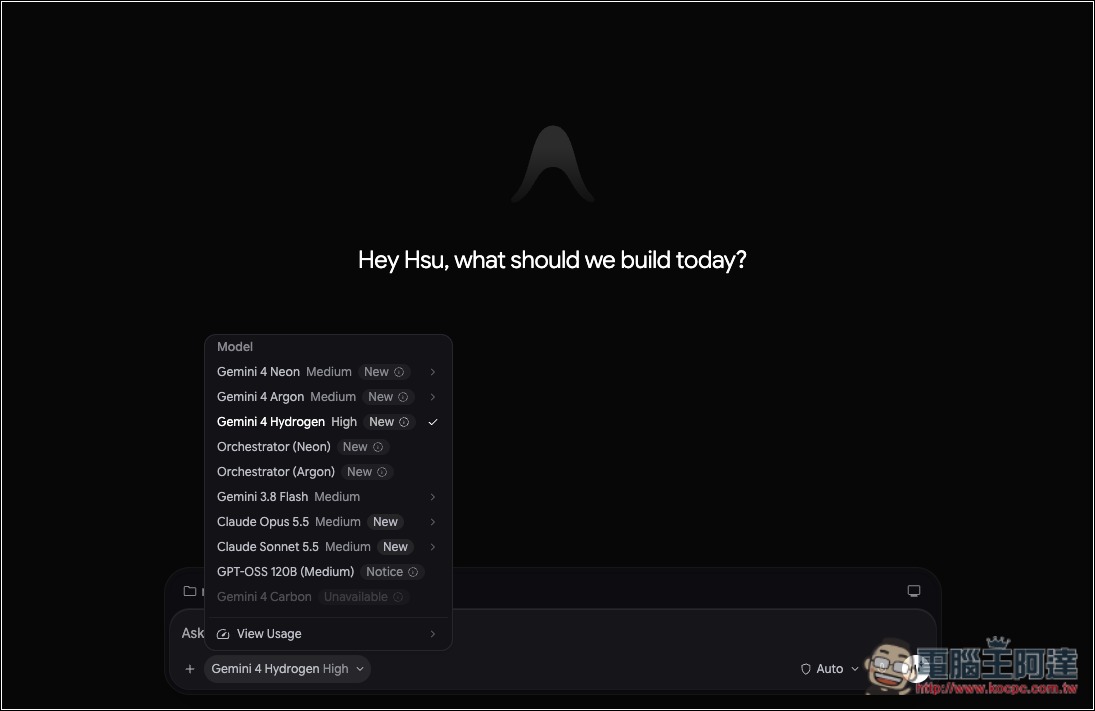
Gemini 4 Neon’s API pricing is $3 per 1 million input tokens and $15 per output token, while cached input is $0.15, which is 95% cheaper than regular input. Below is a comparison of the standard API prices for the three models:
| model | Input | Output | Cache input |
|---|---|---|---|
| Gemini 4 Neon | $3 | $15 | $0.15 |
| Claude Opus 5.5 | $4 | $20 | $0.20 |
| GPT-6.2 Sol | $2 | $10 | $0.10 |
Source: KOCPC Chinese