


Yesterday (the 7th), NVIDIA and the SANA Sol-Engine research team released Sol-H3, an end-to-end inference acceleration solution for the MiniMax-H3 open-source video generation model. On a system with eight NVIDIA B300 Blackwell GPUs, Sol-H3 generates a 5-second, 1344×768-resolution video with stereo audio in just 1.653 seconds of inference time—shorter than the video’s playback duration. The team calls this the “faster than playback” goal, paving the way for real-time generation and truly interactive AI videos.
Sol-H3: From “fast” to “faster than playback”
Sol-H3 is led by Enze Xie (謝恩澤), integrating NVIDIA’s Sol Engine video inference optimization framework with Sol-Attn sparse attention technology, combined with MiniMax’s own four-step distillation scheme, forming a complete inference execution stack. The team collaborated with the Reactor platform to provide API services from day one, with the code released under the Apache 2.0 license.
🚀 Sol-H3: @MiniMax_AI H3 Video Generation Faster Than Playback 🤩
Five seconds of world. 1.653 seconds to infer.
We’re releasing Sol-H3, our fastest end-to-end MiniMax-H3 inference stack yet. On one 8× NVIDIA B300 Blackwell system, it generates five seconds of 1344×768 video… pic.twitter.com/WSHHEbgIJj
— Enze Xie (@xieenze_jr) September 7, 2026
The data speaks for itself. The original Base H3 version takes 18.250 seconds to generate a 5-second video using 50 steps of DiT forward propagation. Sol-H3 requires only four steps of DiT forward propagation, taking just 1.653 seconds on the same 8× B300 setup—an 11.04x speedup. When extended to 10-second and 15-second videos, the speedup further increases to 13.57x and 15.05x, with generation times of 3.732 seconds and 6.612 seconds, respectively.
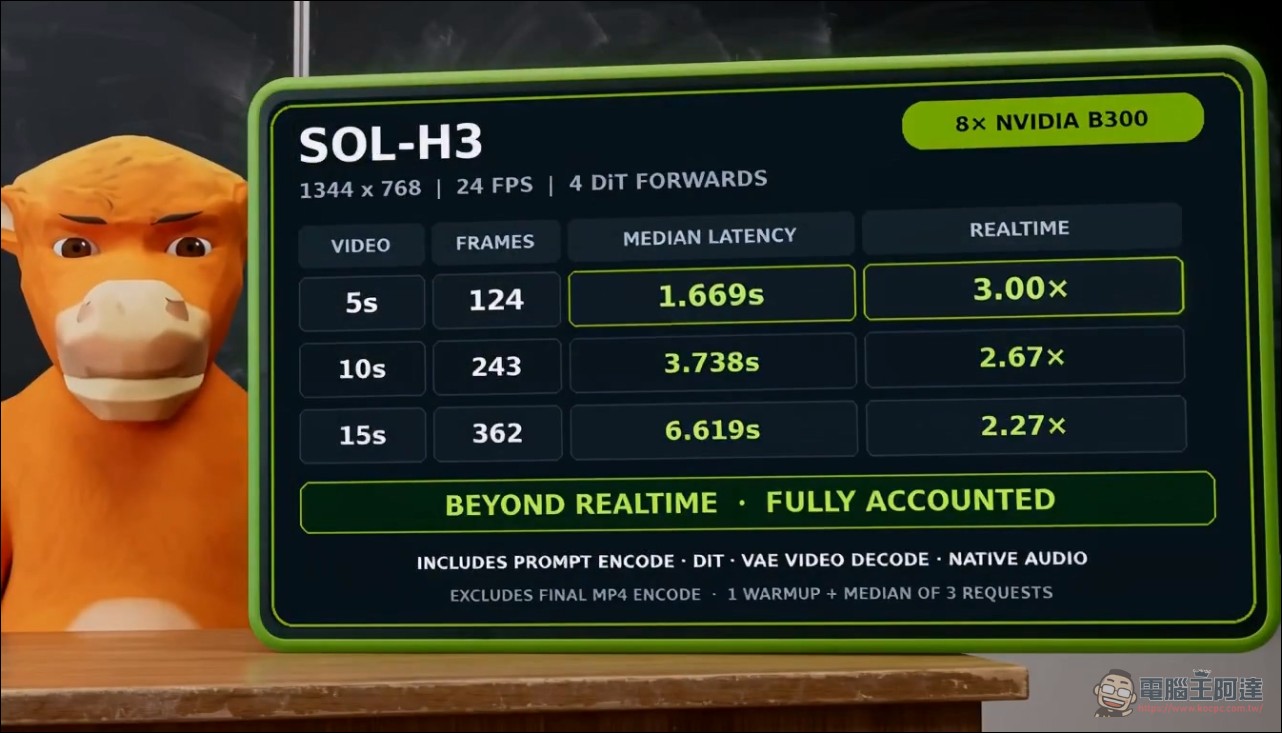
Sol-H3 also demonstrates scalability across different GPU configurations. A system with 4 B300 GPUs generates a 5-second video in 2.918 seconds, a 10-second video in 6.993 seconds, and a 15-second video in 12.542 seconds, achieving speedups between 12.11x and 15.54x. Even scaled down to a single B300, a 5-second video takes only 13.745 seconds, a 9.45x speedup; a 10-second video takes 37.813 seconds, and a 15-second video takes 52.260 seconds. All tests were conducted at 1344×768 resolution, 24 FPS, with stereo audio, using the median of three runs, with model loading and compilation warm-up time excluded. This level of acceleration marks a major step toward real-time generation for H3.
Technical Composition: Sol Engine × Sol-Attn Complete Stack
Sol-H3 integrates a multi-layer inference execution stack technology, where the layers are stacked to produce the final acceleration result. NVIDIA’s Sol Engine previously achieved a 3.95x speedup on 8× GB200 for MiniMax-H3, built on three pillars: lossless core optimization (fusing operations such as RMS-AdaLN, QKNorm + RoPE, QKV merging, GEMM + GELU to reduce HBM read/write counts), cross-step caching (reusing residuals from previous steps in intermediate denoising steps, skipping steps that do not need recomputation, which alone reduced time from 17.7 seconds to 6.88 seconds), and Sol-Attn training-free sparse attention (computing only the attention blocks actually needed at each step).
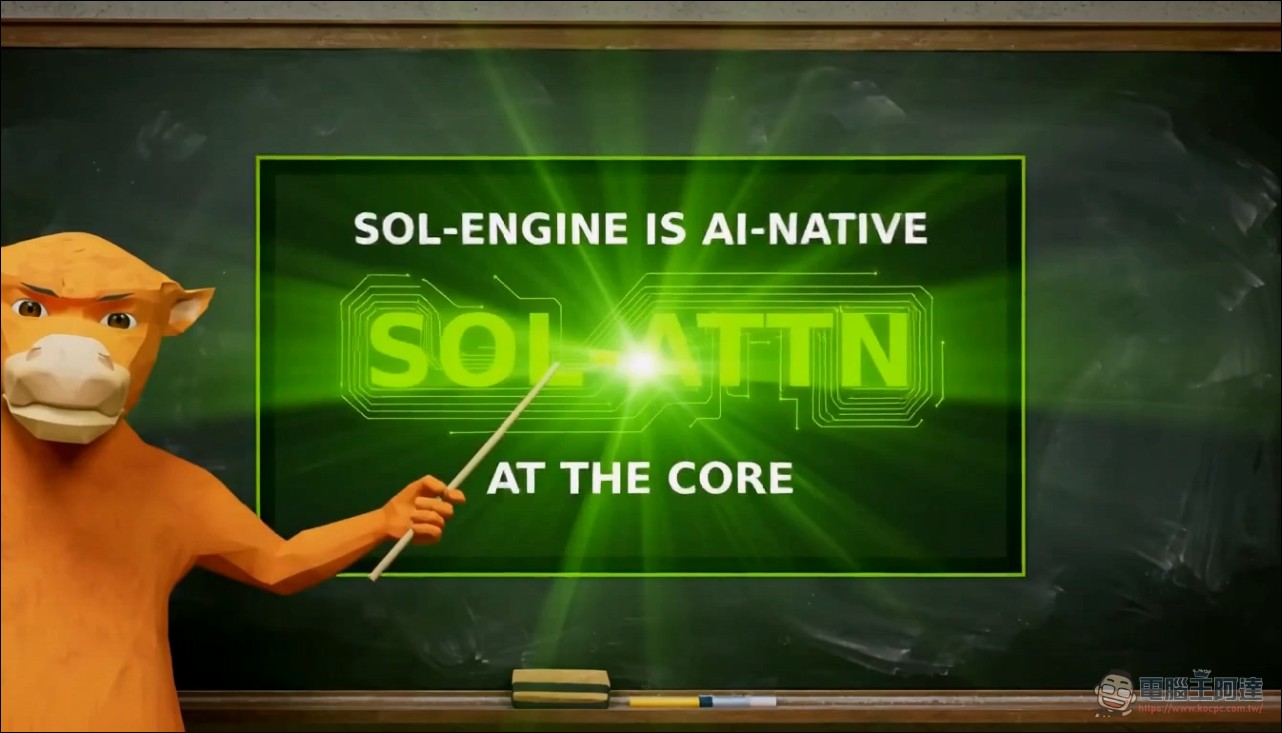
Sol-H3 builds on this foundation by further incorporating four-step distillation and INT8 QKV / FP8 output communication optimization on the B300 platform, pushing the speedup from 3.95x to the 11x–15x level. The team emphasized that this is a complete generation profile comparison: Base H3 uses 50 steps, while Sol-H3 uses 4 steps, covering the entire pipeline of text encoding, DiT denoising, and VAE decoding.
Specific outcomes of key optimizations:
- Dynamic Sparse Attention (Sol-Attn)No retraining required—dynamically determine which attention blocks need computation during inference. Setup time reduced from 1.206 ms to 0.285 ms, a 76.4% decrease.
- Parallel batch VAE decodingDecoding time decreased from 7.55 seconds to 0.602 seconds.
- Memory releaseIn total, each GPU frees up about 24 GB, enabling generation at higher resolutions or longer sequences.
Sol-H3 uses dense attention on 1x B300; at 4x and 8x, it enables Sol-Attn with INT8 QKV / FP8 output transfer. Time measurements include text encoding, DiT denoising, and video/audio VAE decoding; model loading, compilation warm-up, and final MP4 packaging are excluded.
The Competitive Landscape of H3 Acceleration Solutions
Sol-H3 is not the only acceleration solution in the MiniMax-H3 ecosystem, but it is currently the one with the highest acceleration multiplier on B300 hardware. At the end of August, fal.ai released H3 Max, which can generate a 5-second 768p video with audio in 3 seconds, emphasizing rapid deployment and broad availability, and it is already live on the MiniMax Design platform.
vLLM-Omni also released a production-grade deployment solution for MiniMax H3 in early September, integrating FastVideo’s four-step FastH3 and likewise achieving generation speeds faster than playback. The vLLM article mentioned comprehensively optimizing the full stack—text encoding, DiT denoising, and VAE decoding—at the system level, and emphasized a modular, composable design philosophy.
Looking at the current development of the AI video generation market, the H3 ecosystem is rapidly taking shape, from vLLM’s production-grade deployment to fal’s fast API solution, and then to Sol-H3’s extreme acceleration, with different teams contributing their respective optimization solutions across different stages.
Sol-H3 is positioned to combine Sol Engine’s automated search-based optimization workflow with the B300’s hardware acceleration capabilities, achieving over 15x acceleration at 4-step DiT. According to Sol Engine’s documentation, its “agent-native automated optimization” process runs parallel searches across three major technical families—core fusion, sparse attention, and caching—to find optimal parameters, then uses an integrator to identify the best combination. The entire process takes only hours rather than weeks. For teams needing to rapidly deploy H3 services, this efficiency gap is substantial.
Open source licensing and subsequent applications
Sol-H3 is released under the Apache 2.0 license. The team notes that any MiniMax-H3 few-step LoRA model can be directly plugged into the same engine without additional adjustments. The code is designed with deployability in mind. APIs are now available on the Reactor platform, allowing users to directly use Sol-H3-accelerated H3 models through Reactor.
From a technical approach perspective, the biggest difference between Sol-H3 and other acceleration solutions is that it fully covers every layer from core optimization and sparsification to distillation. Most acceleration solutions focus on only a single layer, such as distillation alone or attention optimization alone. Sol Engine’s “agent-native automatic optimization” architecture searches in parallel for the best parameter combinations across three major technical families, then uses an integrator to find the global optimum. This process takes only hours from model release to a deployable acceleration solution, rather than weeks of traditional manual tuning. For teams that need to deploy H3 services quickly, this efficiency gap is substantial.
Conclusion
Generating 5 seconds of video in 1.653 seconds makes inference time shorter than the time needed to finish playing it. This “faster than playback” achievement opens up the possibility of real-time video generation: when the model can produce the next segment in less time than playback, continuous real-time generation at 24 FPS is no longer just theory. The next step is integrating these technologies into a truly usable interactive video system, and Sol-H3 has already crossed the first threshold. Judging by the pace of progress in the H3 ecosystem over the past few months, real-time generative AI video is closer to practical application than many people realize. From Sol Engine’s 3.95x in August to Sol-H3’s 15x now, the speed of improvement is remarkable.
Source: KOCPC Chinese