


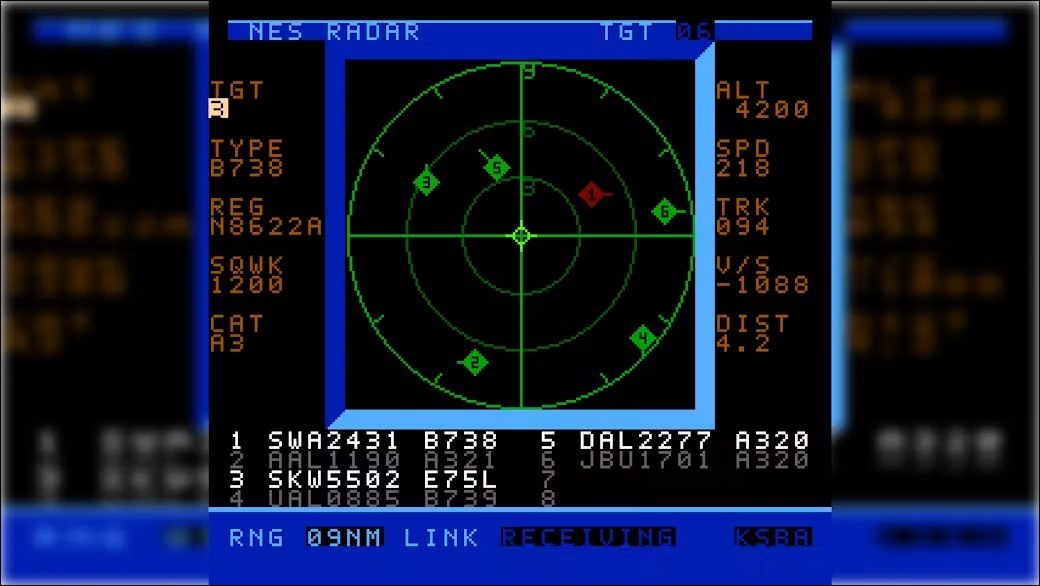
A Nintendo NES console that has been gathering dust for forty years (the Japanese version is the Famicom we all know) can now be used to track aircraft. Recently, developer Levi Maaia created an open-source project called NES Radar that transforms the NES console released in 1985 into a real-time air traffic radar: enter the four-letter ICAO code for an airport, press the Start button, and real flights in the vicinity of that airport will appear on the TV screen, rendered as 8-bit moving targets.
Using the controller to input the airport code, the TV turns into a radar.
The usage is quite intuitive: just insert a homemade cartridge into the NES, use the controller plugged into the first controller port to enter the target airport’s four-letter ICAO code, and press Start. The screen then switches to a radar view showing aircraft flying within a nine-nautical-mile radius of that airport. Enter the code for a local small airport, and you can see arriving flights lining up in sequence to approach the runway; enter KLAX (Los Angeles International Airport), and the dense flight routes on the screen quickly fill up.
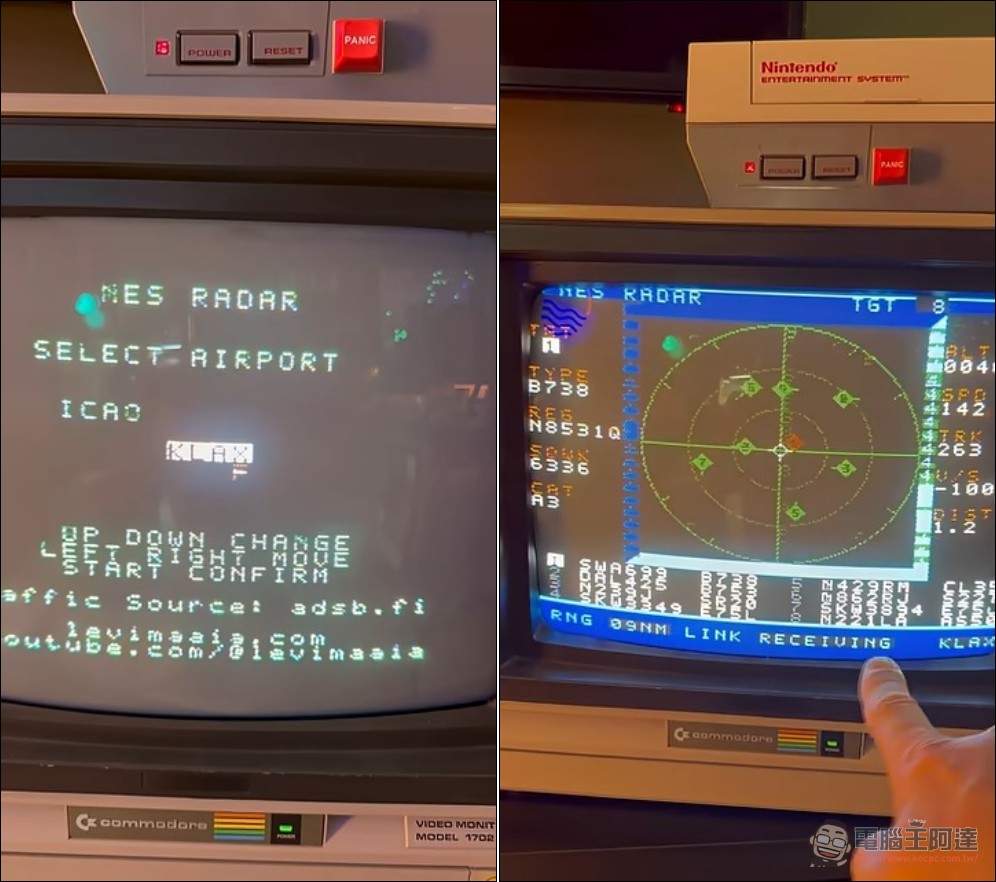
What makes this truly special is that it’s a DIY project anyone can recreate—it’s not just something you watch on YouTube and move on. With an NTSC NES, an FTDI adapter, and a flash cartridge, anyone can put one together over a weekend. The screen displays up to eight aircraft at once, each rendered as a 16×16 pixel sprite. That’s more than enough for small airports, but large hub airports can easily exceed the limit, in which case the system only shows the eight nearest aircraft.
NES is not connected to the internet; it relies on a computer for relay.
How does a 1985 console get real-time flight data? The answer is a computer sitting next to it. The NES itself never touches the network; instead, a small server running on Mac, Windows, or Linux pulls ADS-B flight data from adsb.fi, filters for aircraft within a 9.5-nautical-mile radius of the target airport, and sends it through a 5V FTDI USB serial cable to the NES’s second controller port.
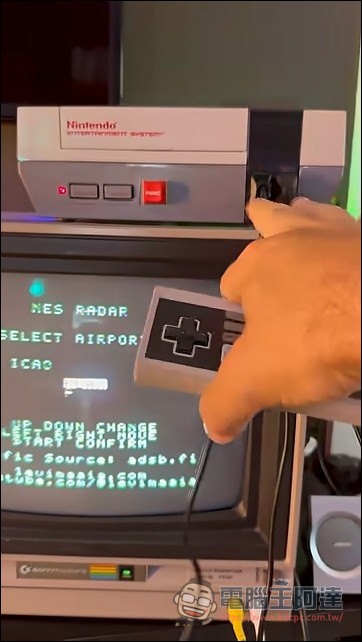
This line runs 9,600 baud bidirectional serial communication. One signal line sends radar data to the host system, while the other transmits the ICAO code entered by the user on the NES back to the server, telling it which airspace’s data to fetch. Pressing the Select button returns you to the airport editor to pick a different target without needing to restart the server.
Open source projects, Mac is the least hassle.
NES Radar has been released as an open-source project on GitHub, including the ROM, server code, wiring instructions, and communication protocol documentation. The repository contains a complete ROM image, Python server scripts, FTDI wiring diagrams, and a field-by-field description of the serial communication protocol, along with steps for flashing the project onto a Flash cartridge. Mac users get a ready-made self-contained binary that runs directly; Windows and Linux users need to run the Python code, which is currently experimental but functional. The Mac self-contained binary is a complete single file that runs right after download; Windows and Linux users must install a Python environment themselves and run the server script, which, while currently functional, is still marked as experimental.
NES Radar GitHub
NES Radar is another example of the retro computing community pushing old hardware toward new purposes in recent years, and yet another testament to the vitality of 8-bit era hardware. It doesn’t solve any practical problem, but Maaia states it clearly in the project description: this is a “kinetic decoration,” and also a public lesson on the NES controller port protocol, giving those who want to tinker a complete starting reference.
Source: KOCPC Chinese