


Just now (US Eastern Time, August 13) Google Unannounced release of the latest Gemini 3.7 Flash Model, only three weeks have passed since the previous 3.6 Flash version. This update, positioned as the “smartest workhorse model,” emphasizes significant improvements in coding, agent workflows, and knowledge processing capabilities, and is targeting the developer market with a half-price promotional strategy. CEO Sundar Pichai Post on XThe core value of the Flash model is “providing high performance at an affordable price,” and the team is accelerating updates to get them into developers’ hands as soon as possible. This is the third version of the Flash model Google has launched this summer—from 3.5 Flash in May, to 3.6 Flash on July 21, to the current 3.7 Flash—and the update pace has clearly quickened.
Google launches Gemini 3.7 Flash: coding matches GPT-5.6 at one-third the price
Coding benchmark results see comprehensive improvement across the board.
According to Google DeepMind Senior Director Tulsee Doshi,Gemini 3.7 Flash shows “substantial progress” on software engineering tasks. The main benchmark improvements compared with 3.6 Flash are as follows:
- DeepSWE v1.149.0% → 65.3% (software engineering task benchmark)
- FrontierCode 1.1 Main: 34.4% → 43.6% (frontier coding capability)
- WebDev Arena Elo: 1,538 → 1,588 (Web Development Quality Score)
- Terminal-Bench 2.178.0% → 85.8% (terminal operation capability)
- GDP.pdf: 22.0% → 34.0% (complex document processing capability)
- AutomationBench17.0% → 30.4% (business workflow automation)
It also delivers impressive performance in multimodality and long context: GDM-MRCR v2 achieves 97.0% in long-context retrieval, and LVBench reaches 85.4% in long-video understanding.
The showdown with GPT-5.6 and Claude Sonnet 5
What’s most striking about Gemini 3.7 Flash is not just its performance improvements, but the cost-performance advantage it demonstrates in head-to-head comparisons with competitors. According to detailed data compiled by the developer community, the key benchmark comparisons with GPT-5.6 and Claude Sonnet 5 are as follows:
- FrontierCode 1.1Gemini 43.6% vs Claude 42.7% vs GPT-5.6 41.3% (Gemini leads)
- Code Arena EloGemini 1,588 vs Claude 1,541 vs GPT-5.6 1,523 (Gemini leads)
- DeepSWE v1.1GPT-5.6 69.6% vs Gemini 65.3% vs Claude 53.8% (GPT-5.6 leads)
- Terminal-Bench 2.1GPT-5.6 87.4% vs Gemini 85.8% (GPT-5.6 leads by a slight margin)
- AutomationBench: Gemini 30.4% vs GPT-5.6 23.6% vs Claude 10.7% (Gemini significantly ahead)
- GDP.pdf: Gemini 34.0% vs Claude 28.0% vs GPT-5.6 24.7% (Gemini leads)
- Long-context GDM-MRCR v2: Gemini 97.0% vs GPT-5.6 93.5% vs Claude 81.5% (Gemini leads)
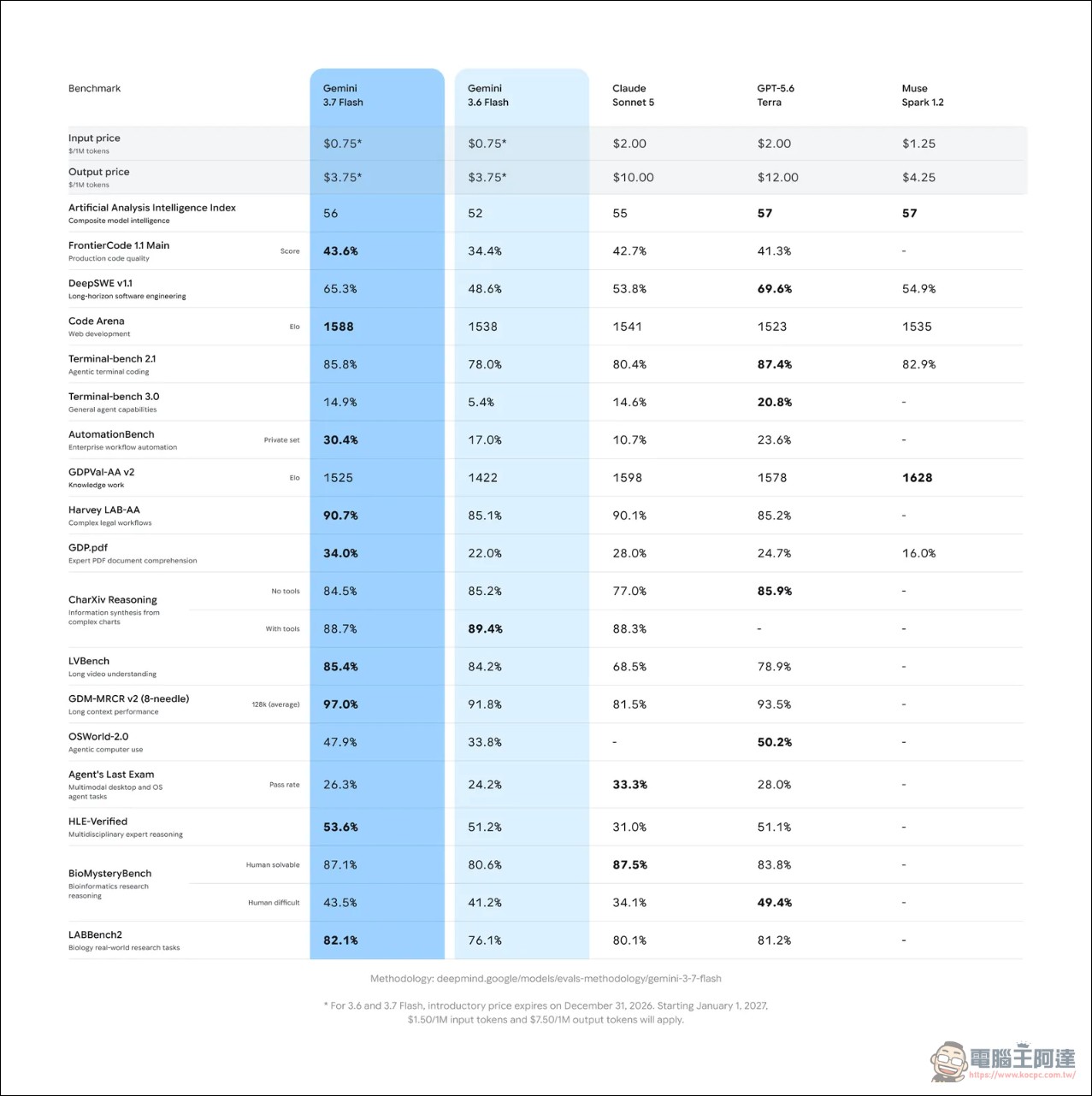
GPT-5.6 still maintains its lead on DeepSWE, Terminal-Bench 3.0, OSWorld, and several high-difficulty reasoning tests, while Claude Sonnet 5 comes out ahead on Agent’s Last Exam (33.3% vs Gemini’s 26.3%). But Gemini 3.7 Flash’s pricing strategy makes this competition even more interesting.
Half-Price Strategy: Price War per Million Tokens
Gemini 3.7 Flash’s promotional price is $0.75 per million input tokens and $3.75 per million output tokens, just half of the original price for 3.6 Flash, with the offer valid through the end of 2026. Compared with the pricing of major competitors:
- Gemini 3.7 Flash$0.75 / $3.75 (promotional price)
- GPT-5.6:$2 / $12
- Claude Sonnet 5:$2 / $10
- Muse Spark 1.2:$1.25 / $4.25
However, OpenAI has also aggressively cut prices for GPT 5.6 recently, with the Flash-tier Luna version priced at $0.20 / $1.20, making it cheaper than Gemini 3.7 Flash. On the OpenRouter platform, Gemini 3.7 Flash pricing has been further pushed down to $0.38 / $1.88.
Google is trading price for developer stickiness. For developers who need to run coding agents, document processing pipelines, or tool-calling systems at scale, the performance-per-dollar ratio matters more than being the champion of a single benchmark. At this pricing, running a full coding task could cost only a third of competitors’ cost or even less—a decisive gap for agent workflows that require heavy token consumption.
Google CTO Tulsee Doshi said that 3.7 Flash can better adapt when encountering obstacles, proactively clarify user intent when needed, and follow instructions more precisely. The model invests more computational resources in multi-step planning and tool calling, reducing the need for developers to manually intervene and retry. On the safety front, the model has updated its safeguards for chemical, biological, radiological, and nuclear (CBRN) domains as well as cyberattack uses.
Using Pipes and Limitations
Gemini 3.7 Flash is now available on the following platforms, and Google has also announced that developers using the Gemini API, AI Studio, and Android Studio can start using it immediately:
- Gemini API / Google AI Studio
- Android Studio
- Google Antigravity (Agent Development Platform)
- Gemini Enterprise Agent Platform
- Gemini Spark in the Gemini app (AI Pro or Ultra subscribers only)
Currently, the general Gemini chat interface still runs on 3.6 Flash, and 3.7 Flash hasn’t been fully rolled out yet—it’s only available in Gemini Spark Agent for AI Pro and Ultra subscribers.
Starting today for Google AI Pro and Ultra subscribers, Gemini Spark – your 24/7 personal AI agent in the @GeminiApp – will also run on Gemini 3.7 Flash ✨
Now when you ask Gemini Spark to get things done for you, our smartest workhorse model is on the job handling multi-step… pic.twitter.com/yigA76BhRR
— Google (@Google) August 13, 2026
Anxiety Over the Absent Flagship Model
Gemini 3.7 Flash’s rapid release cadence also masks a problem Google would rather not face: the flagship model Gemini 3.5 Pro has already been delayed three times. Sundar Pichai promised at Google I/O in May that 3.5 Pro would launch in June, but it still hasn’t shipped (the industry generally believes they’ll go straight to Gemini 4 Pro).
Meanwhile, Google DeepMind faces a severe talent drain. Core researchers such as Noam Shazeer (founder of Character.AI, who left again to join OpenAI after Google acquired it for $2.7 billion), Nobel Chemistry laureate John Jumper, and David Silver (the father of AlphaGo, who founded Ineffable Labs and raised $1.1 billion) have departed one after another. In July of this year, Alphabet’s market value evaporated by about $225 billion due to the delayed news of 3.5 Pro.
Summary
Google is releasing a new Flash model every three weeks, trying to prove to the market how fast it can develop AI models. From one angle, this strategy is working: the Flash series keeps improving, prices keep dropping, and the developer ecosystem keeps expanding. But the real test isn’t whether the Flash series can keep improving—it’s whether Gemini 3.5 Pro, when it finally ships, can deliver results on par with Fable 5, Claude Opus 5, and GPT-5.6 Sol.
Google’s AI strategy is facing a critical contradiction: on one hand, it has the industry’s largest research team and infrastructure, but on the other, it cannot translate these advantages into timely delivery of flagship models. The rapid iteration of the Flash models has indeed bought Google valuable time, but the patience of developers and investors will not last indefinitely. At a moment when OpenAI, Anthropic, Meta, and even startups are accelerating the rollout of their flagship models, Google needs not just a “faster Flash,” but a “Pro that is strong enough.”
Source: KOCPC Chinese