


Meta has officially entered the competitive arena of AI coding agents, challenging a market currently led by products such as Anthropic’s Claude Code and OpenAI Codex. The social media giant has launched Muse Code Beta, focusing on ‘affordable pricing, uncompromising performance’, hoping to attract developers and enterprises with a lower barrier to entry.

Meta enters the AI coding space with “Muse Code”
Meta CEO Mark Zuckerberg said that Muse Code is an AI coding agent that operates in a terminal environment, built on the Muse Spark 1.2 model. It can handle large codebases and complete “full” software development tasks, including planning modifications, writing code, running tests, and verifying results. The system uses background agents to build context, while large projects are split into multiple independent sub-agents, each handling different modules to avoid conflicts.
To improve reliability, Muse Code logs every model call and tool usage, so if an agent crashes, it can recover to the state before the crash, ensuring uninterrupted development workflows.
Releasing Muse Code in beta today. It’s a terminal coding agent that takes on complete software engineering tasks across large repos: planning changes, writing code, validating the results. Powered by Muse Spark 1.2, a coding-focused model update. pic.twitter.com/xqavk41w6v
— Mark Zuckerberg (@finkd) August 5, 2026
Meta AI head Alexandr Wang, in an interview CNBC interviewAt the time, they emphasized that Muse Code’s biggest appeal lies in its “low barrier to entry.” It currently adopts a pay-as-you-go model: $1.25 per million input tokens and $4.25 per million output tokens. For teams that require large volumes of tokens, Meta also offers a “contributor tier” plan, reportedly “more than ten times cheaper.” Users are required to help improve the model, but for startups or large enterprises just getting started, it may be a more cost-effective option.
Meta has also begun accepting requests to avoid data retention, allowing enterprises to ensure that sensitive code is not used for model training, which is especially important for financial, healthcare, and large technology companies.
Muse Code is essentially a coding framework that can manage multiple models and can also integrate third-party platforms. However, Alexandr Wang noted that Muse Spark 1.2 was developed in tandem with the agent, so it performs optimally within Muse Code.
In terms of performance, Meta believes Muse Spark 1.2 can already keep pace with competitors. In the Terminal-Bench 2.1 software engineering benchmark, it slightly outperforms GPT 5.6 Terra (Meta did not mention Sol) and performs comparably to Claude Opus 5. In the long-term test DeepSWE 1.1, it trails both of the aforementioned models but still leads X.ai’s Grok and Google Gemini 3.6 Flash. Meta’s internal testing shows that Muse Spark 1.2’s performance falls between Claude Opus 5 and GPT 5.6 Terra.
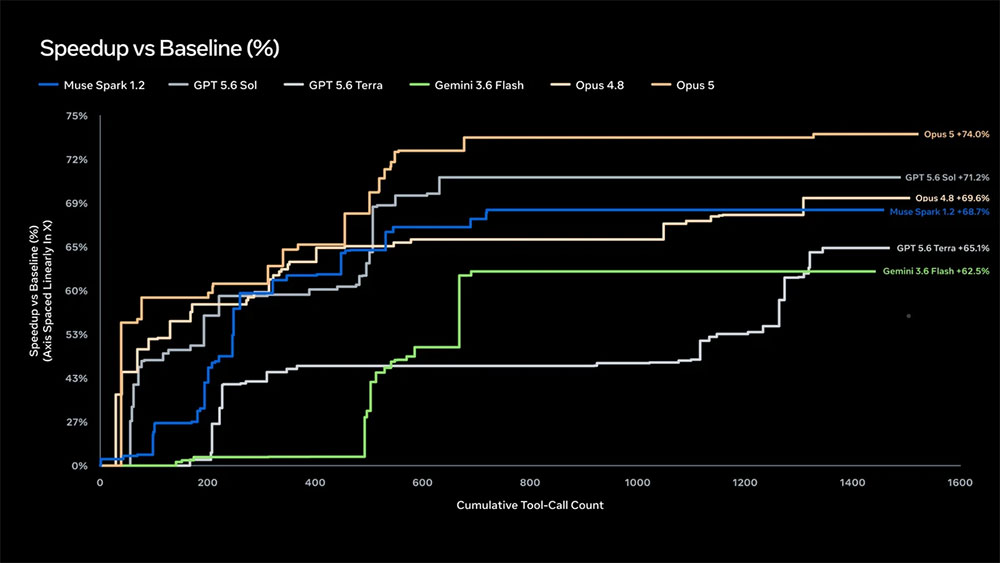
Therefore, the reason for choosing Muse Code isn’t the pursuit of extreme speed, but rather that Meta has managed to deliver a coding agent with mature performance and competitive pricing just four months after launching the Muse Spark series. For developers who use AI coding occasionally, Muse Code’s pay-as-you-go model may be quite cost-effective; however, if you rely on AI for development every day, you may ultimately still need to subscribe to a higher-tier plan.
Meta’s entry signals even fiercer competition in the AI coding agent market. Whether Muse Code can gain a foothold in the developer community will depend on its ability to keep improving performance, and whether Meta can sustain its core strategy of high cost-effectiveness.
Source: KOCPC Chinese