


Due to changing attitudes among women and the current economic climate, countries around the world are generally seeing declining birth rates. However, some couples who have been married for years and are only now financially able to have a child still struggle with infertility. Recently, a foreign couple who endured 18 years of infertility and visited infertility treatment centers around the world finally welcomed the news of their first child with the help of AI technology. This not only brought them hope, but may also completely rewrite the treatment approach for male infertility.

AI works medical miracle again, helping couple with azoospermia conceive after 18 years of infertility
This couple received treatment at Columbia University’s infertility center, where the husband was diagnosed with “azoospermia”: a condition that is difficult to detect outwardly but leaves fertility nearly zero. According to research, most men with azoospermia are physically healthy and have normal sexual function, and even their semen appears no different from that of ordinary men to the naked eye. However, under a microscope, a sample that should contain hundreds of millions of sperm reveals only cell remnants and debris, with actual sperm almost nowhere to be found.
Traditional treatment methods include extracting sperm directly from the testicles through surgery, but this is not only an extremely invasive procedure—it also carries risks of permanent damage and severe pain, so it can typically only be performed a limited number of times. Furthermore, if all methods fail, the final option may be to consider using donor sperm, which is a difficult choice for many families to accept.
STAR method: A novel AI-enabled sperm detection technology
After multiple failures, the couple chose to try a new technology called “STAR (Sperm Track and Recovery).” This is an innovative method that combines AI with high-resolution microscopy, designed specifically to identify extremely small amounts of sperm. The STAR method uses a microscope equipped with high-speed photography and a high-resolution imaging system, placing the male semen sample on a specially designed chip for intensive imaging. In less than an hour, the system can automatically capture over 8 million images and analyze each one through a specially trained AI model to identify any sperm that may be present.
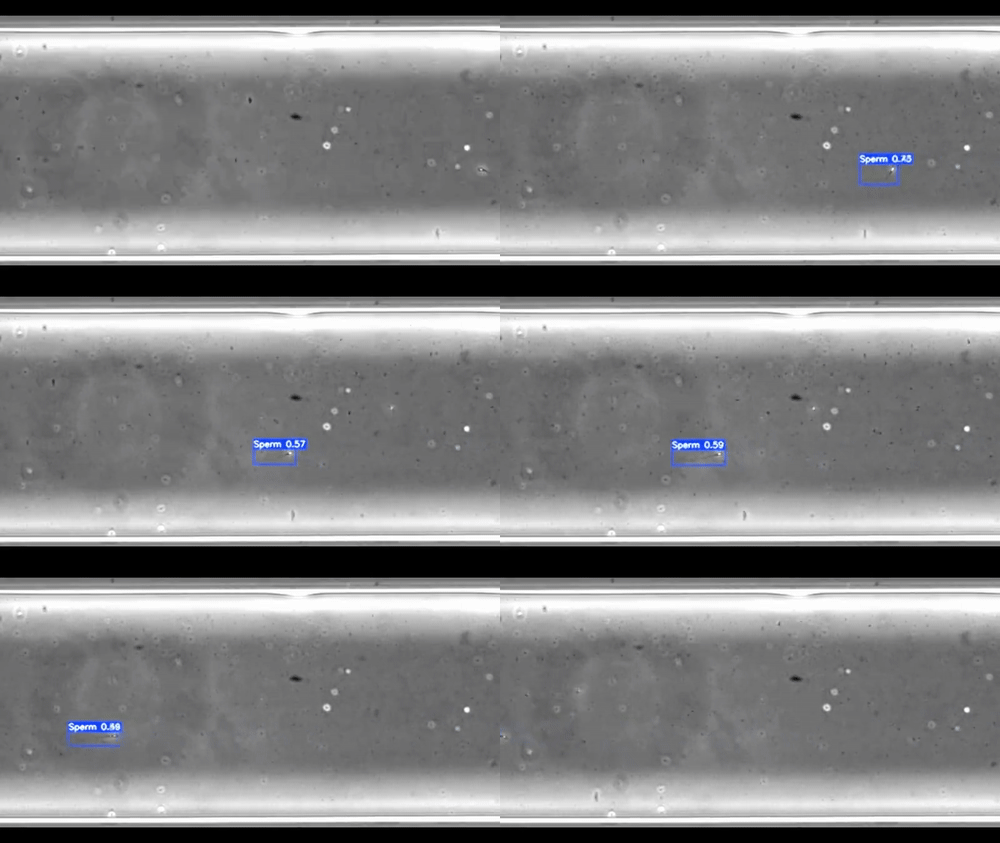
Once the AI successfully locates the sperm, the system can immediately isolate it in a small droplet culture medium, preparing for artificial fertilization. In this couple’s case, the AI identified three hidden sperm cells from the sample and successfully completed the fertilization and pregnancy process, setting a historic milestone as the first successful pregnancy achieved through the STAR method.
Dr. Zev Williams, director of the Columbia University Fertility Center, said that developing the STAR method took five years, during which countless experiments and optimizations were conducted, precisely to address the difficulty traditional detection techniques faced in identifying extremely small numbers of sperm. According to data he shared, in certain samples, even experienced lab technicians could not find sperm after spending two days, yet the STAR method was able to identify up to 44 sperm within one hour.
“When we first used the STAR method to identify sperm invisible to the naked eye, I knew this would change medicine,” Williams said.
Currently, the STAR method is only offered at Columbia University’s fertility treatment center, with a cost of approximately $3,000 (equivalent to about NT$90,000). Although it is not yet widely available, Dr. Williams has stated that he will publish the research findings on this technique, hoping that more fertility centers will adopt it in the future to benefit patients worldwide.
The application of AI in male infertility treatment is not new. A research team at the University of British Columbia in Canada is also developing a similar AI model to automate the sperm search process. Dr. Sevan Helo of the university noted: “What AI does best is learning, especially visual recognition tasks. We can feed it large amounts of sperm image data to help it understand shape, movement patterns, and other characteristics. Ultimately, it will be able to quickly and accurately lock onto the targets we need in cluttered images.”
This combination of deep learning technology with microscope image recognition not only improves accuracy but also significantly reduces analysis time, transforming what was once a tedious and not always successful manual analysis process into a highly efficient, minimally invasive AI-assisted workflow, bringing a ray of hope to patients with azoospermia.
Source: KOCPC Chinese