


Recently, Google officially released its latest lightweight multimodal AI model, “Gemma 3n,” a new AI model that combines high performance, low resource requirements, and open-source flexibility, while also publishing the technical details and benchmark data. Gemma 3n first appeared as an early preview version in May 2025, characterized by its extremely small model size and multimodal support, enabling it to run locally on devices with limited memory resources, such as smartphones.We have also written usage tutorials.yet still retains remarkable language understanding and generation capabilities. Now, the official version of the model has been formally released, not only building on the technical foundation of the preview version but also further optimizing performance.
Google officially launched “Gemma 3n,” a lightweight multimodal AI model that runs on mobile devices.
Google’s flagship AI series, Gemini, has drawn significant attention for its exceptional reasoning and generation capabilities. However, due to its massive parameter count, Gemini can only be accessed through Google’s own applications or API, and it does not offer downloads of the original model weights or support for customized applications. While this closed approach safeguards quality control and the business model, it imposes considerable restrictions on researchers and developers who require greater freedom.
In contrast, the Gemma series has adhered to an open-weights development philosophy since its inception. Whether for cloud applications, edge devices, or academic research, developers can freely download the models and deploy them across various platforms, greatly accelerating innovation within the community. The Gemma name is inspired by the combination of “Gemini” and “open model,” emphasizing accessibility, openness, and ease of use—delivering excellent performance while pursuing low resource consumption and high compatibility. As for the newly released Gemma 3n, its main highlights are a model size of just a few GB with multimodal support, enabling on-device local operation on mobile phones.
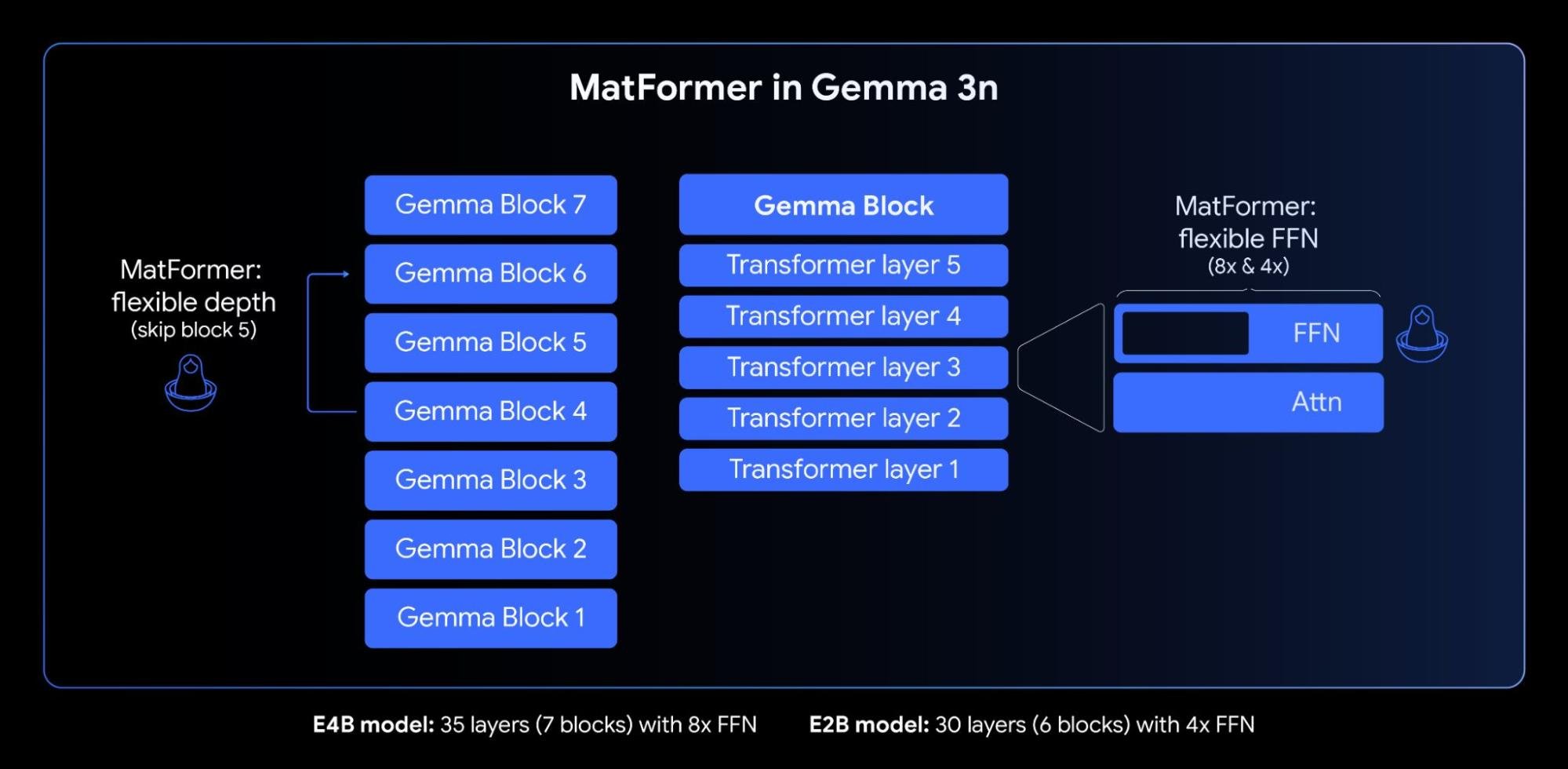
Gemma 3n adopts Google’s self-designed “MatFormer” architecture. The innovation of this architecture lies in a nested model training approach. Google likens it to a “Russian doll”: embedding an independently functioning smaller version within the larger model. Take the flagship model released this time, “Gemma 3n E4BFor instance, it simultaneously optimized a smaller sub-model, Gemma 3n E2B, during training. The two share architecture and knowledge, but models of different sizes can be deployed depending on the use case and device resources, greatly improving flexibility and scalability.
To enable AI to run locally on smartphones or other low-resource devices, Google has introduced an innovative technology called “Per-Layer Embeddings (PLE).” This method significantly reduces the amount of data that needs to be loaded during model execution, allowing Gemma 3n E2B to have actual memory consumption comparable to that of a traditional 2-billion-parameter model, despite having as many as 5 billion parameters.
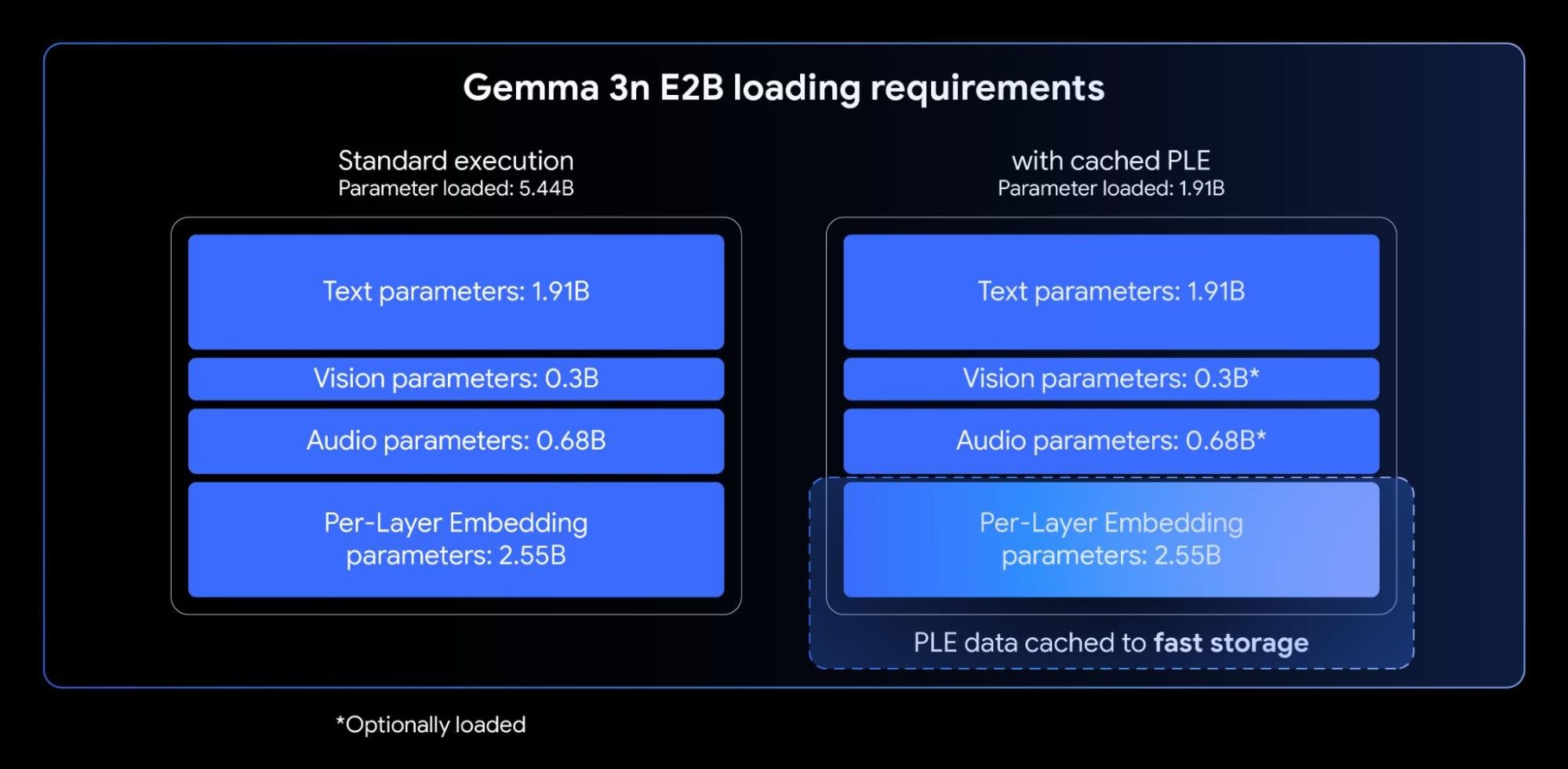
This enables E2B to run on just 2GB of memory, while E4B (8 billion parameters) runs smoothly on 3GB. This is undoubtedly a major breakthrough for embedded devices that require efficient deployment.
Its performance is not to be underestimated, surpassing multiple commercial models.
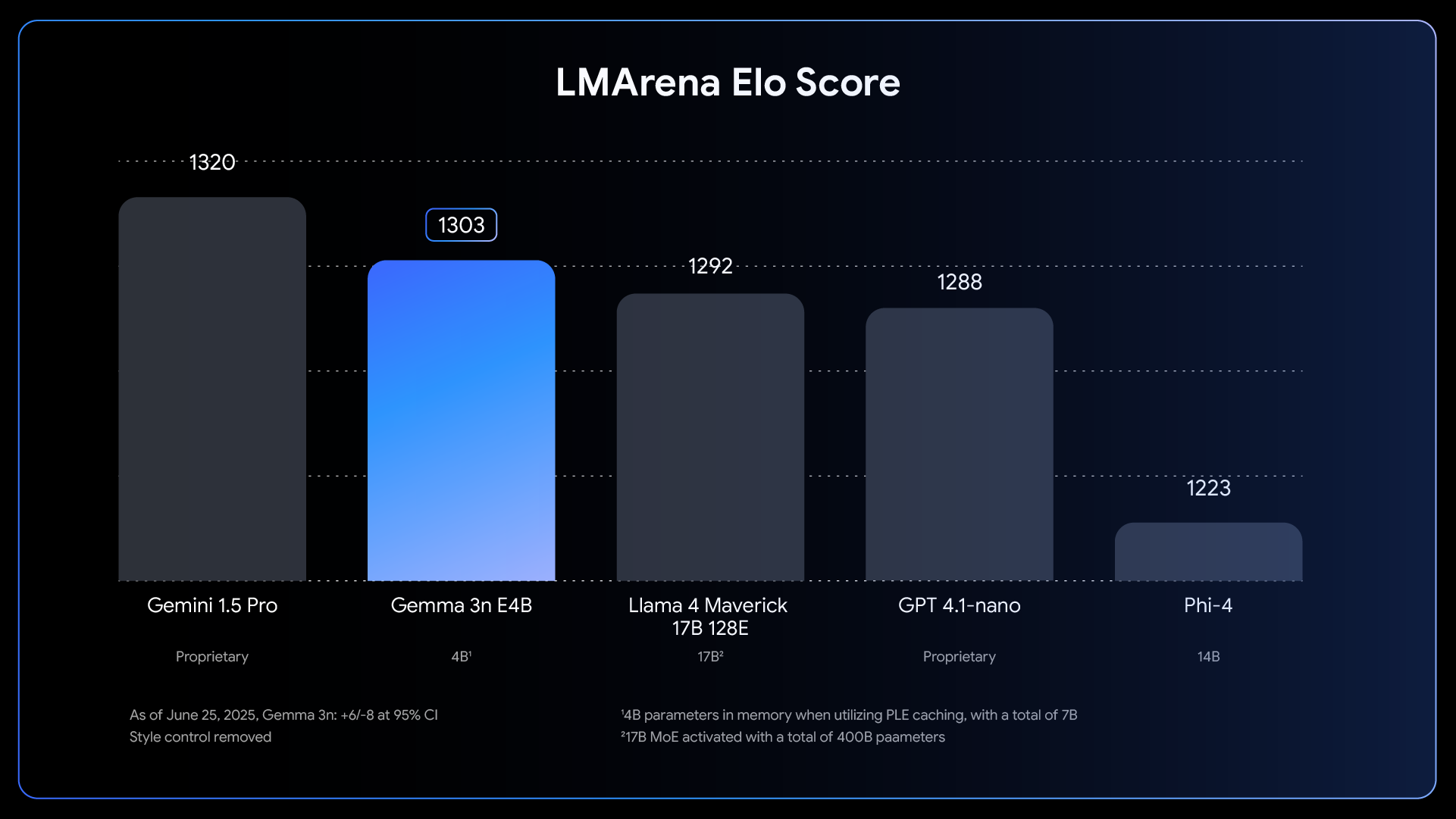
Google officially released a benchmark comparing Gemma 3n E4B against several mainstream AI models. The results show that Gemma 3n E4B not only outperforms open-source models such as “Llama 4 Maverick 17B-128E” and “Phi-4” in chat tasks, but also surpasses OpenAI’s commercial model “GPT-4.1-nano.”
Supports multimodal input with extremely high platform compatibility.
Gemma 3n not only supports text-only input, but also has the ability to process multimodal inputs such as images, audio, and even video, providing a foundation for developing more diverse application scenarios.
Additionally, it can run on multiple mainstream program execution platforms, including:
-
Hugging Face Transformers
-
llama.cpp
-
Google AI Edge
-
Ollama
-
Apple’s MLX framework
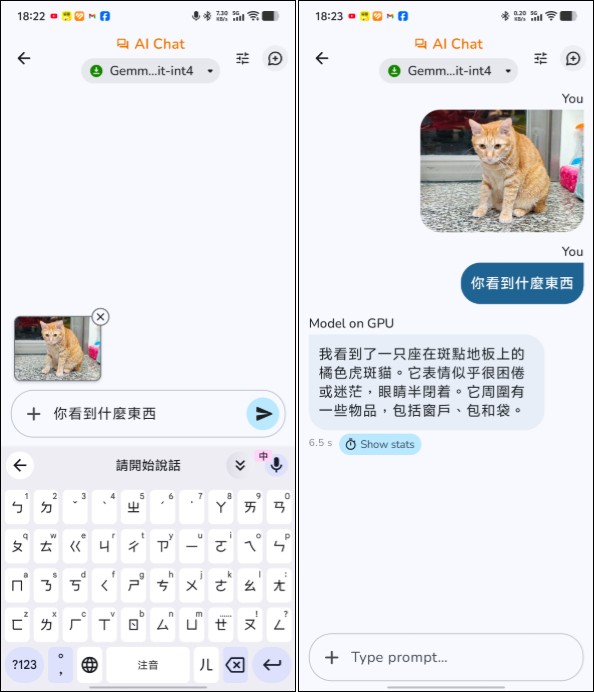
Even more surprisingly, Gemma 3n has been integrated into Google’s smartphone AI platform, “Google AI Edge Gallery“” can be run and tested locally directly on Android devices. After testing, the editor found the model’s chat experience on Pixel devices smooth and natural, showing potential as a “portable AI assistant” (though I personally couldn’t detect the audio and image analysis capabilities).
Abundant development and testing resources lower the barrier to entry.
In addition to making model weights openly downloadable, Google has also released a range of tools to support the development and deployment of Gemma 3n. Developers can use “Google AI Studio” to quickly conduct online chat testing and verify model performance without having to set up their own inference servers, significantly lowering the barrier to experimentation and prototype development. Furthermore, the source code and documentation for Gemma 3n are publicly available on Hugging Face and the Google Developers Blog, providing clear API interfaces and training guides. The official version of Gemma 3n is now available throughHugging FaceAndKaggleFor those interested, you can download and test it directly by following our previous tutorial.
Try Gemma 3n on Google AI Studio
Source: KOCPC Chinese