


Not surprisingly,OpenAI launch GPT-5.4 flagship modelShortly after, the smaller model versions, GPT-5.4 mini and GPT-5.4 nano, also debuted. As with previous generations, their positioning is “faster and more efficient” and “smallest and cheapest” respectively, designed for use cases requiring large-scale, high-speed processing. Compared to the previous generation, not only is the speed 2x faster, but this time around, significant improvements have been made in coding, tool calling, and computer operation capabilities. In particular, computer operation has approached human-level performance, with test data only lagging behind GPT-5.4 less than 3%
Image source: OpenAI
OpenAI releases GPT-5.4 mini and nano — smaller, faster, cheaper, and available to free users too
GPT-5.4 mini is OpenAI’s most powerful compact model to date. It shows significant improvements over the previous GPT-5 mini across four key areas: coding, reasoning, multimodal understanding, and tool use, with speeds more than twice as fast. For everyday use, you’ll notice snappier responses and answer quality that’s closer to the GPT-5.4 flagship model. GPT-5.4 mini also performs well on common tasks like coding, debugging, and understanding image content.
GPT-5.4 nano is the smallest and most cost-effective model in the GPT-5.4 series, ideal for developers who need to make high-volume API calls, such as for data classification, extracting specific fields, ranking and sorting, or serving as a “small helper” within AI agent systems to handle simpler sub-tasks.
Let’s look directly at the test data shared by OpenAI. Below are just a few key highlights; for the complete tests, please refer to OpenAI official websitereading class
- In the SWE-Bench Pro benchmark for code repair capabilities, GPT-5.4 mini achieved 54.4%, compared to 45.7% for the previous generation GPT-5 mini, while the flagship GPT-5.4 reached 57.7%—meaning the mini version is already very close to flagship-level performance. GPT-5.4 nano also performed impressively, scoring 52.4%.
- On GPQA Diamond (Scientific Reasoning), GPT-5.4 mini scored 88.0%, showing considerable improvement over GPT-5 mini’s 81.6%, and GPT-5.4 nano also slightly led with a result of 82.8%.
- The OSWorld-Verified (desktop computer operation) test is most impressive. GPT-5.4 mini reaches 72.1%, not only significantly ahead of GPT-5 mini’s 42%, but also very close to the GPT-5.4 flagship at 75.0%, approaching the human baseline of 72.4%. GPT-5.4 nano, however, is still not there yet at only 39%.
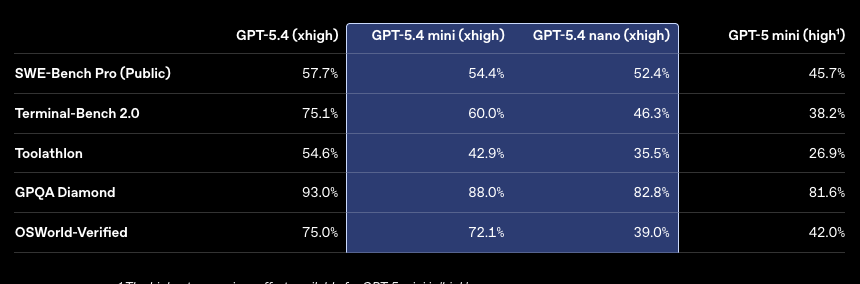
Image source: OpenAI
The chart below shows the accuracy vs. latency and cost comparison of various models in SWE-Bench Pro software testing. GPT-5.4 mini not only significantly outperforms its predecessor GPT-5 mini in accuracy, but also has lower latency and lower cost, approaching the performance of GPT-5.4. As for GPT-5.4 nano, although its overall accuracy is lower than mini, it still significantly outperforms GPT-5 mini and is also cheaper, making it very suitable for handling large volumes of simpler programming assistance tasks:
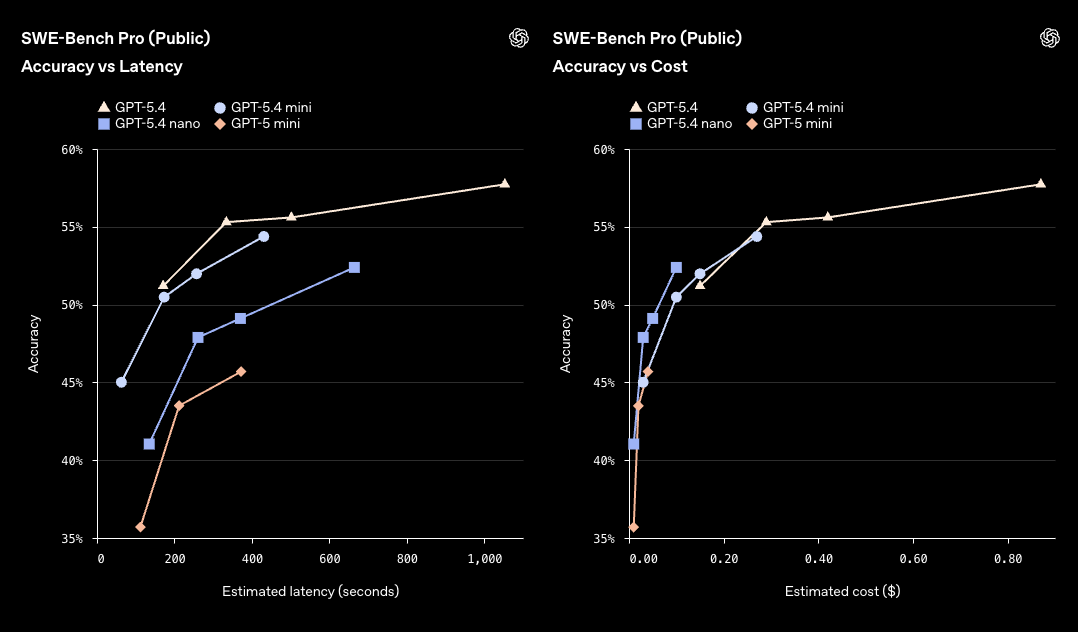
Image source: OpenAI
The figure below shows a comparison with competitors. GPT-5.4 mini versus Claude Haiku 4.5 and Gemini 3 Flash demonstrates significantly more comprehensive overall performance. In programming-related tests, it achieved 60.0%, higher than Haiku 4.5’s 41.0% and also higher than Gemini 3 Flash’s 47.6%. Computer operation mini at 72.1% also significantly leads Haiku 4.5’s 50.7%. Tool calling MCP Atlas shows mini at 57.7%, nearly tied with Gemini 3 Flash’s 57.4%. Although GPT-5.4 nano is positioned as more affordable, it remains competitive in most benchmarks, with solid scores like 56.1% for MCP Atlas and 82.8% for GPQA Diamond.
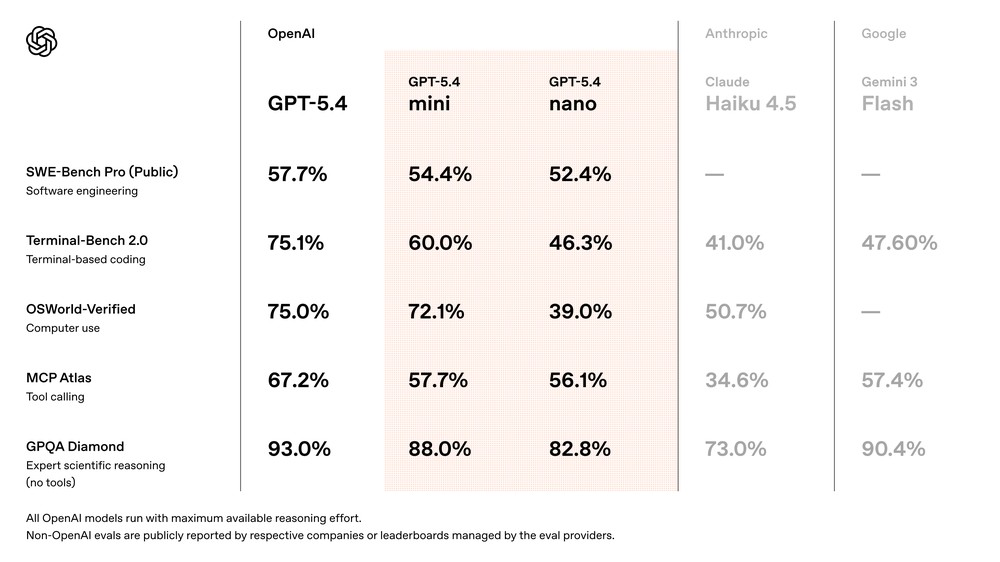
Image source: OpenAI
GPT-5.4 mini is now live, available to ChatGPT free users and Go plan subscribers through the “Thinking” option in the + menu. For Plus and Pro paid users, the system will automatically switch to the mini version as a fallback when GPT-5.4 Thinking hits rate limits. It’s also available within Codex and the Developer API.
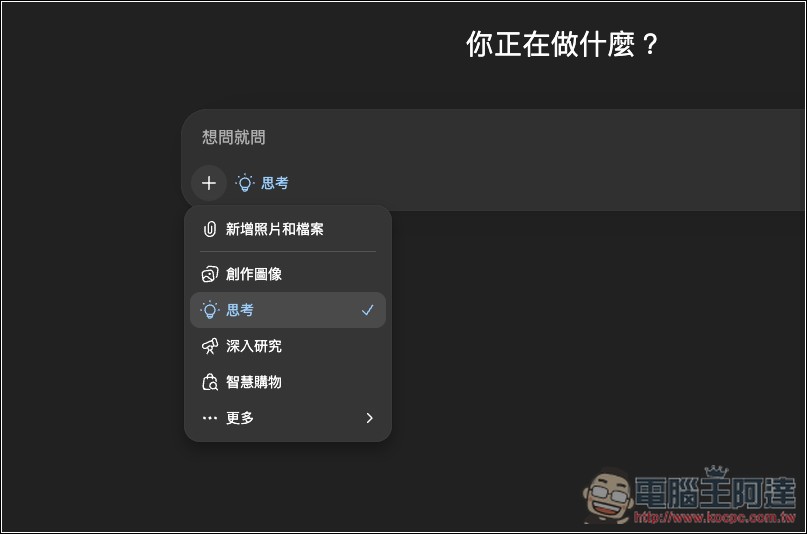
GPT-5.4 nano will only be available via API access and will not appear in the ChatGPT chat interface. As for API pricing, GPT-5.4 mini is priced at $0.75 per million input tokens and $4.50 for output; nano is even cheaper at just $0.20 for input and $1.25 for output.
However, it’s worth noting that the prices have indeed increased compared to the previous generation. GPT-5 mini was $0.25 per million input tokens and $2.00 per million output tokens, while GPT-5 nano was $0.05 per million input tokens and $0.40 per million output tokens. That translates to roughly 2 to 3 times the price increase for the mini version and roughly 3 to 4 times for the nano version. As for whether it’s worth it, that depends on whether the performance improvements can justify the price difference.
Source: KOCPC Chinese