


We’ve heard a lot of news about graphics card prices soaring, but it has only been information about some graphics cards, so many people must be wondering: Have the vast majority really risen this sharply? How much more expensive are they now compared with when they first launched? Foreign media TechSpot’s latest graphics card price survey gives a very detailed answer, and it also provides the average of the lowest prices in 10 countries, so it is very useful as a reference. In short, graphics cards are currently on average 44% higher than their launch MSRP, and in the US and Canada that figure reaches 58%.
This survey covered 14 mainstream graphics cards from NVIDIA, AMD, and Intel, and not a single one could be bought at its MSRP—not even Intel’s.
Image source: TechSpot
Comparison of NVIDIA, AMD, and Intel graphics card launch MSRPs and latest prices
TechSpot Earlier, the Q4 2026 Graphics Card Price Update Report was released, surveying 10 countries—the United States, Australia, Germany, the United Kingdom, Canada, India, the Philippines, Brazil, Poland, and the Netherlands—and compiling the lowest in-stock prices in each location in October 2026, then comparing them with launch MSRPs. The global price increase is calculated by converting the USD suggested price into each country’s local tax-inclusive price before comparison, which is fairer than using exchange rates directly.
However, note that the table lists the cheapest model in each region, so these are usually base models. If you want a high-end custom card like the ROG Strix, it will definitely cost more than this in practice.
| graphics card | Launch MSRP | U.S. current price | U.S. gains | Global gains |
|---|---|---|---|---|
| RTX 5050 | $249 | $420 | +69% | +41% |
| RTX 5060 | $299 | $450 | +51% | +40% |
| RTX 5060 Ti 8GB | $379 | $530 | +40% | +24% |
| RTX 5060 Ti 16GB | $429 | $790 | +84% | +69% |
| RTX 5070 | $549 | $900 | +64% | +48% |
| RTX 5070 Ti | $749 | $1,250 | +67% | +60% |
| RTX 5080 | $999 | $2,200 | +120% | +77% |
| RTX 5090 | $1,999 | $9,400 | +370% | +262% |
| RX 9060 XT 8GB | $299 | $500 | +67% | +46% |
| RX 9060 XT 16GB | $349 | $620 | +78% | +58% |
| RX 9070 | $549 | $700 | +28% | +28% |
| RX 9070 XT | $599 | $870 | +45% | +36% |
| Arc B570 | $219 | $290 | +32% | Not counted |
| Arc B580 | $249 | $350 | +41% | +47% |
Source: TechSpot, lowest in-stock prices by region in October 2026; Arc B570 was not included in the global price increase due to stock shortages in multiple countries.
As can be clearly seen from the table above, even the entry-level models are at least 40% more expensive.
Looking at global price increases, the RTX 5050 launched at $249 and has now risen 41%. The RTX 5060 has risen 40% from $299 and now costs about $420, already exceeding the $379 suggested retail price of the RTX 5060 Ti 8GB. AMD’s RX 9060 XT 8GB has also risen 46%, and buying it now costs nearly $140 more than at launch.
16GB mid-range cards are something of a disaster zone.
For the RTX 5060 Ti, the 8GB version has risen only 24% globally, making it the NVIDIA graphics card model closest to its suggested retail price. However, the 16GB version has risen by as much as 69%, from $429 to an average of about $727, nearly $300 more than at launch. The RX 9060 XT 16GB also rose from $349 to about $550 (+58%), but in various countries it is still 20%–40% cheaper than the RTX 5060 Ti 16GB, remaining the best-value choice for getting a 16GB graphics card.
Although NVIDIA’s RTX 5070 series rose by 50–60%, comparable AMD graphics cards were relatively moderate: the RTX 5070 rose from $549 to about $814 (+48%). The RTX 5070 Ti also rose by 60%, averaging about $450 more than at launch. AMD’s comparable RX 9070 and RX 9070 XT rose only 28% and 36%, respectively, about $155 and $216 more, making them the models with relatively smaller price increases in this survey.
Because of this, the RX 9070 XT’s current average price is roughly on par with the RTX 5070, while the RTX 5070 Ti costs about 47% more:
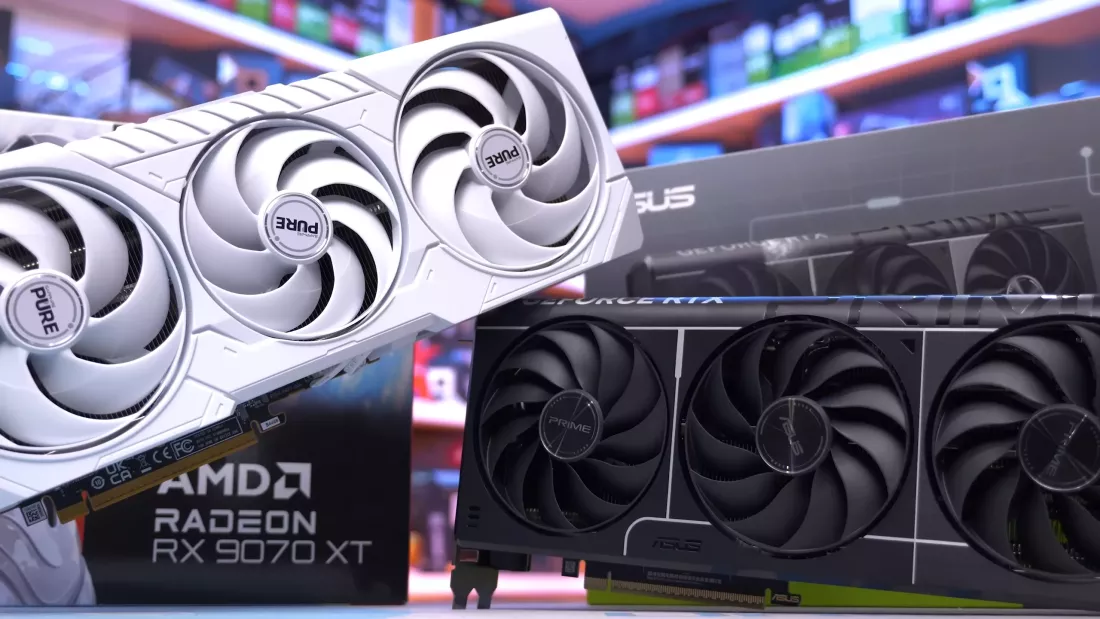
Image source: TechSpot
High-end cards are completely out of control. The RTX 5080 launched at $999, the global average has risen 77%, the lowest price in the US is already $2,200, more than double. The RTX 5090 has a suggested price of $1,999, averages about $7,240 across 10 countries (+262%), and the lowest US price is $9,400:
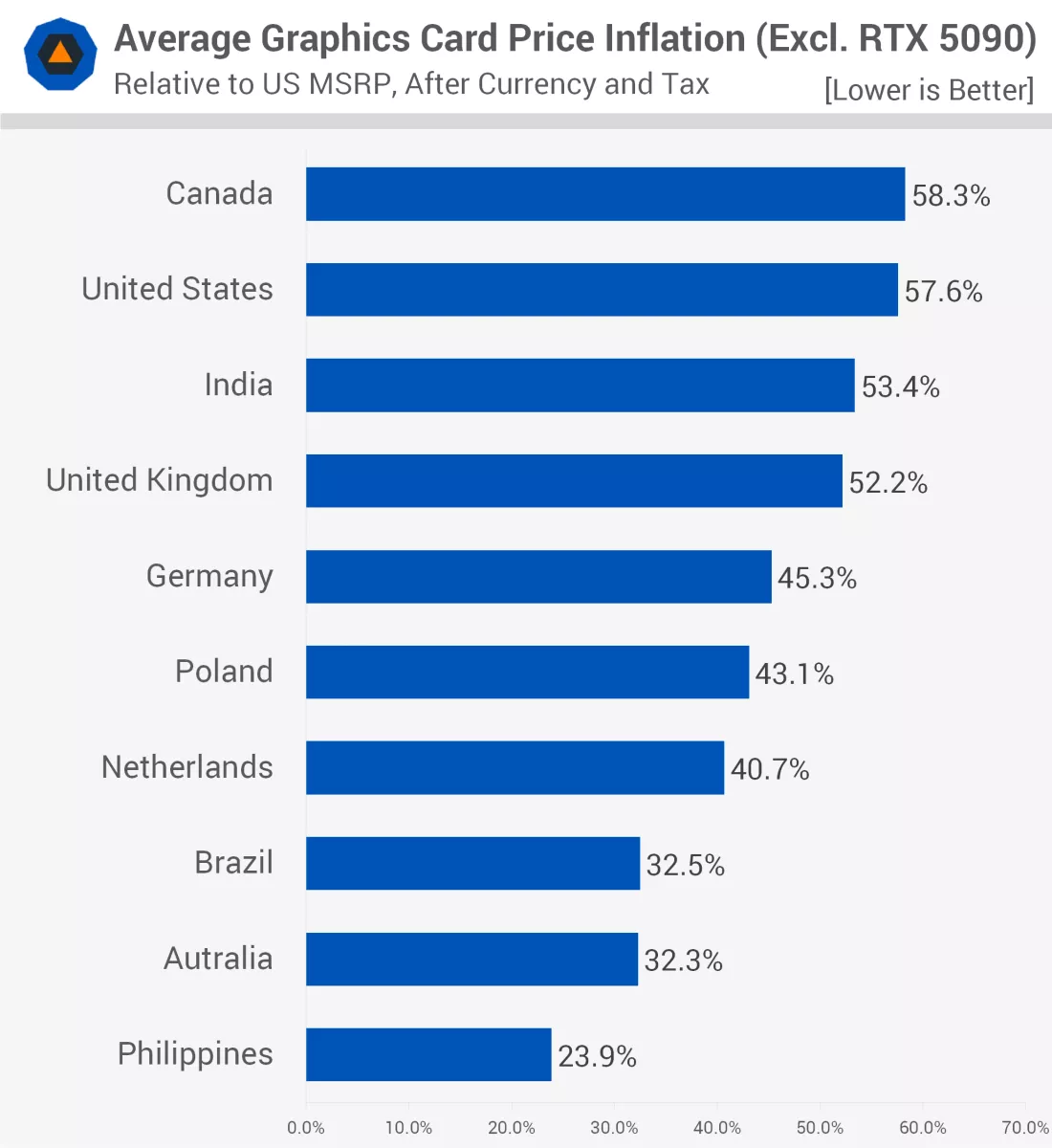
Image source: TechSpot
Intel didn’t escape either. The Arc B580 launched at $249, and its global average price has risen 47%; after excluding the anomalous increase in the UK, it is about $90 more expensive. There is no global figure for the Arc B570 because it is out of stock in multiple countries, but in the U.S. it is 32% above the suggested retail price.
It is worth noting that a large portion of these increases has accumulated only recently. TechSpot points out that graphics card prices were relatively stable in the first half of the year, but rose about 15% in August, about 7% in September, and about 11% in October—a cumulative increase of about 35% over the three months.
As for how prices will move next? According to what TechSpot heard from retailers, the wholesale price of the RTX 5080 has risen noticeably in recent weeks, and retail prices will be raised further. Therefore, current prices in the US are likely to be what other regions see next. At this rate, it looks unlikely that this generation of graphics cards will return to their launch MSRP.
Source: KOCPC Chinese