


Google’s new-generation Gemini 4 series models have finally shown promising capabilities, though experiencing top-tier performance still requires getting past a high subscription barrier. However, Google is still the Google we know, and with product naming it has once again delivered a baffling “chemistry lesson”: faced with Argon, Carbon, Hydrogen, and Neon, which one is actually the true flagship model?
Gemini 4 has made a huge leap in capability, but among Argon, Carbon, Hydrogen, and Neon, which one is actually the flagship?
Just looking at these four chemical element names, users have no way to tell which one came first, which one computes the fastest, or which one to choose for everyday work. In this era of efficiency, no one has time to read word for word the lengthy technical blog posts Google writes for each model just to understand basic product positioning.
All four elements are present at once, yet there is no clear logic to their arrangement.
These four models, named after chemical elements, together form Google’s next-generation Gemini 4 lineup. If we lay out the timeline, their launch sequence is actually quite compressed:
- Argon: the first model in the series, it debuted on September 30 and expanded access on October 13. At the time, it was positioned as Google’s frontline flagship for competing with the latest technology from Anthropic and OpenAI.
- Carbon (碳): widely rolled out starting November 10.
- Hydrogen (氫): widely rolled out starting November 12.
- Neon: Widely rolled out starting November 18.
In terms of release order, Neon is the newest member, but Google recommends assigning complex projects to Carbon, which was released earlier; meanwhile, Hydrogen, which debuted two days after Carbon, is positioned as lightweight and highly efficient.
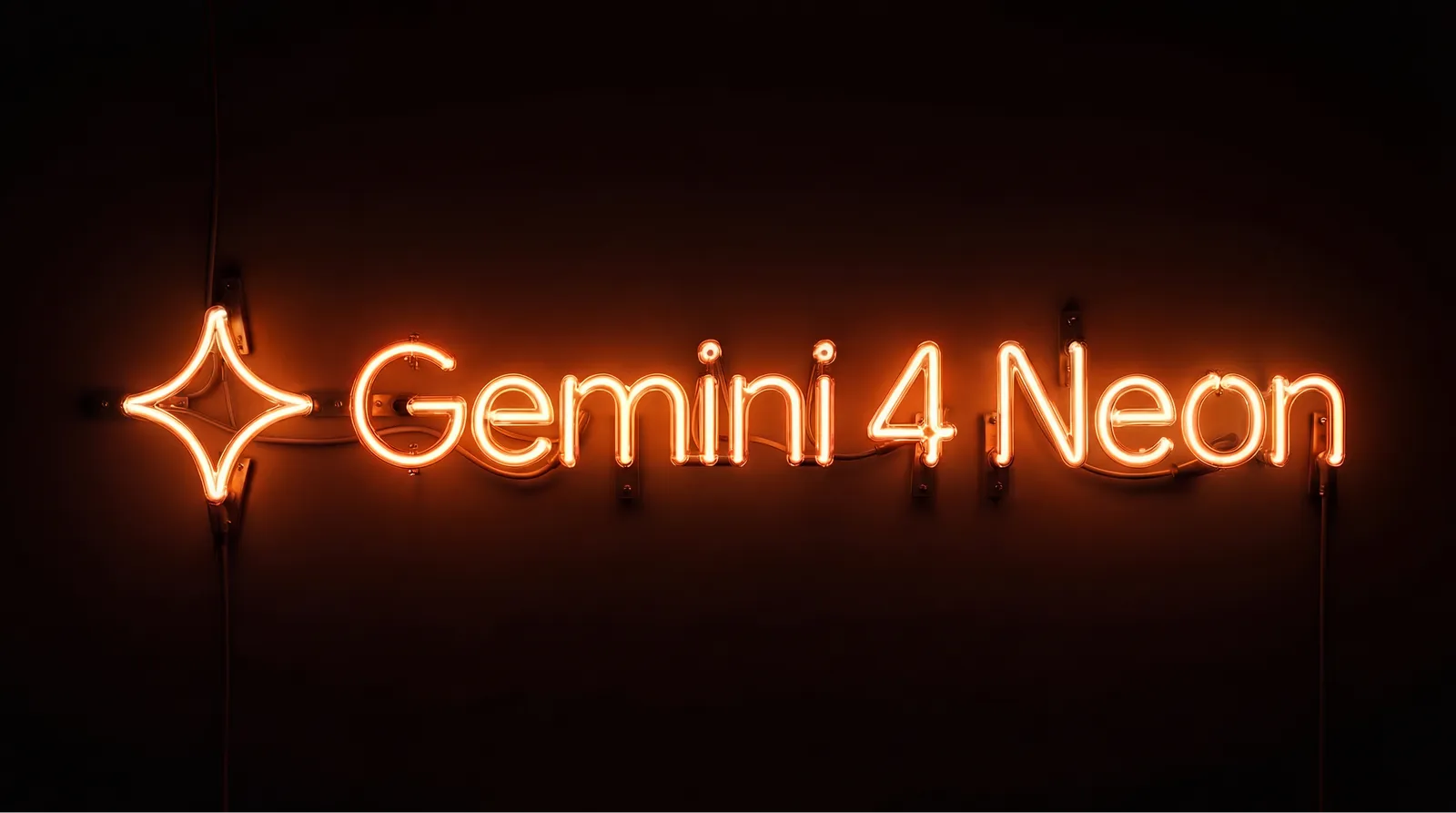
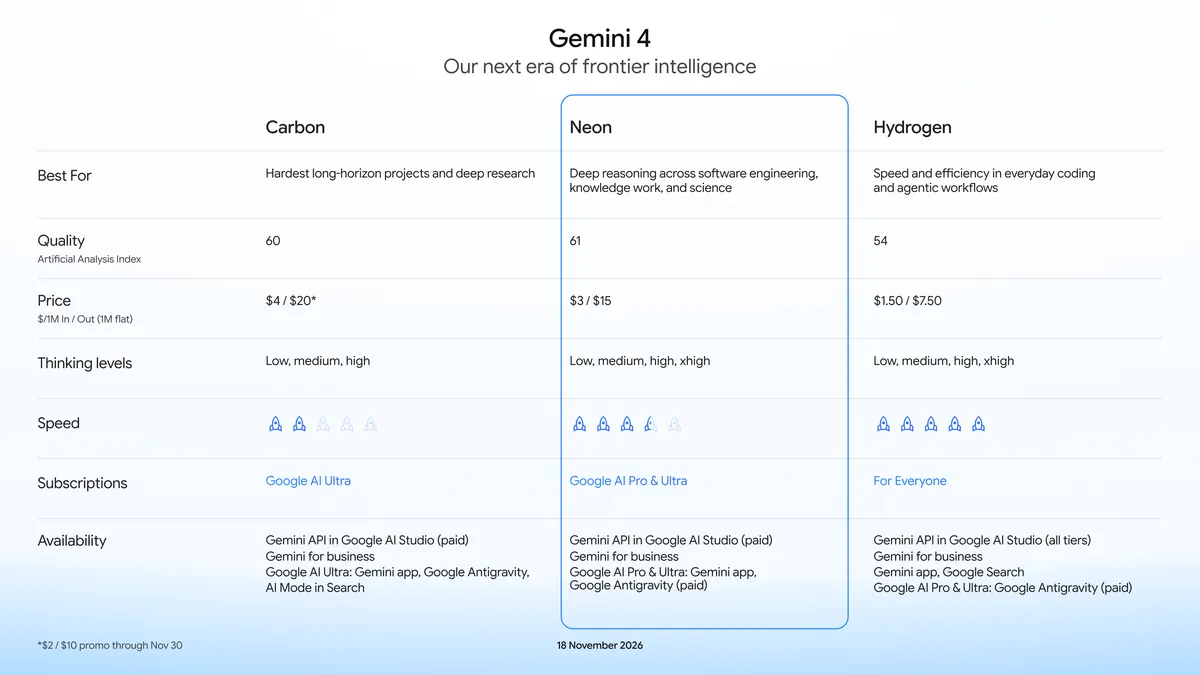
After some careful sorting, we can finally sketch a clearer positioning outline for these three models:
- Hydrogen (氫): Focuses on ultimate speed and efficiency, ideal for quickly handling everyday trivial tasks.
- Neon: Positioned between Hydrogen and Carbon, it is the preferred choice for advanced everyday applications. It is deeply integrated into the Gemini app and can handle writing, document analysis, and topic research.
- Carbon (碳): Built for the most demanding tasks, suited to complex scientific and software engineering projects that require extended deep research and repeated verification.
So the question is: what exactly is Argon, the first to appear, now?
Where Neon sits in the Gemini model family ⬇️ Neon is built for complex coding, analytical reasoning, and production-grade enterprise workflows. While Carbon tackles your hardest, long-horizon projects and Hydrogen handles fast everyday execution, Neon balances depth and efficiency. Swipe through for a quick breakdown.
— Google (@Google) November 23, 2026
The Vanishing “Former Flagship”: Argon’s Awkward Predicament
As the trailblazer of the Gemini 4 series, even after Carbon was officially released on November 10, Google initially still recommended Argon for most software engineering and knowledge-intensive work. However, in the subsequent official lineup description, Google put the spotlight entirely on Carbon, Neon, and Hydrogen, deliberately omitting Argon. Even more subtle was the benchmark performance. In the “High Thinking” test of the Artificial Analysis Intelligence Index (AII), even Hydrogen, which emphasizes speed, scored 51, whereas Argon scored only 50, making its “flagship model” aura seem especially blurred.
Fortunately, users will soon no longer have to worry about this legacy issue. According to Google’s latest technical documentation, Argon will officially stop being supported on the Antigravity platform on November 30, 2026; at that point, when eligible users start a new conversation, the default model will be fully switched to Neon.
In short, Argon has completed its phase of frontier exploration, and now Carbon—which consumes more tokens and verifies more thoroughly—is taking over to tackle the toughest problems, while Neon serves as the everyday workhorse.
A paid subscription is just an admission ticket—platform differences are the real maze.
In the ChatGPT or Claude ecosystem, a paid subscription usually means “models are available immediately upon release.” But in Google’s world, figuring out “which model to use” is only the first step; next, you also have to deal with dual restrictions at the cross-platform and account levels:
- Access gap between the app and the development platform: Even if you are a paid Google AI Pro subscriber, you still cannot select Carbon in the standard Gemini app (that option is reserved only for Ultra users in the app; Pro users can only use Neon). It was not until November 23 that Google made Carbon available to paid Pro users on the Antigravity platform. In other words, the same paid account can access different models depending on the interface.
- Personal and enterprise versions are out of sync: As product lead Logan Kilpatrick confirmed that Gemini 4 Neon has officially arrived in Google Workspace, it also highlights the disconnect between personal accounts and enterprise work accounts in the timing of model rollouts.
- The Invisible Wall Between Trial and Paid Versions: In Antigravity, the free version and the promotional Pro trial not only have lower quotas, but the list of accessible models is also strictly limited.
The various intricate conditions make “choosing the Gemini plan that suits you” itself a highly challenging mental task.
Google has finally delivered the long-awaited report card for Gemini 4, and the model’s technical strength is beyond doubt. But next, Google urgently needs to establish a more intuitive naming logic and a unified permissions mechanism for this sprawling product line.
Users shouldn’t have to read through lengthy technical documentation, closely follow executives’ social media updates, or even build spreadsheets to compare subscription differences across platforms just to decide which model to use for the task at hand. As AI capabilities continue to push past previous limits, making the product lineup “simple and easy to understand” may be Google’s key next step to retain developers and everyday users.
Source: KOCPC Chinese