


Samsung actually turned down Musk? The Wall Street Journal (WSJ) reported on November 26, revealing this behind-the-scenes story: Musk first proposed a long-term memory procurement contract, then offered to provide a financing guarantee for Samsung’s new wafer fab. Both times, Lee Jae-yong shot him down with the same line: “Everyone is offering this condition—what can you do for us?” This also explains why Musk has been launching a barrage of attacks on Samsung on X since October: he has been nursing the grudge over being rejected for four months.
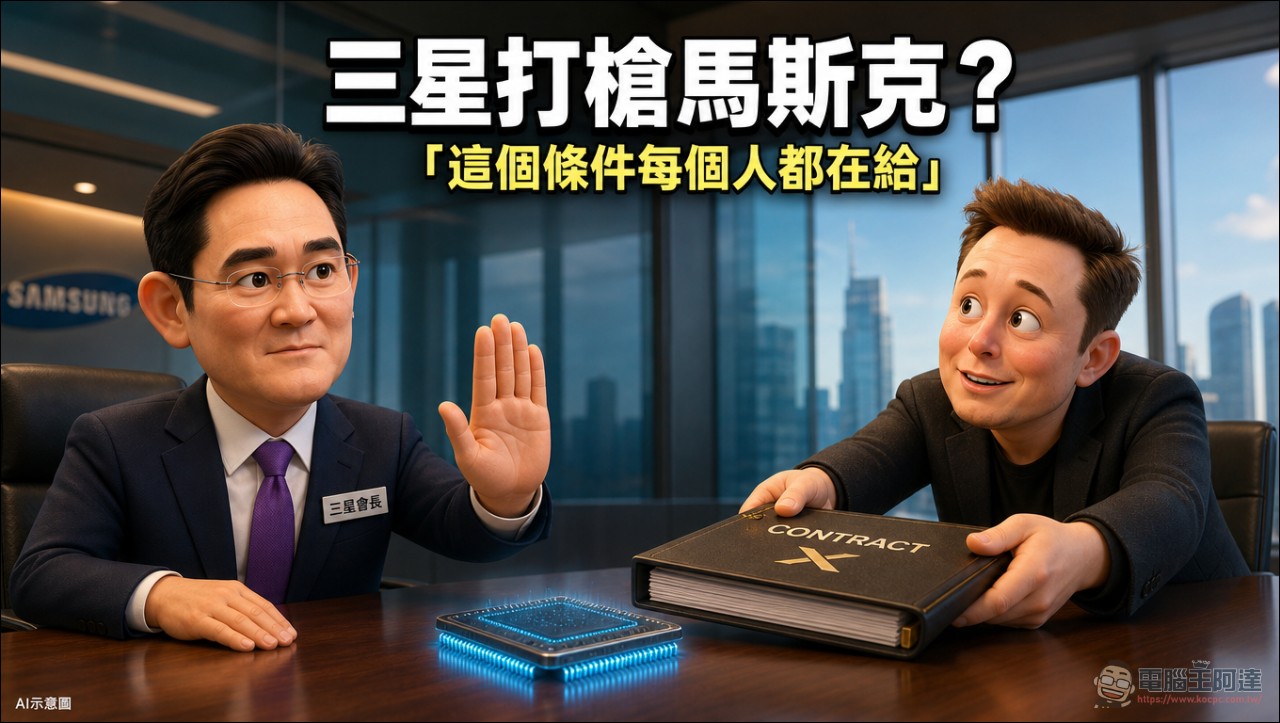
The June dialogue: Musk upped the ante twice, and Lee Jae-yong gave the same answer twice.
This exchange was recounted by Capital Group portfolio manager Carl Kawaja, who discussed Tesla’s memory chip procurement with Musk at a June meeting and later shared what he had heard; WSJ included it in its November 26 report on the memory shortage. At the time, Musk was exploring the path for Terafab, the wafer fab project jointly formed by his companies and SpaceX, and asked whether Samsung could sign a long-term memory procurement contract. Lee Jae-yong’s reply was: “We get that offer from everyone. What else can you do for us?”
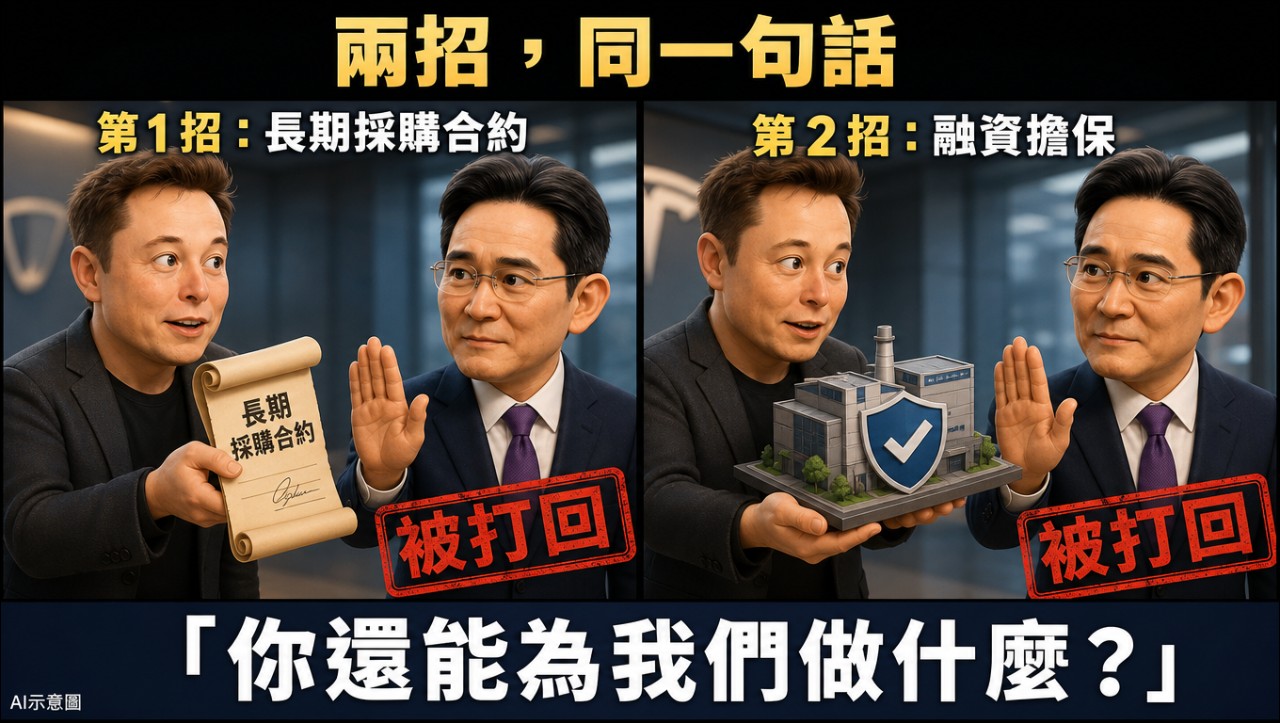
Musk then upped the ante: Then I’ll provide a financing guarantee for your new wafer fab. Lee Jae-yong repeated the same sentence. After the WSJ report was published, both Capital Group and Samsung declined to comment, and Tesla did not respond to a request for comment. However,This information is second-hand: Musk himself has not confirmed this conversation, and Kawaja’s setting was not a formal interview.。
Why Is Lee Jae-yong So Unyielding? The Standard Conditions of a Seller’s Market
Lee Jae-yong’s remark that “anyone can offer that” was not bluster. AI infrastructure investment has completely reversed memory supply and demand. The WSJ reported that some memory chips have risen 10-fold in a year, and global electronics CEOs are personally flying to South Korea to line up and snap up supply. Citi semiconductor analyst Peter Lee told the WSJ that the current contract norm is: contracts lasting up to 5 years, buyers prepaying 25% to 30% of the purchase price, and even sharing the construction costs of new fabs. In this market, long-term contracts plus financing guarantees are the ticket to entry, and Musk’s terms indeed did not exceed others’ quotes.
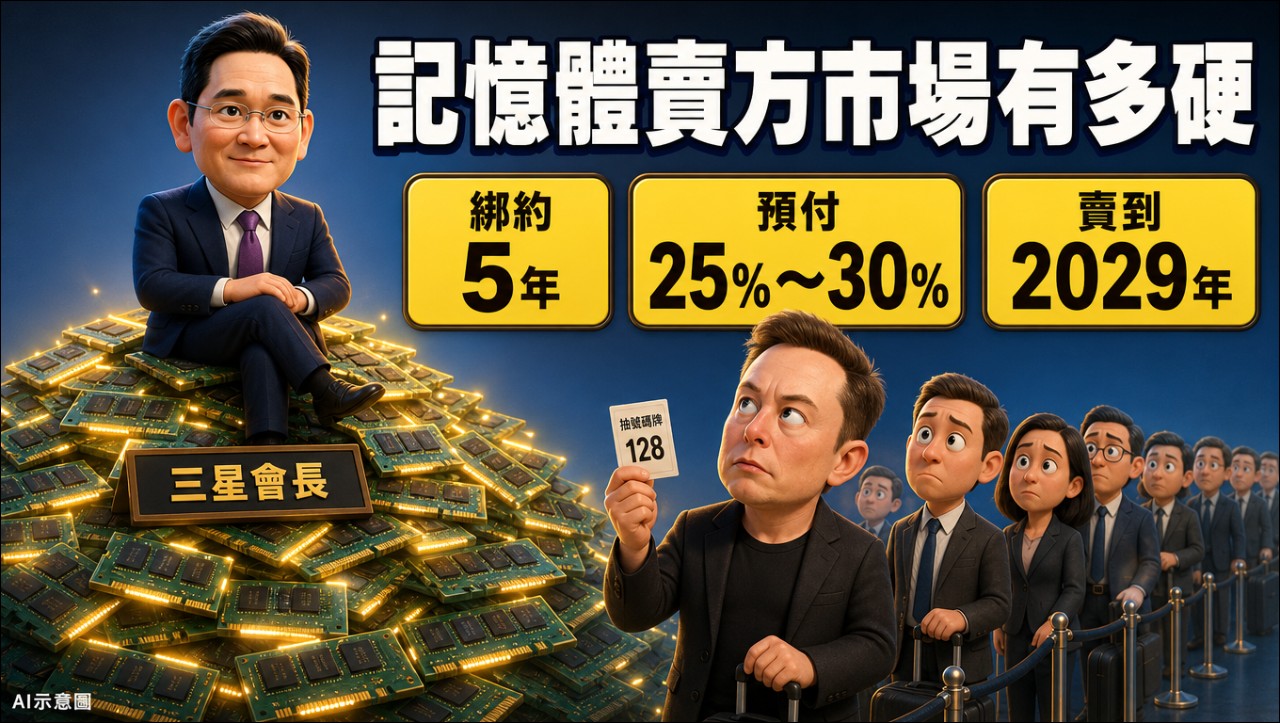
The supply side is even more firmly in control: SK Hynix’s DRAM (dynamic random-access memory) and HBM (high-bandwidth memory, a standard feature of AI chips) are already sold out through 2029, and Micron’s multi-year contract presales amount to at least US$150 billion (about NT$4.7 trillion). Gibson Chen, president of Taiwanese USB flash drive maker Apacer, told WSJ that the company borrowed money first to have cash ready: “As soon as chips show up, we take them. It’s crazy, but there’s no other way.” Priority access that even Musk can’t get—small manufacturers can only line up.
October offensive: praising Micron, blasting “price gouging,” and invoking the China threat
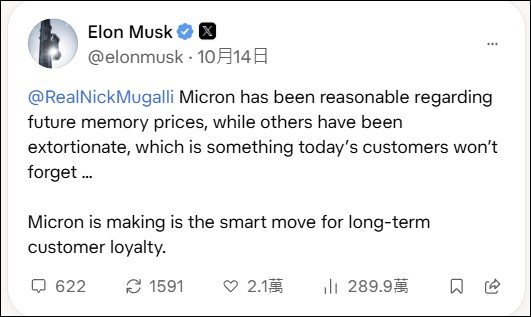
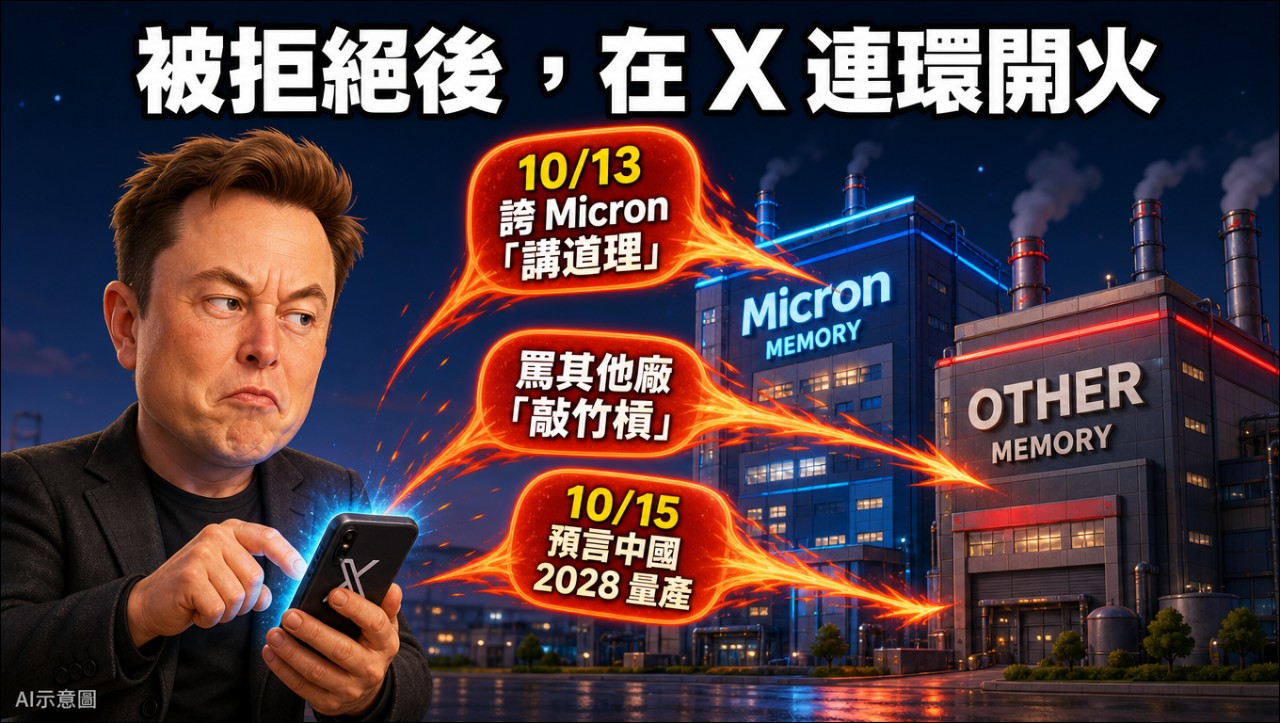
After being rejected, Musk’s public remarks changed tone. On October 13, he was on X PostHe praised Micron for being “fairly reasonable about future memory pricing,” while calling other manufacturers “extortionate” (rip-offs), and the industry unanimously interpreted the target as Samsung and SK Hynix. On October 15, he posted again predicting that China will mass-produce memory chips in 2028. South Korean industry observers interpreted this series of remarks as strategic pressure on memory suppliers: first set the public narrative that you are too expensive, then hint that alternatives are coming.
The China factor is not mere rhetoric: CXMT already captured about 10% of global DRAM revenue in Q2 2026, and its monthly capacity is expected to reach 500,000 to 600,000 wafers by the end of 2028, ranking third globally. South Korean experts estimate that the DRAM technology gap between China and South Korea is still 5 to 7 years; Musk used it as a bargaining chip, but Samsung ignored him.
Samsung’s grievances on its side: harsh contracts, audit rights, and talent poaching.
The friction between the two is mutual. On October 16, a South Korean semiconductor engineer with the handle @TTHUEONE posted on X that when Tesla signed the foundry contracts for the AI5 and AI6 chips, it imposed harsh conditions: it demanded access to information about Samsung’s internal fabs and even audit rights, while aggressively driving down prices. Terafab also poached a large number of employees from Samsung’s Taylor plant in Texas (very Musk-style).
생각할수록 열받네. 삼성 파운드리에 AI5,AI6 맡길 때는 TSMC가 자기들 요구를 안 들어줘서 넘어온 거면서, 온갖 거지 같은 계약 조건 다 요구하고, 특히 팹 내부 정보 제공이랑 Audit까지 요구하면서 가격도 겁나 후려쳐 놓고. 거기다 자기 팹 짓겠다고 삼성 오스틴 팹 현지 인력까지 대거 빼가고 있는 마당에, 정작 삼성 메모리에는 대놓고 저딴 식으로 말한다고? 진짜 어이가 없네.
— THEONE (@TTHUEONE) October 14, 2026
The site selection itself is already making Samsung uneasy. Terafab is a joint-venture wafer fab project between Tesla and SpaceX (with technical support from Intel), with the ultimate goal of producing 1 terawatt (TW) of AI compute per year; its first phase involves a US$16.8 billion investment (about NT$529 billion) in Grimes County, Texas. South Korea’s Business Post warned as early as March that Terafab’s site is only a 30-minute drive from Samsung’s Taylor fab, and that the two will compete for the same regional workforce and suppliers; the report also singled out Musk’s plan to set up a private office at Samsung’s Taylor fab, which could cause Samsung’s 2nm (2-nanometer) process manufacturing know-how to leak.
Ironically, Samsung is also one of Tesla’s most important chip partners. The Tesla AI5 chip has entered trial production at the Taylor plant, with mass production targeted for 2027 and compute specs of 2,000 to 2,500 TOPS; AI6 and AI6.5 are slated for Samsung’s and TSMC’s 2nm capacity, respectively. Musk claims AI5’s performance per watt is 2 to 3 times that of comparable Nvidia chips, without third-party verification. Cursing each other while still placing orders—this is the truest portrayal of their relationship.
What does this stalemate show: who needs whom?
The main thrust of this WSJ report is the impact of the memory shortage on the consumer side: Apple’s MacBook, Microsoft’s Xbox, and Amazon’s Echo Dot have all raised prices or cut specs, and the shortfall is expected to last until 2028; Apple, Microsoft, and Amazon have all adjusted end-product pricing as a result. Lee Jae-yong’s attitude toward Musk is best read in this context: when supply is tight, the seller does not need the buyer’s story. The long-term contracts and financing guarantees Musk can offer, Apple, Google, and Meta can each offer just as well; what Samsung’s memory business has never lacked is orders.
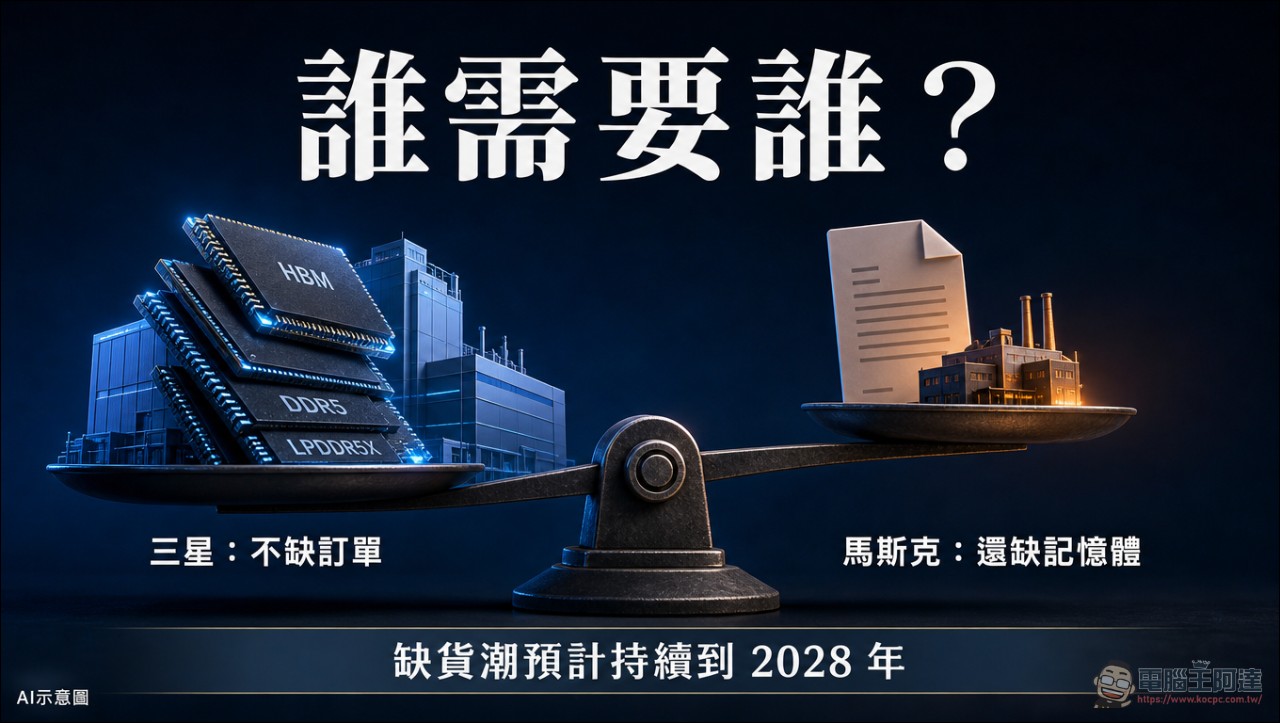
Conversely, Terafab’s situation is even more awkward. The plan aims to produce 1 terawatt of computing power annually, and reports estimate that memory demand alone would reach the level of 700,000 wafers per month, approaching more than half of Samsung’s entire DRAM capacity. With no existing fabs, no memory supply chain, and having poached people from Samsung, Terafab’s dependence on and threat to Samsung exist at the same time. The condition in Lee Jae-yong’s remark is clear: if you want me to prioritize supply, you have to offer something no one else has; and as of November, Musk still has not offered that something.
Three things to watch going forward: whether the mass-production schedule for Tesla’s AI5 at the Taylor plant will be affected by this round of friction; whether Musk’s prediction that China will mass-produce memory chips in 2028 comes true, which bears on Samsung’s bargaining position; and whether Terafab can find memory sources other than Samsung. But if Samsung is really going to be this tough on Musk, it had better pray that this memory upcycle truly lasts a long time. After all, as the saying goes, “The swaggering don’t last as long as the down-and-out.” Once memory prices fall, they can wipe out everything you have—though that will be relatively unlikely over the next two years…
Source:The Wall Street Journal
Source: KOCPC Chinese