


NVIDIA has long been the undisputed king of the GPU market. Its graphics cards are good, but it has always been stingy with VRAM: the RTX-5090, which currently costs 200,000, has only 32GB of VRAM. If you want more, you either pay extra for a PRO6000 (nearly 600,000) or wait for a modded version. Recently, Chinese GPU manufacturer Moore Threads’ next-generation gaming graphics card “Lushan” has been rumored to possibly come with 64GB of VRAM, twice that of NVIDIA’s RTX 5090 (32GB). If this figure is accurate, Lushan will become the consumer graphics card with the highest VRAM capacity in history. The official announcement is scheduled for the MDC 2026 developer conference on December 29–30.
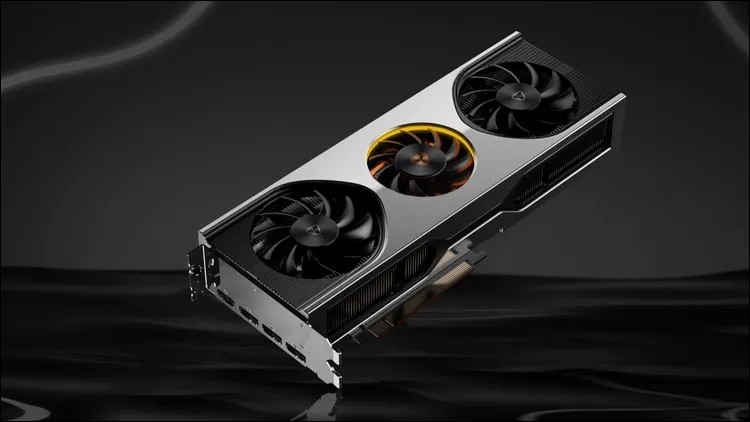
64GB is an estimate; it has never been officially confirmed.
The source of this news is not an official spec sheet. On November 18, AIR_FORCE, a product manager involved with the MTT S80, posted on Weibo and Bilibili that Lushan will feature “the largest memory capacity in the history of consumer graphics cards,” but did not give any numbers. Tom’s Hardware’s 64GB figure was derived from another old promise by Moore Threads: the company had previously claimed that Lushan’s VRAM capacity would be 4 times that of the MTT S80 (16GB GDDR6), and 16 times 4 is exactly 64.

VideoCardz notes that Moore Threads has not yet confirmed that the “4x” comparison applies directly to its upcoming consumer cards, nor has the company defined what it means by “consumer-grade” here: Lushan could be aimed primarily at gaming, or it could lean toward local AI or workstation use.
The teaser’s visual clues also remain vague. Moore Threads this week released the first poster for MDC 2026, showing a graphics card partially obscured by two mountain peaks—one formed from a 3D mesh and the other from a neural network. The post title directly includes the two characters “Lushan,” echoing the earlier statement that “Lushan products will launch before the end of the year.”

15x gaming, 50x ray tracing: all are the manufacturer’s own claims.
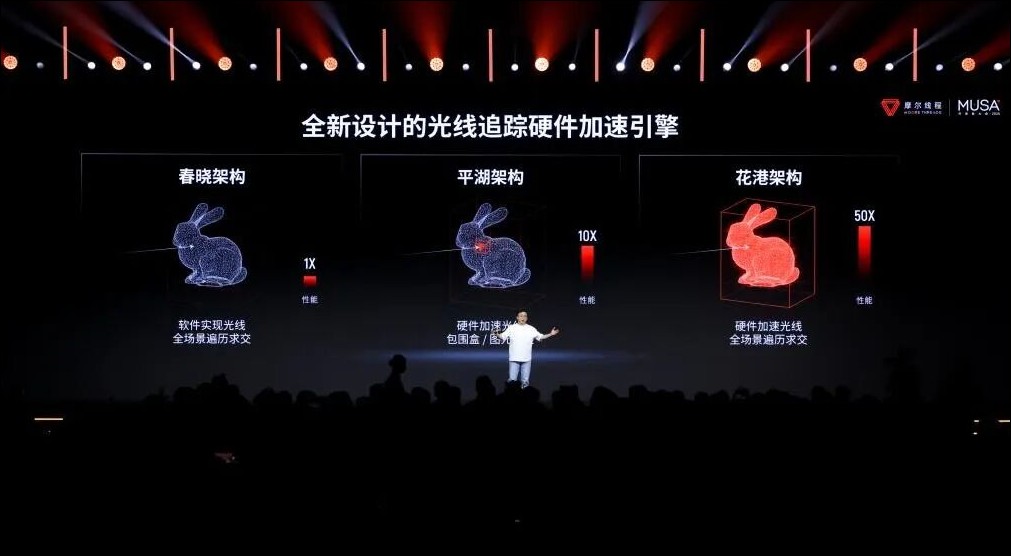
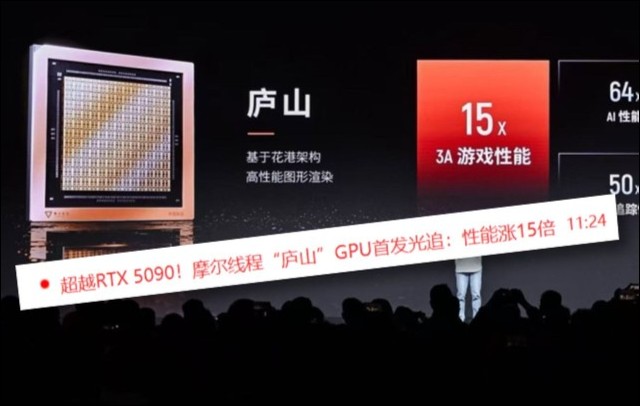
On performance, Moore Threads announced a set of figures comparing it with the S80 at the first MUSA Developer Conference in December 2025: 15x performance in AAA games, 50x in ray tracing, 64x in AI computing, and 16x in geometry processing. These are all one-sided vendor claims, and there are currently no independent tests.
In terms of technical details, Lushan adopts the “Huagang” architecture and is the mainstay chip of the architecture’s second generation, positioned for high-performance graphics rendering. The newly added hardware ray tracing engine makes it China’s first domestic GPU to support hardware real-time ray tracing, and it is fully compatible with DirectX 12 Ultimate; it also introduces the UniTE unified task rendering architecture and AI generative rendering technology. MyDrivers describes the latter as Moore Threads’ counterpart to NVIDIA DLSS and AMD FSR, covering image quality enhancement and multi-frame generation. The Huagang architecture itself claims a 50% increase in compute density over the previous generation and a 10x improvement in energy efficiency, and supports full-precision computing from FP4 to FP64.
The starting point was very low: back then, the S80 could only beat the GT 1030.
To understand the figure of 15x, you first have to look at how low the S80’s starting point was. The MTT S80 launched in November 2022 at RMB 2,999 (about US$410, NT$13,000), initially sold only bundled with ASUS motherboards; it has 16GB GDDR6, PCIe 5.0, and 255W power consumption. In early 2023 tests, the S80, whose drivers were still immature, had gaming performance equivalent only to a low-end card—it couldn’t even match a GT 1030. Today its price on JD.com in China has dropped to RMB 1,499 (about NT$7,000).
Last December, Moore Threads said that after continuous monthly driver updates, the S80’s benchmark scores had improved 3.4 times compared with launch. With such a low starting point, a 15x target is not arithmetically impossible, but going from “can’t beat a GT 1030” to being able to hold its own against 2026 mainstream cards still leaves a gap in software ecosystem and driver quality.
On the company side, Moore Threads was founded in 2020 by former NVIDIA global vice president Zhang Jianzhong. In the first half of 2026, its revenue was RMB 1.736 billion (about NT$7.8 billion), up 147.42% year on year and already exceeding its full-year 2025 level; R&D investment was RMB 769 million, MUSA ecosystem developers exceeded 800,000, and cumulative patent applications reached 2,167.
Beyond Capacity: The Memory Shortage and the Headline Controversy
64GB sounds excessive, but markets outside consumer-grade have long offered larger capacities: NVIDIA’s RTX Pro 6000 Blackwell workstation card comes with 96GB of GDDR7; Chinese modding shops list RTX 4090 mods with 48GB, and even an RTX 5090 mod with 96GB launched in September; Maxsun’s Arc Pro B60 Dual has two GPUs on a single board for 48GB total. The noteworthy point is that Moore Threads is packing this class of capacity under a consumer label. At the same time, memory supply is tight and GDDR7 is expensive, which puts direct cost pressure on a card that needs to carry 64GB.
There is also controversy on the demand side. The RTX 5090 has an MSRP of US$1,999 (about NT$63,000), but by mid-November its actual price on Newegg had reached US$6,599 (about NT$208,000). Most games do not use 64GB, and this capacity is more likely to appeal to workstation users and people running LLMs locally. The phrase “surpassing the RTX 5090” itself has already triggered a backlash in China once. In September, after Moore Threads CEO Zhang Jianzhong confirmed at the half-year earnings briefing that Lushan would launch in Q4, some Chinese media used “Surpassing the RTX 5090” as a headline; the article only meant that its VRAM capacity surpassed it, while its overall graphics compute performance did not beat NVIDIA’s flagship. One article was criticized by netizens until its headline was changed to “A Historic Breakthrough for Domestic Graphics Cards,” and the comment section was filled with criticism such as “Would it kill you not to brag?” The card’s actual positioning and performance will be revealed at a keynote in Zhongguancun, Beijing, on December 29, when Moore Threads promises to announce new flagship products, technologies, and solutions.
Source: KOCPC Chinese