


NVIDIA’s board announced on November 23 U.S. time that founder Jensen Huang would immediately resume his roles as president, CEO, and director, only 11 days after the board accepted his resignation on November 11. During that period, NVIDIA’s stock price fell nearly by half from its October high, and its market value evaporated by about $2.7 trillion; as soon as news of his reinstatement came out, the stock surged more than 30%. This article, based on documents NVIDIA submitted to the U.S. Securities and Exchange Commission (SEC), official press releases, and reports from major media outlets, recounts the entire episode from the beginning.
1. Starting Point: A Singapore Company, Megaspeed
The source of the incident is Singapore data center company Megaspeed. The company was originally part of a Chinese gaming group and was renamed from 7Road International in March 2023, timing that came right after the United States restricted exports of advanced AI chips to China in October 2022. The New York Times reported that Megaspeed bought more than $4 billion worth of Nvidia chips, and that Alibaba was both a customer and a financial backer.
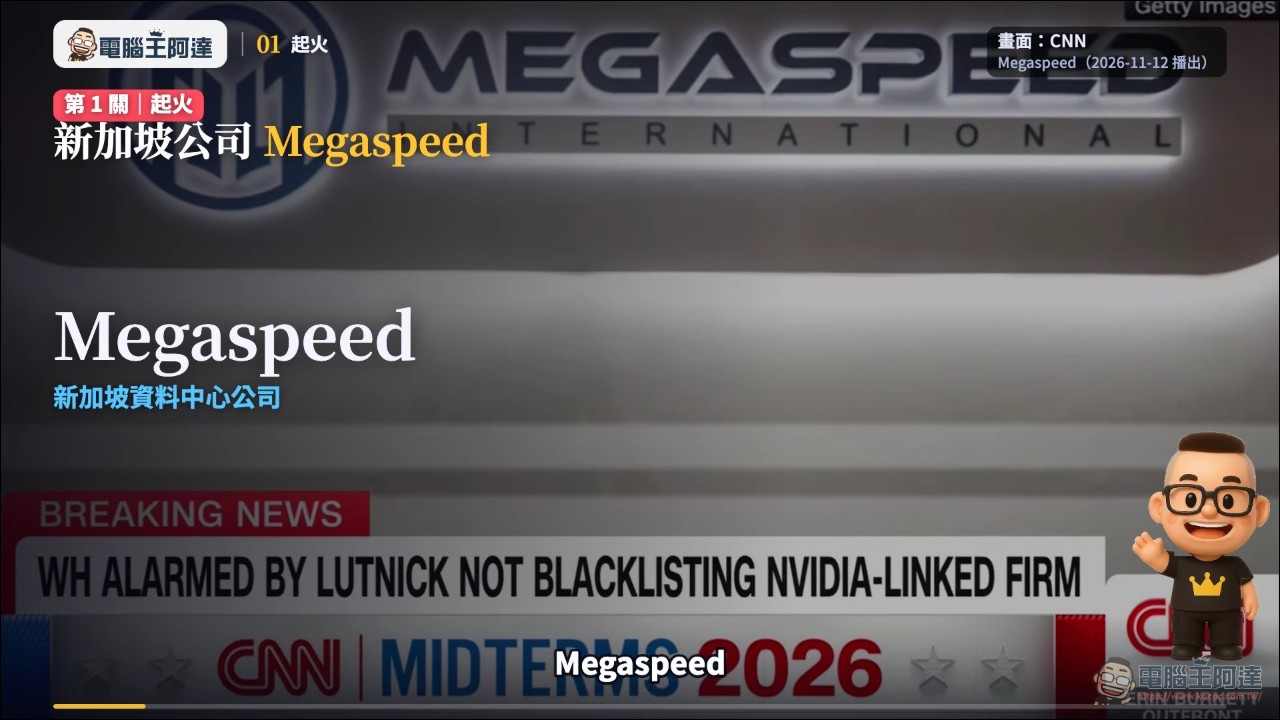
Megaspeed has long been on the regulators’ list:
September 2024: U.S. Commerce Department officials visited its facility in Malaysia and found the Nvidia equipment still in boxes, apparently ready for transshipment.
February 2025: Singapore police and customs investigated whether Megaspeed and related individuals made false declarations when purchasing servers, and in June seized the passport of former executive Alice Huang (Huang Le).
June 2025: Nvidia placed Megaspeed on a banned sales list. But after comparing trade records, The New York Times found that over the following eight months, Megaspeed’s Malaysian subsidiary continued to receive large shipments of Nvidia equipment through server manufacturers; Nvidia said these included repair parts that the Commerce Department allowed to be shipped.
February 2026: Singapore police found insufficient evidence for the alleged offenses related to Huang Le, but concluded that she deliberately downplayed her role in the company; they issued her a stern warning and banned her from re-entering the country.
Huang Le is a Chinese national and is not related to Jensen Huang. Megaspeed said she left the company in August 2025.
II. Ignition: The New York Times Reveals the “Intelligence Asset” Mystery
On October 29 U.S. time, The New York Times, citing people familiar with the matter, reported that U.S. surveillance had found that Jensen Huang and Huang Le had close ties, and that U.S. officials suspect Huang Le is an intelligence asset recruited by China’s Ministry of State Security. Nvidia responded at the time that the allegations of chip transshipment “have been investigated and disproven”; China’s Foreign Ministry said the report was “baseless speculation” intended to smear China.
3. Admitting Mistakes: An Apology Letter to All Employees
The real flashpoint came on November 7. The Financial Times reported that the U.S. side believed the two were in a romantic relationship. According to The Information, Nvidia’s general counsel went to Jensen Huang’s home that evening to ask him about it, and he admitted it.
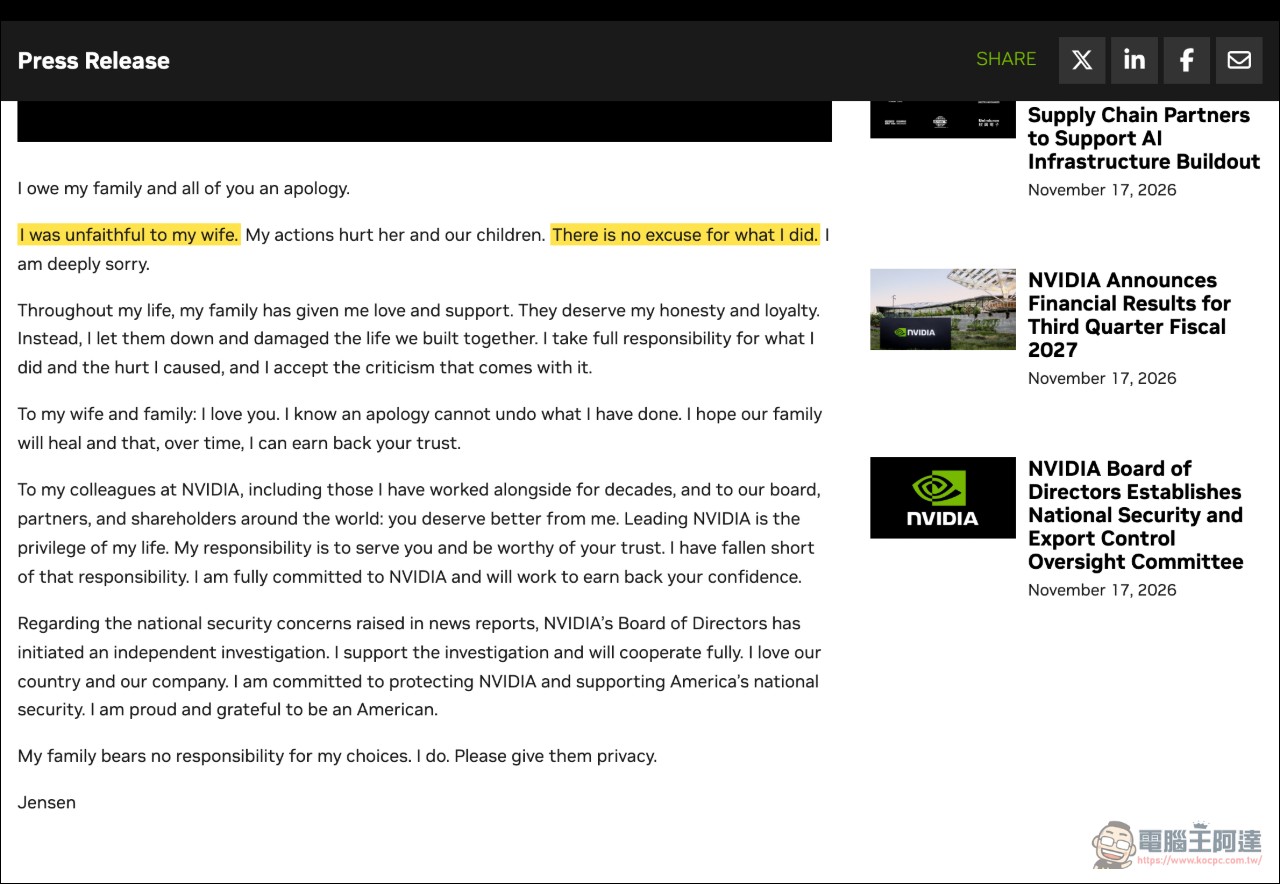
On November 8, Jensen Huang sent a letter to all employees, and the letter was also published in NVIDIA’s newsroom. In the letter, he admitted to being unfaithful to his wife, saying his actions had hurt his wife and children and that there was “no excuse”; regarding national security concerns, he said the board had launched an independent investigation and that he would fully cooperate. The board subsequently commissioned the law firm Wachtell, Lipton, Rosen & Katz to conduct the investigation.
At the same time, The New York Times and CNN reported successively that Secretary of State Rubio had written a classified memo this spring warning of the risks of this relationship, and that Trump had also been briefed before taking Jensen Huang to China in May; the White House denied parts of the reports.
4. Stepping down: The second relationship was exposed, and the board accepted the resignation that same day.
According to reports, Jensen Huang initially told company executives that this was the only affair. But on November 11, The New York Times, citing five employees, reported that he had also had a romantic relationship with a female vice president who reported directly to him, violating Nvidia’s own code of conduct.
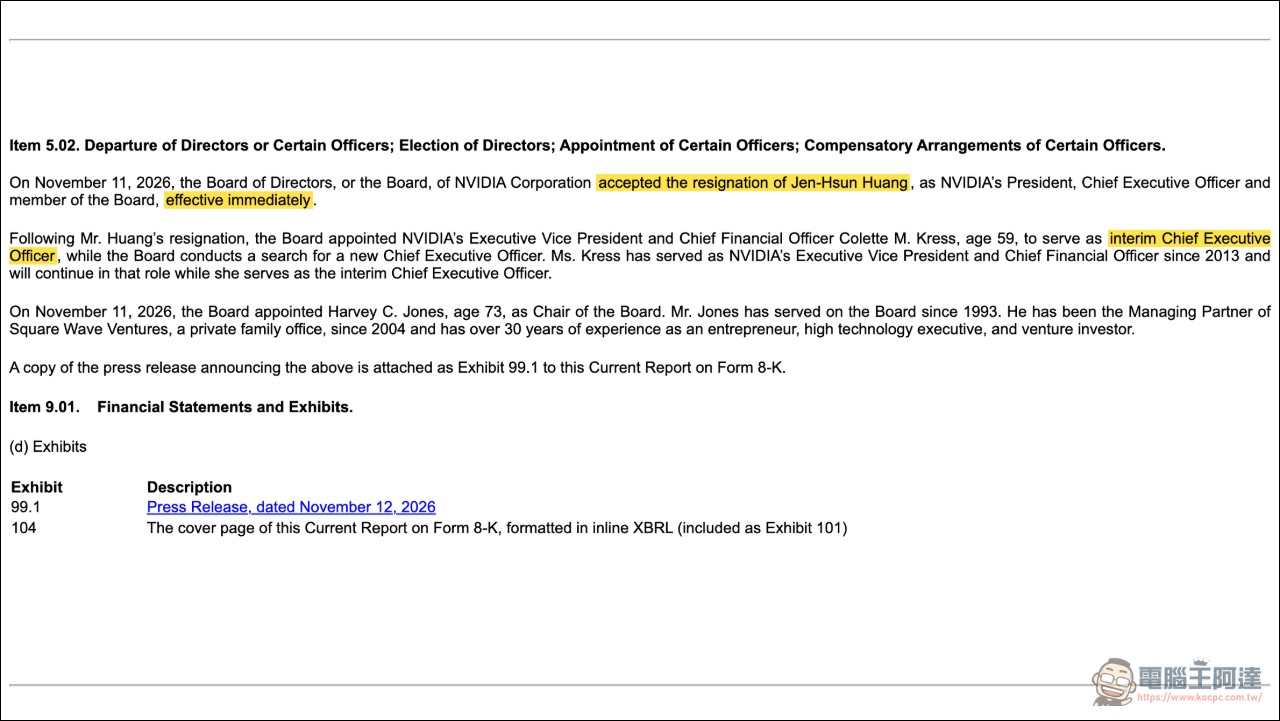
The board held an emergency meeting that day. Nvidia’s 8-K filing with the SEC shows that on November 11 the board accepted Jensen Huang’s resignation as president, CEO, and director, effective immediately. Nvidia officially announced on November 12 that CFO Colette Kress would also serve as interim CEO, and Harvey C. Jones, a director since 1993, became Nvidia’s first chairman.
On the day the news was announced, Nvidia shares fell more than 13% at one point after the opening bell before closing down 4.3%. Trump said on social media that the only person who could succeed Jensen Huang was Apple’s Tim Cook.
A small aside: the Denny’s in San Jose that commemorates NVIDIA’s founding briefly took down the plaque next to a booth, then put it back the next day, because Jensen Huang had washed dishes at Denny’s when he was 15.
5. Doubt: Is she really a spy?
The accusation of being a “spy” itself remains disputed to this day:
– U.S. Attorney General Todd Blanche said that the Department of Justice and the FBI have “no conclusion” about her identity.
– CNN, citing multiple sources, said the available intelligence is not sufficient to prove that she was ever a spy.
– The New York Times reported that people who had seen the intelligence believed she was an “asset” who provided information, but not a trained intelligence officer.
Treasury Secretary Bessent turned the focus to the company itself. Speaking on CNBC, he said the point is not Jensen Huang’s private life, but whether Nvidia knows its customers and whether it has sold chips to companies that are clearly shell resellers. The U.S. Commerce Department also issued new rules on November 16 requiring licenses for exports of advanced chips to Singapore, Malaysia, Thailand, Indonesia, and Brazil, aiming to prevent Chinese companies from using them remotely through overseas data centers.
Congress is also moving in parallel: the House Foreign Affairs Committee, the Select Committee on China, and the Intelligence Committee have scheduled an interview with Jensen Huang on December 1, and the Senate Banking Committee has also requested that he testify.
6. Rejection: He wanted to return, but the board said no.
Four days after he stepped down, the Financial Times reported that Jensen Huang was discussing a comeback with close associates, and allies had organized a Silicon Valley “war room” to lobby the White House. An online petition, “Stand With Jensen,” gathered more than 178,000 signatures in four days, though the website itself stated that the signatories’ identities had not been verified; The Wall Street Journal also found employees who said they had not signed at all. Musk publicly said he would be willing to recruit him, while Oculus founder Palmer Luckey said removing him was a mistake.
On November 17, Jensen Huang spoke publicly for the first time after stepping down. On X, he said he had made serious mistakes in his personal life, would “fully take responsibility,” and was cooperating with the board’s independent investigation; if the board believed his return would serve the best interests of shareholders, employees, the company, and the United States, he would be honored to return as CEO.
That same day was Nvidia’s third-quarter earnings day, with quarterly revenue of $115.8 billion, up 103% year over year. But Chairman Harvey Jones said at the very start of the earnings call that the board had “no intention” of bringing Jensen Huang back and had commissioned executive search firm Heidrick & Struggles to find a new CEO. However, Semafor reported that 3 directors were pushing for his return that same night, and that Jensen Huang had spoken with at least one director before issuing his statement.
At the November 18 all-hands meeting, Jones told employees that the board accepted the resignation because of Jensen Huang’s personal conduct and “lack of candor.”
7. Crash: The Worst Week Since 2008
In the days that followed, a series of bad news items emerged: Moody’s revised the outlook on Nvidia’s Aa1 credit rating from “positive” to “stable”; The Wall Street Journal reported that the SEC is investigating whether Nvidia’s disclosures misled investors; and the California Attorney General also issued an investigative subpoena to Nvidia.
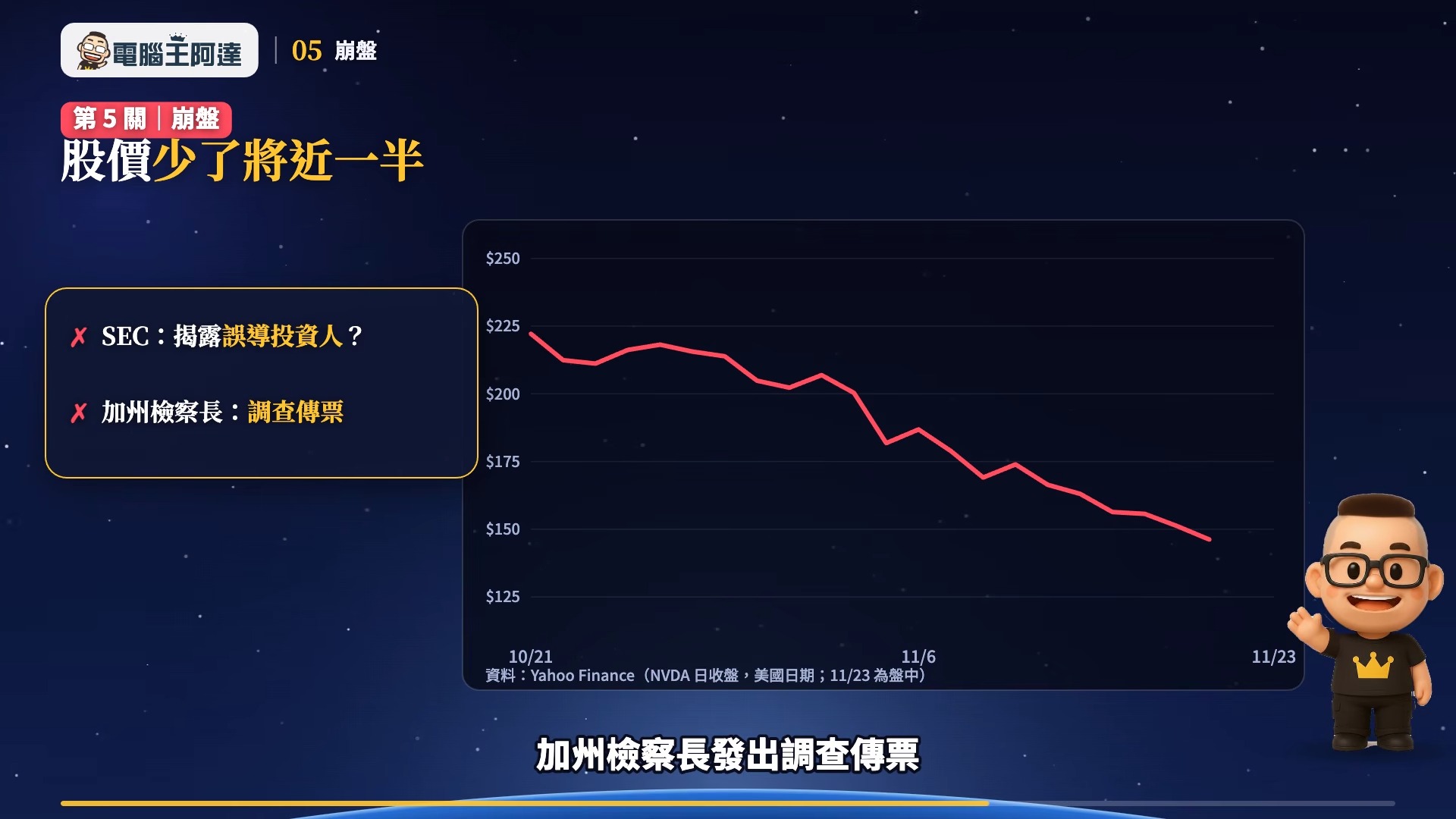
On November 20, Reuters reported that the SEC’s investigation had extended to accounting records. Nvidia shares plunged about 14% in a single day, closing at $125.53, marking their worst week since October 2008. Compared with the closing high of $239.24 on October 6, the stock was down 47%, and about $2.7 trillion in market value had been wiped out—roughly NT$85 trillion at an exchange rate of NT$31.5 per US dollar.
8. Reversal: White House Relents, Board Unanimously Invites Him Back
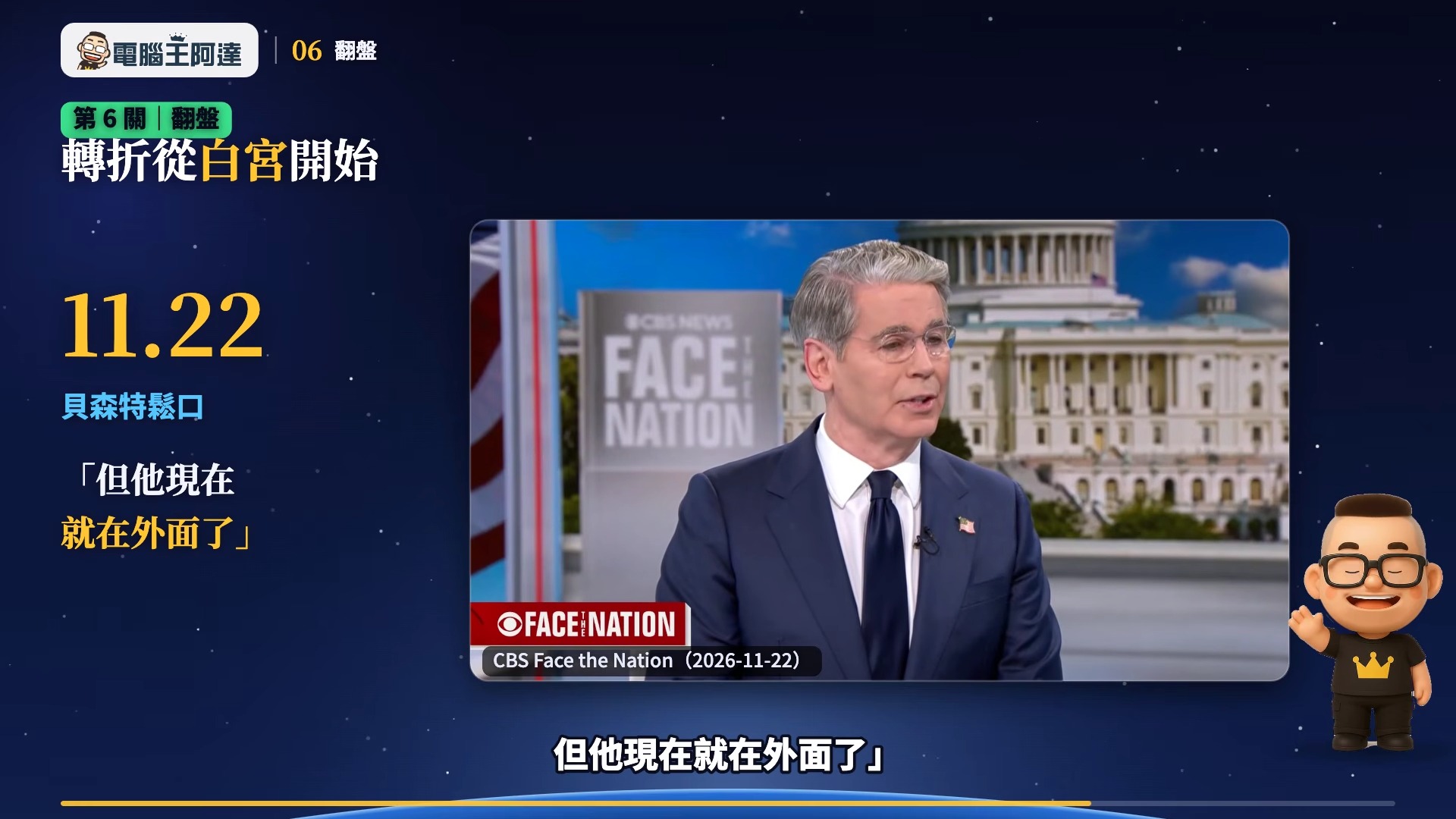
The turning point began at the White House. At a November 20 press conference, Trump said that America is a country that gives people second chances, and that he hoped Jensen Huang would apologize properly and then return. Bessent, who had originally argued that the board should look for an outside candidate, also softened his stance during a November 22 interview with CBS’s Face the Nation: he had said they should find someone from outside, “but he is outside now.” Trump subsequently posted on Truth Social, hoping that Nvidia’s board would rehire Jensen Huang.
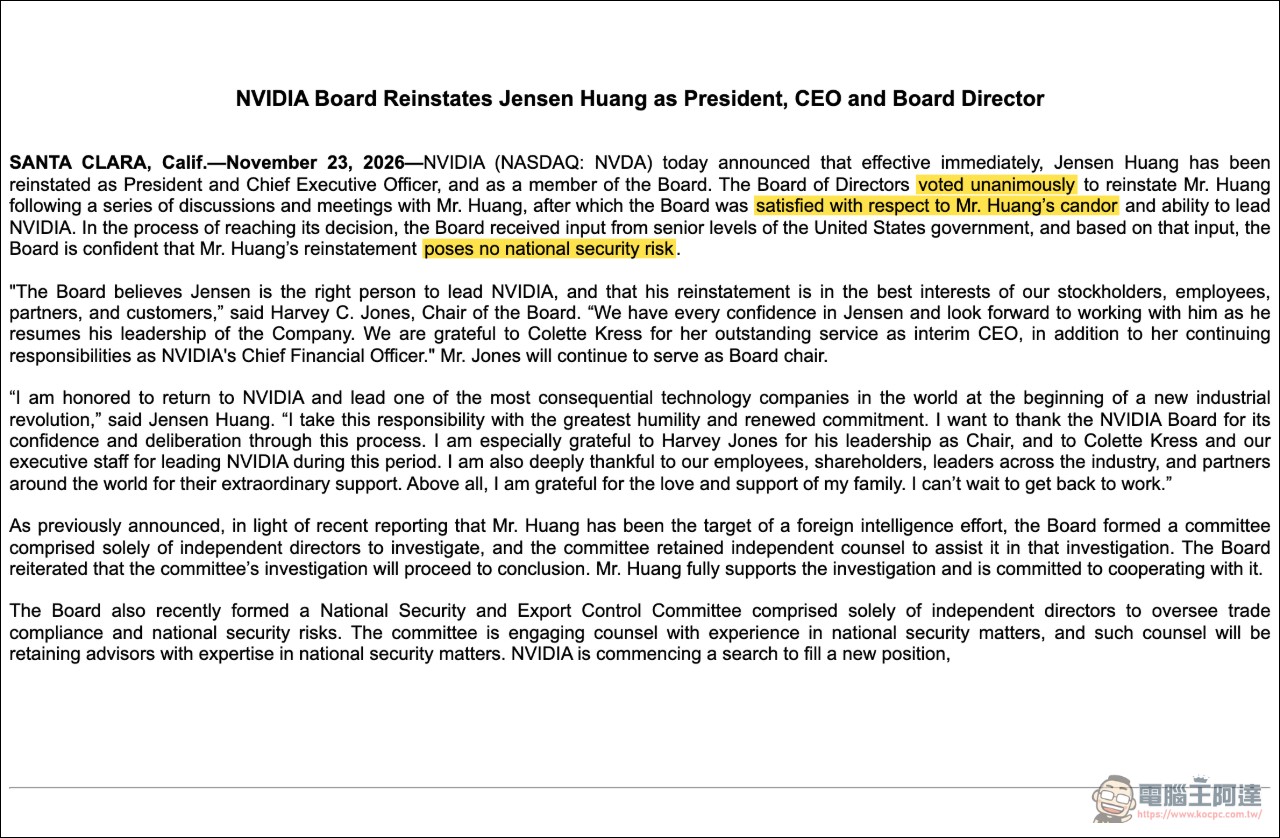
Nvidia’s 8-K filing submitted on November 23 shows that the board made a decision on November 22, unanimously approving the immediate reinstatement of Jensen Huang as president, CEO, and director, and publicly announced it at about 10 p.m. Taiwan time on the 23rd. The board gave two reasons:
1. After multiple meetings with Jensen Huang, I am satisfied with his candor and leadership;
2. Senior U.S. government officials provided their views, and based on this, the board believes there is no national security risk in his returning to the position.
NVIDIA Board reinstates Jensen Huang as President, CEO and Board Director. Read the release: https://t.co/x4bnjiSVil
— NVIDIA Newsroom (@nvidianewsroom) November 23, 2026
It is worth mentioning that 6 days ago the chairman said one of the reasons for the resignation was “not candid enough,” while this time one of the reasons for the reinstatement was “satisfied with his candor.” Harvey Jones remains chairman, and Colette Kress steps down as interim CEO while continuing as CFO. In a statement, Jensen Huang said he is taking on this responsibility with the utmost humility and a renewed commitment, and his final sentence was, “I can’t wait to get back to work.”
The market reaction was written directly into the stock price: Nvidia surged nearly 30% in premarket trading and, as of 11 a.m. ET on the 23rd, was trading intraday at $168.8, up about 34% from the 20th close. In Taiwan stocks, Taiwan index futures rose more than 3,000 points in the night session (reports ranged from 3,400 to 3,632 points). Hon Hai Chairman Liu Young-way had said earlier that day that people should trust Jensen Huang’s vision; for Taiwan’s AI supply chain, this amounted to a reassuring pill.
9. It’s not over yet.
Jensen Huang is back, but the incident is far from over:
Independent investigation: The board stressed that the independent investigation into foreign intelligence operations will be pursued to the end, and Jensen Huang promised to cooperate.
New oversight mechanism: Nvidia has newly established a National Security and Export Controls Committee composed of independent directors, and will hire a chief compliance officer who reports directly to the board’s Nominating and Corporate Governance Committee.
Congress and regulators: the House interview on December 1, the Senate invitation to testify, and the investigations by the SEC and the California Attorney General are all still ongoing. Bessent also asked Nvidia to explain by November 25 whether it used shell companies to evade export controls.
Core questions: whether Megaspeed’s chips have flowed into China and whether Huang Le is an intelligence asset remain unresolved.
It took only 11 days to get through all six stages, but the investigation stage has only just begun.
Source: KOCPC Chinese