


Over the past few years, rumors about the next-generation DDR6 have never stopped, with people leaking figures ranging from 8,800 MT/s to 21,000 MT/s, but there had never been a confirmed official plan—until now, when things have finally become more concrete. JEDEC, the organization responsible for setting memory standards, recently officially released a DDR6 technology preview, with speeds starting at 12,800 MT/s and a roadmap planned for 14,400 MT/s and above, while bandwidth, capacity, and energy efficiency are all upgraded as well. However, JEDEC also stated clearly that these details are still under development and are not the final approved standard, and the launch time is unknown.
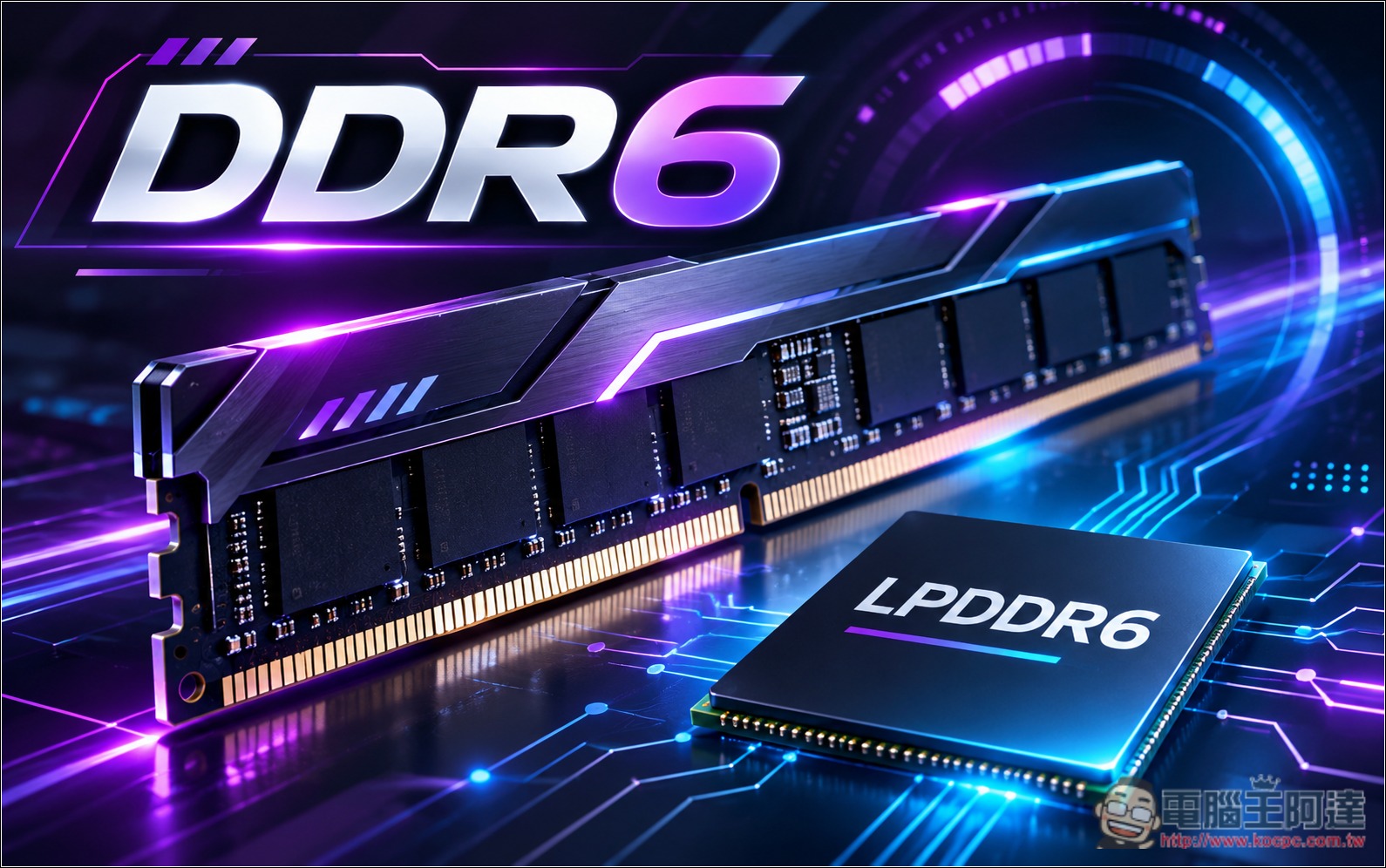
JEDEC announces DDR6 technology preview! Speeds starting at 12,800 MT/s, bandwidth increased by over 50%, module length reduced by 44%
JEDEC is the organization that sets global semiconductor memory standards; the DDR4, DDR5, and LPDDR series were all developed by it. Earlier JEDEC issues a press release., announced the DDR6 main memory plans under development by its JC-42 committee.
Speed is the main focus this time. Taking JEDEC’s server RDIMM example, DDR5’s standard maximum is 9,200 MT/s, while DDR6 starts directly at 12,800 MT/s, with future roadmaps planning for up to 14,400 MT/s or even higher.
As speed increases, the underlying architecture naturally changes accordingly:
- Data bus widening: expanded from DDR5’s 64 DQ to 96 DQ, a 50% increase in width.
- Introduce a pseudo-channel architecture: divide memory accesses into multiple pseudo-channels in order to increase the bandwidth each DRAM package can provide while giving the system more flexibility in reliability configurations.
- The number of banks doubles: DDR5 has a maximum of 32, while DDR6 doubles it directly.
- Improved refresh mechanism: JEDEC says that improving Refresh can boost bus efficiency and support higher speeds and capacities.
Taking all these changes together, JEDEC’s official target is: when DDR6 is first introduced, its bandwidth will already be more than 50% higher than DDR5, and it will increase further as speeds are raised.
| Comparison item | DDR5 | DDR6 (planned) |
|---|---|---|
| RDIMM transfer speed | Up to 9,200 MT/s (JEDEC comparison baseline) | Starting at 12,800 MT/s, with a target of 14,400 MT/s or higher. |
| data bus | 64 DQ | 96 DQ (pseudo-channel architecture) |
| Memory bandwidth | comparison baseline | Initial target increase of over 50% |
| Bank quantity | At most 32 | Double |
| DRAM die density | Up to 64Gb | Planning for up to 128Gb |
| Module length | Traditional DIMMs are approximately 133mm | Proposal to simplify the design to 74mm |
| I/O terminal design | VDDQ termination | VSS terminal |
| Module format | UDIMM、SO-DIMM、RDIMM、MRDIMM、CAMM2 | Consider RDIMM, UDIMM, and CAMM. |
| Technical status | Already in commercial use | Standard development in progress. |
In addition to speed, DDR6 capacity density is also increasing. JEDEC plans for DDR6 to support DRAM dies up to 128Gb, which is 16GB, while DDR5’s current upper limit is 64Gb (8GB), meaning single-die density directly doubles.
In addition, JEDEC has also optimized die stacking, allowing the same package size to accommodate more layers of dies and pack in more capacity without increasing the footprint.
However, this upgrade offers relatively limited benefit to ordinary gamers; the real beneficiaries are AI, data centers, and servers. Today’s AI inference and large models require a large amount of memory, and the number of modules that can be installed in each server is limited. The higher the density per module, the greater the total capacity that can be configured in the same machine.
Currently, standard DDR5 DIMM modules are about 133mm long (precisely 133.35mm), and the DDR6 compact module design proposed by JEDEC will be only 74mm, reducing the length by about 44%.
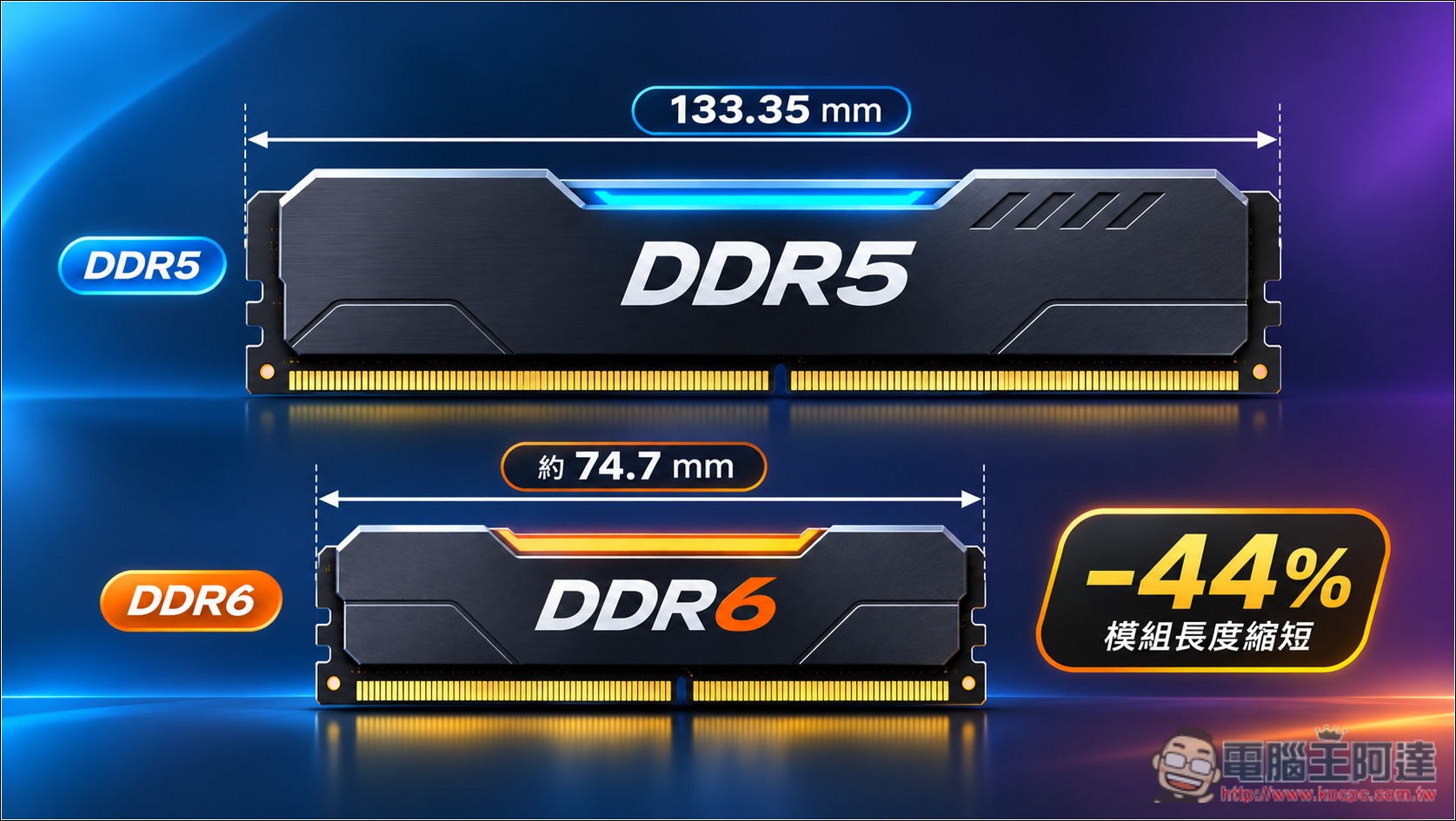
JEDEC says the shorter modules are intended to increase memory configuration density in systems with limited motherboard space, primarily targeting server and data center platforms. At 74mm, the size is roughly that of the SO-DIMMs used in laptops today. It should be noted that JEDEC has not said all DDR6 memory will uniformly be changed to 74mm, so future desktop DDR6 memory will not necessarily be shortened this much. What is certain, however, is that DDR6 cannot be inserted into existing DDR5 slots; the two are incompatible.
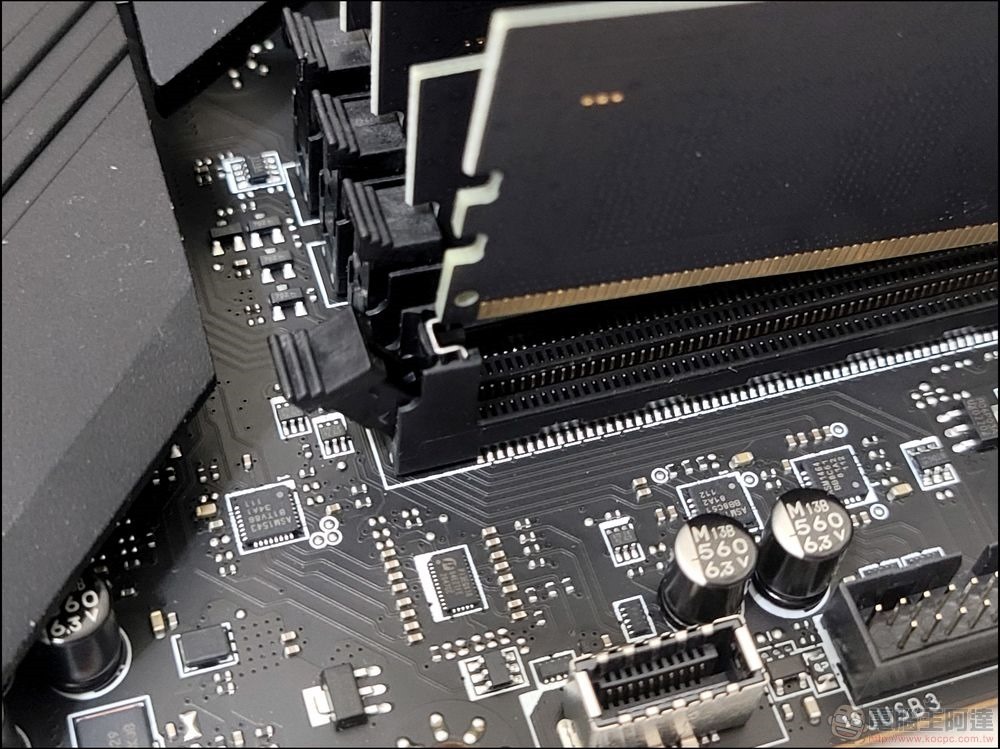
In terms of module form factors, DDR6 is currently considering support for different designs such as RDIMM, UDIMM, and CAMM, but none have been finalized yet.
DDR6 also has several upgrades that are important for servers:
- Switch to VSS-terminated I/O: DDR5 I/O signal termination is tied to VDDQ, while DDR6 changes it to VSS. JEDEC says the goal of this change is to significantly improve performance per watt.
- Data center-oriented low-power mode: Added a power-saving mode designed for data centers, allowing servers to reduce memory power consumption when under low load.
- Multiple system-level ECC error correction: DDR6 is planned to support multiple system-level ECC implementations, allowing system designers to make their own trade-offs among cost, power consumption, and reliability. DDR5, by contrast, has on-die ECC, with RDIMMs adding system-level ECC on top.
As for when DDR6 will be launched, JEDEC has not yet announced a date for finalizing the DDR6 specification, nor has it confirmed the actual launch or widespread adoption timeline. The industry expects DDR6 to be introduced in 2028 to 2029, starting with servers. SK hynix’s roadmap lists DDR6 for 2029 to 2031.
Source: KOCPC Chinese