


China’s Tencent late at night on November 16 in HunyuanOfficial AccountAnnouncing the launch of Hy4 flash, the first model in the Hunyuan Hy4 series to carry the Flash name, positioned as “the cheapest everyday productivity model.” The company claims that in human blind tests, its everyday office performance comes close to Anthropic’s Claude Haiku 5.5, while the cost per task is only one-eighteenth of the other’s. API pricing has been pushed down to $0.07 per million input tokens (about RMB 0.5, NT$2.2), $0.281 for output (about RMB 2, NT$8.8), and $0.003 for cache hits (about RMB 0.02, NT$0.1).
224B total parameters, only 12B active.
Hy4 flash has 224B total parameters, of which 64B are Engram lookup parameters; only 12B are actually activated per token during inference. Compared with the flagship Hy4’s 770B total parameters and 49B activated parameters, its scale is significantly smaller. Like Hy4, it natively supports multimodal input, and its context window also reaches 1 million tokens.
The price gap is clearest in the pricing table. Hy4 flagship’s API list prices are $0.834 for input, $2.501 for output, and $0.042 for cache per million tokens; the corresponding figures for Hy4 flash are roughly one-twelfth, one-ninth, and one-fifteenth.
Cost-reduction methods for four stages
Tencent breaks cost reduction into four stages: pre-training, post-training, evaluation, and inference. The official blog lists the optimizations for each stage one by one, with corresponding actions spanning pre-training architecture, post-training distillation and reinforcement learning, internal evaluation, and inference decoding. In the pre-training stage, Hy4 flash integrates three architectures—hybrid attention, LatentMoE, and Engram—compressing the KV cache size to one twenty-fourth of Hy3 and one-sixth of Hy4. The official blog states that these architectural choices went through extensive scaling ladder experiments, confirming that performance meets expectations. In the post-training stage, it first builds basic general capabilities through self-distillation from Hy4, then uses reinforcement learning to cut the average output length of end-to-end tasks in half; shorter output lengths reduce both billing amounts and wait times. On the inference side, megakernel, 4-bit quantization, and DFly push decoding speed past 150 tokens per second, supporting large-scale low-cost services and allowing low-priced models to run large numbers of agent tasks for long periods.
The evaluation phase is the most distinctive design of this release. Tencent built an internal benchmark, WorkIndex, comprising 8 evaluation groups covering presentation creation, presentation editing, human-AI collaborative presentation writing, Markdown human-AI co-creation, document editing, spreadsheet repair, audio/video processing, and visual understanding, combined with manual scoring that assesses output quality, single-turn output length, and task completion time, with public leaderboard scores secondary. The same evaluation also retains 7 public agent benchmarks as controls, including DeepSWE, ProgramBench, Terminal-Bench 4.0, APEX-Agents, AutomationBench, HLE, and OSWorld 2.1.
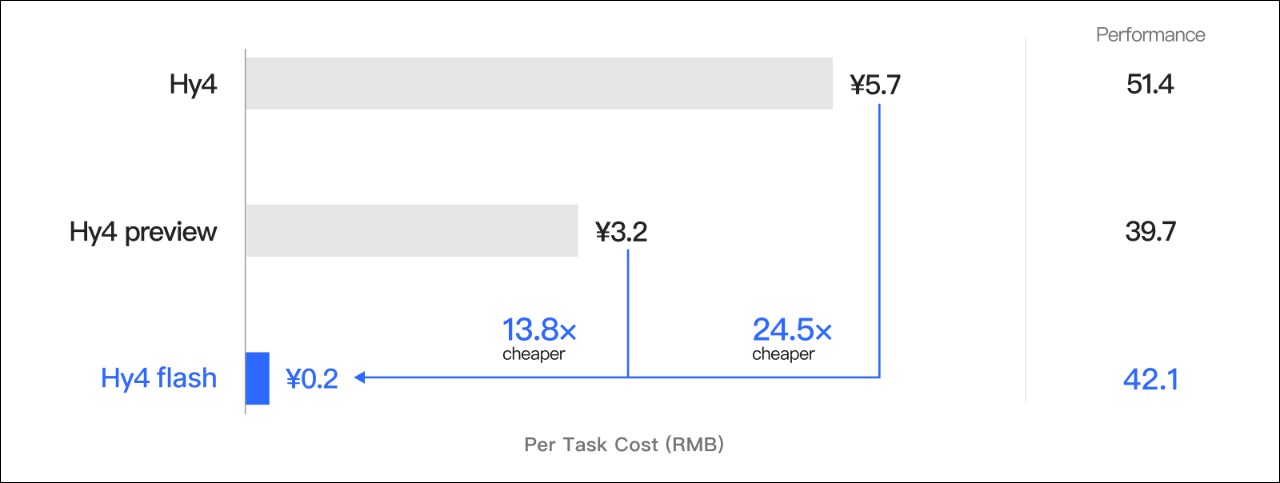
Cost account: the per-task price has dropped to around one-twentieth of Hy4.
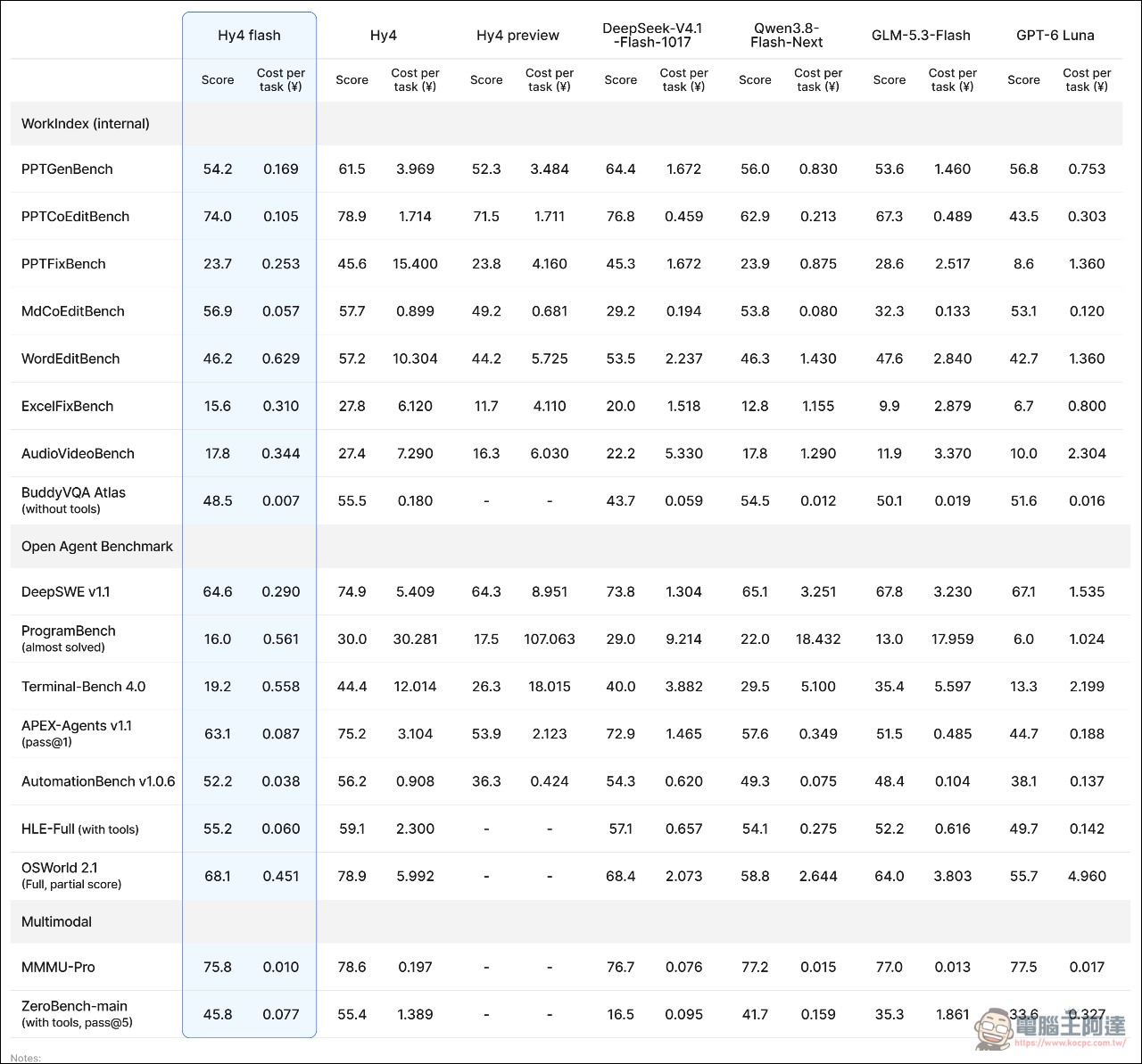
On WorkIndex, Tencent’s figures show that Hy4 flash’s overall task performance is slightly higher than that of Hy4 preview, which has three times as many parameters. Its average cost per task is only one-thirteenth that of Hy4 preview and one-twentieth that of Hy4, or about one-eighth of DeepSeek-V4.1-Flash-1017’s highest-tier off-peak pricing. In concrete numbers: on the collaborative PPT editing benchmark, Hy4 flash scores 74.0, lower than Hy4’s 78.9, but its cost per task drops from 1.714 yuan (about US$0.26, NT$8.2) to 0.105 yuan (about US$0.016, NT$0.5); its automation task score dips slightly from 56.2 to 52.2, while its cost per task drops from 0.908 yuan to 0.038 yuan.
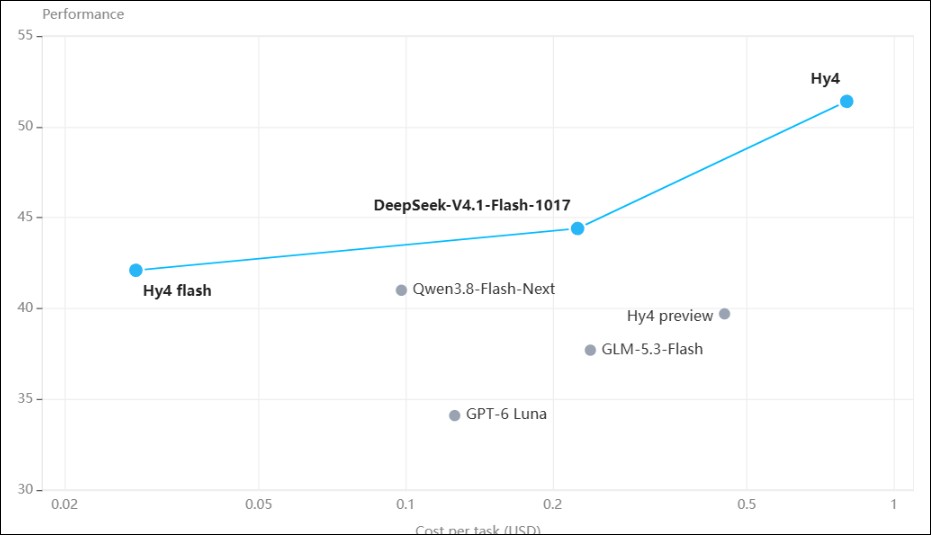
In the blind test, Tencent had 85 internal WorkBuddy users conduct double-blind ratings across 27 categories and 259 tasks. Hy4 flash’s user satisfaction was close to Claude Haiku 5.5, and its per-task cost and completion time were the lowest and shortest among the participating models.
The trade-off is explicit: it falls well short on complex tasks.
Tencent did not report only good news. On the Terminal-Bench 4.0 terminal operation test, Hy4 flash scored 19.2, while Hy4 scored 44.4; on the ProgramBench coding test, it dropped from 30.0 to 16.0, a gap of more than 40%. The official blog also explicitly recommends assigning daily tasks such as deep search, document processing, presentation creation, simple front-end demos, and computer use to Hy4 flash, while continuing to use Hy4 for complex work such as long-horizon software engineering, because the flagship version has a higher intelligence ceiling. The WorkBuddy team’s evaluation also acknowledges that long coding workflows have declined slightly compared with Hy4.
All products are fully integrated, with a commitment to open weights.
Hy4 flash is now live on Tencent Cloud TokenHub, WorkBuddy, Yuanbao, WeCom, QQ, ima, Marvis, and other Tencent product lines, and will launch on OpenRouter soon. Until November 30, WorkBuddy users can use it for free, and TokenHub’s API is 50% off. Logan, product lead for Yuanbao, gave the internal figures: in Yuanbao workflows, Hy4 flash’s agent performance improved 13.6% over Hy3, its side-by-side human-machine GSB evaluation improved 7.56%, it outperforms GLM-5.3-Flash by 2.52% in general conversation, and the improvement is most noticeable in multi-turn conversations. The Yuanbao team attributes the highlights to more complete task completion, clearer information presentation, and more reliable outputs.
Tencent has also promised to release Hy4 flash as open weights and to keep updating it. Once the weights are open, the impact of low pricing will extend from cloud pricing to self-built compute, and enterprises and developers will be able to stand up the model themselves. At RMB 2 per million output tokens (about NT$8.8), compared with the USD pricing for Claude Haiku 5.5 at the same tier, Tencent is targeting high-frequency, high-volume, low-unit-price everyday agent workloads. Research published around the same time by Wharton and Accenture also noted that most AI agent tasks do not require frontier models, and the market space for low-cost models is expanding. Whether Hy4 flash can truly deliver on the claim of being a “Haiku replacement” will not be settled until it is listed on OpenRouter, third-party benchmarks are run, and the open weights are actually released.
Source: KOCPC Chinese