


On November 16, 2026, Alibaba’s Qwen team officially released the next-generation foundation model Qwen4-Max. Built on the all-new Qwen4 architecture, the new model has 2.4 trillion total parameters, natively supports visual understanding, and expands the context window to 1 million tokens. The company also lowered API prices across the board: input is priced at US$1.5 per million tokens (about NT$47), and output at US$4.5 (about NT$142), both cheaper than the previous generation. Developers can call it directly on QwenCloud and also use it in applications such as Qwen Studio, QwenWork, and Qoder.
New architecture: 2.4 trillion parameters, activating only 71 billion per token
According to the official blog, Qwen4-Max’s backbone has 2.4T parameters, activates 71B parameters per token, and additionally includes 328B N-gram embedding parameters. The architecture makes systematic upgrades in three areas—attention, residual connections, and embeddings: Gated DeltaNet (GDN) paired with Qwen Sparse Attention (QSA). Every three layers, GDN compresses history into a fixed-size state, and QSA then uses a lightweight indexer to select relevant context at micro-block granularity, reducing attention and indexing costs for long sequences. Gated Residual splits a single residual stream into four parallel branches, using dynamic read/write gates to strengthen cross-layer information flow; N-gram Embedding provides representations of local token patterns through context lookup at the second layer and above, expanding model capacity with almost no additional computation.
Officials emphasized that this 2.4T-scale training run did not experience any loss spikes throughout, attributing this to improvements in architecture and training optimization. In internal evaluations of knowledge, coding, question answering, and STEM, Qwen4-Max-Base’s bits-per-byte is about 5% to 13% lower than Qwen3.8-Max-Base’s, while its activated parameters are 25% fewer.
Efficiency bill: cost per task fell from $4.43 to $1.67.
The Qwen team built its own Work360 evaluation framework, whose classification hierarchy covers 26 first-level domains, 182 subdomains, and 721 specialized directions, to compare the performance of new and old models on real-world industry tasks. In the latest evaluation under this framework, Qwen4-Max scored 52.69, while the previous-generation Qwen3.8-Max scored 47.74; average cost per task dropped from US$4.43 (about NT$139) to US$1.67 (about NT$53), a 62% decrease.
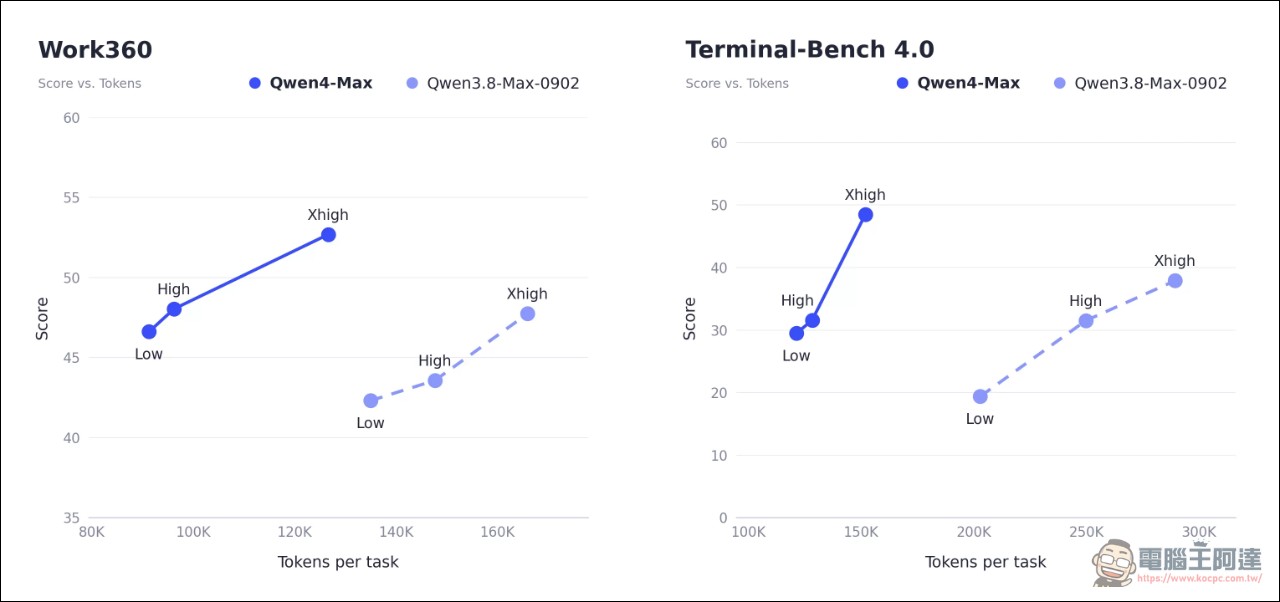
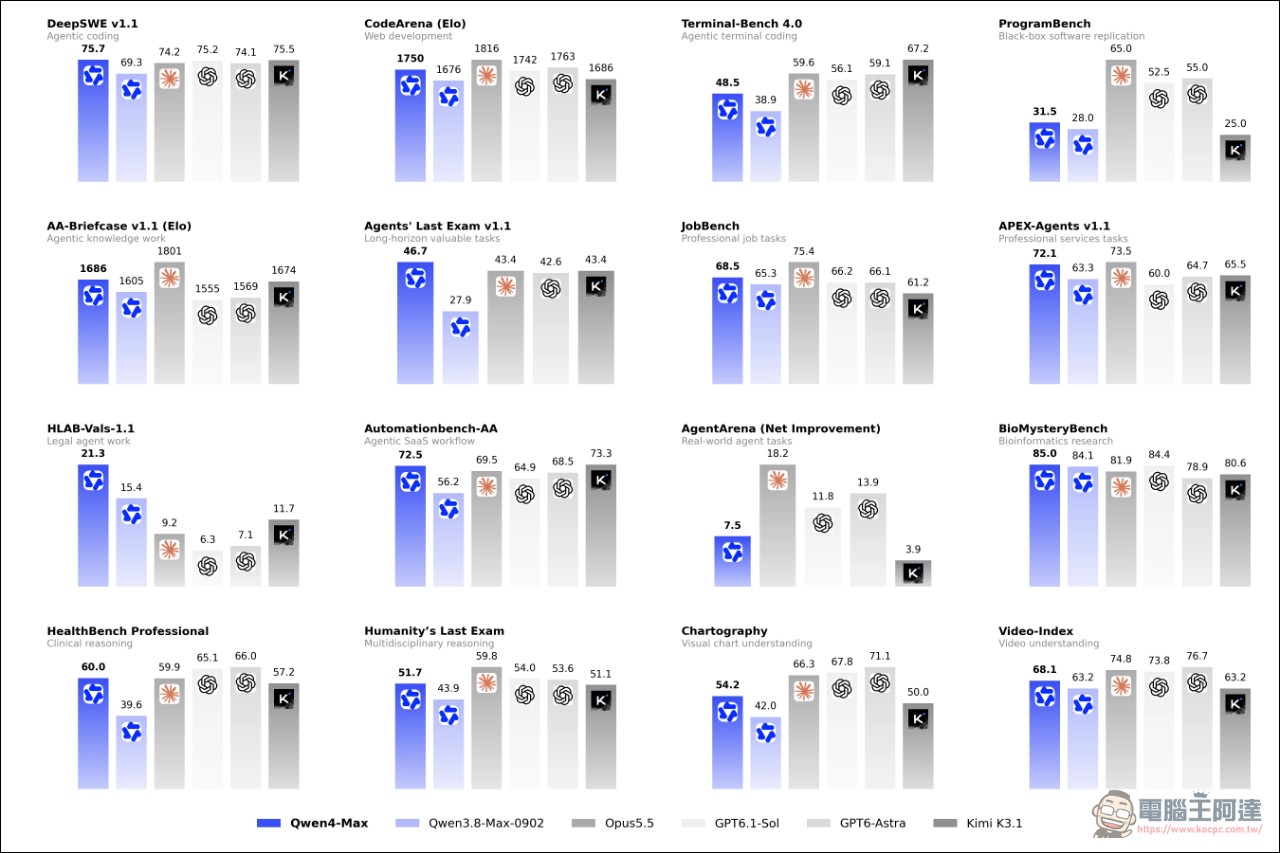
For token usage, the official comparison data is: Work360 saves about 24% at the highest reasoning intensity (Xhigh) and about 35% at High intensity; Terminal-Bench 4.0 saves about 48% and 49% at the two intensities, respectively. For Terminal-Bench 4.0 at the same Xhigh setting, average token usage per attempt dropped from 289k to 151k, while the score rose from 37.9 to 48.5. In third-party blind tests, the official claim is that Qwen4-Max ranks 6th in the frontend programming blind test CodeArena, and that its agentic capabilities and professional task items in evaluations such as Agents’ Last Exam and Vals Index are in the first tier.
Pricing: 25% lower than Qwen3.8-Max, with cache reads down 70%
According to Alibaba Cloud Model Studio’s international pricing table, qwen4-max is priced at US$1.5 for input and US$4.5 for output, while the previous-generation Qwen3.8-Max is listed at US$2 and US$6 in the same table, meaning the new model’s input and output prices are each 25% lower. The implicit cache read price is US$0.075 per million tokens (about NT$2.4), which the company says is 70% lower than the previous generation.[1]In China, domestic pricing is RMB 10 for input, RMB 30 for output, and RMB 0.5 for implicit cache hits.
On specifications, QwenCloud documentation lists a maximum output of 131,072 tokens in non-thinking mode; in thinking mode, thinking plus the final answer can total up to 262,144 tokens, with thinking enabled by default and the default intensity set to high. The model supports function calling, structured output, web search, PDF, code interpreter, and the MCP protocol, but currently does not support fine-tuning, model deployment, or batch inference.
Official demo: machining process planning reduced from 475 minutes to 24 minutes.
The official blog uses a set of industry cases to illustrate the positioning of “real productivity.” In automotive manufacturing, Qwen4-Max demonstrated production line planning, part design, and machining validation on actual production lines at SANF and Pacific Union: the manual hours for machining process planning for a single part fell from about 475 minutes to 24 minutes, a reduction of about 95%. On the legal side, it showcased pre-IPO due diligence: the model renamed 198 workpapers in inconsistent formats that the client provided in batches according to their substantive content and organized them into 14 folders, then cross-checked public records such as company registration, intellectual property, judicial, and credit records, ultimately delivering an 86-page report of more than 60,000 words covering 12 review dimensions and 14 legal issues, with each conclusion citing the workpapers.
In the financial investment research case, 90 MCP tools are called to retrieve market data and financial reports for A-shares, Hong Kong stocks, US stocks, bonds, funds, and derivatives, producing Excel files and presentations with traceable sources. In the critical care medical demonstration, it reads dozens of days of lab reports, more than 10,000 words of clinical course records, and 1,433 raw images in a single conversation, organizes six days of disease progression into a timeline, and provides four management recommendations corresponding item by item to that day’s physician orders.
Timeline and open-source commitment: the 27B successor draws the most attention.
This release had long been telegraphed. At the Yunqi Conference on September 22, 2026, Alibaba confirmed that Qwen4 was in training with an entirely new architecture, with the family named Qwen4-Max, Qwen4-Plus, Qwen4-Flash, and Qwen4-27B. Liu Dayiheng, head of the Qwen large language model, confirmed at the time that the open-source side would prioritize 27B. On October 29 at the Apsara Conference in Amsterdam, Alibaba Cloud CTO Li Feifei told attendees “See Qwen4 next week,” pointing to November 2–8; the actual preview did not open until November 11 and was limited to Token Plan subscribers. Only after the official version launched on November 16 did the pay-as-you-go API fully open.
Regarding open-source commitments, officials mentioned in tweets and blog posts that smaller models in the Qwen4 series will be released with open weights, but did not provide a date or model list. As of the check on November 11, the Qwen team’s Hugging Face organization still had no Qwen4 repositories, and the community’s focus is on Qwen4-27B as the successor to Qwen3.8-27B.
Looking at the entire launch, Qwen4-Max shifts its focus from benchmark rankings to unit cost and delivery quality: officially, Work360, Terminal-Bench, and a set of industry case studies pull the competition onto the battlefield of “can real work be done cheaply and delivered,” while its price band is a full quarter lower than the previous generation. Two things remain clearly unverified: when these vendor self-reported figures will be reproduced by independent labs, and when the promised open-source small-size Qwen4 model will be released.
Source: KOCPC Chinese