


Using a handheld game console to control a car, just like playing Mario Kart—some people must have imagined it, but it turns out it can now actually be done in the real world. Recently, a security researcher overseas successfully used a Nintendo Switch 2 to control a Tesla. In his 55-second demo video, he not only used the Switch 2 to activate multiple car functions, but could even turn the Tesla’s steering wheel.
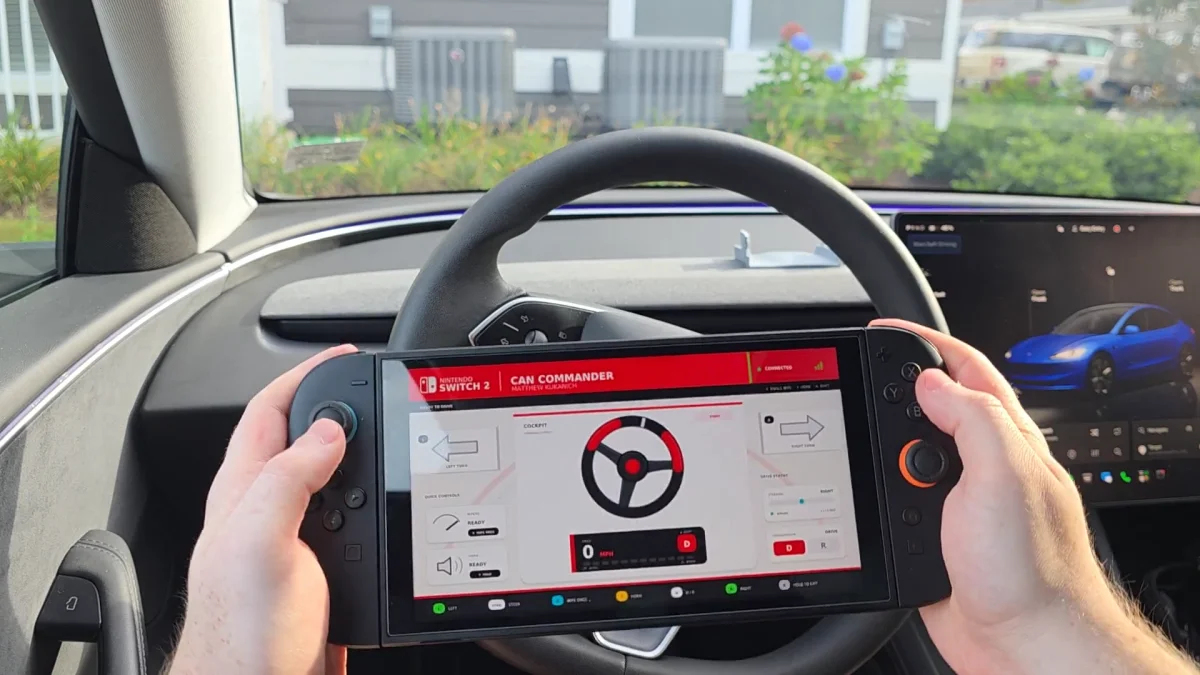
Switch 2 Becomes a Tesla Controller! Security Researcher Builds a Custom Program So the Steering Wheel Turns With a Push of the Joystick
According to Not a Tesla App According to the report, U.S. automotive cybersecurity researcher Matthew KuKanich shared on Reddit how he used a CAN-connected Nintendo Switch 2 running a user-level program he wrote to gain full access to Tesla vehicle functions, along with a demonstration video.
In the video, KuKanich parks the car next to his home, sits in the driver’s seat, and holds a Switch 2. He then pushes the left analog stick to the left, and the Tesla’s steering wheel turns left; when he pushes it right, the steering wheel turns right, with the degree of rotation synchronized to how far the stick is pushed. In addition, when he presses the L and R buttons, the car’s left and right turn signals blink according to the commands. The Switch 2 screen shows a steering-wheel-style driving interface titled “CAN Commander — Matthew KuKanich,” which displays the vehicle speed, steering wheel angle, current gear, and connection status in real time:
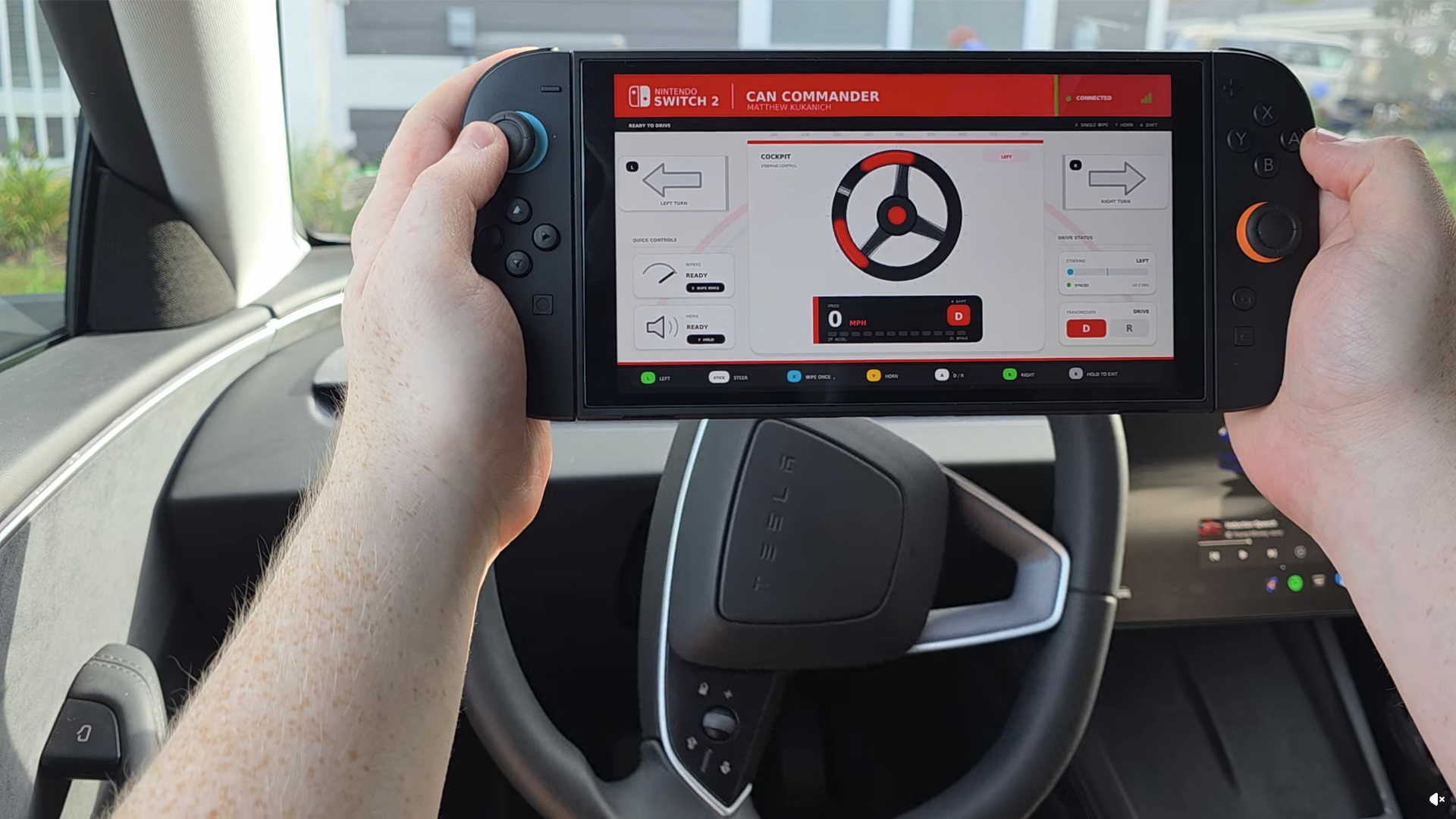
So how does the Nintendo Switch 2 communicate with the car? The answer is the car’s internal CAN Bus (Controller Area Network).
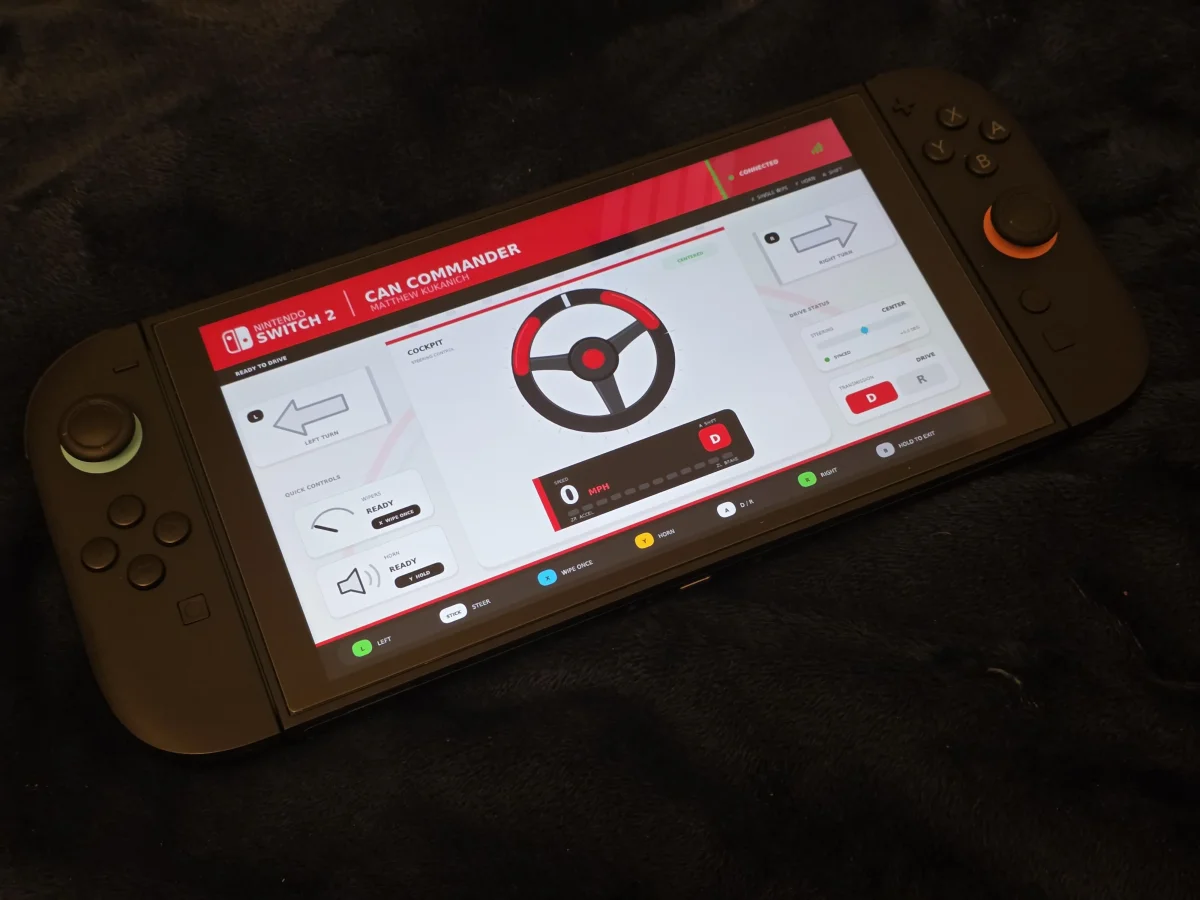
CAN Bus is an in-vehicle communication standard developed by Bosch in the 1980s and remains the mainstream of the automotive industry today. Modern cars have dozens of electronic control units (ECUs), each managing functions such as the motor, brakes, steering, lights, and wipers. You can think of CAN Bus as a shared “in-car group chat” for these components: all units send messages on the same line, and each component picks out only the commands relevant to it to execute.
KuKanich’s system is divided into three parts. The first part is a custom program on the Switch 2 that reads the joystick and buttons; the second part is an external hardware device he developed separately, the “Vehicle Control CAN Link,” which contains a microcontroller; the third part is Tesla’s own in-vehicle network.
But the one actually doing the work is the “microcontroller” in the middle. The Switch 2 only sends high-level commands such as “turn left” and “accelerate”; the hardware in between is responsible for translating the commands into CAN messages the car can understand, then sending them into the in-car network so that the messages appear to come from the Autopilot computer.
In other words, this system is impersonating Tesla’s driver-assistance computer.
So could other cars do it? In principle, many modern cars have features like lane keeping and active parking assist that steer the wheel themselves, which means the car already has an electronically controlled steering pathway, so theoretically it should also be possible. Of course, even if it can be done, you absolutely should not actually drive it on the road; there are many safety risks, including latency, accidental activation, connection dropouts, and so on.
Source: KOCPC Chinese