


In the early hours of November 11, 2026, MiniMax announced on X that its image generation model MiniMax H3-Image has open weights. The official post highlighted three figures: a 4096 x 4096 output at about 16 million pixels, a 10-second generation time, and up to 16 reference images; usage channels include its own API, MiniMax Code, and Hailuo AI, with 50% off generation requests at specs above 16MP in the first week.
H3-Image is a derivative of the MiniMax-H3 family, combining text-to-image generation and image editing in a single checkpoint. Its weights are now available on Hugging Face, with the transformer and VAE totaling about 68.65 GB. During post-training, MiniMax strengthened data, reinforcement learning, step compression, prompt expansion, and deployment optimization, and claims its speed can reach 5 times that of mainstream offerings on the market.
4K image generation in 10 seconds! ⚡ Meet MiniMax H3-Image. 16 million pixel resolution. Stunning realism. Precise prompt following & editing. Up to 16 reference images. All in 10 seconds. And it’s open-weight. 🚀 Available now via our API, MiniMax Code, and Hailuo AI — with 50% off 16MP+ generations during launch week! Can’t wait to see what you create. 🔥 Hugging Face: https://t.co/bpbJAIvXg0 API: https://t.co/avbsq6GAcM MiniMax Code: https://t.co/GmxLmDurCL
— MiniMax (official) (@MiniMax_AI) November 10, 2026
Architecture: a 33.1B DiT, distilled to six steps
MiniMax’s model card is very detailed. H3-Image’s diffusion transformer is a 33.1B-parameter dense single-stream architecture with 50 layers, hidden size 5,376, 56 attention heads, and FFN width 14,336. It uses 3D multimodal RoPE, the same as H3-Omni-Transformer, just with the audio branch removed.
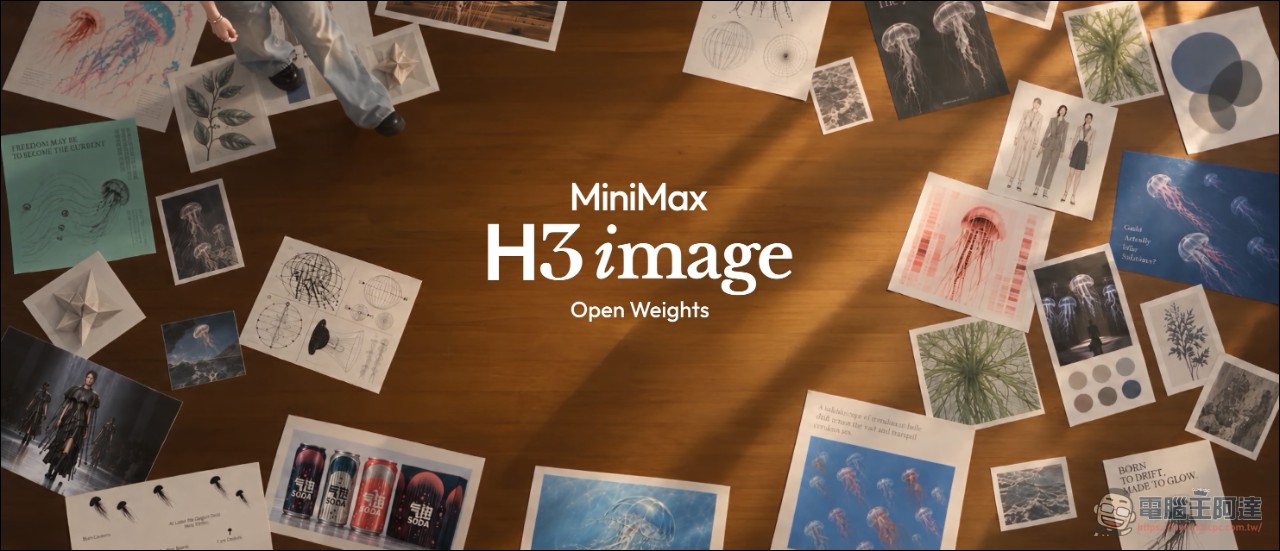
The text encoder directly reuses MiniMax-H3’s full Qwen3-VL without modification, and the DiT reads the hidden states from its 50th layer; the image VAE is a CNN encoder paired with a 24-layer 2D ViT decoder, with 16× spatial downsampling and 24 latent channels. The DiT then splits the latent into 2×2 patches, which works out to each transformer token corresponding to 32×32 pixels.
The speed comes from distillation. This checkpoint is compressed to 6 sampling steps (6 NFEs) and uses no classifier-free guidance at all. These are not default values that users can adjust: the official API returns HTTP 400 whenever it receives a num_inference_steps value other than 6 or a guidance_scale value other than 1, and it rejects negative prompts outright.[4]
Dimensions and reference images
The output achieves about 16 megapixels at any aspect ratio, without going through an additional upscaling model: 1:1 is 4096 x 4096, 4:3 is 4736 x 3552, 3:2 is 5024 x 3360, 16:9 is 5472 x 3072, and 21:9 is 6272 x 2688. The model card describes a practical range of about 4MP to 20MP, and the API sets the upper limit on total output area at 20 megapixels.

Edit mode accepts up to 16 reference images, referenced in the prompt as <Picture 1> through <Picture 16> in upload order. The prompt length limit is 32,000 characters, but when prompt enhancement is disabled, only the first approximately 4,096 tokens take effect. The API also offers a high-speed version called MiniMax-H3-Image-Highspeed, with identical parameters and limits but higher pricing.
Deployment ecosystem: four frameworks, in place on day one
For a newly launched checkpoint, H3-Image’s framework support is unusually comprehensive—and it was in place from day one. SGLang is the reference path in the official demo, with a cookbook and single-GPU launch commands; vLLM-Omni provides deployment recipes for various hardware, naming accelerators including NVIDIA H200, RTX PRO 6000 Blackwell, and AMD Instinct MI350X; diffusers and ComfyUI are also supported. To reduce latency, you can split a single request across multiple GPUs; SGLang uses --ulysses-degreevLLM-Omni is used --usp。
However, both the model card and the API documentation state that the maximum number of reference images is 16, but the vLLM-Omni day-one recipe only demonstrates up to 9. In addition, the model repository also includes an optional prompt expansion model, MiniMax-H3-Image-PE, which uses NVFP4 precision and is 17.9 GB, can be deployed locally, and is used to expand short prompts into detailed English descriptions that the model prefers.
Release cadence: launch first, then announce.
This release sequence was the reverse of most models. The model repository on Hugging Face was created on November 3 but remained empty; the weights were only uploaded on November 10 at 14:50 UTC. On the same day, MiniMax’s API documentation gained an update card titled MiniMax H3 Image, with only one sentence: “Leading open-weight image model, from idea to new world,” and no specifications; and to date, the company’s own blog and news index have no articles about this image model.
As for the price,The standard plan is billed per token.Text input is US$2.30 per million tokens (approx. NT$74.75), image input is US$1.50 per million tokens (approx. NT$48.75), and image output is US$3.80 per million tokens (approx. NT$123.50). Converted per image: 1K image generation is approximately US$0.022 (approx. NT$0.71), 2K is approximately US$0.023 (approx. NT$0.76), 4K list price is US$0.069 (approx. NT$2.24), and US$0.034 after discount (approx. NT$1.12). For editing, 4K plus one reference image has a list price of US$0.073 (approx. NT$2.38), and US$0.037 after discount (approx. NT$1.19); 4K plus three reference images has a list price of US$0.079 (approx. NT$2.57), and US$0.040 after discount (approx. NT$1.29).
With 16 times more pixels but only a little over 3 times the price, this is the most distinctive aspect of this launch in terms of cost structure. Comparing 4K list prices, this open-weight checkpoint is roughly one-eighth of FLUX 3 Image 4K and one-fifth of Nano Banana 2.1 4K.
“Open weights” does not equal global open source.
Weights can be downloaded and the architecture is documented—this is already more open than most frontier image models. But the license terms are the hurdle that determines whether you can use it. H3-Image uses the MiniMax-H3-Image Community License Agreement, with excluded territories covering the EU, UK, South Korea, and the US; annualized revenue over US$1 million (about NT$32.5 million) requires prior written authorization; making the model into a hosted service also requires authorization, with no revenue threshold; commercial interfaces must prominently display the model name; outputs may not be used to train or improve other models. The Hugging Face page reduces all this to a single line: license: other.
Conclusion
MiniMax H3-Image has two notable layers. On the technical side, distilling a 33.1B dense DiT into six-step guidance-free sampling and enabling 16-megapixel output without an upscaling model is the key to turning 4K generation into “a single request” rather than “batch work.” On the commercial side, it pushes the per-image cost of 4K images down to the level of $0.069 (about NT$2.24). In addition to the 68.65 GB of weights, you also need to pull a 66.7 GB text encoder from MiniMax-H3, so the first local generation requires downloading about 135 GB; those capable of deploying it should pay a little attention to this.
Source: KOCPC Chinese