


On November 9, 2026, Meta released “Muse Ember,” the smallest and most cost-effective model in the Muse series, designed to let AI agents perform large volumes of repetitive work, including tool calls, coding subtasks, request routing, data extraction, and long-document parsing. The day after the release, third-party evaluation firms such as Artificial Analysis, Vals AI, and Arena.ai published their results one after another: this model matched Anthropic’s Claude Haiku 5.5 and OpenAI’s GPT-6 Luna on multiple benchmarks, while its actual cost was only about one-third that of its competitors.
Intelligence score matches Claude Haiku 5.5, with per-task cost down to one-third.
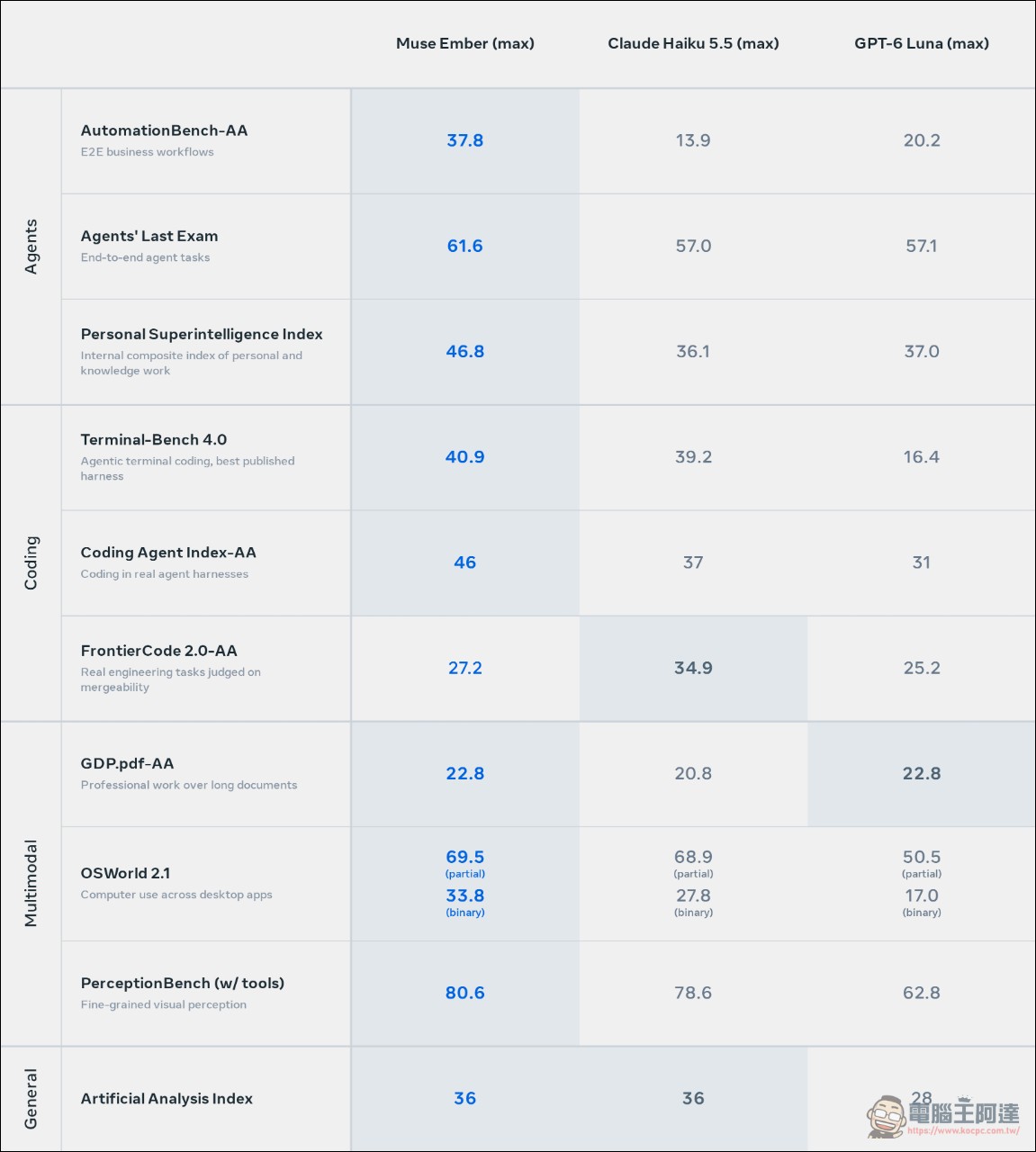
According to Artificial Analysis evaluations, Muse Ember scored 36 on the Intelligence Index, which measures overall intelligence, tying the highest reasoning setting of Claude Haiku 5.5; Meta’s published unrounded values were 35.8 versus 36.2, a very small gap. In terms of processing cost per evaluation task, Muse Ember costs about US$0.14 (about NT$4.4), while Claude Haiku 5.5 costs US$0.41 (about NT$12.9). OpenAI’s GPT-6 Luna scored 27.8 at its highest setting at about US$0.15 per task; at a lower setting, the cost dropped to about US$0.07 but the score fell to only 21.4.
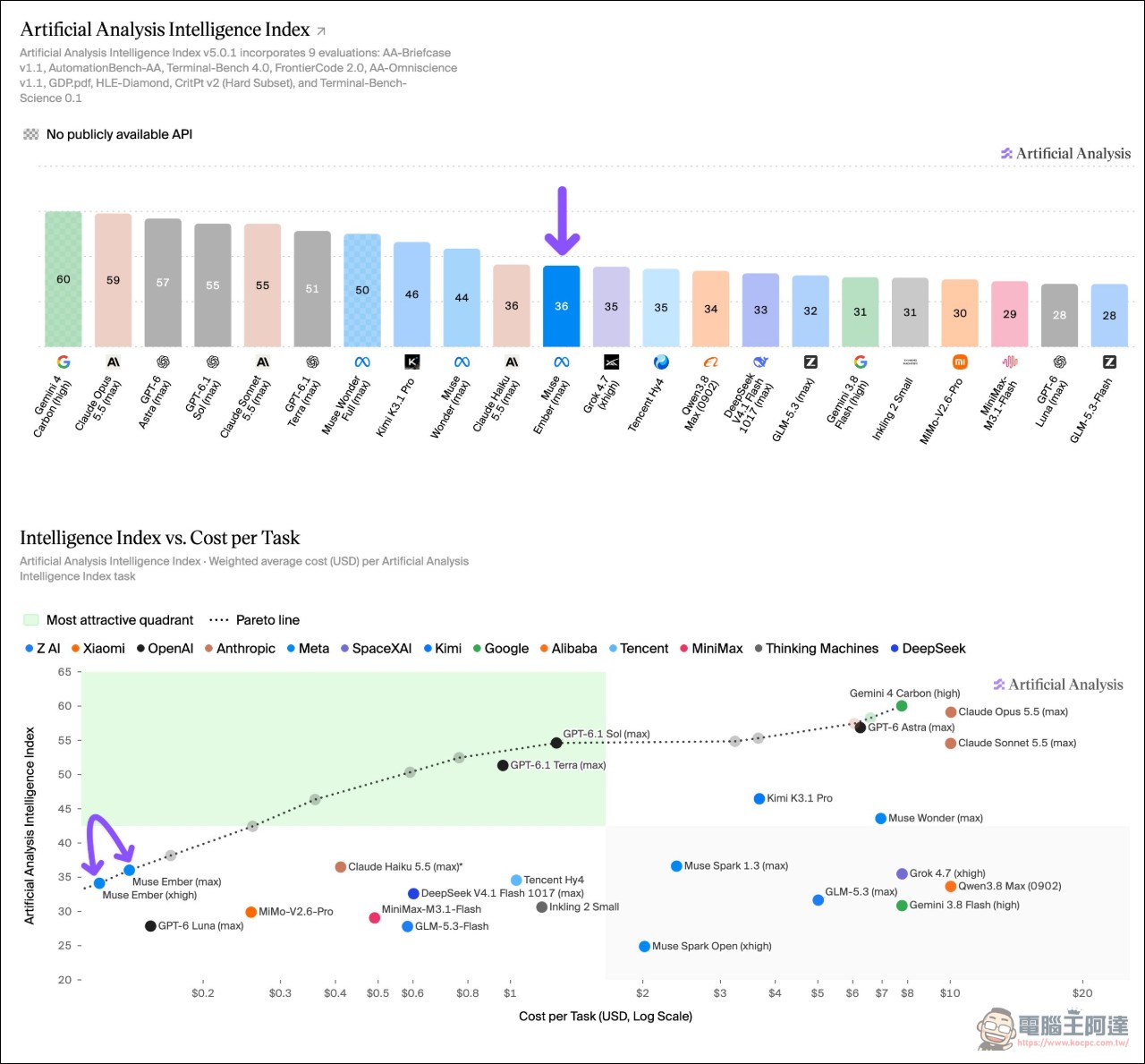
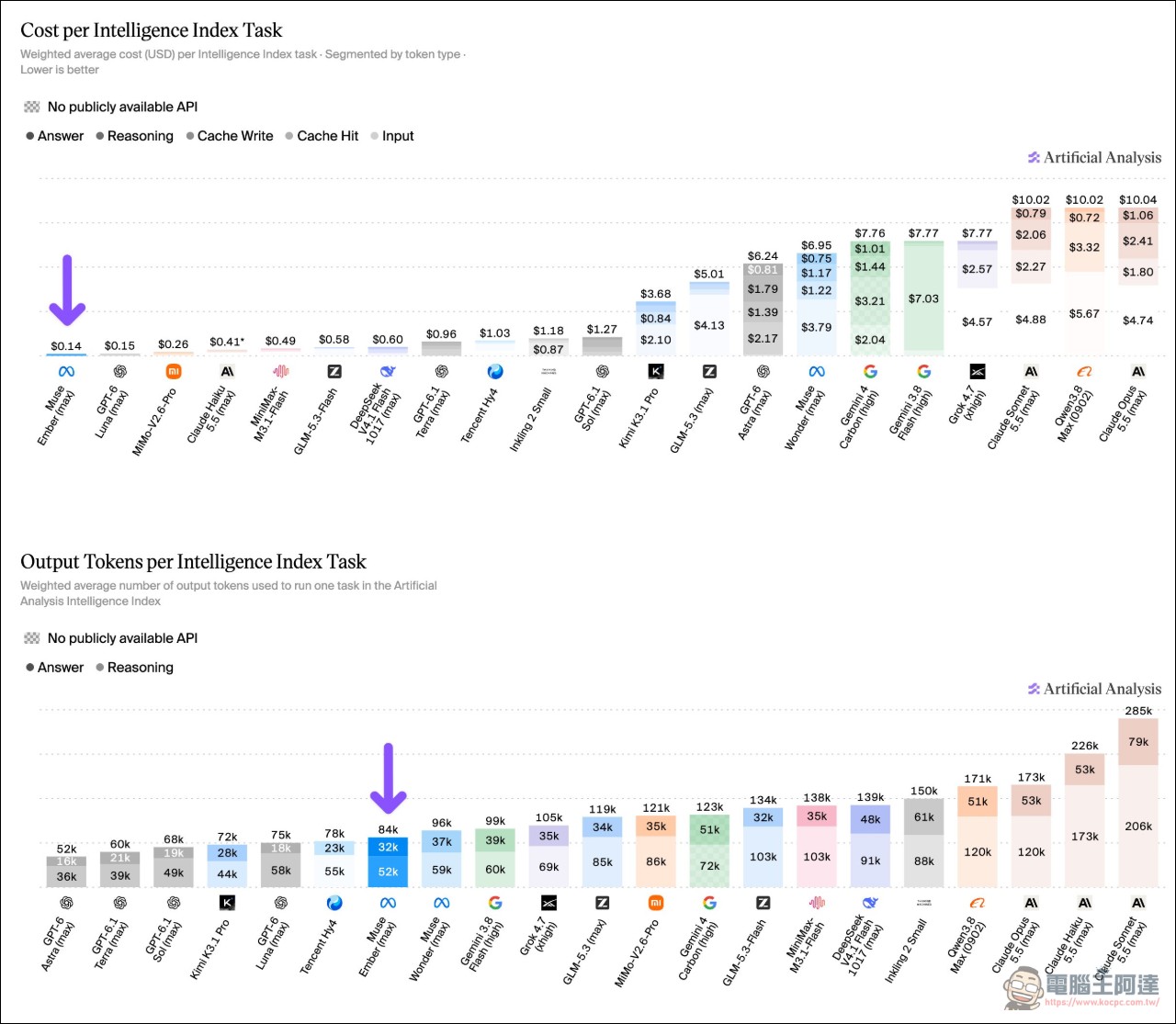
Interestingly, the two companies’ API unit prices are exactly the same: US$0.10 per million input tokens (about NT$3.2) and US$0.50 per million output tokens (about NT$15.8). Artificial Analysis attributes the cost gap to two sources: Muse Ember’s cached input token price is 60% cheaper, and in the organization’s agentic evaluation, cached input is the main cost driver; in addition, the output tokens Muse Ember needs to handle the same task are only about one-third of Claude Haiku 5.5’s. Meta’s official blog also cites this set of data, emphasizing that Muse Ember sits at the best combination of efficiency and intelligence, and that no model can achieve a higher score at a lower cost per task.
Its weakness is knowledge-based Q&A, but it rarely makes things up.
Muse Ember is not strong across the board. In Artificial Analysis’s “AA-Omniscience” knowledge test, its accuracy was only 21.1%, the lowest among models of comparable intelligence, mainly because it chose to refuse to answer 64% of the questions. The benefit of this conservative strategy is a low hallucination rate: its rate of producing incorrect information was 17.4%, about half that of Claude Haiku 5.5. On most benchmarks, Muse Ember beats Haiku and Luna by only a few percentage points, with its advantages concentrated in specific uses. In the “FrontierCode 2.0” evaluation, which approximates real-world software development scenarios, Muse Ember lost to Claude Haiku 5.5.
Law, finance, and agent automation are strengths.
Another evaluation organization, Vals AI, gave Muse Ember 60.48% on its “Vals Index v2.2,” ranking it 12th among 35 models; each test costs about US$0.15 (about NT$4.7), the cheapest overall, and completing the test takes only about 15 minutes, the fastest among the top 12. Looking at individual domains, it ranked 4th in the legal category “Legal Index” (out of 36 models), tied for 2nd in the professional tasks “HLAB-Vals-1.1,” 10th in finance “Finance Index” (out of 38 models), 15th in terminal programming “Terminal-Bench 4.0” (out of 62 models), and 14th in tax agent “Tax Agent Bench” (out of 83 models).
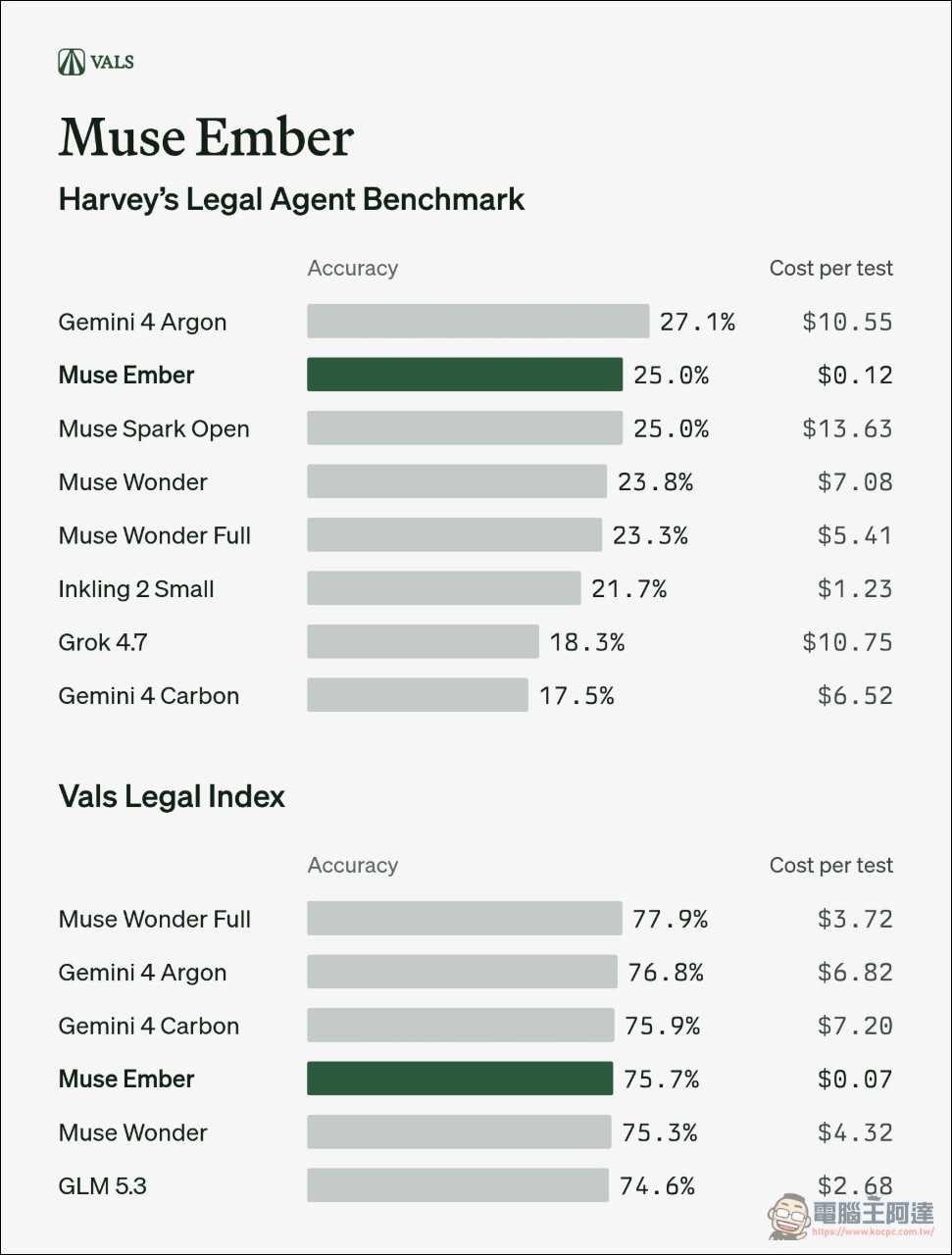
Muse Ember’s biggest lead is in enterprise process automation: on “AutomationBench-AA,” which covers 657 tasks across cloud applications such as Gmail and Salesforce, it leads Haiku and Luna by 17%, while its advantages on other benchmarks are mostly only a few percentage points. This is Meta’s first AI trained using its own flagship model, Muse Wonder. Meta did not specify which specific part of automation it targets; speculated directions include post-training processes. In common multi-model architectures, the flagship model breaks work into small tasks and dispatches them to agents powered by low-cost models, and Meta states that Muse Ember is optimized for the latter role.
First among small models for web development
Arena.ai, which specializes in web development evaluations, announced that Muse Ember’s highest reasoning setting scored 1608 on “Code Arena: WebDev,” the highest score among small AI models, surpassing Claude Haiku 5.5 (high setting) at 1595 and GPT-6 Luna (highest setting) at 1578; the two competitors rank 35th and 42nd on the overall leaderboard, respectively, while Muse Ember’s 1608 corresponds to about 34th on the overall leaderboard. The cost side is even more striking: for median cost per web development task, Muse Ember is US$0.03 (about NT$0.9), GPT-6 Luna is US$0.06, and Claude Haiku 5.5 is US$0.11 (about NT$3.5).
Muse Ember (Max) from @AIatMeta just landed in the Code Arena: WebDev as the highest-performing small model – built for fast, high-quality, low-cost work. Watch the video below: 20+ websites and animations, all generated by Ember in one go. Across the generations we timed, the average was about 2 minutes and about $0.04 per task.
— Arena.ai (@arena) November 9, 2026
In terms of launch positioning, Meta places Muse Ember within the division-of-labor architecture of agent systems: AI agents can break complex tasks into small jobs and execute them repeatedly—for example, in software development, reading files, running tests, and modifying code. If these steps were all handed to expensive frontier models, costs would quickly accumulate; Muse Ember’s goal is to handle these smaller operations at scale.
Pricing structure and the price jump above 200,000 tokens
Muse Ember is available on the Meta Model API under the name “muse-ember-1.0” and supports the Responses, Chat Completions, and Messages endpoints. It can read text, images, audio, video, and PDFs, and outputs text. Reasoning intensity can be set from lowest to highest, with the default being highest. The context window is 1,048,576 tokens, with a maximum output of 524,288 tokens. Pricing has two tiers: when input does not exceed 200,000 tokens, uncached input costs $0.10 per million, cached input $0.004 per million, and output $0.50 per million; once it exceeds 200,000 tokens, the entire request (including output) is billed at $0.30, $0.012, and $1.50 respectively.
On the access channel side, in addition to the Meta Model API, Muse Ember is also integrated into Meta’s own coding assistant tool, Muse Code. Meta also lists Oracle Cloud as another access route, while Google Cloud’s preview documentation states that it supports text and image input. The model is under a proprietary license, and the model weights are not available for download.
Executive Positioning and Developers’ Hands-On Reviews
Meta CEO Mark Zuckerberg introduced Muse Ember on X as “our smallest model, offering higher intelligence per dollar in its class.” Chief AI Officer Alexandr Wang put it more directly: “Wonder handles planning, Ember handles capacity.” The official blog also emphasized that Muse Ember sits on the efficiency frontier of the full Artificial Analysis leaderboard, where no model can achieve a higher intelligence score at a lower cost per task.
Releasing Muse Ember today — our smallest model that delivers higher intelligence per dollar than others in its class. Built for token-heavy work that agents repeat all day: tool calls, coding subtasks, routing, extraction, and long document parsing. Available today on the Meta Model API and in Muse Code.
— Mark Zuckerberg (@finkd) November 9, 2026
Across the results from various evaluators, Muse Ember trails Claude Haiku 5.5 on knowledge Q&A and high-difficulty software engineering, but in high-repetition scenarios such as repeated agent execution, enterprise automation, and web development, it uses same-priced tokens, fewer output tokens, and cheaper caching to push per-task cost to about one-third of its competitor’s. Different evaluation organizations test different tasks and execution environments, so scores cannot be directly compared; for agentic workloads that prioritize cost and speed, this model is an additional practical option.
Source: KOCPC Chinese