


If you often follow online news, you’ve probably heard that Claude loves banning/deleting Chinese users’ accounts. The main reasons are: 1. anti-distillation (the main reason), 2. some Chinese accounts do “carpooling” (sharing account quota with relay stations or other people), 3. problems with payment channels (they can’t receive the money)… As a result, a usable Claude Max account in China can be sold for money; the price is not cheap, so some gray-market industries have emerged. Recently, someone on X shared a new business: some people specialize in handling Claude KYC (Know Your Customer, identity verification) on behalf of clients. These people travel to underdeveloped villages in western Indonesia, find local residents offline to complete identity verification face-to-face, register Claude accounts, and then settle in cash.
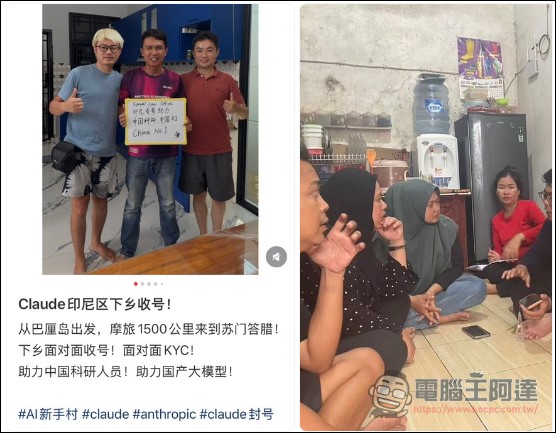
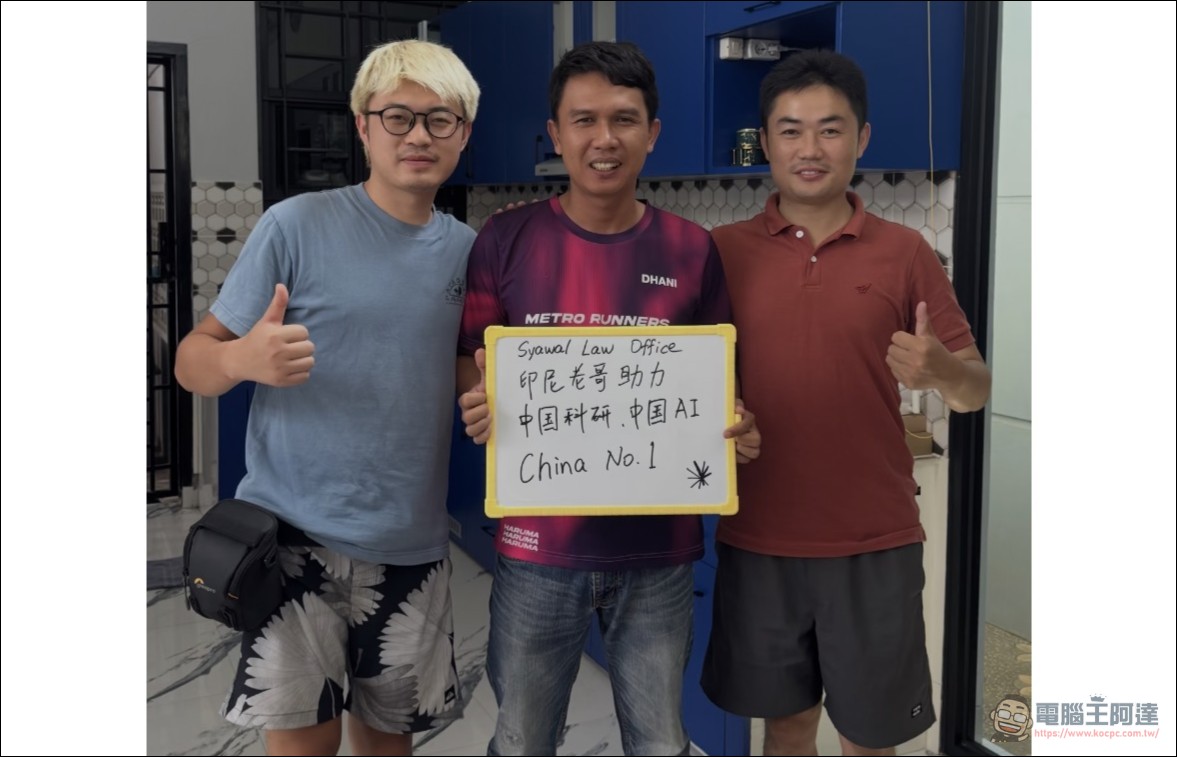
In the accompanying image, three men indoors in front of a blue cabinet hold up a handwritten whiteboard reading, “Syawal Law Office Indonesian old accounts, boosting Chinese research and Chinese AI, China No.1.” The leaked advertising copy circulating with the tweet also claims they rode motorcycles 1,500 kilometers from Bali to Sumatra to collect numbers in rural areas, which shows the profits are quite substantial.
这也太卷了。一位做 Claude KYC 生意的老哥,跑到印度尼西亚西部的村庄,线下找印尼大妈,面对面做身份验证,注册 Claude 账号,然后现金结算。 https://t.co/60prssKqti
— AB Kuai.Dong (@_FORAB) November 7, 2026
How did KYC get into Claude?
On April 15, 2026, Anthropic quietly uploaded a support center article titled〈Identity verification on Claude〉, with no announcement or press conference, some users began being asked to present a government-issued photo ID and take a live selfie facing the camera, with the verification process handled by San Francisco-based identity verification provider Persona Identities. Photocopies, digital IDs in mobile wallets, and temporary paper IDs are not accepted. Public opinion is split: privacy advocates see it as surveillance creep, while AI safety researchers believe this is exactly the approach they have been advocating for more than a year. Claude thus becomes the first major AI platform to implement this level of identity check for consumer users.
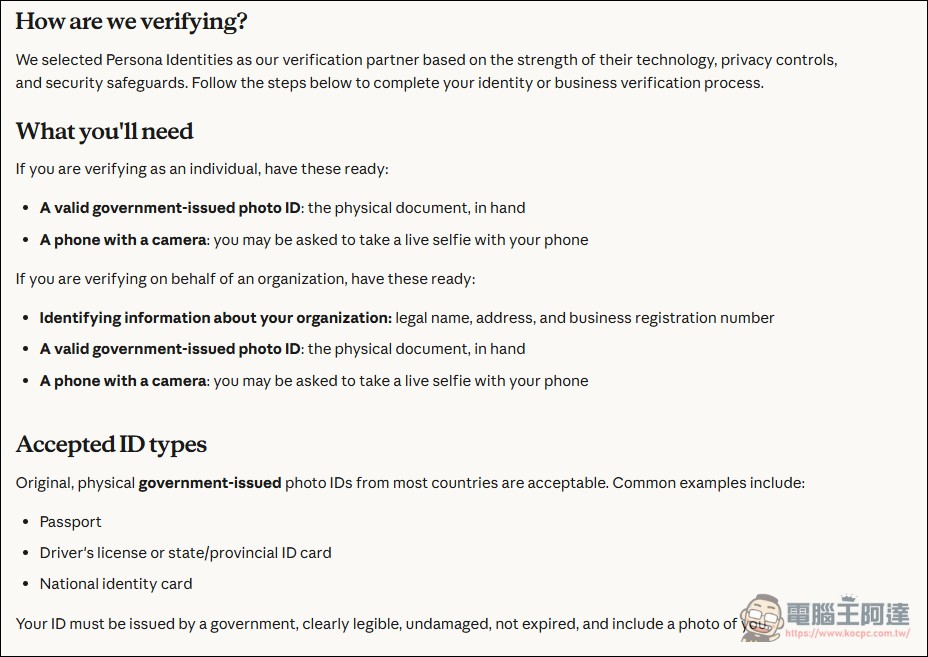
The timing correlation is clearly documented. In February this year, Anthropic released a distillation attack report naming three Chinese labs—DeepSeek, Moonshot AI, and MiniMax—that collectively used about 24,000 fraudulent accounts to conduct more than 16 million conversational exchanges with Claude and used the outputs for distillation training. An April White House memo also warned that Chinese entities were using “tens of thousands of proxy accounts” to conduct large-scale extraction from U.S. frontier models. The design logic behind KYC is that fake phone numbers and fake addresses can be forged, while a real-time selfie paired with a physical ID is difficult to forge. Implementation uses selective rollout, triggered by specific use cases or platform integrity flags, rather than being a blanket requirement.
The gray industry’s response: when online channels fail, find people offline.
Zilan Qian, a researcher at the Oxford University China Policy Lab, documented the division of labor in this trade in a long-form ChinaTalk article: AI services can already mass-produce highly realistic fake IDs convincing enough to fool verification on major platforms, and deepfake tools can remotely create digital personas that pass biometric authentication. Once defenders upgrade detection, the underground industry switches to a more labor-intensive but more reliable approach—sending people to low-income countries to hire real people to complete offline verification. The specific precedent she cites is the Worldcoin black market: KYC merchants in Cambodia and Kenya had their iris scans collected and resold for less than $30 each. In Indonesian villages, cash transactions to register Claude Max accounts match the currently popular playbook, pulling the KYC circumvention industry from online deepfakes back to offline physical bodies.
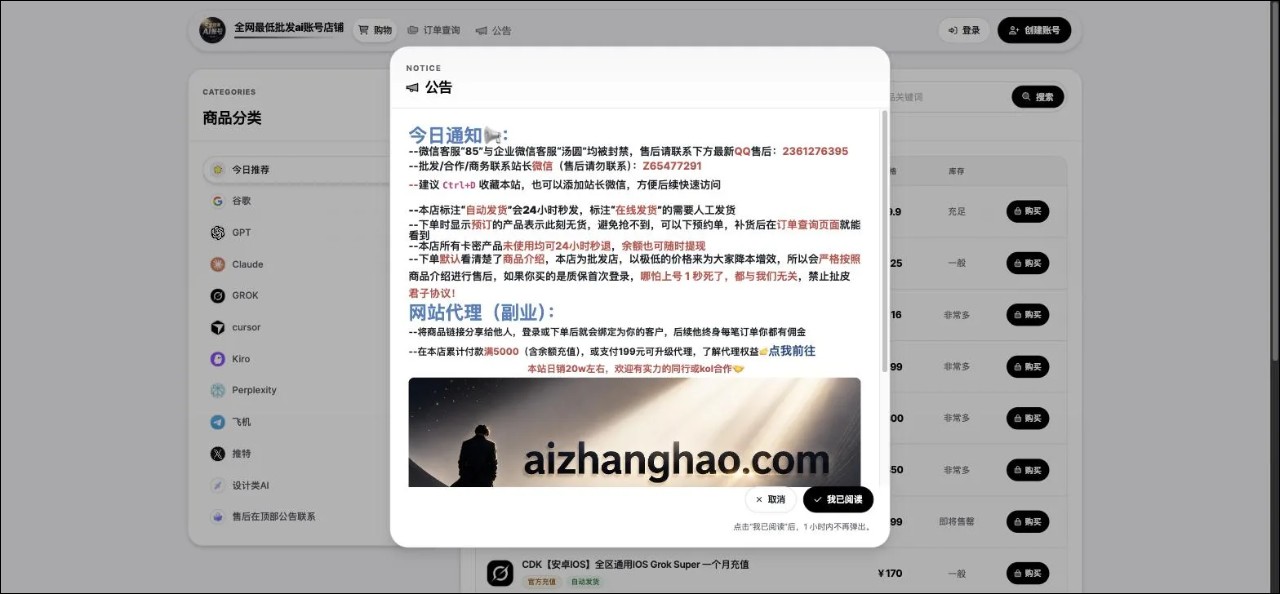
On the demand side, what sustains this business is a sizable account trading market, and security researchers Vectoral An investigation found that a business that packaged itself as a software design studio—registered in the UK, with a company address, and outwardly normal—was actually reselling Claude accounts and openly seeking sources for more than 1,000 accounts per month. Another account trading platform, which claims daily sales of about 200,000 RMB (about NT$945,000), welcomes partnerships with industry peers and influencers. The account acquisition channels are also publicly documented: upstream suppliers’ regular tactics include bulk-registering accounts to exploit Anthropic’s $5 free credit, reselling the remaining credit on other people’s accounts, arbitraging enterprise and education discounts, and “APImaxxing”—splitting a $200 Max subscription and reselling it to multiple people.
Account Wholesale Market Price List
According to price listings on trading platforms compiled by Vectoral, Claude-series accounts are mainstream market products: Claude Pro accounts make up 74% of one platform’s listings, Claude Max 5x 54%, Claude Max 20x 24%, and ChatGPT Pro 5x 24%. Wholesalers on Telegram are directly pitching operators of “relay stations,” quoting a unit price of RMB 200 (about NT$945) for ready-made Pro 20x accounts.
Downstream buyers fall into three categories: model labs doing distillation, API relay stations reselling credits, and ordinary consumers circumventing geopolitical restrictions or chasing bargains. Trading mostly happens in Telegram groups, with some listings on second-hand marketplaces like Goofish. Relay stations push Claude model prices down to 10% or even 5% of official pricing. The low prices are essentially a “one fish, three ways” arrangement: selling credits is just customer acquisition; harvesting and selling users’ conversation logs is the real profit source (which is why it’s best not to use relay-station APIs).
Whose document was bought?
Anthropic emphasized in its official explanation that verification data is kept by Persona, does not enter Anthropic’s systems, is not used to train models, and is not shared with third parties except under legal process. The business logic of the offline agent business is exactly the opposite: at the moment the ID and face are recorded in an Indonesian village, account ownership has already been transferred to the buyer, and the flow of ID and biometric data has left the platform’s protection framework. ChinaTalk’s commentary is that the infrastructure supporting account farms (mass SMS verification, fraudulent registrations, stolen-card accounts) simultaneously feeds broader criminal markets such as scam calls, phishing texts, and credit loan fraud, while those who bear the consequences are often already vulnerable residents of the Global South. The verification system also inadvertently harms ordinary users: there are parents in Hacker News reflectsA 15-year-old son’s Claude Max subscription was suspended after the system detected “signals that the user is a child,” and he was asked to prove he was at least 18; Anthropic later refunded the full fee for that month.
Conclusion: For every additional layer of regulation, another layer of circumvention emerges.
This distorted situation is actually a structural problem: every layer of control that frontier AI companies stack on—geoblocking, phone verification, credit card requirements, real-time biometric KYC—has correspondingly spawned a layer of circumvention infrastructure, and KYC has nurtured an industry chain running from forged documents to biometric data collection in Southeast Asia. Tweets on X show the last link in this chain: now that technical defenses have escalated to this point, the most efficient bypass has returned to the most primitive manual labor—cash, villages, face-to-face. An account being able to pass verification means the system recognizes a real person who exists, but this person may never use these AI services in their lifetime, and they don’t care. However, whether this behavior will, like scam syndicates buying up bank accounts everywhere, ultimately affect the people who sell their accounts remains unknown.
Source: KOCPC Chinese