


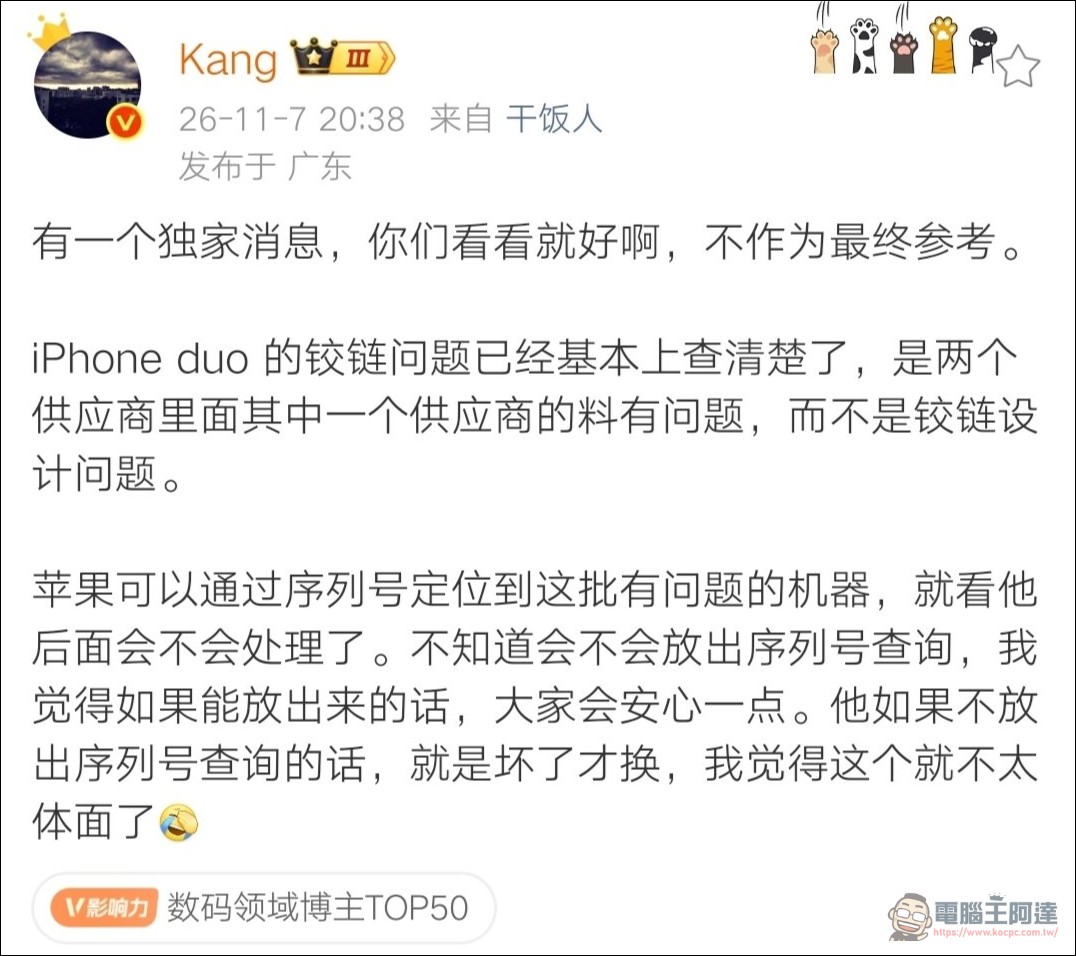
Three weeks after Apple’s first foldable phone, the iPhone Duo, went on sale, the issue of the inner screen cracking along the hinge continues to escalate. Apple has acknowledged that a small number of devices are affected and is offering replacements, but it has never explained the cause or disclosed the affected batch or serial number ranges. On the evening of November 7, Chinese tech analyst Kang posted an “exclusive” on Weibo, pointing the finger at the supply chain. He said the iPhone Duo’s hinge problem has basically been identified: the issue lies in the “material”—the material itself—from one of two suppliers, not in the hinge design. He also noted that Apple can use serial numbers to locate this batch of problematic devices, but whether it will release a public lookup tool and whether it will proactively replace them remain unanswered.
The tip-off was about the materials, but the supplier is crying foul.
This leak makes two key points: first, the root cause is a material defect from the supplier, not a problem with Apple’s hinge design; second, Apple has a list and can use serial numbers to identify batches of machines that may have issues.
The second point holds up logically. Apple’s old practice for handling batch hardware issues has been to check serial numbers; with the 2016 and 2017 MacBook Pro Flexgate display cable issue, it first opened serial number lookup and only later expanded it to models from other years. As for the first point, hinge-related component supplier Fine M-Tec has proactively issued a statement distancing itself. In its October 26 statement, the company said the quality issues recently reported on certain products were not caused by quality defects in components supplied by the company. Fine M-Tec makes internal hinges and metal support plates for foldable OLED displays; these support plates are intended to help share the stress placed on the panel during folding. The company also said it is considering legal action against those who spread related allegations before the issue had been clarified.
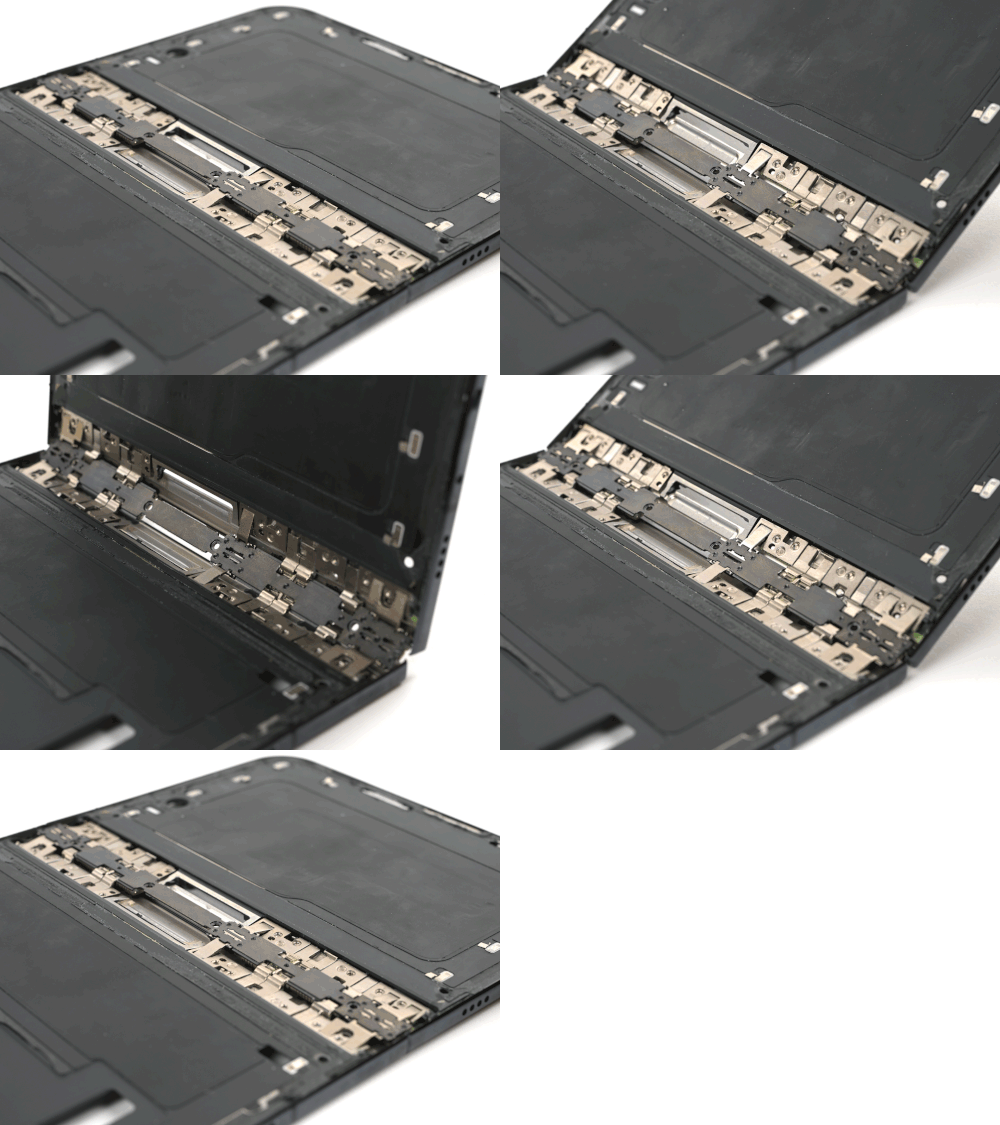
The iPhone Duo’s hinge assembly has two main suppliers, Amphenol and Shin Zu Shing, both US and Taiwanese manufacturers. The liquid metal hinge shaft is supplied by Yian Technology. If the leak is accurate, the other company should be the one being questioned, not Fine M-Tec.
iFixit’s conclusion points to the design side.
The most complete technical analysis so far comes from iFixit. They took the iPhone Duo apart, reconstructed a 3D hinge model using teardown videos, patents, and CT scans, and then overlaid user-reported damage locations for comparison.
The conclusion is that the cracks are not concentrated at the usual stress point where the display cable passes through the hinge, but slightly lower, in the transition zone where the gap between the crossing cables leads into the central hinge support. iFixit’s own description is that multiple edges meet at that location, and the way the display panel is supported when it bends changes there, making it the most likely place for stress to accumulate.
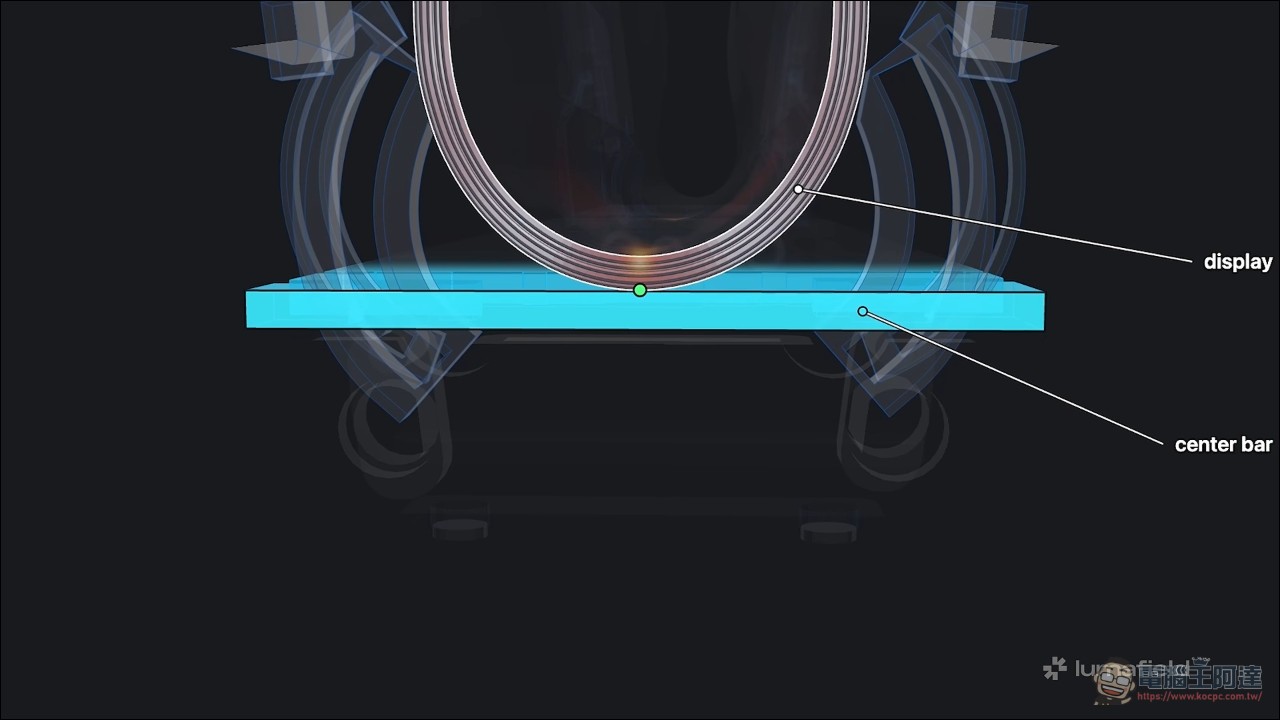
One possibility they raised is that the central support strip did not fully retract when closing, and the curved fold corner of the screen pressed down, creating a small stress concentration point at that location. Apple’s hinge patent describes a variable torque design, with more than a hundred parts operating through different gear ratios. iFixit also pointed out that this hinge survived more than 10,000 folds in durability testing without cracking, yet on production units it cracked after just a few dozen folds. This is one of their reasons for judging that the problem lies in manufacturing rather than the design drawings.
Apple’s own official support document doesn’t pin down the cause either. The document lists five hinge conditions that users need to handle themselves: the device cannot fully open or close, unexpected noises when opening or closing, a loose hinge, a bent or damaged hinge, and damage to the chassis that affects hinge operation.
Apple’s internal claims versus the actual numbers
Apple’s public statements have remained at the level of “a small number of devices.” The official statement says that early user response after the iPhone Duo launch has been very positive, but it has noticed that a small number of iPhone Duo inner screens have developed problems. Such issues usually appear shortly after initial use, and the vast majority of devices have not been affected. Affected users can contact AppleCare to replace their devices.
For users in Taiwan, the most practical consideration is repair cost. According to the estimated repair service fees published on Apple Taiwan’s official website, for inner screen damage, the charge without AppleCare+ is NT$37,350, while with coverage it is NT$3,200; other accidental damage is also NT$3,200. Incidentally, the nano-texture protective layer on the iPhone Duo’s inner display and the inner display are designed for independent repair, so the two can be replaced separately.
How should the credibility of a leak be judged?
Putting this report into the standard framework for interpreting leaks leads to a somewhat conservative conclusion. If Apple can precisely identify a small batch of inventory units by serial number, the cost of dealing with those units would be far lower than a full recall, and it would not have to admit that the hinge design is defective. And the claim that “there is a problem with supplier materials” neatly explains three things at once: Apple not disclosing the root cause, suppliers issuing separate statements to distance themselves, and fluctuations in yield.
One clue echoes this. A Foxconn employee told the media that when capacity was tight, yield standards had been relaxed, and the production line later urgently replaced a batch of materials; this account has likewise not been officially confirmed by Apple. The so-called “material replacement” and “the supplier’s materials had problems” sound like two ways of saying the same thing.
And even earlier, this kind of judgment had a rather pessimistic precedent. Among the three possibilities iFixit raised for the Duo hinge failure, besides speculation about design, there were also manufacturing- and usage-level factors such as external pressure, foreign objects getting stuck, and repeated bending. In other words, even if Kang’s account is accepted, “the supplier’s material had a problem” and the stress concentration hypothesis proposed by iFixit are not entirely mutually exclusive.
Conclusion
What can be confirmed now is this: Apple acknowledges that a problem exists and offers free replacements, but it has never disclosed the root cause, the affected batches, or the serial number range. Hinge supplier Fine M-Tec has publicly denied responsibility, pointing to the other of the two main hinge assembly suppliers. iFixit’s teardown analysis, meanwhile, points the finger at design and manufacturing rather than at the material quality of a single part.
The leak offers a new possible direction: Apple has a list, and the list may not be large enough to require a full recall. But this is still only a single leaker’s claim, and Apple has made no public move to corroborate it. For users already experiencing the problem, the conclusion need not wait. Apple will accept replacement for any device reported as abnormal; there is no need to wait for Apple to release a serial number lookup tool. In Taiwan, the inner-screen repair fee for users without AppleCare+ is NT$37,350, versus NT$3,200 with coverage; that gap is worth factoring into the insurance cost calculation for the next foldable phone.
Source: KOCPC Chinese