


GPT-6.1 Terra is finally here! OpenAI announced its official launch earlier, and this upgrade is huge. Compared with the previous generation, the AI not only understands screens better and is better at operating computers for you, but its software development capabilities have also improved significantly. More importantly, the price: the API unit price is more than 50% lower than the previous generation. According to test results published by third-party benchmarking organization Artificial Analysis, GPT-6.1 Terra Max’s overall capability is already about on par with GPT-6.1 Sol Medium, and in some of OpenAI’s official tests, it even beats GPT-6.1 Sol Max.
GPT-6.1 Terra officially launches: major upgrades to computer use and visual understanding, API price cut in half, scores 48 in third-party comprehensive evaluation
OpenAI officially announced earlier. GPT-6.1 Terrasucceeding the previous generation GPT-5.6 Terra, positioned as a fast and efficient model.
This upgrade has four key points:
- Stronger visual understanding and computer operation skills.
- Factual errors have been significantly reduced.
- Programming development capability more than doubled.
- The standard API price is 50% cheaper than both GPT-5.6 Terra and GPT-6.1 Sol.
First, “stronger visual understanding and computer operation.” This time, OpenAI provides three tests to demonstrate Terra’s computer operation and visual capabilities: OSWorld 2.1, Agents’ Last Exam v1, and MMMU-Pro.
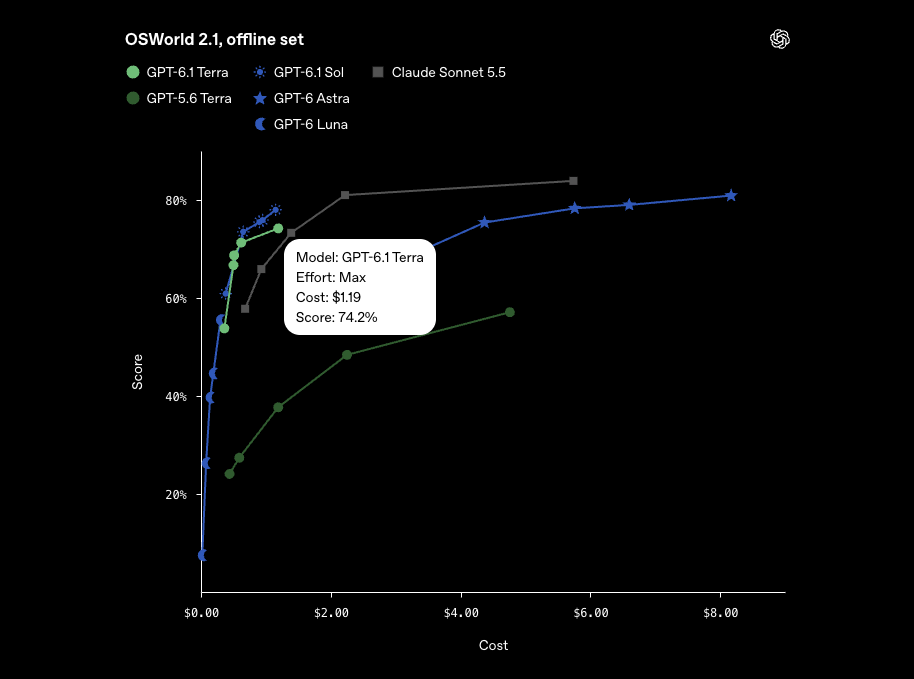
OSWorld 2.1 is a benchmark that has AI actually operate desktop software, and it usually takes several steps to complete, for example, building a corresponding 3D model in the software based on a technical drawing. With only Medium reasoning enabled, GPT-6.1 Terra’s score already surpasses the best performance among all reasoning levels of GPT-5.6 Terra. At Max, its 74.2% score is roughly close to GPT-6.1 Sol Xhigh (75.9%):
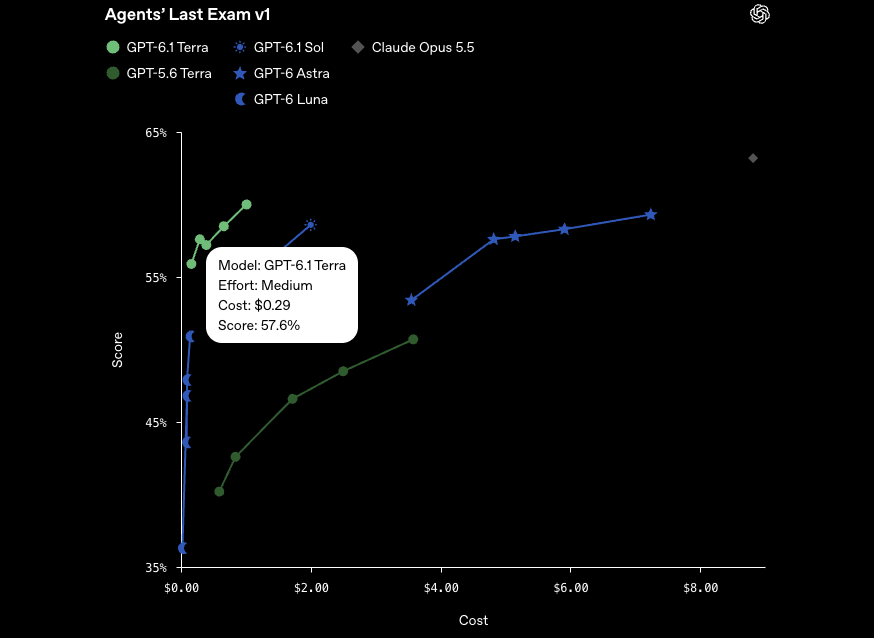
Agents’ Last Exam v1 is closer to real workplace professional tasks, including converting architectural drawings into 3D models, or reviewing an animated film shot by shot and compiling a time-coded record for the restoration team. With Medium reasoning, GPT-6.1 Terra’s score of 57.6% is already 6.9% higher than GPT-5.6 Terra Max’s 50.7%, while costing only about one-third as much. Its performance is even comparable to the strongest GPT-6 Astra Medium, but the price per token is only one-tenth:
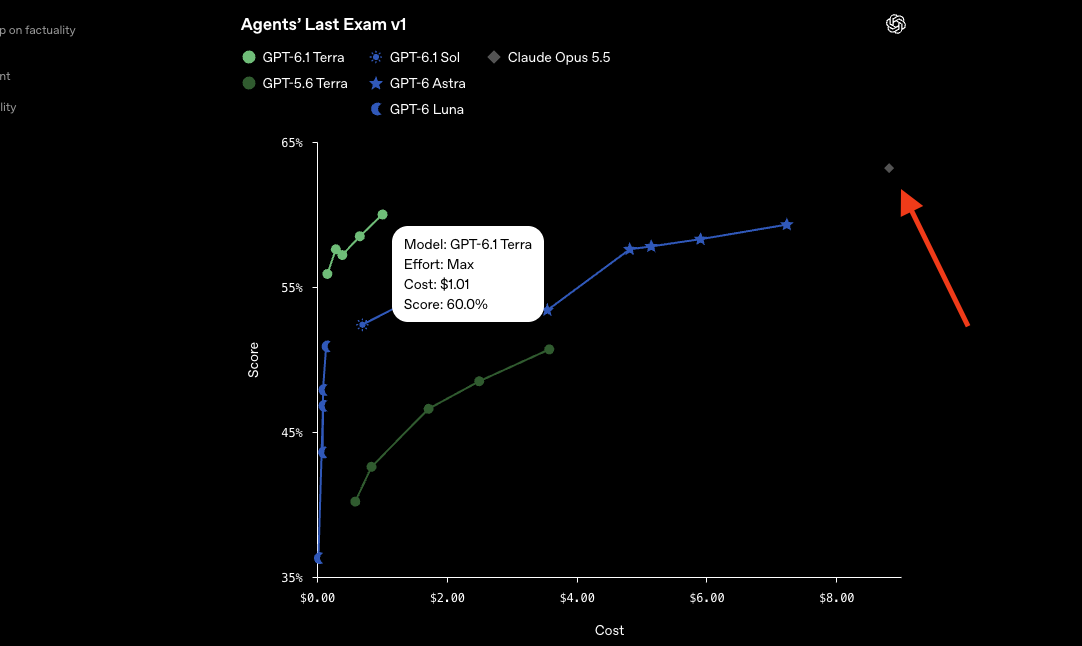
Compared with Claude Opus 5.5, GPT-6.1 Terra Max scores only 3.2% lower, yet its token usage efficiency is more than three times that of Opus 5.5, and its price per token is only one quarter; multiplying the two together, the cost per task is about 9 times lower:
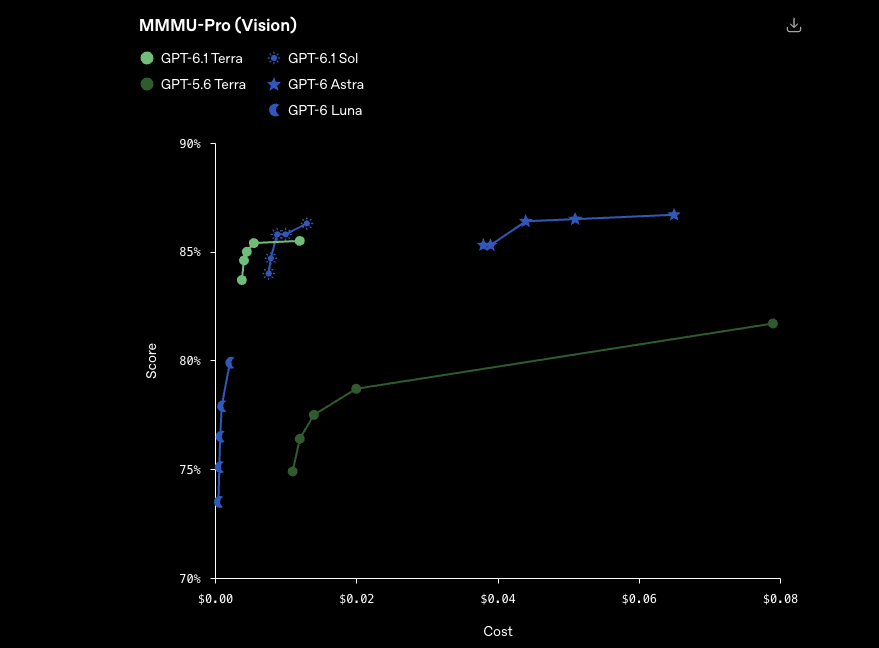
MMMU-Pro measures image-based reasoning ability; its questions mix charts, diagrams, photos, and text, testing whether a model can truly understand the image content before reasoning. GPT-6.1 Terra beats GPT-5.6 Terra under every reasoning setting, and its scores nearly catch up to GPT-6 Astra and GPT-6.1 Sol:
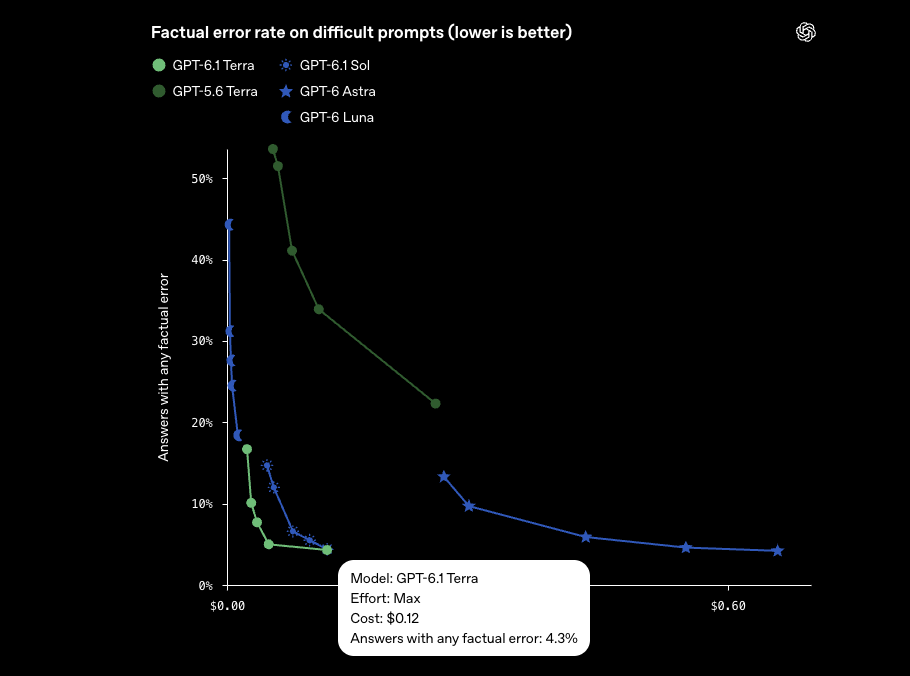
In the “Factual Errors Greatly Reduced” section, OpenAI stated that this year it invested substantial resources in reducing hallucinations and factual errors. Under Low reasoning, the previous generation GPT-5.6 Terra had an error rate as high as 53.6%; GPT-6.1 Terra dropped to 16.7%, a decrease of nearly 37%. In plain terms, previously, when Low reasoning was enabled and trick questions were given, more than half of the responses contained factual errors; now only about one-sixth do. When Max reasoning is enabled, the error rate drops by a further 18%, to only 4.3%, already approaching the level of GPT-6 Astra Max and GPT-6.1 Sol Max:
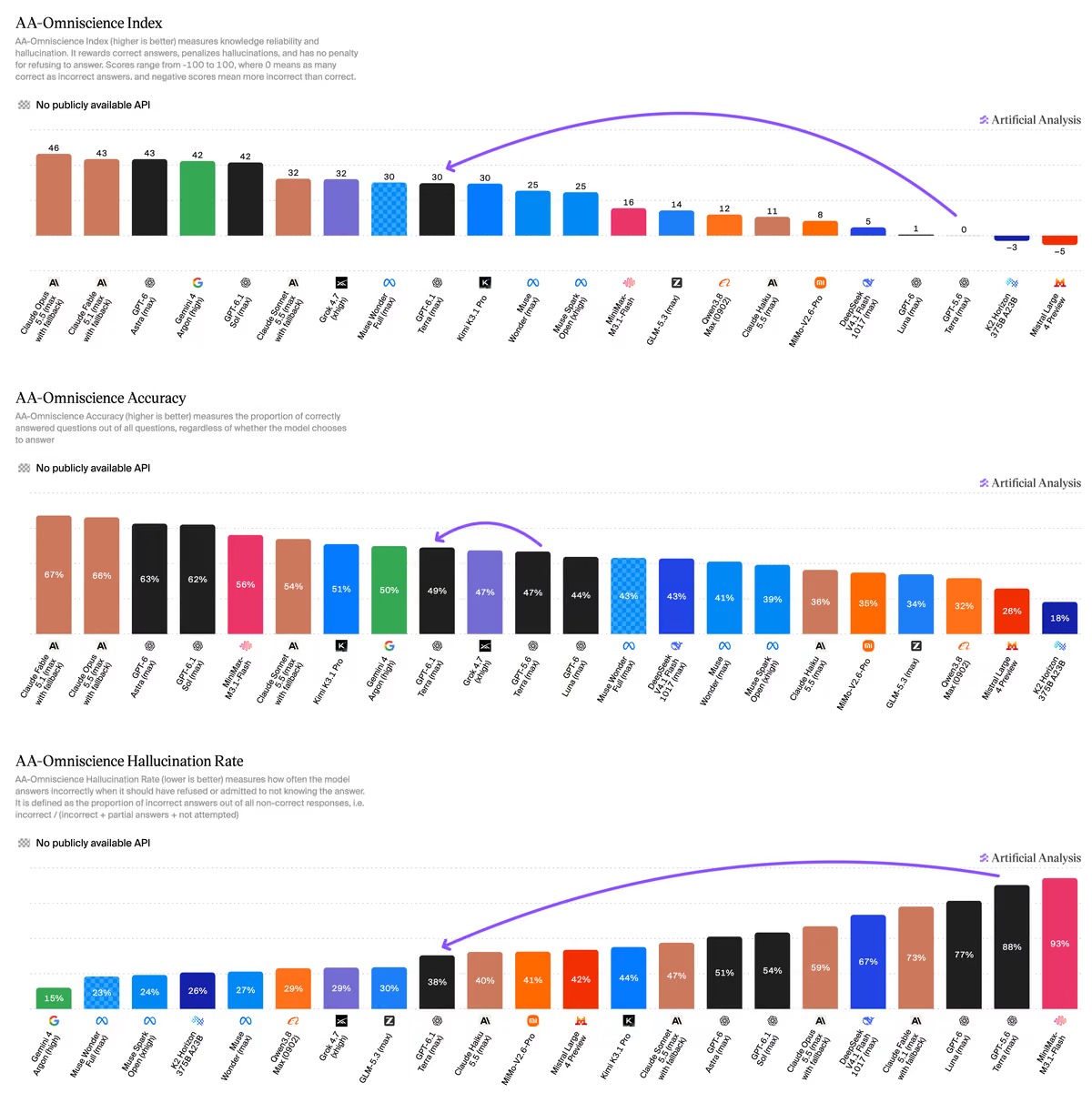
Third-party test results are the same. Artificial Analysis’s AA-Omniscience is a proprietary knowledge and hallucination test that records the proportion of times a model guesses when it does not know the answer. GPT-5.6 Terra Max’s Hallucination Rate is 88%; GPT-6.1 Terra Max drops to 38%, while its accuracy rate also improves by 2 points:
Next is “software development.” Terminal-Bench 4.0 tests AI coding agents’ ability to solve problems in a command-line environment, such as fixing a webpage whose layout jumps around when it loads. GPT-6.1 Terra solved 50.3% of tasks under Max reasoning, while GPT-5.6 Terra scored 21.5%, more than doubling:
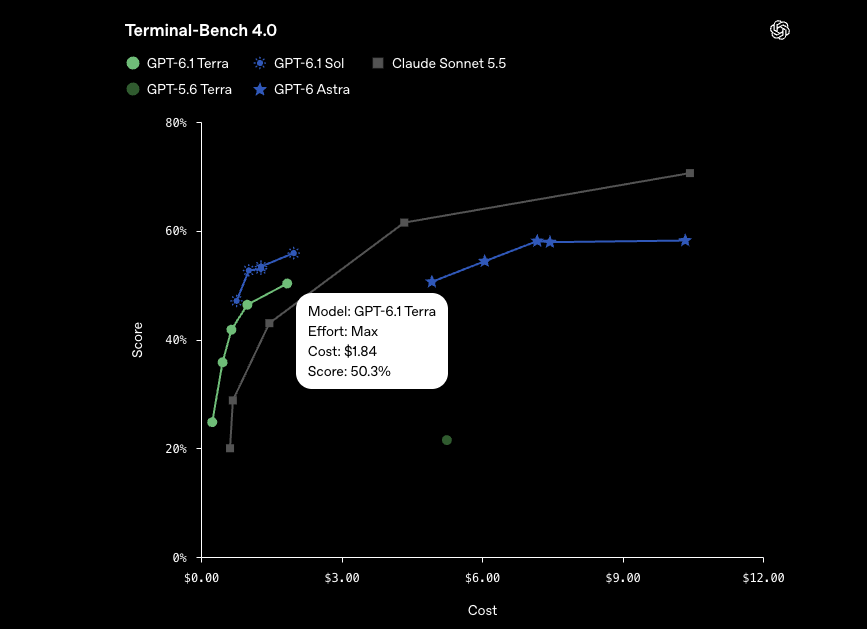
Compared with GPT-6.1, Max’s score falls between Low and Medium, but GPT-6.1 Terra Max costs more than GPT-6.1 Sol Medium, so in this regard GPT-6.1 Sol still looks more cost-effective. OpenAI also mentioned that for the most complex programming tasks, using GPT-6.1 Sol and GPT-6 Astra remains the better choice.
After reviewing the official data, you can also refer to the third-party Artificial Analysis Intelligence Index scores, which combine multiple evaluations into a single composite score covering work tasks, coding and agentic capabilities, knowledge and hallucinations, visual understanding, and reasoning:
| Model (Reasoning Level) | Intelligence Index | Average cost per task |
|---|---|---|
| GPT-5.6 Terra(Max) | 42 | US$1.40 |
| GPT-6.1 Terra(Max) | 48 | US$0.40 |
| GPT-6.1 Sol(Medium) | 48 | US$0.21 |
Overall, Terra Max and Sol Medium perform similarly, both scoring 48. However, this doesn’t mean they are equally strong on every test; the composite score is the sum of multiple tests, so it’s possible that one stands out particularly in coding tests while the other is more consistent in knowledge or document comprehension.
Also note that the average cost per task measured by Artificial Analysis was $0.40 for GPT-6.1 Terra Max—nearly double the $0.21 for GPT-6.1 Sol Medium.
Finally, let’s look at API pricing: GPT-6.1 Terra is $1 per million input tokens, $0.05 for cached input, and $5 for output:
| Model | Input (per million tokens) | Cached input (per million tokens) | Output (per million tokens) |
|---|---|---|---|
| GPT-6.1 Terra | US$1 | US$0.05 | US$5 |
| GPT-5.6 Terra | US$2 | US$0.20 | US$12 |
| GPT-6.1 Sol | US$2 | US$0.10 | US$10 |
| GPT-6 Astra | US$10 | US$1 | US$50 |
Compared with the previous generation, input pricing is halved; output drops from $12 to $5, nearly 60% lower; cached input is only a quarter of the original. Cache write fees are also halved, to $1.25 per million tokens.
Compared with GPT-6.1 Sol, Terra’s input and output unit prices are exactly half. Compared with GPT-6 Astra, they are only one-tenth.
Source: KOCPC Chinese