


Renowned authoritative repair team iFixit: Apple’s highly anticipated first foldable-screen phone. iPhone Duo Teardown ReportIt is officially out. This report not only reveals the highly ingenious precision engineering inside the new device, but also delivers a repair score that has impressed the outside world, while offering an in-depth analysis of early screen failures reported by some users.
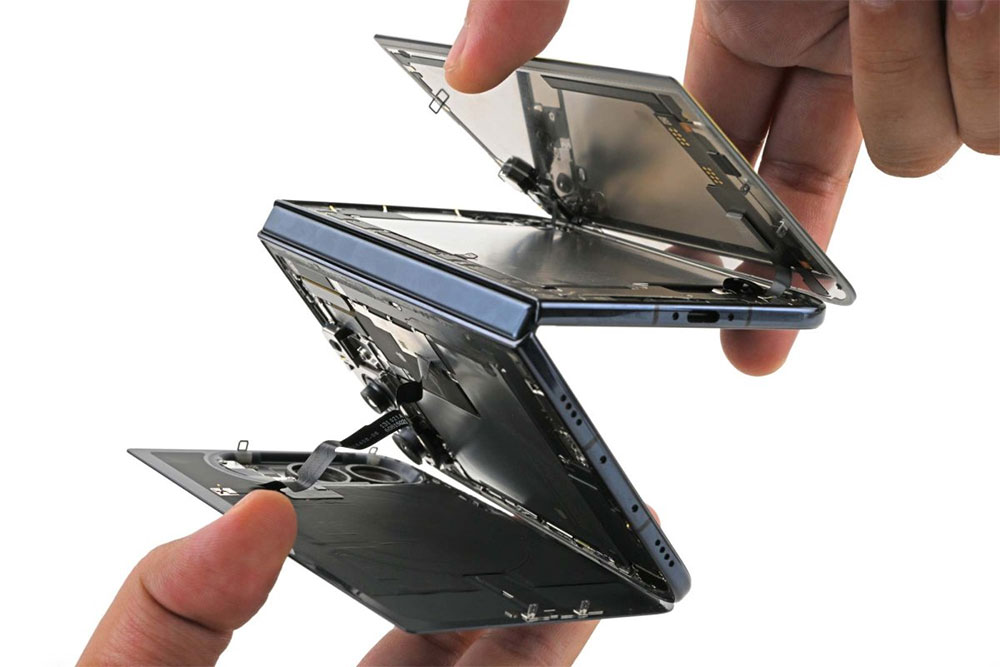
The most repairable foldable phone ever? iFixit tears down Apple’s iPhone Duo
Among the many teardown findings, the most exciting is undoubtedly the repairability score iFixit gave the iPhone Duo—5 out of 10. Although this is only a provisional score and will ultimately depend on the actual availability of official replacement parts later, for the foldable-screen phone market, which has long been known for precise structures and difficult repairs, this is already the highest score iFixit has given to date, undoubtedly giving Apple’s first foldable product a good start.
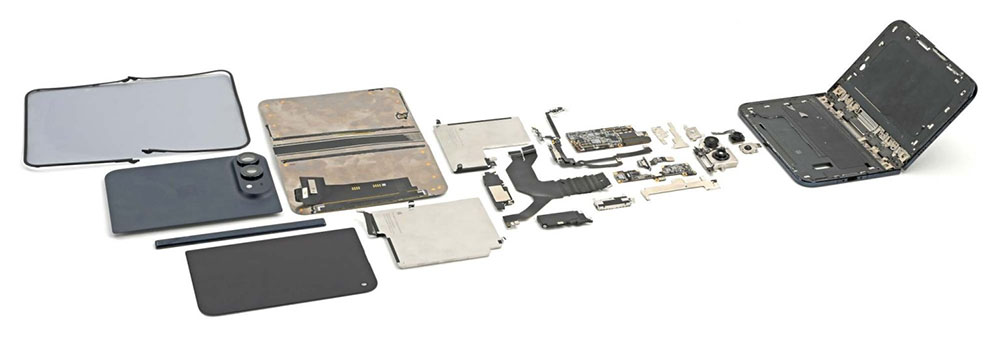
iFixit points out that Apple did not rely entirely on strong adhesive in its structural design. For example, the bezel around the inner display uses a clever “clip design” that allows repair technicians to remove it smoothly without damaging the bezel. In addition, removing the outer display is surprisingly smooth, which is a great boon for repairs that require removing the outer display first before certain internal repairs can be performed.
Hinge Mechanism Explained: Teardrop Design and Potential Stress Concerns
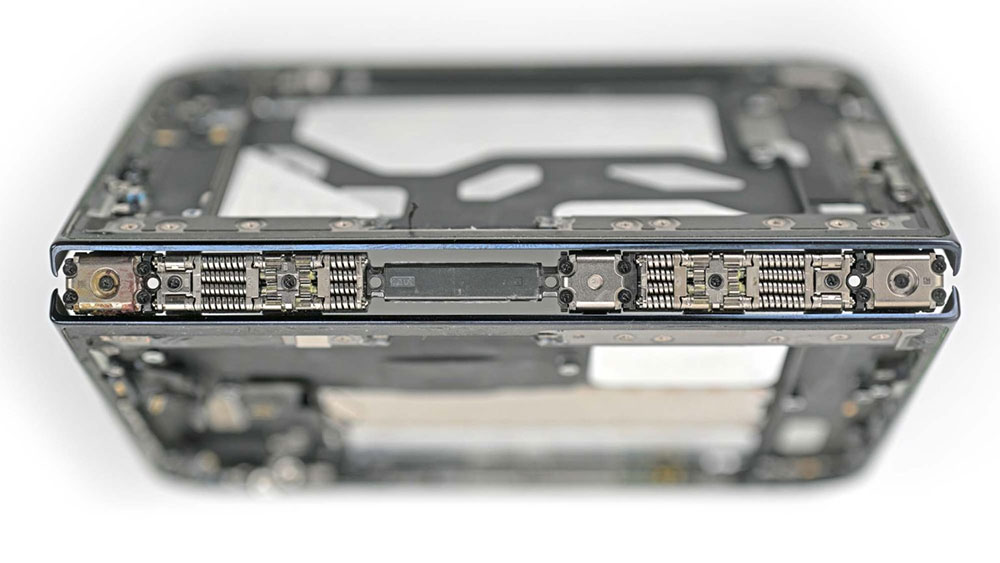
As expected, the core focus of the teardown fell on the precision hinge system. Although Apple’s patent revealed some design clues, the mechanical structure shown by the actual teardown was more complex and ingenious than expected. Before starting the disassembly, iFixit performed a fluorescent dust test as usual. The test showed that the iPhone Duo, which has an IP68 dust and water resistance rating (it can be submerged in water up to 6 meters deep for 30 minutes), began to show slight creaking in the hinge after the dust test, but the dust particles that actually penetrated inside the hinge were relatively sparse, and its protection performance was better than most competing products on the market.
- Precision structure
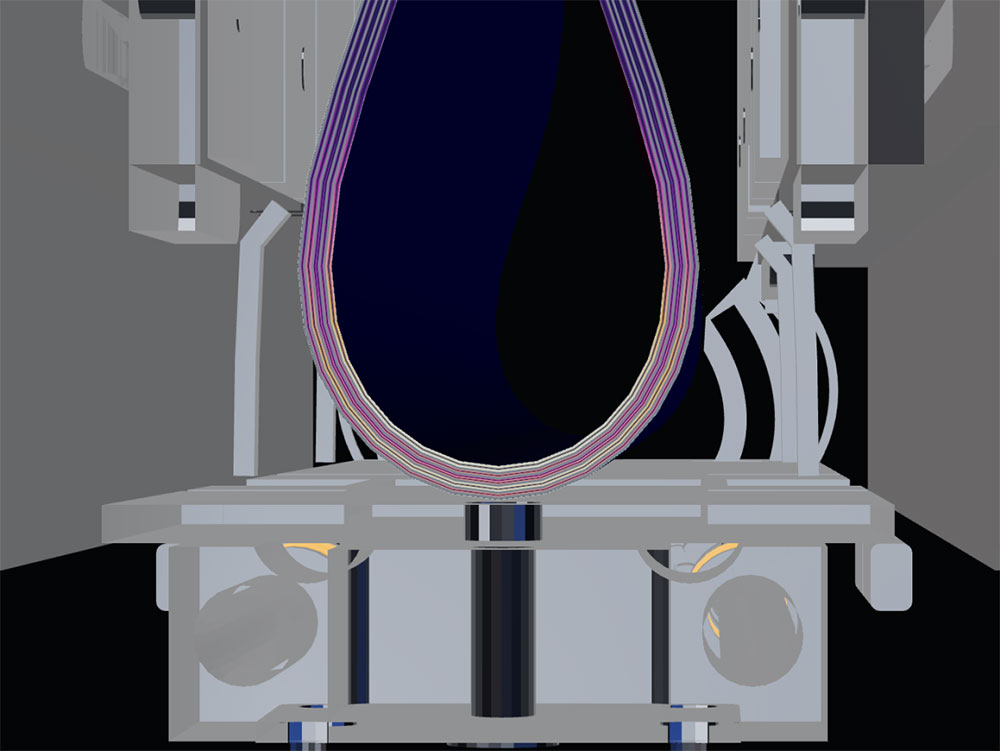
The hinge itself combines gears, springs, and interlocking metal joints, and adopts a classic teardrop-shaped design to ensure that the screen does not develop excessive dead angles when it bends. At the same time, Apple has also introduced special curved guide rails to control the joint movement, thereby distributing the mechanical stress that the display bears when the phone opens and closes. - Early failure indicators
In response to recent reports from some users of a clicking sound when opening and closing, followed by bright lines appearing on the inner screen, iFixit investigated using CT scans and 3D models. They found that the problem is mostly concentrated in the transition area between the cable opening and the central hinge support. Possible causes include: the central support bar failing to retract completely when closed, the curved guide rail being higher than surrounding components when folded and causing interference, or structural edges converging and causing excessive stress to concentrate on the fragile display layer. However, the exact cause still requires further clarification.
Innovation in Nano-texture Displays and Pixel Arrangement
On the display side, iFixit took a detailed look at the iPhone Duo’s matte nano-texture display. Observing it under a microscope, the team found that its surface is covered with tiny circular bumps that effectively diffuse light—the key technology Apple uses to make the screen crease less noticeable.
In addition, microscopic inspection of the screen pixels and camera area has also yielded new findings:
- Many subpixels are arranged in ellipses with varying orientations; the patent shows this helps reduce diffraction artifacts and further reduces the visual interference caused by creases.
- Above the front camera on the inner display, Apple has adopted an under-display infrared camera design similar to that of the iPhone 18 Pro; improved, rounder, and more regularly arranged pixel gaps allow sufficient light to pass through to the camera module beneath.

The battery removal experience set a new best record.
In terms of power configuration, the iPhone Duo uses a dual-battery layout: one battery with a capacity of 11.567 Wh is located beneath the back glass, while the other 7.506 Wh battery is located beneath the outer display (total capacity 19.073 Wh).
It is worth mentioning that iFixit highly praised Apple for using Electric-release adhesive on both batteries. Repair technicians can easily remove the batteries without prying with brute force—the best battery removal design the team has seen in any foldable smartphone to date.
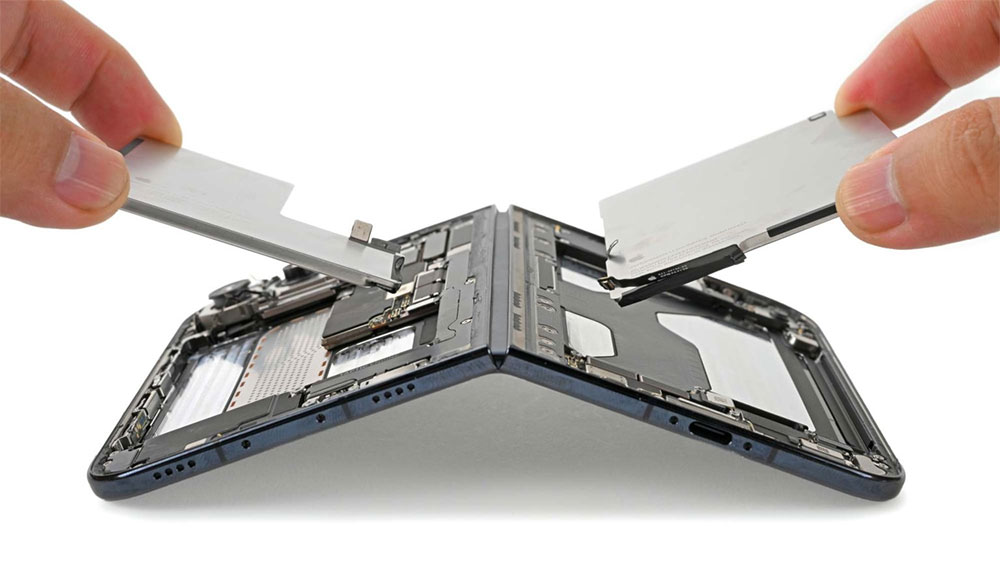
Overall, the iPhone Duo teardown report not only demonstrates Apple’s formidable strength in mechanical engineering, but also sets a new milestone for future mobile device repair through modularization and innovative bonding technology.
Source: KOCPC Chinese