


Thanks to AI, porting and emulating various systems is now much easier than before, as previously introduced… AnyPS5、HackiOS All of these and more: recently, a brand-new project called “UniXNU” has appeared online, and it can install iPadOS on an Android device. At present, whether you’re swiping, opening Settings, or pulling down Notification Center, it operates no differently from a real iPad. In less than 48 hours, the same development team released another short video, this time announcing that the GPU driver also works, with frames composited directly by Qualcomm Adreno 740 hardware.
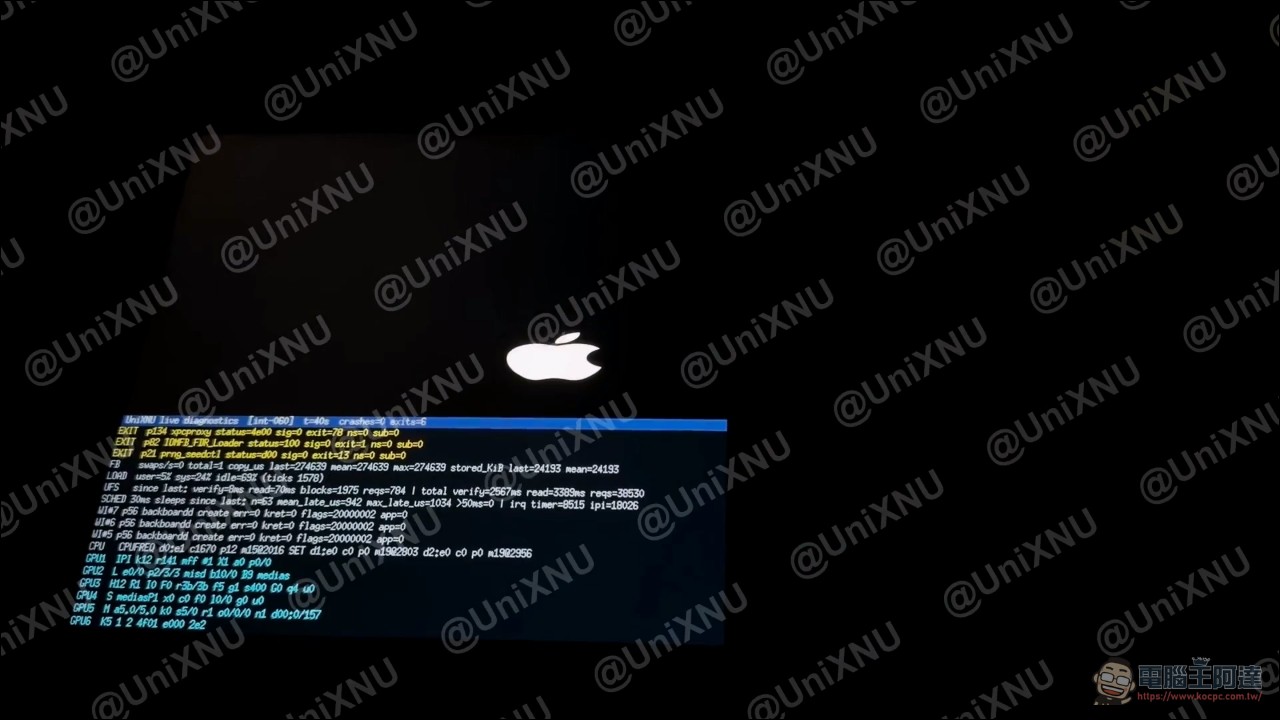
The project’s official name is UniXNU, led by developers sharky_dev and bluse50. The original post was published on October 19 and was blunt: “Our team has successfully gotten iPadOS 17 to run natively on the Xiaomi Pad 6S Pro, which is powered by the Snapdragon 8 Gen 2 chip.” The word “natively” alone was enough to set the whole community ablaze, because HackiOS, another project touting similar functionality, has not released a single line of code to this day.
iPadOS 17 on Xiaomi Pad 6S Pro https://t.co/xyLtU8oVdA
— Sharky Wang (@sharky_dev) October 19, 2026
Let’s be clear from the start: this is not a simulator, nor is it a reskin.
In enthusiast circles, when people say “running iOS on Android,” nine times out of ten they mean fake efforts using wrapper apps or theme changes. UniXNU takes a completely different path, and its official documentation clearly describes the layered model: Android’s ABL bootloader loads the Android boot image, which contains BootShim plus a UEFI firmware volume and device tree; UEFI hands off to the UniXNU boot manager, which then has DarwinBoot load the XNU kernel, and what finally runs is the iPadOS userland extracted unchanged from an IPSW.
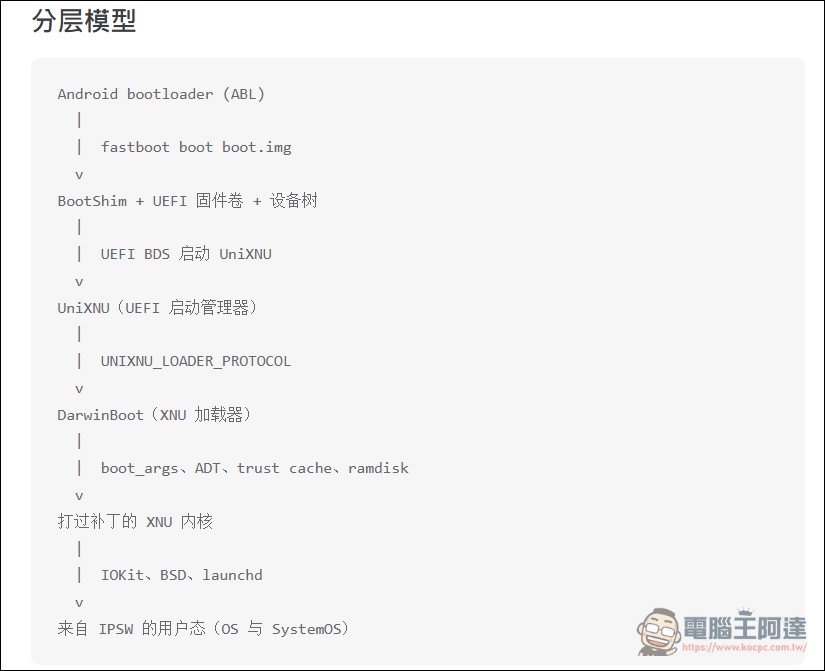
The entire tech stack is divided into six layers, each with its own independent Git repository, build artifacts, and handoff protocols. Officially, it describes itself as “a unified bootloader similar to OpenCore.” The PC Hackintosh world relies on OpenCore to let ordinary x86 computers load the XNU kernel of macOS. What UniXNU aims to do is abstract away the hardware differences of Qualcomm ARM devices and replace them with reusable infrastructure.
However, there is one easily overlooked detail worth mentioning: the system version the team demonstrated is iPadOS 17.7.11, sourced from the original IPSW for the 2017 12.9-inch iPad Pro (2nd generation, codename iPad7,1), without changing a single byte—not the latest iPadOS 26.
The hardest part: fitting 16 KiB pages into 4 KiB hardware
Apple’s own ARM64 cores use 16 KiB memory pages on most SoCs, whereas Snapdragon platforms use 4 KiB. This isn’t something that can be fixed by changing a constant—UniXNU changed the XNU kernel itself for this.Official documentsThe listed patch scope includes boot page table capacity, runtime page size selection, user address space mapping, and code-signing hash page size; even the allocator’s alignment has to be handled through separate decoding.
The trickiest part is code signing. Apple’s CodeDirectory hashes in 16 KiB units, but the 4 KiB kernel must verify signatures on a 4 KiB basis. UniXNU’s approach is to first verify using the original 16 KiB blocks, then derive a digest for each 4 KiB page from them and store these in kernel read-only memory as a cache for the signature verification function to look up. The entire process involves no virtualization and does not use Shadow Page Tables.
The GPU is the real barrier, and it only took two days.
Booting into the desktop is easy; the graphics are the hard part. iPadOS interface compositing and app rendering all go through Metal. Without a GPU driver, the system falls back to CPU computation, which is too slow to be usable, and apps have no drawing interface available. When the first video was released on October 19, the official statement was that “because the GPU driver is still missing, the system is extremely laggy,” and they predicted it would be done within three days. Late at night on October 20, the second video was released, titled “Xiaomi Pad 6S Pro iPadOS completes GPU driver,” and the description said this is “the first open-source third-party ARM device iOS execution project with a Metal GPU driver.” The official README was also updated in sync, announcing that the render server can already composite the system interface through the Adreno 740, and that the processes on the list each get their own Metal device.
Open source is moving fast, but hardware support is still quite lacking.
All three repositories are public: the main repository UniXNU currently has 475 stars and 44 forks, the device repository UniXNU-sheng has 12 stars, and the UEFI firmware repository uefi-sheng has 6 stars. All were created on October 19, and commits were still ongoing on October 20. The official status table is written very conservatively, with nothing exaggerated: touch, display, UFS storage, and GPU are marked as available; Wi-Fi, Bluetooth, camera, USB, audio, sensors, battery driver, and sleep/wake are all marked as unavailable. After this tablet gets iPadOS runningCan’t connect to the internet.pbxscience’s write-up also points out that currently only this device is supported; other motherboards each require their own port, and the firmware stage can randomly get stuck and need retrying.
There is also a barrier for those who want to try it themselves. The build environment listed in the official documentation must run on macOS and requires Xcode, Python 3.11 or later, LLVM and lld, mtools, dtc, and fastboot; moreover, inputs such as the target IPSW, trust cache package, and platform seed are kept outside the repository and must be prepared by the user.
UniXNU – GitHub
The difference from HackiOS can be explained in one sentence.
At the same time, another project was operating under a similar banner. OOSexGang’s HackiOS They claim to run iOS 16.5 on the Poco X5 Pro and Xiaomi Mi 11 Lite 5G. By following their Telegram channel, the community can see the process of “fixing” audio, Wi-Fi, and the camera one by one, but so far the entire project has not released any code, has no installable version, and has no third-party verification on real devices.
There is also iOS-Sweet projectPorting XNU to the Redmi Note 10 Pro global version and open-sourcing the code is much more honest than HackiOS, but its graphics rely entirely on CPU software rendering, with a frame rate of only 20 to 30 fps, and Wi-Fi, Bluetooth, cellular, camera, speaker, and sensors all do not work. UniXNU’s difference lies in the GPU part: it replaces software rendering with a hardware-accelerated Metal path.
The weight of this matter
After Apple moved to its own chips, most people thought the Hackintosh path had reached a dead end, because Apple’s GPU and Metal stack are closed. UniXNU’s approach shows another possibility: translating Metal calls to the open-source Mesa and Turnip ecosystem used by Adreno, which is feasible on at least one device. Once the GPU works, whether peripherals such as wireless and audio follow suit will determine whether this tablet stays stuck at the boot screen or can be used for everyday use.
Another layer of value lies in open source itself. On October 20, the official team submitted more than a dozen commits in succession—covering everything from SMMU TLB invalidation handling, BO memory pools, and shader specialization to GPU authorization for the render server—almost a day’s worth. Technical reviews at home and abroad have been quite consistent: the issue is not technical feasibility, but that “ordinary users should not try it”: unlocking the bootloader will wipe data and void the official warranty, so those with the ability can test it themselves.
Source: KOCPC Chinese