


Ever since AI came along, many things are no longer “seeing is believing.” The Hillsborough County Sheriff’s Office in Florida announced on October 16 that a 15-year-old girl is suspected of using AI to edit images and fabricate screenshots of Instagram posts, falsely accusing her ex-boyfriend of threatening to carry out a shooting on a high school campus. She has now been arrested on three charges. (Editor’s note: You’re telling me this woman is 15?!)
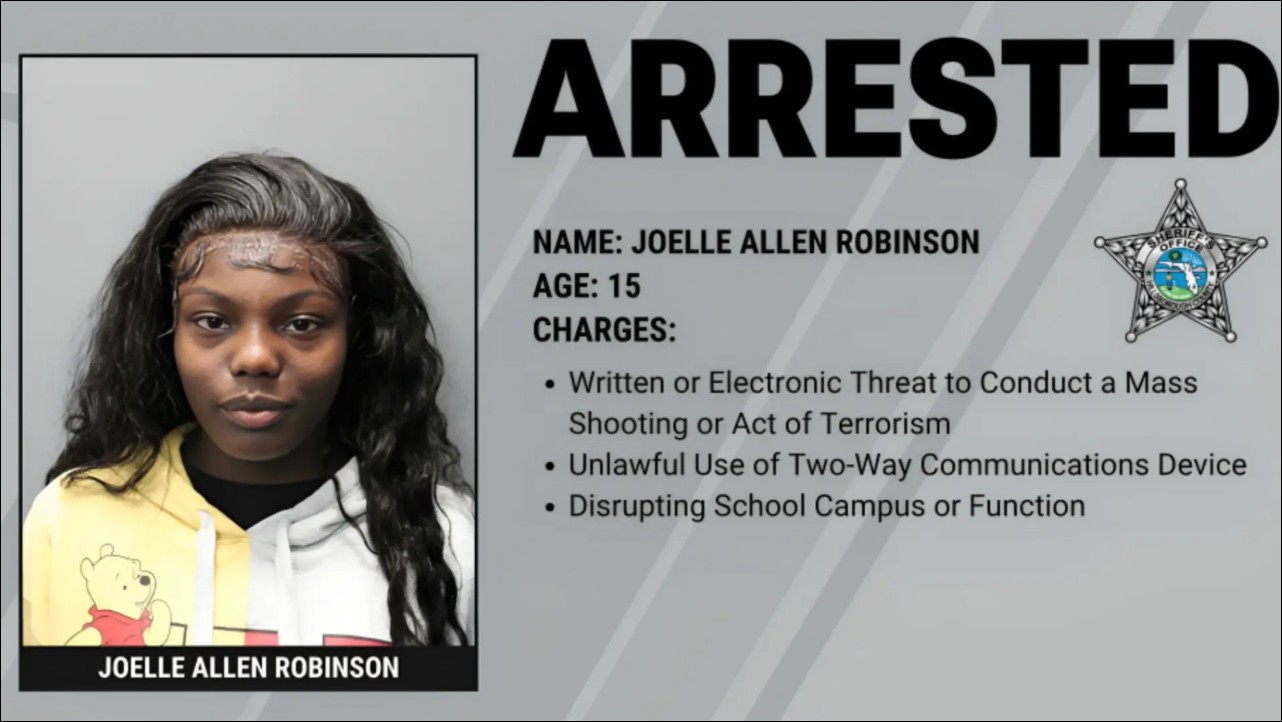
A complaint letter ended up identifying the sender instead.
The incident occurred on October 14 (Wednesday). Staff at Riverview High School in suburban Tampa, Florida, received an email containing a screenshot of an Instagram post threatening to shoot up the campus; the screenshot appeared to come from a male student’s account at the school. School officials immediately reported it, and the Hillsborough County Sheriff’s Office (HCSO) sent deputies to the school.
After interviewing the male student, the investigative team confirmed that he had not made the post. HCSO Public Relations Director Amanda Granit described it this way: “Our detectives quickly saw that the post had been altered by AI and traced it back to a 15-year-old former student; she was the ex-girlfriend of the person in the screenshot.” After the girl appeared before authorities, she admitted that she had sent the complaint letter and knew the image had been AI-altered. The entire frame-up, from the complaint letter being sent to it being exposed, lasted less than a day; the male student proved his innocence and received no disciplinary action.
Three charges and their legal consequences
The three charges against the girl are: making threats in writing or electronically to carry out a mass shooting or terrorist attack, unlawful use of a two-way communications device, and disrupting campus instruction and activities. The first charge is based on Florida Statute 836.10, “Written or Electronic Threats to Kill, Do Bodily Injury, or Conduct a Mass Shooting or Terrorist Attack,” a second-degree felony punishable by up to 15 years in prison and a $10,000 fine; the statute’s definition of “electronic record” covers digital text, graphics, video, and photographs, and an AI-altered screenshot clearly falls within its scope.
Because the suspect is a minor, U.S. media uniformly are not disclosing his name; the Sheriff’s Office has also not yet said whether the case will be handled through juvenile or adult proceedings. The case is still at an preliminary stage, and there has been no court ruling. The Sheriff’s Office also took the opportunity to warn the public, with Granit saying: “In Hillsborough County, threatening a school is a felony. Whether it’s a joke, whether it was made with AI, whether you’re angry, or whether you’re trying to frame someone else, you will face consequences.”
AI photo manipulation used for false accusations becomes a new type of campus risk.
This case is considered a rare example of “consumer-grade AI tools being used to fabricate criminal evidence.” In the past, forging a convincing post screenshot required knowledge of image-editing software; now generative tools on a phone can change text, swap profile pictures, and rearrange the layout, greatly lowering the barrier. In the United States, reports of school shooting threats are always handled as real incidents: police deployment, campus lockdowns, and parental panic are all costs that are paid in full. This is exactly the mechanism the framer wanted to exploit, and it is also why fabricating threats is treated severely under the law. For schools and law enforcement, a screenshot must be taken seriously but cannot be accepted at face value: this time, the police immediately dispatched officers to maintain campus safety while also using digital forensics to verify the screenshot’s authenticity, so an innocent student did not take the blame.
Police did not explain the forensic details and only said investigators “quickly recognized” that the image had been altered by AI; claims circulating externally, such as “the case was solved by relying on metadata and traces of image forgery,” have not been officially confirmed, and the investigation method remains a black box. HCSO also did not further disclose the tools the girl used or the extent of the forgery.
Conclusion
From the report to being exposed in under a day, the lesson of this case is blunt: AI photo editing can fool the school’s initial response, but it cannot get past the investigation—and in Florida, fabricating a school shooting threat is itself a felony punishable by up to 15 years. The takeaway for ordinary people is that, since AI-generated images are now almost effortless to produce, screenshots will only become less credible in court over time. AI companies also embed hidden watermarks, so anyone thinking of using them for wrongdoing should think twice: if the frame-up fails, they may be the one heading to prison first.
Source: KOCPC Chinese