


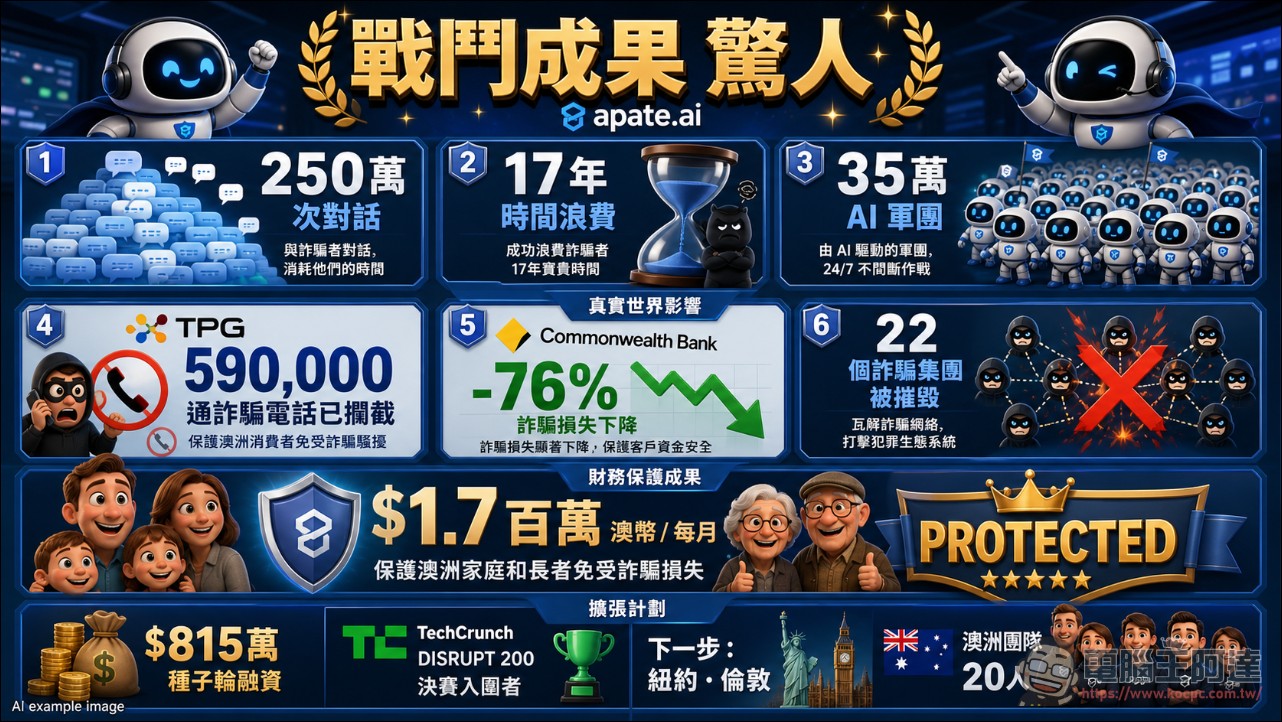
Scammers spend all day making random calls looking for easy marks. The grandmas and grandpas on the other end are friendly, a little forgetful, and very polite—the only small problem is that they’re AI. Australian startup Apate.ai has deployed an army of about 350,000 AI fake victims specifically to answer scam calls, reply to scam texts, and infiltrate scam groups. Their only job is to keep scammers tied up until they have no time left to scam real people. As of October 2026, this army had engaged scammers in 2.5 million conversations in total, which works out to wasting a full 17 years of scammers’ time. Even more ruthless: these AI fake victims don’t just waste time. The bank account numbers, cryptocurrency wallet addresses, and phishing websites scammers hand over as they chat are all copied down and passed to banks, telecom carriers, and government agencies to be blocked—a kind of reverse harvesting.

Starting point: A scam phone call that reached a family barbecue.
The origin of this idea is pretty ridiculous. A few years ago, Apate founder Professor Dali Kaafar got a call from an unknown number at a family barbecue, and he knew right away it was a scam. He pretended to be clueless in front of his kids and strung the scammer along for 44 minutes, while the whole family cracked up. Later, he thought: for those 44 minutes, the scammer had no time to scam anyone else, but he himself had also wasted 44 minutes. Could he automate playing dumb—and maybe get something useful out of it along the way?

This idea eventually became a research project at Macquarie University’s Cybersecurity Center in Sydney and was spun off as a standalone entity in 2024. Apate.aiThe company name comes from Apate, the Greek goddess of deceit, and its specialty is “using scammers’ tactics to fight scammers.” Turning the practice of wasting scam syndicates’ time from manual time-wasting into mass-produced time-wasting is just one idea away. This poison-against-poison product positioning upgrades scambaiting—once a personal hobby—directly into an enterprise-grade service.

How 350,000 “perfect victims” lure people
Apate’s approach is a honeypot strategy: it partners with telecom carriers to obtain a large batch of dedicated phone numbers and waits for scammers to automatically scan them and call in. When a scammer gets through, they reach an AI playing the victim. The personas are wildly varied—gender, age, accent, cultural background, and more—and they speak Australian slang and crack corny jokes at the drop of a hat. They also act willful like real people: sometimes they don’t answer, and sometimes they deliberately hang up mid-conversation saying, “I’ll call you back later.”The GuardianThe reporter once encountered a character named Malcolm—British accent, well along in years—who, after listening to a scammer go on for ages, replied with just one line: “What business are you talking about?” A Nikkei reporter, meanwhile, overheard a classic opening: a man claiming to be “Dayton” called saying he was “Amazon customer service,” notified the person that their account had an anomaly, that a MacBook Pro was being shipped to San Diego, and that $999.98 had been charged. The “victim” on the other end of the line just slowly played along.
Is it realistic enough?《WIREDThe reporter personally stepped in to play the scammer in a test, teaming up with a colleague to play victim Lucy and her financial adviser Mickey, pressing from both sides and hard-selling a cryptocurrency investment opportunity for six minutes straight, yet the AI remained polite and still would not pay. The reporter’s takeaway: the rhythm of the conversation was infuriatingly natural. In official records, the longest single call starts at 54 minutes, and many conversations can drag on for two hours. The key design focus of the AI victim is “giving hope”: showing reasonable skepticism, but leaving an opening that makes the scammer feel that with just a little more effort they will bite. When the scammer cannot bear to hang up, that is when the protective net takes shape.
The liar swore, and the whole company popped champagne.
Co-founder Brad Joffe put it bluntly: “Most people in this industry are fixing things after the fact. Telecom carriers block a number, and the scammers just switch to another one; banks monitor transactions, but by then the customer has already been scammed. We go straight to the scammers and get the intelligence before anyone gets hurt.” Now their AI engages tens of thousands of scammers every day across phone calls, text messages, email, and the web.

Scammers’ reactions after they realize the other side is a bot are celebrated by the company as a KPI. Joffe said they even put footage of scammers cursing at the bot into their fundraising pitch deck: “We treat that as a frustration metric—every swear word is worth celebrating. We’re probably the only product in the world that pops champagne when it gets cursed at.”
Reverse Harvest: The Scammer Hands Over Their Own Account
Clients can also assign tasks to the bot, specifying that it should extract bank account numbers or wallet addresses. The text bot scans forums, investment groups, and social platforms, fabricating identities to infiltrate conversations. The material it copies back includes bank accounts, crypto wallets, phone numbers, malicious websites, and impersonated brands—all intelligence that normally only becomes available after a real person has been victimized.
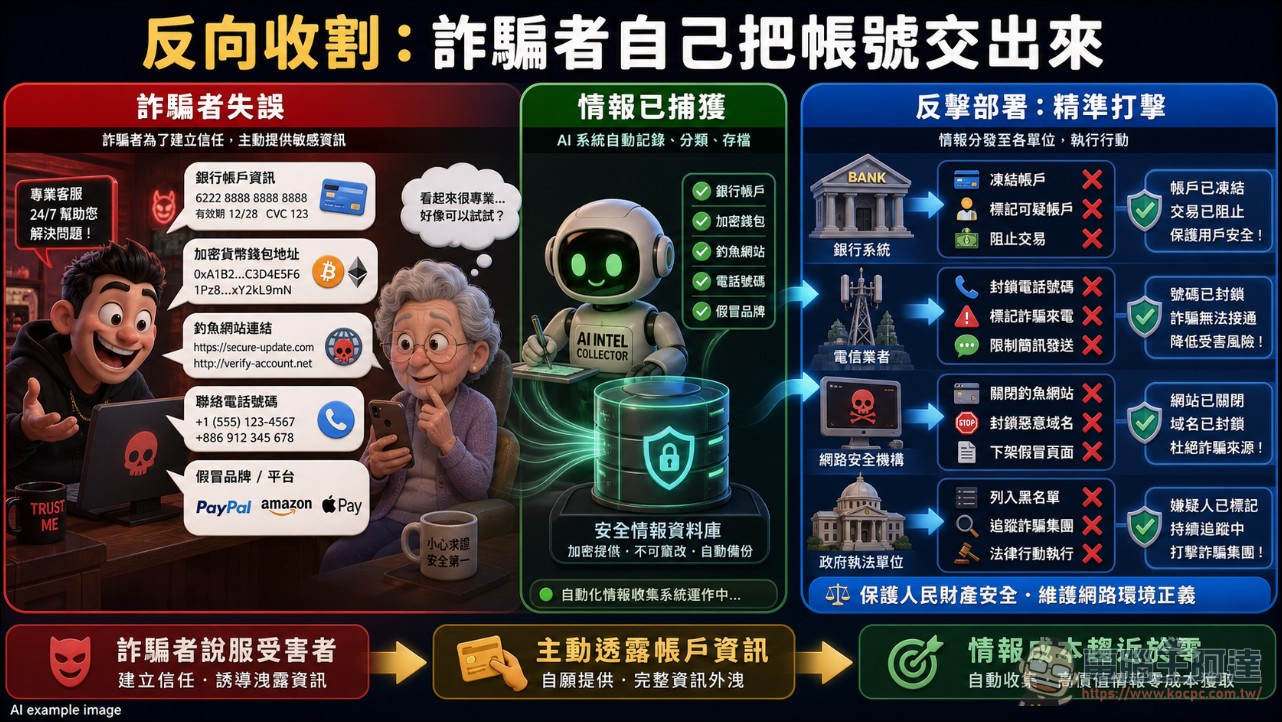
In terms of real-world results: Australian telecom carrier TPG Telecom has routed nearly 590,000 scam calls to a bot to answer; Commonwealth Bank reported publicly that scam losses fell 76% after adoption; and another unnamed Australian bank used a proactive bot to break up 22 scam campaigns. Government body Australia’s Economic Accelerator has also publicly endorsed it, noting that a telecom carrier used the system to block nearly 10,000 scam calls in one day, estimating that it protects Australians from more than AUD 1.7 million in losses each month. The cleverness of this business lies in the cost of acquiring intelligence approaching zero: to persuade the “mark,” scammers voluntarily spell out accounts, scripts, and channels in full detail. The persuasiveness of the scam is exactly the richness of the intelligence.
Next step: sell “playing the trickster” to the whole world.
August 31, 2026, Apate.ai AnnounceIt raised an $8.15 million seed round (about NT$265 million), led by Lobby Capital, with participation from OIF Ventures, Investible, Concept Ventures, and Baobab Ventures. It also reincorporated in Delaware, USA, and is preparing to establish a presence in New York and London. The company has only 20 employees, has raised nearly $10 million to date, and is one of this year’s TechCrunch Disrupt “Startup Battlefield 200” finalist teams.

The market really is big enough. Official data cited says global annual fraud losses have climbed to $1.03 trillion; the FBI also counted more than 22,000 AI-related crimes in 2025, with losses of about $893 million, of which investment fraud accounted for $632 million. Scammers use AI to run conversations and deepfake celebrity voices to pitch offers everywhere. Scammers use AI to mass-produce phishing, while Apate uses AI to mass-produce victims—essentially burning through compute against each other on the same supply chain. The takeaway for ordinary people is actually pragmatic: when you get a suspicious call, dragging it out for a few extra minutes means you are also adding bricks to the overall cost of fraud—except now there is AI willing to do it for you.
Conclusion
From that 44-minute scam call at a barbecue to an army of 350,000 AIs, 2.5 million conversations, and 17 years of scammers’ work hours wasted, Apate.ai has turned scambaiting—an old-school internet pastime—into a serious business. The next time you get a call from someone claiming to be customer service, the chatty “grandpa” on the other end who keeps asking questions may be copying down your account details for some bank—and waiting for your first swear word so they can pop the champagne.
Source:TechCrunch
Source: KOCPC Chinese