


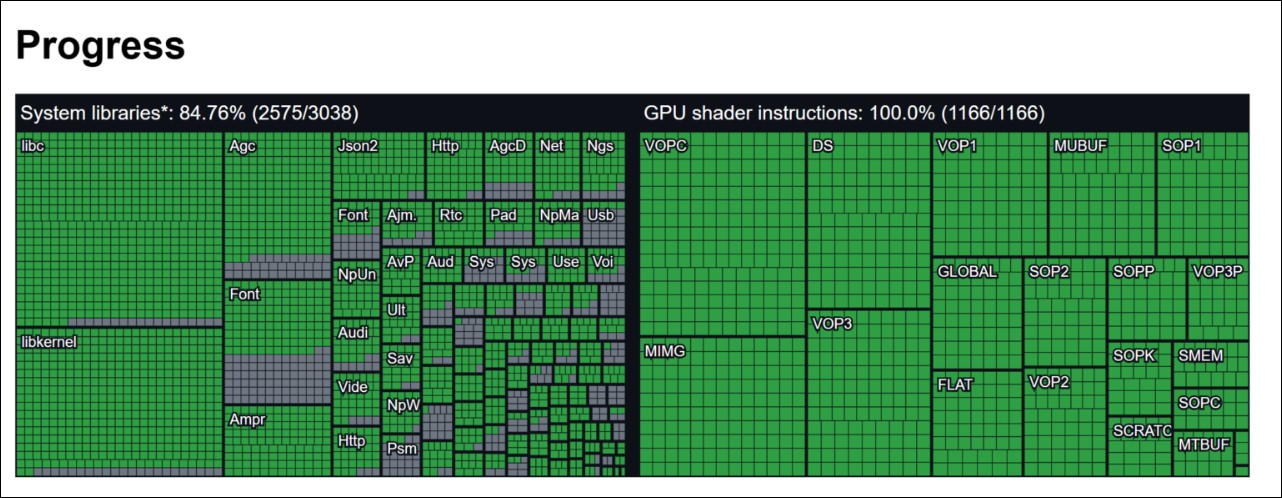
The progress tracker for running PS5 games directly on PC has advanced another notch. On October 9, the official tracking page for the AnyPS5 project filled up the progress bar for GPU shader instructions: all 1,166 AMD RDNA 1/RDNA 2 shader instructions on the tracking list are marked as implemented, covering seven major categories: DS, FLAT, GLOBAL, MIMG, SMEM, SOP, and VOP. The status date on the tracking page is stuck at October 9. On the same page, the left side is the system library dashboard, and the right side is the instruction progress bar; the gap between the two tables is clear at a glance. However, what is meant by “100%” here: according to the developers, if the shader decoder recognizes the instruction, it counts as implemented. What it guarantees is “recognition”, not that it will be executed completely and correctly in every game.
What is AnyPS5?
We previously started reporting. AnyPS5 At the time of this project, its repository had only been created on August 3, it had 1,674 stars, it had not released a single official version, and it could not even run one game through: it crashed after the main menu. The conclusion at the time was that it “looked more like a tech demo.” Now its GitHub star count has reached 23,807, on September 28 it released two versions back-to-back, v0.1.0 and v0.1.1, and the repository was still getting code pushes yesterday. On the finished-product side, external developers used it to create the first PS5 game to run natively on Windows, Dead Cells: Return to Castlevania Edition, while the official team used Dreaming Sarah as a demo, achieving a stable 60 FPS on office-PC hardware such as a GTX 1050 Ti plus Core i5-7500. The native version of Dead Cells tracked in the previous article already had indoor 55 to 60 FPS and outdoor 30 to 35 FPS at the time, and its music and sound effects worked normally.
As we discussed in the previous article, the technical approach is this: AnyPS5 does not do emulation and instead takes a relinking approach. PS5 and PC are both AMD x86-64 architecture, so CPU instructions do not need translation; the relinker converts PS5 executables into Windows PE or Linux ELF native formats, PRX system libraries are replaced with alternative implementations, and the shader recompiler converts console-side shaders into Vulkan SPIR-V. There is also a rough idea of the execution requirements: the GPU driver must support Vulkan 1.1 and VK_EXT_depth_clip_control, BC texture compression, and buffer device address; 16GB of memory is recommended; the test machine in the previous article was an RTX 5070 Ti.[2]Ars Technica compared this approach to Apple’s Game Porting Toolkit: a species somewhere between “static decompilation” and “full emulation.” In our previous article, we compared it to Steam Deck’s Proton compatibility layer: the machine code runs as-is, and only the two outer layers—system calls and shaders—are translated. The developer also stressed to Ars Technica that the entire system was “built from scratch” and did not touch any of Sony’s source code.
The other half of the progress bar still isn’t filled in, and the denominator keeps moving. The system library is currently 84.76% implemented, with 2,575 functions completed out of 3,038 tracked; this percentage only counts functions “the project has discovered,” and as developers dig up more functions, the total will keep growing, and figures pulled from different sources (84.69% and 84.76%) will also diverge. The sprint pace is astonishing, though: when Ars Technica reported in early October, shader support was only 50% and the library about 76%; in less than a week, it filled to 100% and 85%.
VideoCardz also states the bad news upfront: getting games to run still requires compatible system libraries, correct graphics behavior, and synchronization mechanisms. This time, only one tracked limitation has been removed; it does not mean GT 7 or GTA VI will be playable tomorrow. To use an analogy: having every word in a dictionary does not guarantee that the sentences translated from it will read smoothly; a decoder recognizing instructions still has execution accuracy and timing that must be verified one game at a time.
There is no verified evidence that AnyPS5 can run GTA VI. Instruction coverage measures a tracking list, not a guarantee of game compatibility; any claim that “100% means GTA VI is playable” can be treated as fake news.
Currently, someone in the community has already created a pkg-to-anyps5 tool. Version v0.1.0, released by developer Dekazeta, can unpack PS5 debug .pkg files with x7FFIH headers into an input format that relinker can consume, effectively laying a dedicated track for third-party tools. Meanwhile, the rules for DeadCells-PS5-Native introduced in the previous article remain unchanged: players must provide their own legally obtained decrypted game files, drivers require Vulkan 1.1 and specific extensions, the project does not include any Sony software, and the disclaimer positions it for interoperability, research, preservation, and compatibility purposes.
To date, Sony has made no public statement or taken any legal action regarding the project as a whole. Among other projects in the same space, KytyPS5 takes the emulator route (GTA V at 40 to 60 FPS but unstable), SharpEmu pursues accuracy (Astro’s Playroom at 0.5 to 1 FPS), and AnyPS5’s relinking approach is currently the only one that has produced “native executable” results.[2]Each of the three approaches has its adherents: in the short term, AnyPS5’s performance advantage is the most obvious; in the long term, SharpEmu’s accuracy-focused approach may prove more valuable in game preservation; if KytyPS5 can stabilize its frame rate, the versatility of the emulation approach remains its trump card.
Two months in, the report card is out: 100% command recognition, 85% of the library, two games have appeared, the star count has grown 14-fold, and community tools are starting to land. There is still a long way to go before “playing all PS5 games on a computer,” and Sony’s stance remains an unexploded bomb. But compared with the previous piece’s line, “still very far from being able to run all PS5 games,” we can at least revise that now: the road has been paved to the bend where the finish line is visible. If you want to play games, buying a console is still the better deal. Next, keep an eye on four things: how fast the library advances toward 90%, how much version 1.2 corrects game behavior, the moment the first big AAA title runs smoothly on mainstream hardware, and when Sony finally makes its stance clear.
Source: KOCPC Chinese