


Have you ever thought that old Android phone in your drawer that you no longer use could now become a robot’s brain? A research team at the University of California, Los Angeles (UCLA) has introduced PhoneBot: a bipedal humanoid robot about 48 cm tall and 1.8 kg in weight, with an ordinary Android phone mounted on its torso to handle seeing, thinking, and directing. The hardware costs about US$400 (about NT$13,000, excluding the phone), and even an old 2017 model can run it. The US$400 covers the frame, motors, battery, and other electronic components; the phone itself is not included, and the total price depends on whether you still have that old phone on hand. The research paper was uploaded on October 6. arXiv, positioned as a low-cost open-source research platform, with the main selling point being that both students and researchers can afford to put one together.
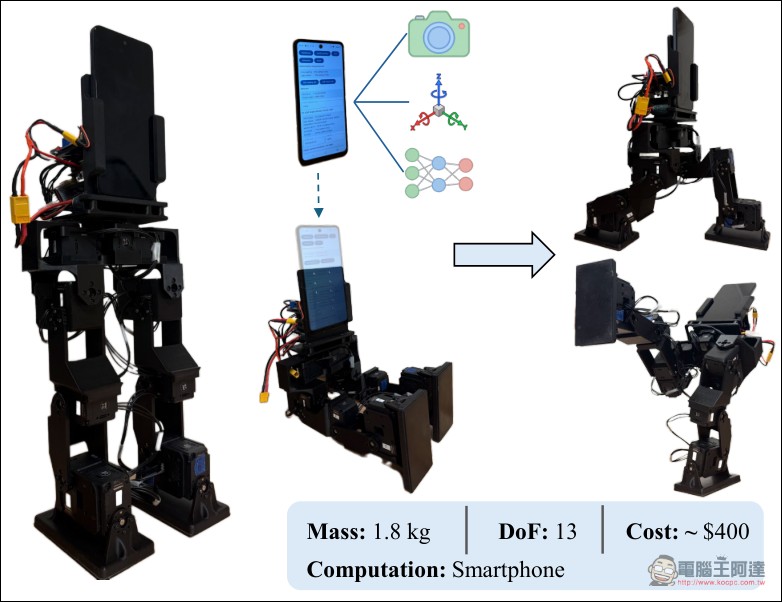
UCLA PhoneBot builds a $400 bipedal robot that can walk and get back up after falling.
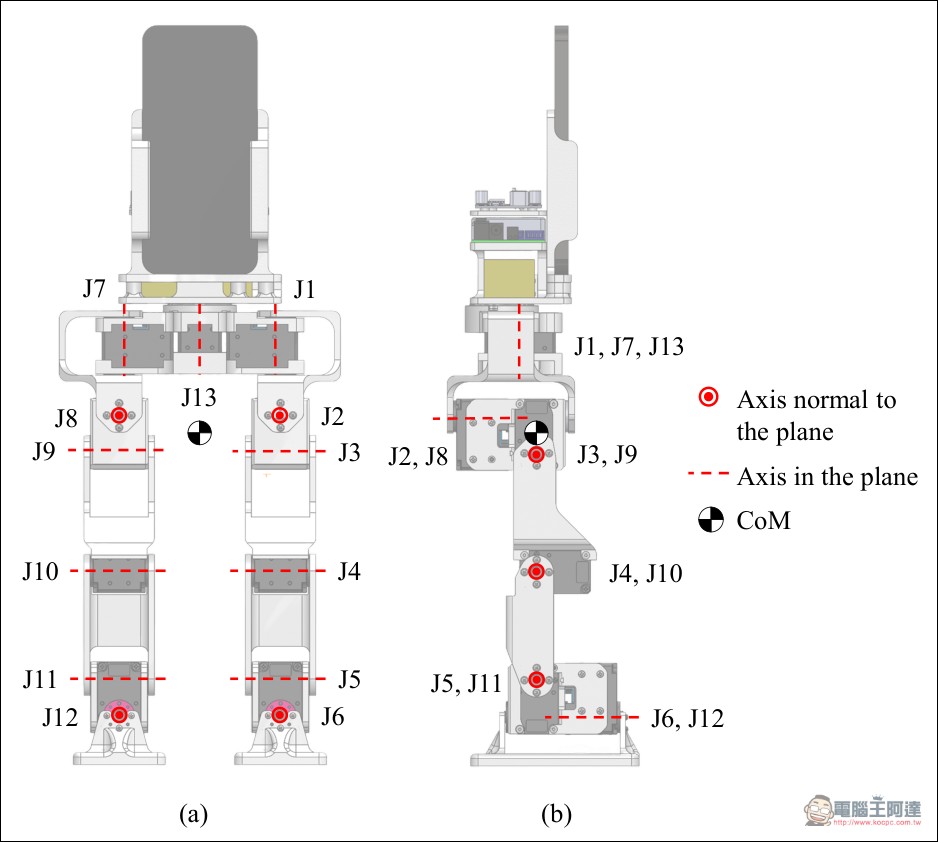
Looking at the specs, PhoneBot stands about 19 inches (48 cm) tall and weighs about 4 pounds (1.8 kg) including a phone, making it just right for a desk. It has 13 low-cost actuators in total, six on each leg, with the remaining one a torso rotation joint that lets it turn the phone camera mounted on its chest to look around without moving its feet. The phone serves as the hub for the entire sensing + computing + interaction stack: its built-in inertial measurement unit (IMU) measures posture, the camera recognizes and follows a specific person, the processor runs motion control software, and commands are then sent over Wi-Fi to a small computer that drives the motors. The division of labor is easiest to understand with a body analogy: the phone is the brain and eyes, the small computer is the spinal cord, and the 13 motors are the muscles. By eliminating the expensive standalone sensor array and dedicated compute box, the architecture slims down in one stroke.
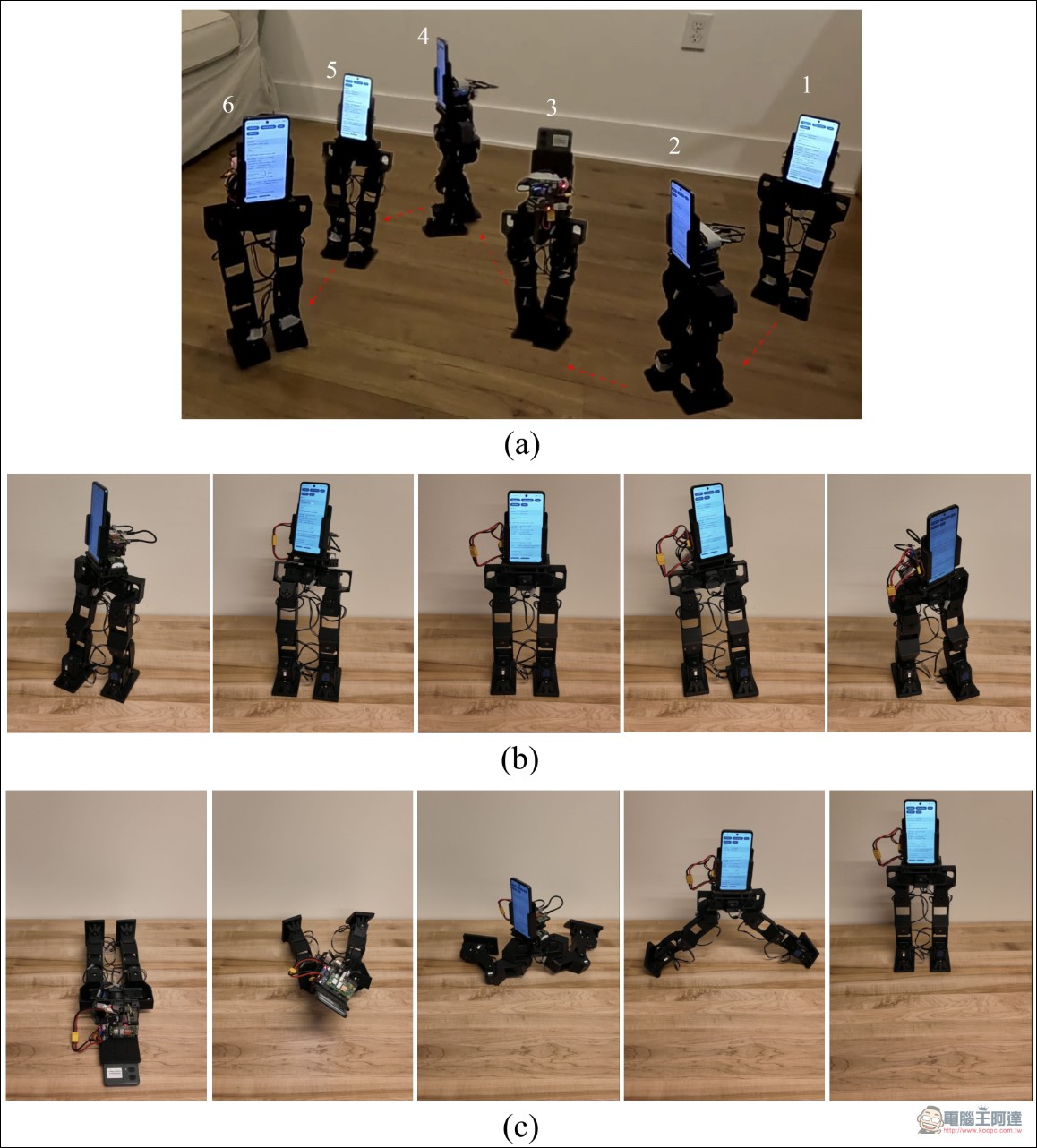
In the demo images, it can walk and follow people, and most dramatically, after falling flat on its face, it picks itself up and gets back to work. For a bipedal robot, being able to get up after falling is worth more than walking, because it first has to figure out what posture it is lying in, then plan a series of movements to recover its center of gravity. For a small robot sitting on a desk, this kind of dynamic ability has already crossed the threshold of a “model that can move.”
The phone compatibility testing was quite solid. The team tested four Android devices: a 2017 Honor 9, 2025 and 2024 Moto G models, and a Samsung Galaxy A16 5G. All four handled the core sensing, vision, and motion-control tasks, and three on the list were entry-level models, proving that year and price are not barriers. The only failure was the Honor 9: it couldn’t run the map-building feature because it couldn’t access the required Google services. This also highlights a practical issue: when it comes to whether old phones get held back, software support is just as critical as the processor.
The paper opens by identifying the three major barriers keeping humanoid robots from taking off: hardware is too expensive, sensing systems are too complex, and computational demands are too high. PhoneBot takes aim at all three at once by “reusing off-the-shelf smartphones.” Technically, it stands on the shoulders of giants, but the challenge has shifted gears. PhoneBot’s positioning extends from Intel’s early wheeled smartphone robot platform OpenBot. The problem is that after swapping wheels for two legs, balance control goes from “won’t tip over” to “could fall at any moment.” The research team used mirrored motion examples to train the walking policy, making the left and right legs share the workload more evenly and improving the limping gait. The paper also models the torque limits of cheap motors, exerting force when it should and holding back when it should, compensating for the hardware’s inherent shortcomings with control. Opening the paper’s reference list, it runs the gamut from reinforcement-learning bipedal walking to academic platforms such as Berkeley Humanoid. PhoneBot is meant to fill the affordable gap in this lineage. The paper was submitted on October 6 and posted under the cs.RO robotics category.
Don’t gloss over the limitations, either. It has no arms, its walking has only been validated on flat ground, and cheap motors can produce only limited force, so it can’t carry heavy objects. Voice conversation is usable, but speech recognition and language processing currently run on an external laptop and haven’t been fully handed over to the phone. Anyone hoping to ask it to fetch coffee or clean a room should wake up: it’s a research platform right now, not a household robot. Another practical issue is that the phone can’t replace the rest of the hardware; the frame, motors, and battery still have to be bought and assembled. What the phone absorbs is the two most expensive budget items: sensing and computation.
The team’s next to-do list is very pragmatic: teach it to walk on uneven terrain, attach lightweight arms, and move speech processing onto the phone itself. Once speech is moved over, it will be fully offline and autonomous, with no need to drag a laptop around as support. Its overall positioning has aimed from start to finish at the “affordable, repairable, and not heartbreaking when it breaks” tier, taking a different path from humanoid robots that cost hundreds of thousands of dollars, and its open-source release lets anyone take over and modify it. This matters a lot for teaching settings: humanoid robotics research that used to require a classroom-level budget can now fit an entire setup on a small desk, and students can handle everything single-handedly, from tuning motors to training gaits. The most direct benefit of lowering the barrier is experimentation speed: the same budget that used to buy roughly one joint can now assemble a whole robot and still leave change.
Breaking down the architectural idea makes it even more intriguing: a modern smartphone is already a complete, ready-made robot component kit—camera, IMU, wireless communications, and neural network accelerators are all inside, and manufacturers even upgrade the fabrication process for you year after year. PhoneBot spells it out: what robots lack is the algorithms and the courage to string these components together. $400, an old phone, and a little guy that falls down and gets back up—the entry ticket to robotics research is suddenly much cheaper; as for that old device in your drawer, whether to give it a new identity depends on whether you want to see it stand up. Incidentally, this is also an unconventional remedy for e-waste: among the hundreds of millions of phones retired worldwide each year, most are replaced through upgrades despite having intact computing power. Giving them a robot identity is far more meaningful than letting them quietly grow mold in a drawer.
Source: KOCPC Chinese