


Buying a computer requires showing ID and signing a declaration—it sounds ridiculous, but it actually happened. A few days ago, an internet user in California went to Micro Center to buy a prebuilt PC with an RTX 5090. At checkout, the store manager suddenly pulled out a “No Export” declaration for him to fill out and also asked to scan his driver’s license; only after completing it could he make the purchase.
AI-generated illustration
Micro Center appears to be requiring RTX 5090 buyers to scan their ID and sign an “Advanced Computing Product Buyer Statement,” promising that the product will remain in the United States.
according to Tom’s Hardware According to reports, Reddit user u/Krothic posted on r/Microcenter saying that he bought a PowerSpec AI90 Workstation at the Micro Center store in Tustin, California. The specs were an AMD Ryzen 9 9950X, RTX 5090 Founders Edition, 64GB DDR5-6000 memory, and a 2TB SSD. However, at checkout, the store manager required him to fill out an “Advanced Computing Product Purchaser Declaration,” and he could only complete the transaction after signing it.
我買了一台裝著 RTX 5090 的 PowerSpec AI90 預組電腦。經理要求我填這份表單,還要掃描我的駕照。他說這是大概兩天前才開始的新規定。我填是沒什麼問題,只是覺得滿有意思的。有其他人遇過嗎?我是在 Tustin 這家買的。
From the photo, the heading of this statement reads “Required before completing the sale of a Covered Product (regulated product),” and it further notes that it is based on internal “SOP 391, Section 5,” indicating that this form was not a request made ad hoc by the store employee, but rather comes from Micro Center’s internal operating procedures:
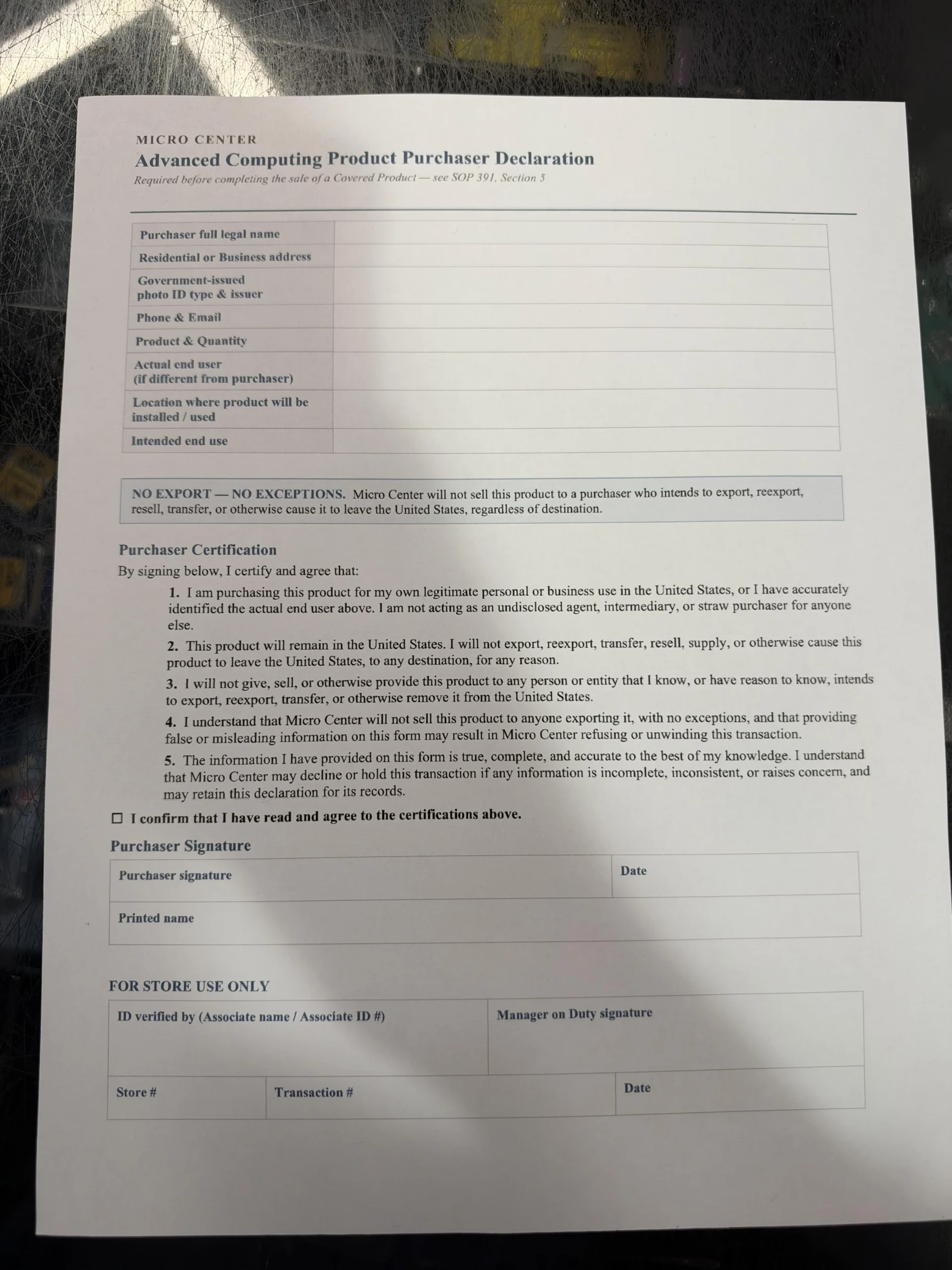
There are a total of 8 fields for the buyer to fill in:
| Form field (original text) | Chinese translation |
|---|---|
| Purchaser full legal name | Purchaser’s full legal name |
| Residential or Business address | Home or business address |
| Government-issued photo ID type & issuer | Types of government-issued photo identification and issuing authorities |
| Phone & Email | Phone and Email |
| Product & Quantity | Product and Quantity Purchased |
| Actual end user (if different from purchaser) | Actual user (if different from purchaser) |
| Location where product will be installed / used | Product Installation / Usage Location |
| Intended end use | Intended use |
Below the field, there is also the most important “NO EXPORT — NO EXCEPTIONS” confirmation box, which reads: Micro Center will not sell this product to anyone who intends to export, re-export, resell, transfer, or in any way cause it to leave the United States, regardless of destination.
Further down are five statements that you also need to check to agree to, namely: “The product is being purchased for lawful personal or business use in the United States,” “The product will remain in the United States and will not be resold or supplied to anyone else,” “I will not give the product to any person or company whom I know, or have reason to know, intends to take it out of the United States,” “I understand that Micro Center will not sell the product to any exporter, and that Micro Center may refuse or cancel the transaction if false or misleading information is provided,” and “If the information is incomplete, inconsistent, or questionable, Micro Center may refuse or delay the transaction and retain this statement on file.”
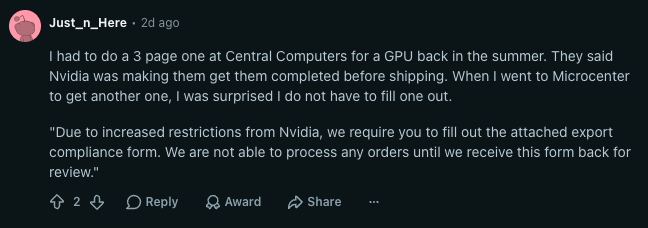
As things stand, this really does seem to be a new Micro Center policy. One commenter said they themselves had previously bought a 5090 at Micro Center and weren’t asked to sign anything like this. Someone else said that when they bought a GPU at another computer store, Central Computers, last summer, they also signed a similar but longer form:
Micro Center has not publicly explained why it started requiring this statement. Tom’s Hardware has written to ask but has not yet received a response. Currently, besides the Tustin, California store, people on Reddit also claim that other Micro Center locations have implemented similar rules.
Although it’s ridiculous that buying a computer with an RTX 5090 still requires signing this kind of declaration, it seems more like a deterrent; the document doesn’t even require recording the RTX 5090’s serial number, so tracking a specific graphics card later wouldn’t be easy.
Source: KOCPC Chinese