


“We’re building Copilot into the new OS for work, spanning every model, every device form factor, and every task.” Microsoft CEO Satya Nadella announced in a post on X on September 25 what he called “the biggest update to Copilot ever,” with an attached image that simply read: Your new OS for work. But this “OS” is a bit unusual. It has no desktop, no Start menu, and no File Explorer. The four things Microsoft put into it are Autopilot, Code, Home, and the entire Office suite.
We’re building Copilot as a new OS for work that spans every model, every form factor, and every task. Today, we’re announcing our biggest update to Copilot to date, bringing four things together:
· Autopilot: proactive and long-running agent built for the enterprise
· Code:… pic.twitter.com/W2ClHHkCK3— Satya Nadella (@satyanadella) September 25, 2026
Three new Copilot entry points: Home, Code, and Autopilot
According to an announcement posted on Microsoft’s official blog the same day, the new Copilot App is made up of three modules and has Word, Excel, and PowerPoint built directly in.
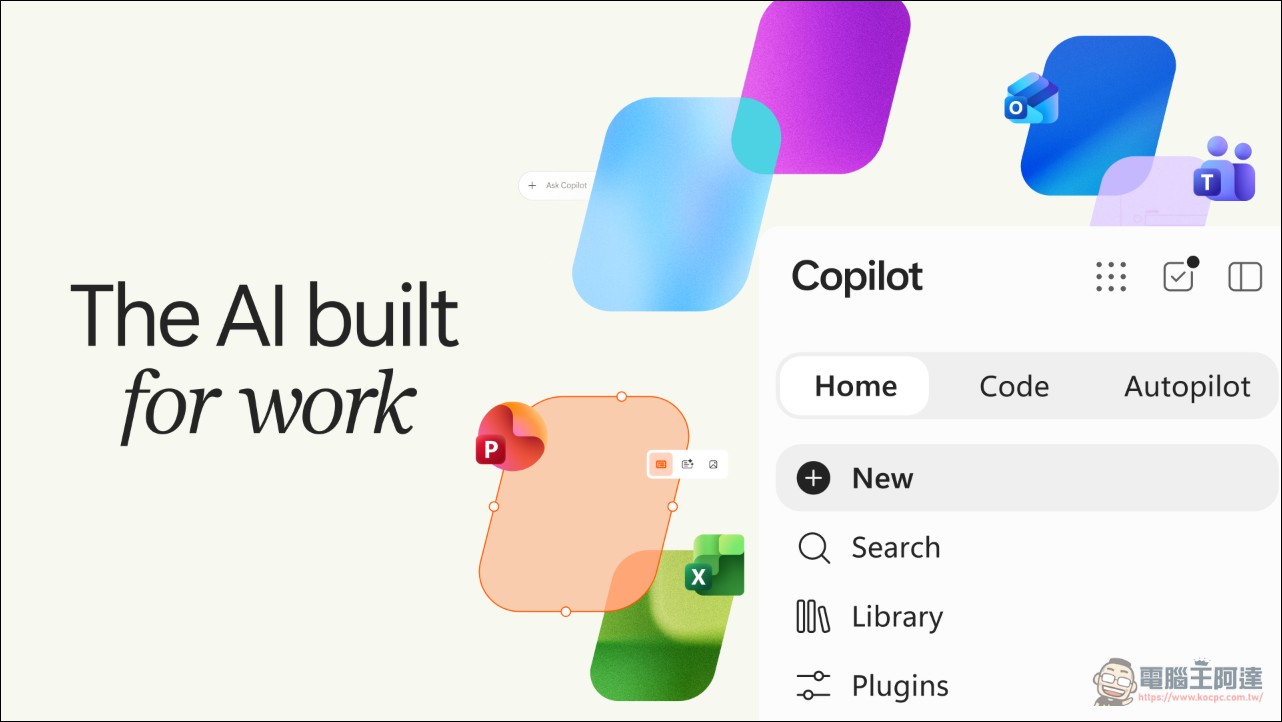
- HomeThe new homepage combines the original Chat and Cowork. Chat handles quick Q&A and drafts, while Cowork handles delegated work such as RFP responses, product launch kits, client presentations, and financial close packages. The user assigns a task, and it runs until completion.
- CodeLet non-engineers build too. Describe the app, tracker, interactive dashboard, or automation you want in natural language, and Copilot picks the method to build it. It runs on the same underlying technology as GitHub Copilot, executes in a sandboxed environment, and can be hosted within an enterprise’s own Microsoft 365 tenant.
- AutopilotIts predecessor was Scout, announced at this year’s Build conference. Users give it a name and assign it a role and goals; it then monitors channels, tracks progress, and runs routine tasks on its own, and can even pick a project back up days later and continue working on it. It has its own identity, memory, cloud computer, and workspace, and can be @-mentioned in Teams, Outlook, channels, and documents, just like a colleague.
Microsoft also previewed that going forward, users will no longer have to choose a mode themselves. They just need to describe what they want to do, and Copilot will automatically determine whether to route it to Chat, Cowork, or Code. The accompanying Copilot Managed Runtime provides managed infrastructure for securely executing code within enterprise Microsoft 365 environments, governed by IT, and is now available in preview.
Office has moved entirely into Copilot.
Word, Excel, and PowerPoint are now native features in Copilot. The official pitch is that this removes the hassle of formatting getting messed up, versions being scattered, and having to rebuild context in another app. From Home, you can ask Copilot directly to draft a launch presentation, build a budget model, or create a presentation, generating directly editable files. Colleagues’ edits sync in real time, keeping Copilot and Office consistent. In Excel, you can see who changed what and why, and the system recommends the most suitable charts.

Enterprise data integration is also expanding in tandem. Fabric IQ brings more than 20 million semantic models from Power BI into Copilot, now fully available in Chat and Cowork; Dynamics 365 and Power Platform data and flows will enter public preview over the next month. Microsoft is also launching a new plug-in registry that consolidates first-party, partner, and custom plug-ins into a single list, centrally reviewed and managed by IT.
Today and @Copilot in Teams
Microsoft also gave an early look at its next step: Today in Home is a personalized command center that brings together emails, calendar, Teams discussions, meetings, and to-dos, proactively telling you what you missed, what needs to be handled now, and what can wait. Beyond listing tasks, it will draft the messages and propose rescheduling options, leaving you only to hit send. Today enters private preview in October and will then roll out in Copilot, Outlook, and Teams.
In Teams, @Copilot will get the shared context and permissions of the entire channel, group chat, or meeting. If you want to ask, “Why was this product decision originally made this way?” Copilot will pull the background from various conversations so you don’t have to dig through records yourself; if the decision affects manufacturing, packaging, and launch timelines, it will also suggest preparing a cross-departmental review checklist. This feature will enter private preview at the end of the month.
Switch billing to a dual-track system.
Microsoft has split Copilot pricing into two tracks:
- User Subscription License (USL): Covers Chat, plus Copilot in Word, Excel, PowerPoint, Outlook, and Teams; the model is automatically selected by “Auto” based on accuracy, speed, and cost.
- Usage-based billing (UBB)Long-running agentic work such as Cowork, Code, and Autopilot, as well as frontier models like OpenAI’s Astra and Anthropic’s Fable, are all billed based on usage.
Usage-based services are off by default. Administrators can set spending policies and limits through the newly launched FinOps for AI, and users can also see their own quotas and usage records in Copilot.
Market buys it: stock rises 4% intraday as analysts raise price target.
Investors are clearly buying into the corporate pivot. Microsoft shares rose 4% intraday that day to $516.39, and Oppenheimer analyst Brian Schwartz raised his target price from $515 to $570, maintaining an Outperform rating, citing customers increasingly standardizing on Microsoft as their preferred enterprise AI platform. He also flagged the risks of AI disruption and enterprise technology spending being pulled forward. Year to date, Microsoft shares are up 7%, while the technology sector ETF (XLK) is up 37% over the same period.
As of July this year, Microsoft 365 Copilot had accumulated about 30 million paid seats. Seats bring predictable subscription revenue; usage-based billing, meanwhile, has agentic businesses pricing by how much work customers run, which is also the most discussed part of this business model.
Conclusion
Yet expectations and skepticism from the outside coexist. A user commented in a related discussion: “You’re always the first to adopt every new technology, but when it comes to scaling, things always go wrong.” Such concerns are not unfounded, because the vast majority of features are still on the way: Home and Code will enter the Frontier early access program in the coming weeks; Code will open in Frontier first at the end of the month, and will only open in preview to Microsoft 365 Premium and Pro subscribers later this year; Autopilot will enter private preview at the end of the month.
Microsoft is betting on the turf it knows best: Office, identity management, and enterprise governance. Whether it can live up to the claim of being “the new OS for work” depends on whether, after the early-access phase ends, enterprises are actually willing to pay for usage-billed agents.
Source: KOCPC Chinese