


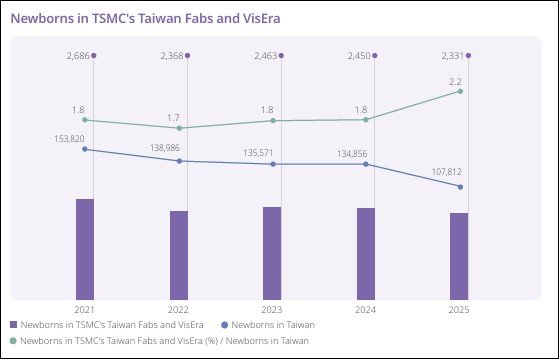
Taiwan’s low birth rate has become one of its most severe social problems, and the National Development Council estimates that the number of newborns this year will fall below the 100,000 mark. But amid this wave of declining birth rates, one company stands out: TSMC. According toTSMC’s latest sustainability reportIn 2025, employees at TSMC’s Taiwan sites and VisEra welcomed a total of 2,331 newborns, accounting for 2.2% of all newborns in Taiwan. That means 1 in every 46 newborns is a “TSMC baby.”
Births across Taiwan fell by 20%, but TSMC babies fell only 4.9%.
Over a longer time horizon, the change in the number of “TSMC babies” has been much more stable than that of Taiwan as a whole. According to sustainability report data, the number of newborns in TSMC employee families fell from 2,450 in 2024 to 2,331 in 2025, an annual decline of about 4.9%; over the same period, Taiwan’s total births plunged from 134,856 to 107,812, a drop of more than 20%, so the decline in TSMC babies was clearly lower than the national level. In fact, as early as the end of 2024, statistics indicated that about 1 in every 50 newborns in Taiwan was the child of a TSMC employee; the ratio has now risen further to 1 in 46.
Another sharp contrast is the employee base: the population of employees aged 20 to 64 at TSMC’s Taiwan sites and VisEra accounted for only 0.54% of Taiwan’s population in that age group, yet contributed 2.2% of all newborns in Taiwan. Less than 1% of the population gave birth to more than 2% of the newborns, which is exactly why TSMC employees are called “fertility heavyweights” by outsiders.
How far has TSMC gone with its fertility benefits?
TSMC links its employees’ high fertility rate to family-friendly policies in its sustainability report. The company provides comprehensive benefits and childbirth benefits. Each site has breastfeeding (pumping) rooms so female employees can pump breast milk conveniently. Female employees are entitled to 12 weeks of maternity leave for their first child, 16 weeks for their second, and 20 weeks for their third or later child. Other arrangements include prenatal checkup accompaniment and paternity/parental leave, assisted reproductive leave, childcare leave, and work-from-home days. To create an environment that supports worry-free pregnancy and childbearing, TSMC has also responded to the Ministry of Labor’s flexible unpaid parental leave program (effective January 1, 2026) by launching a flexible unpaid parental leave program, giving employees greater flexibility in using time for childrearing and caring for their children.
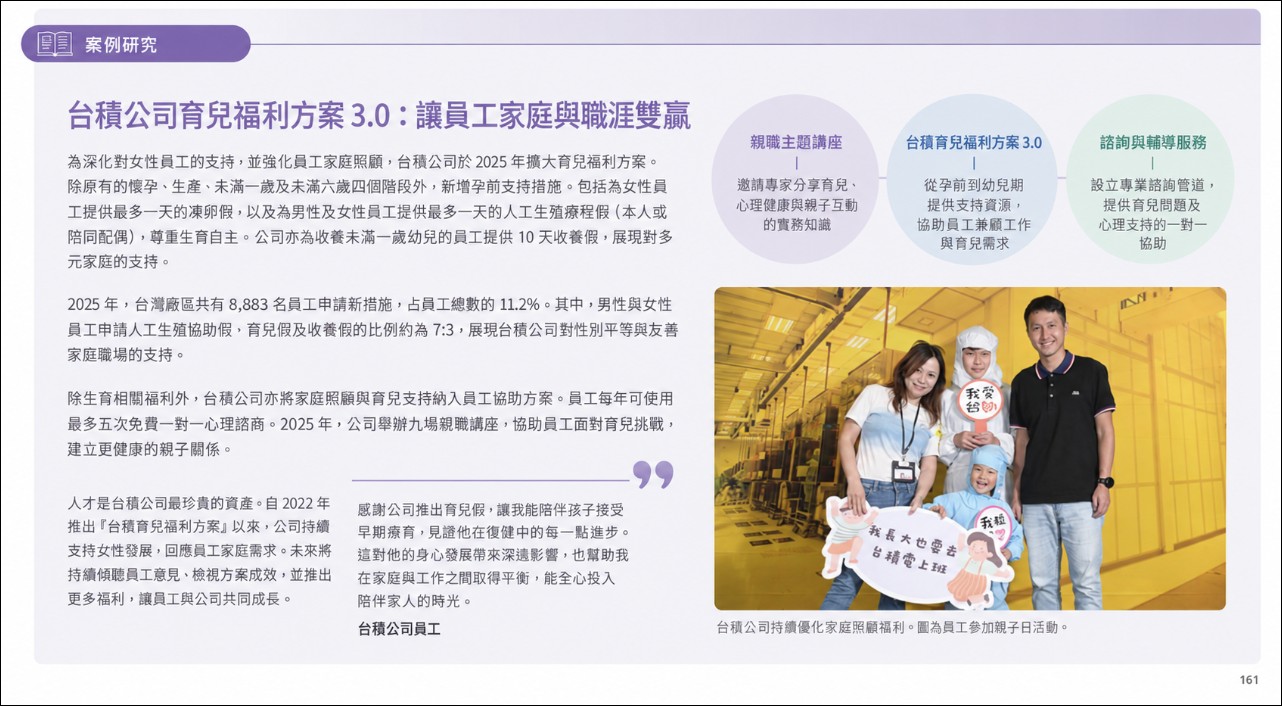
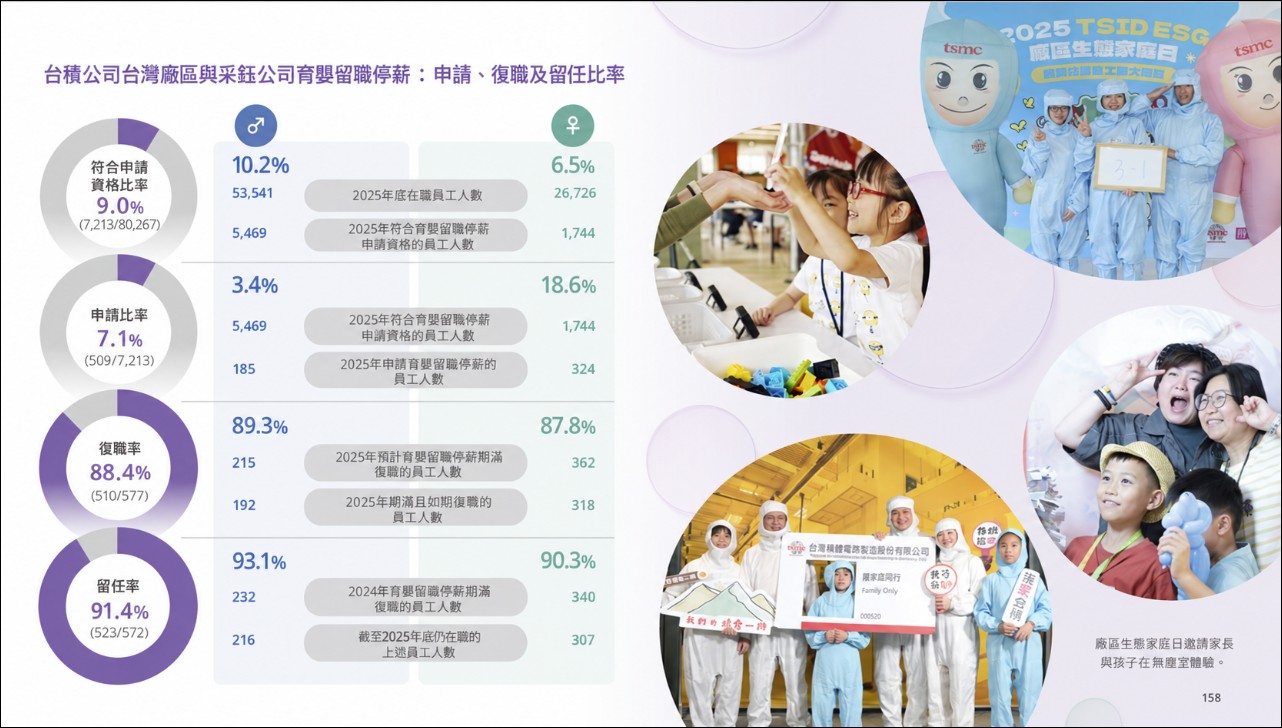
In terms of physical childcare resources, TSMC has four preschools in Hsinchu, Taichung, and Tainan, with capacity for 528 young children; the new family care measures introduced in 2025 received 8,883 applicants, accounting for 11.2% of employees at its Taiwan sites. Data on unpaid parental leave usage and return is also quite complete: in 2025, 7,213 employees were eligible to apply for unpaid parental leave (9.0%), of whom 509 actually applied; 577 were expected to return to work during the year, and 510 returned on time or early, for a return-to-work rate of 88.4%. In terms of retention, of the 572 employees who returned to work in 2024, 523 were still employed at the end of 2025, a retention rate of 91.4%. Judging from the numbers from application to return to retention, TSMC’s parental leave system is indeed being used by employees, so calling it a paper benefit would not be fair.
“5-fold” or “2-fold”? Age structure must be adjusted first.
C.C. Wei claims that the fertility rate among TSMC employees is five times Taiwan’s national rate, but physician and columnist Shen Cheng-nan bluntly says, “That’s not how you look at it.” HeAnalysisMore than 80% of TSMC employees are between 18 and 50, and those aged 18 to 30 account for more than 30% of the total, a huge gap from Taiwan’s overall age distribution; women also make up only just over 30% of employees, likewise differing from the overall population structure. Young people are the main childbearing group to begin with, and male employees also have children in their families, so directly comparing all employees with Taiwan’s entire population would be misleading. After adjusting for both age and sex factors, he roughly estimated TSMC’s fertility rate to be about twice Taiwan’s.
Even if you cut it in half, a 2-fold difference is still significant. The adjusted figures show that TSMC employees are indeed more willing to have children than ordinary Taiwanese people, but the gap is not as exaggerated as the uncorrected multiple. Shen Cheng-nan also admitted that it “of course makes sense” for TSMC to attribute its high fertility rate to fertility benefits; the problem is that there is another variable that cannot be ignored.
The biggest variable pointed out by physicians: salary.
Shen Cheng-nan pointed out that instead of relying on hearsay, it is better to look directly at official reports: TSMC’s median employee salary is NT$3 million and its average salary is NT$4 million. “How does that compare with Taiwan’s average? More than four times! That is precisely why TSMC employees are more willing to have children.” Citing foreign research, he explained that income and fertility rate follow a U-shaped curve: when income rises from poverty to moderate comfort, the willingness to have children declines; but as people move from moderate comfort to affluence, the willingness to have children begins to rise again. The reason is that the cost of having children increases with economic development. Salaries and housing prices make most young people afraid to have children, while families with more resources can afford the cost of having children, so they are willing to have them.
Following this logic, Shen Cheng-nan offers his solution: “To solve the fertility problem, all you have to do is double salaries and cut housing prices in half, and the fertility rate curve will shoot up; the high fertility rate of TSMC babies is clear proof.” Contrasting with the government’s current childcare subsidies, his criticism is even more direct: “To boost fertility, giving each child 5,000 a month is not enough; it should be 50,000.” In his view, Taiwan’s declining birthrate is inseparable from economic factors such as salaries, housing prices, and family burdens, and if subsidy amounts are insufficient, the effect will naturally be limited.
Conclusion
The TSMC baby phenomenon is equivalent to examining both sides of the low birthrate debate within a single sample: TSMC officially emphasizes institutional design such as maternity leave, childcare, and parental leave, while Shen Zhengnan points to the economic capacity behind wage levels. Based on existing data, both are probably true; for employees to dare to have children, they need institutions to back them up and income to sustain child-rearing expenses. When Taiwan’s overall decline in births is far greater than the decline in TSMC babies, this special sample at least shows one thing: low birthrates are not necessarily an irreversible trend—it depends on whether young families can afford it. After all, not everyone is a TSMC employee, and Taiwan’s low birthrate problem cannot be solved by a single company. The government must still address childcare subsidies, housing prices, and other issues; otherwise, the birth rate will still not improve significantly.
Source: KOCPC Chinese