


Google’s flagship models had long been jokingly described as making no progress, but recently the update pace has become so fast it’s almost unreasonable. After launching Gemini 4 Argon on September 30, it followed up with the next generation on October 28. Gemini 4 CarbonBoth models belong to the Gemini 4 family and were released less than a month apart. At launch, Carbon’s positioning was clear: Google defined it as its most powerful model, purpose-built for cybersecurity and long-horizon agentic work, covering complex knowledge work, software engineering, and scientific reasoning. The official X account’sa more direct way of putting itArgon is suited to complex tasks, while Carbon is reserved for the hardest problems.

But this Carbon model, fromPublishThere was a two-week gap before today’s full opening. On October 28, Google released it in stages, first providing it to some cybersecurity defenders and gradually expanding it to other partners through the Fairwind Program; at the time, officials did not announce a date for full opening. On November 10, Google officially announced that Carbon was fully open, available to developers, enterprises, scientists, and general consumers. This time it was not just about opening access; Google also published a large number of real-world cases, including multi-agent collaboration to reconstruct 3D scenes, using the model to prove the security of the Signal encryption protocol, and finding real logic flaws in public code repositories.
How to use: five channels
Officials have compiled five ways to obtain Carbon:
- DeveloperGoogle AI Ultra subscribers can also try the Gemini API paid tier in Google Antigravity and AI Studio, in addition to using it in AI Studio and Android Studio.
- Enterprise: via the Gemini for business API or model dropdown menu, Google Antigravity, and CodeMender
- General users: Google AI Ultra subscribers can use it in the Gemini app and AI Mode in Search
- Scientists and researchers: Apply for Google Antigravity’s highest usage tier and get free access to Argon and Carbon for six months
- Cybersecurity defenderApply to join the Fairwind Program to obtain Carbon for cyber
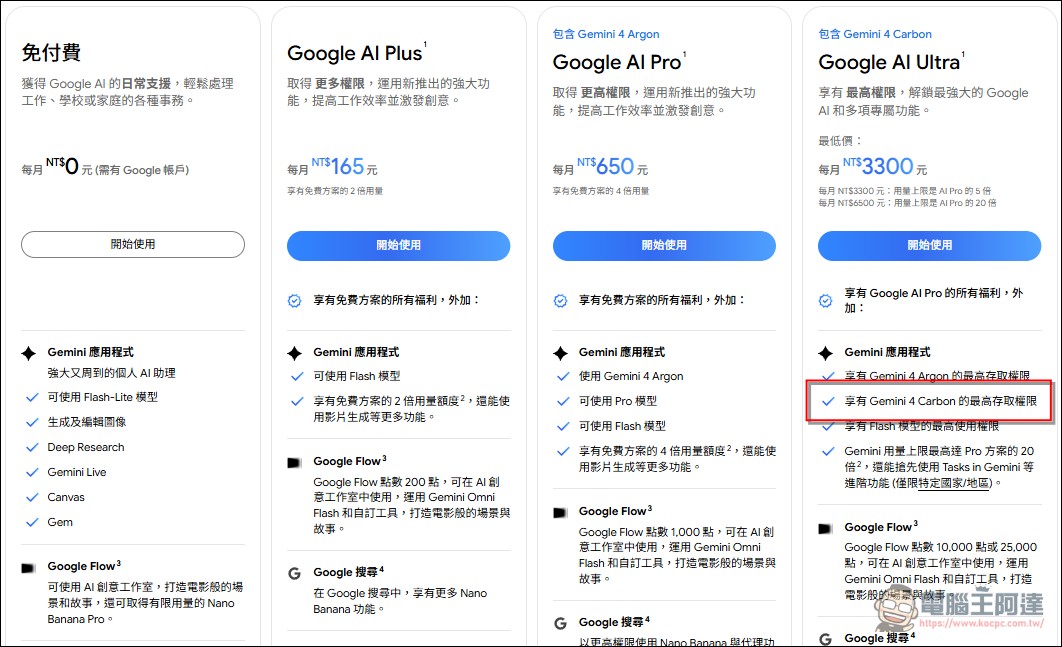
Taiwan’sThere are two Ultra plans in the subscription section.At NT$3,300 per month, the usage cap is 5 times that of AI Pro; at NT$6,500 per month, it is 20 times. However, Taiwan’s subscription page currently still lists Gemini 4 Argon as the flagship model and does not include Carbon. Officials say Carbon is “currently being rolled out”; whether it can actually be selected in the Gemini App in Taiwan, readers may have to open the App themselves to confirm.
Specifications and Prices
The model ID listed in the official AI Studio documentation is gemini-4-carbon, shares a unified 1M context window with Argon, with a combined upper limit of 1,048,576 tokens across input, thinking, and output. Maximum output defaults to 64K; enable background execution and increase it. max_output_tokens After that, a single response can exceed 64K, going all the way up to 1M minus the input portion.
Thinking levels are divided into three tiers,low Most token-efficient, lowest latency,medium is the default value,high Used for the hardest reasoning and coding tasks, with the slowest speed. The official documentation specifically emphasizes that the difference between Carbon and Argon is how many thinking tokens they spend per turn; Carbon spends more, so its per-turn token usage and latency are both higher than Argon’s. AI Studio’s model card also labels Carbon’s speed as Deliberate and Argon’s as Moderate.
On pricing, Carbon and Argon are the same: until November 30, it is $2 per million input tokens and $10 per million output tokens; starting December 1, it reverts to $4 and $20. Cached input tokens get a 95% discount, at $0.10 per million, then becoming $0.20. Converted to New Taiwan dollars, before the end of November the input price is about NT$66 per million tokens and output about NT$330; starting the next day, these become NT$132 and NT$660.
The official documentation states two limitations. Carbon is only available on paid plans, and output pricing includes thinking tokens; when using grounding, the tool’s system instructions and function declarations are also billed. Additionally, it does not support explicitly specifying a cache, which means cachedContents and caches.create They all have to be removed; the official docs say implicit caching is automatically applied to prompts over 4,096 tokens.
Benchmark scores and ranking changes
At the official announcement on October 28, Carbon scored 59 on the Artificial Analysis Intelligence Index v5.0 and ranked first. (Editor’s note: But after Claude Fable 5.2 launched yesterday, it returned to first place with 65 points, while Carbon’s 60 points fell to fourth.)
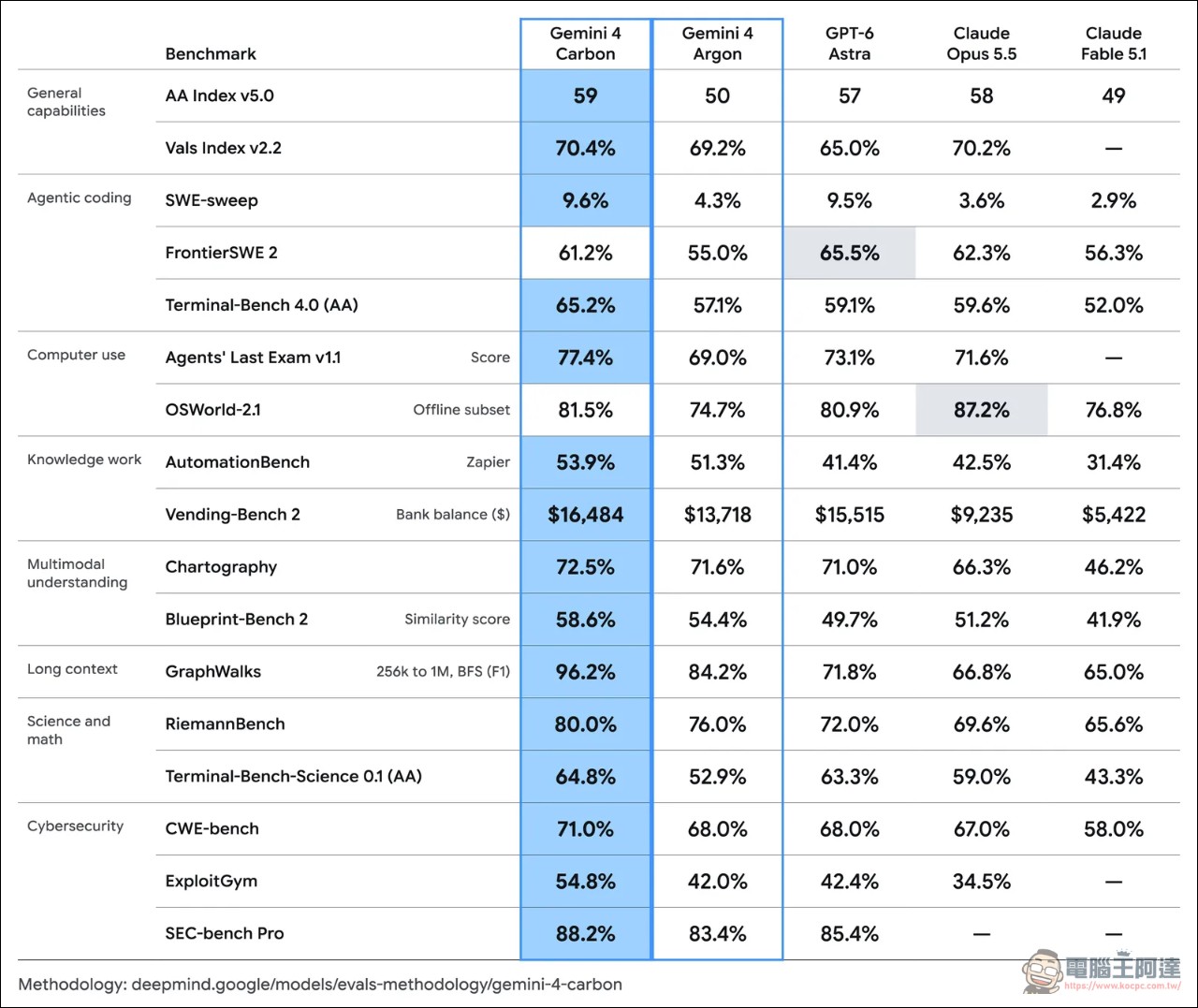
Google’s announcement this time focused on evaluations of real-world workflows. The company said Carbon ranked first on CursorBench 4.0, Perplexity’s WANDR, and Zapier’s AutomationBench, and that its cost per task is more than two times lower than the best external model.
Security capabilities are the focus of this update. Google said that under the Fairwind Program channel, Carbon scored 88.2% on SEC-bench Pro for finding vulnerabilities, 54.8% on ExploitGym for validating exploitability, and 71.0% on CWE-bench for patching vulnerabilities. In real-world examples, Google’s internal Project Fortify scans achieved 100% recall and 95% triage accuracy, and on open source codebase tests improved recall by a relative margin of more than 25% over Argon. The cloud vulnerability research team used Carbon to confirm that two bugs in a popular open source project were exploitable vulnerabilities, with severity comparable to the recent PHP2Shell, helping maintainers reclassify them as critical and release fixes. Wiz’s Scan for Good program scanned two large SaaS providers and found 0-day vulnerabilities within two hours.
The new benchmark MKA, developed through a collaboration between Google DeepMind and Artificial Analysis, is another highlight. It tests whether agents can read visually complex files such as architectural drawings, engineering schematics, and clinical scans, and produce presentations, spreadsheets, PDFs, and annotated images. Carbon ranks second on this benchmark, with an average cost per task more than six times lower than that of the top-ranked model.
debate trade-offs in real time, jump from the member roster into any agent’s trace to intervene, and use an interactive Graph timeline to trace back how the team moved from requirements convergence to verified code.
Real-world cases showcased by the official source
The examples accompanying this release announcement are much more densely packed than those in typical model launches, and most are complete applications rather than code snippets.
In terms of 3D reconstructionUse /swarm Converting the 206 engineering drawings in seven city council planning PDFs into an interactive 3D model, the team ran loops for ten straight nights to produce a 906K-triangle Three.js version of the Google Platform 37 office reconstruction.
Another example is an open-world 3D game for exploring the Google Mountain View campus, where the player rides a pelican; the user built the browser game using Three.js and WebGL shaders.
In the areas of science and musicThe Google research team established a new formal verification agent framework, AlphaProof Code, using Carbon together with other models to turn safety goals into mathematical theorems and generate millions of lines of code in Lean to prove the security of the actual code of the Signal encryption protocol. Officially, this work has historically required expert teams to spend years, but now it has been reduced to weeks. The research team also used Carbon in the CASP17 blind test across seven low-homology protein families, increasing the homologous sequences found by an average of 40 times. In music, a multi-agent loop reconstructed a fortepiano of the Stein and Schuler school around 1780, with the physics of a 61-key escapement mechanism, and placed it into a 3D model of Koerner Hall at the Royal Conservatory of Music in Toronto with seat-specific spatial acoustics.
A showcase specifically highlighted by the official Twitter account.It turns bird research into an interactive 3D simulation that can synthesize the syrinx sounds of six bird species in real time.
Our strongest frontier model, Gemini 4 Carbon, is now available. Built for deeply complex, long-horizon workflows that push a frontier model’s intelligence, Carbon delivers frontier performance in agentic workflows across complex knowledge work, software engineering and web development, cybersecurity, and scientific reasoning. While Gemini 4 Argon remains the ideal model for the majority of software engineering and knowledge work, Carbon steps in for your hardest tasks that push a model to its limits — from complex, multi-step debugging to open-ended scientific research. Available starting today: — Consumers: use it in the @GeminiApp and AI Mode in Search for Google AI Ultra subscribers — Developers and Enterprises: build via the API in @GoogleAIStudio and @AndroidStudio, Google @Antigravity for Google AI Ultra subscribers, and Gemini for business — Scientists and Researchers: apply for a chance to get 6 months free via @Antigravity — Cybersecurity Defenders: apply to join the Fairwind Program for access to Carbon for cyber Watch how Carbon brings reasoning and coding together, turning avian research into an interactive 3D simulation of a songbird’s vocal organ that synthesizes the sounds of six bird species live.
— Google AI (@GoogleAI) November 10, 2026
Safety and Honesty
Carbon retains Argon’s multi-layered security architecture, and the figures officially released this time focus on agent honesty and prompt injection defense.
Google says that on a 375-task agent honesty benchmark, Carbon had a 92% pass rate and Argon 70%; when experimental data was missing, Carbon refused to fill it in 98% of the time and flagged methodological flaws 68% of the time. On Gray Swan’s indirect prompt injection benchmark, Carbon’s attack success rate was 0.0%, and the company also acknowledged that prompt injection defenses remain an area requiring continuous improvement. In terms of abuse protection, in a simulated attack environment comprising ExploitBench and CyScenarioBench, Carbon blocked 99% of attack trajectories, and the single-attempt breach rate fell from Argon’s 3.1% to 0.8%.
Conclusion
Carbon went from being announced on October 28 to full availability on November 10, and there was a clear reason for the two-week wait in between. Google said this model brings stronger cybersecurity capabilities, so it took part in the U.S. government’s voluntary pre-release testing, first making it available to cybersecurity defenders and Fairwind Program partners, and only releasing it publicly after collecting feedback and adjusting its safeguards.[1]Koray Kavukcuoglu, Senior Vice President at Google DeepMind, is also an author of this open announcement.
For developers, choosing a model has become a clear trade-off. The official documentation recommends keeping Argon for everyday interactive coding and feature development, and handing complex root-cause debugging, architecture design, intensive multimodal integration, scientific proof, and security audits to Carbon only. Upgrading from Argon to Carbon does not require changing the request structure—just replace the model ID—but you have to max_output_tokens Lengthen the HTTP timeout as well, because difficult problems may take several minutes to run.
Price is the timing detail most easily overlooked. November 30 is the deadline for introductory pricing; starting the next day, both input and output prices will double. Teams with needs must finalize their usage estimates and budget caps before December 1, or the same work order will directly become twice as costly.
Source:Gemini 4 Carbon is now available
Source: KOCPC Chinese