


Many Apple users online often cite the Mac’s unified memory as suitable for running local AI large models, but it seems no one has clearly explained how large a model can be run. Recently, Apple turned “which machine can run how large a model” into a table, listing the unified memory ceiling, memory bandwidth, and supportable model scale from iPhone and iPad all the way to Mac Studio clusters, with the top tier saying 1.6 trillion active parameters.
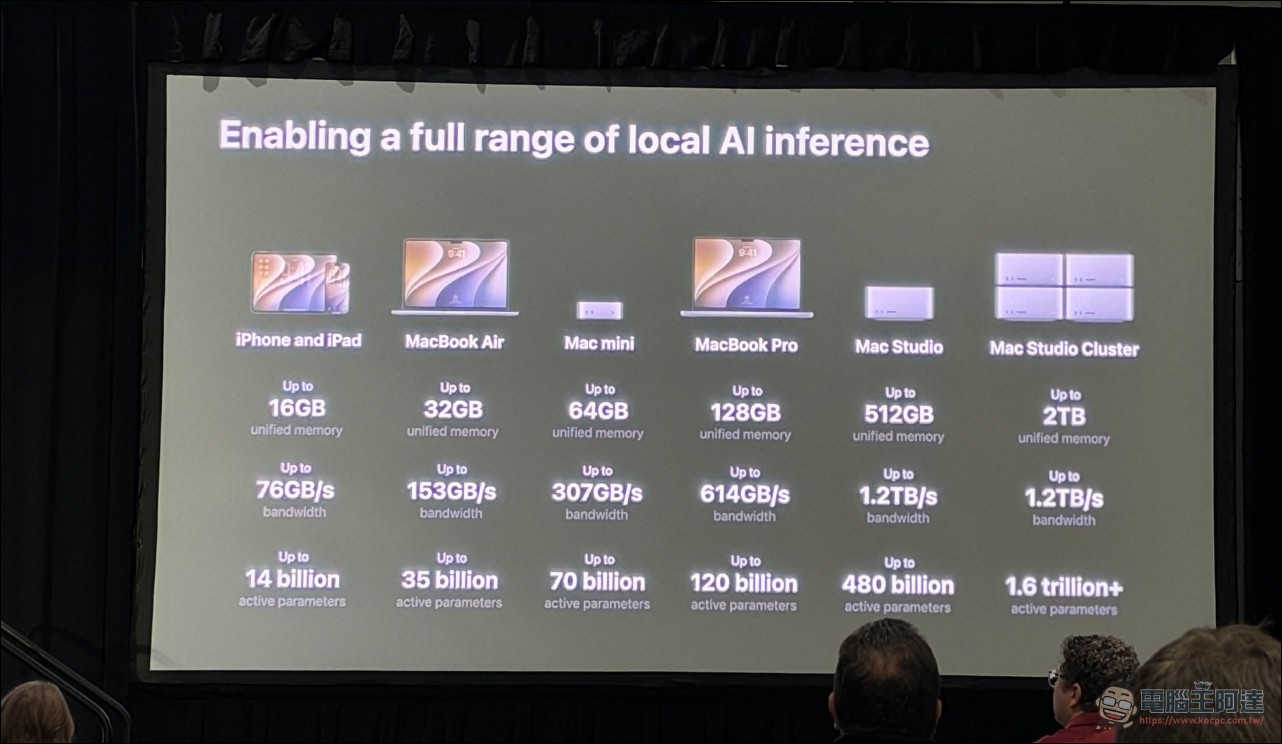
Six columns, all in one table.
The table lists six product lines, and each column gives three numbers: memory, bandwidth, and model scale:
- iPhone and iPad
- MacBook Air: 32GB, 153GB/s, up to 35 billion
- Mac mini: 64GB, 307GB/s, up to 70 billion
- MacBook Pro: 128GB, 614GB/s, up to 120 billion
- Mac Studio: 512GB, 1.2TB/s, up to 480 billion units
- Mac Studio cluster:2TB, 1.2TB/s, over 1.6 trillion
Apple has shared a chart of their on-device AI capabilities across their product lines pic.twitter.com/yTGu5tDeko
— Aaron (@aaronp613) September 24, 2026
Apple itself has written the numbers for Mac mini and Mac Studio.
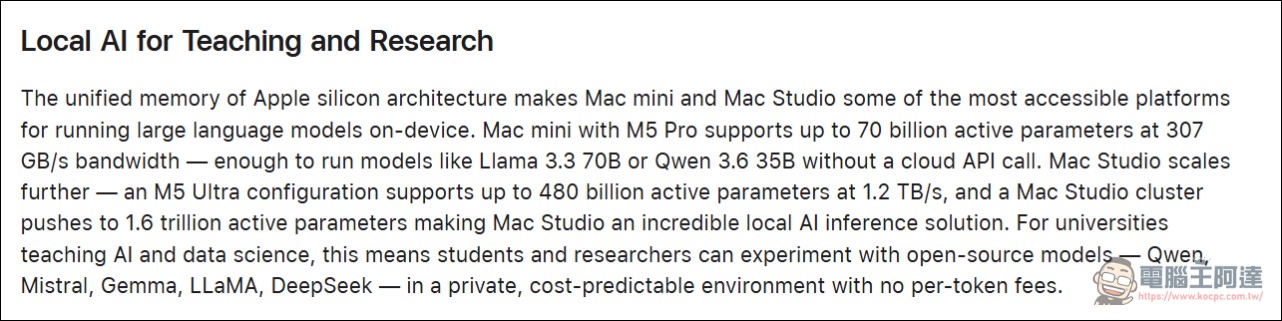
According to the Apple Education Community article written by Consulting Engineer James Garringer on the topic of campus procurement.ArticleThe article states that the M5 Pro version of the Mac mini supports up to 70 billion active parameters and 307GB/s of bandwidth, enough to run Llama 3.3 70B or Qwen 3.6 35B locally without calling a cloud API; the M5 Ultra version of the Mac Studio supports 480 billion active parameters and 1.2TB/s, while a cluster formed by linking multiple units scales to 1.6 trillion active parameters. The article lists the use cases as university AI and data science courses, where students and researchers can experiment with open-source models such as Qwen, Mistral, Gemma, LLaMA, and DeepSeek in a private environment without token-based billing.
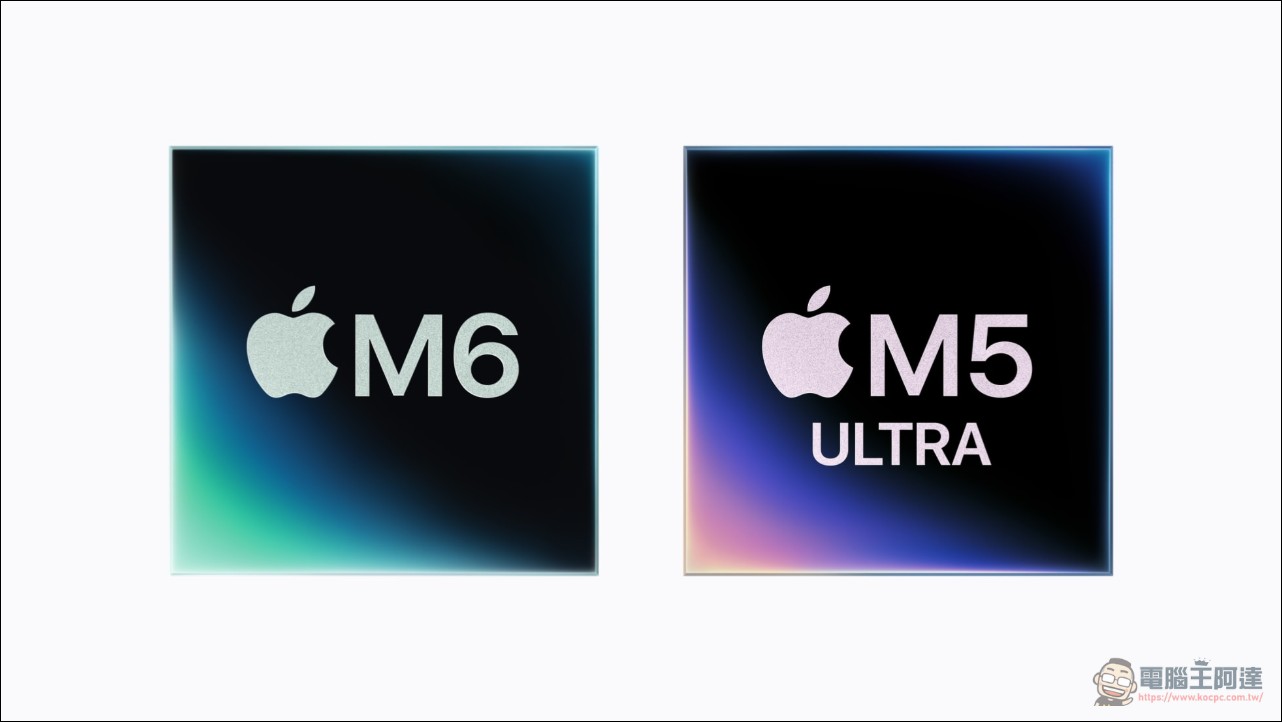
The Mac mini column in the table corresponds to the M5 Pro configuration. The 2nm M6 has dual 16-core Neural Engines, a neural accelerator in every GPU core, unified memory up to 32GB, and bandwidth up to 170GB/s; to get 64GB and 307GB/s, you have to choose the M5 Pro version, which is the tier listed in the table. We also recently got a Mac mini M6 32GB version to test locally (a detailed review video will come later), just so everyone knows; in principle, the experience on a 40,000-plus machine isn’t very good either.
The phone tier: the 76GB/s threshold
The requirements listed in the table for iPhone and iPad are 16GB unified memory and 76GB/s bandwidth. The A20 Pro’s memory bandwidth has already reached 115.2GB/s, which is higher than the figure listed in the table. So it may be based on the lowest-spec supported model.
Mac Studio’s hardware foundation
The 480 billion tier relies on the M5 Ultra. This chip uses UltraFusion to connect four dies, with up to 36 CPU cores, up to 80 GPU cores each with a built-in neural network accelerator, a 32-core Neural Engine, up to 512GB of unified memory, and 1.2TB/s of memory bandwidth, 50% higher than the M3 Ultra. Apple says its peak AI compute can reach 4.5 times that of the M3 Ultra, and prompt processing in LM Studio is 4x faster. These figures all come from Apple’s own published test results, not independent third-party testing.
How to achieve 1.6 trillion: Thunderbolt 5 plus RDMA
Models too large for a single machine are distributed across multiple machines. In its WWDC26 session “Explore distributed inference and training with MLX,” Apple lays out the entire architecture clearly: starting with macOS 26.2, it supports RDMA over Thunderbolt 5, allowing data to be written directly from one machine’s memory to another, eliminating most CPU and operating system handling costs; one layer up is Apple’s own open-source collective communications library, JACCL, responsible for data exchange and result merging between nodes; at the top is the open-source framework MLX, responsible for splitting models and dispatching work to each machine.
In its demo, Apple used four M3 Ultras to test a 27-billion-parameter Qwen 3.6, and the cluster’s token generation speed was nearly 3x that of a single machine; when fine-tuning a 9-billion-parameter Qwen 3.5, a single machine generated about 180 tokens per second, while the cluster did about 600. Apple uses the same wording in its official Mac Studio documentation, saying distributed AI inference performance can be up to 3x faster than a single system, and notes that actual results vary by model size and architecture. However, note that such a setup costs at least NT$2 million; that said, it is still the cheapest local workstation-class setup available right now.
“Startup parameters” are not memory usage.
Each tier in the table is measured in active parameters, a term that only makes sense when applied to mixture-of-experts (MoE) models. An MoE model consists of multiple expert subnetworks. When processing each token, only a few of them are used. The total parameter count covers all experts, while the active parameter count only includes the small portion used at that moment. Whether the model can run depends on whether the total parameters, at the specified quantization precision, fit into unified memory while still leaving room for the context window and the operating system; speed follows the active parameters.
Apple’s demo already provides a ready-made example. The open-source model Kimi 2.6 has 1 trillion total parameters. Even when compressed to 8-bit quantization, the weights alone require about 1TB of memory, which a single M3 Ultra cannot fit; four are enough. The “1.6 trillion” in the table is closer to reality if read as “how large a model this memory capacity can accommodate.” It does not specify quantization precision or context length, nor does it mention speed.
The control group at the 120 billion tier
The MacBook Pro column in the table lists 128GB unified memory, 614GB/s, and up to 120 billion active parameters. That combination puts it in the same tier as an RTX Spark laptop that also has 128GB of memory, and the two can run models of comparable size. The dividing line when choosing a machine is therefore not GPU core count but memory capacity and bandwidth: unified memory lets the CPU and GPU share the same pool, so models don’t have to be split up and moved into the graphics card’s memory (though Apple is at a relative disadvantage in performance because it doesn’t support the CUDA ecosystem).
Conclusion
This table answers whether you have enough memory, not whether it runs smoothly. When choosing a machine, factoring in the model, quantization precision, and context length together is far more useful than memorizing whether the label says 14B or 480B. This time, Apple at least made the starting point for buying clear: pick the model first, then go back and choose the memory. However, Apple’s advantage in running local AI is its large memory; its disadvantage is ecosystem issues (relying on gurus burning with passion), so its performance won’t be better than NV. But as long as your pockets are deep enough, it’s all “can run”; you won’t be left without even a chance to test it. It just depends on how you choose.
Source: KOCPC Chinese