


Apple’s current highest-spec processor M5 Ultra In late August 2026 with new Mac Studio Also announced, this SoC features a 36-core CPU (12 high-performance cores paired with 24 efficiency cores), while the top-end version comes with a 40-core GPU and supports up to 512GB of unified memory architecture. Compared with the previous-generation M3 Ultra’s 32-core CPU, the M5 Ultra has 4 more high-performance cores, which is also one of the key factors behind the significant improvement in multi-core performance. Recently, the M5 Ultra’s CPU benchmark score hasbe the first to exposeToday’s GPU results are also out, allowing the outside world to fully assess the fearsome strength of Apple’s custom chips in the workstation-class market.
GPU results: highest Metal benchmark score across the entire lineup, OpenCL matches the RTX 4080.
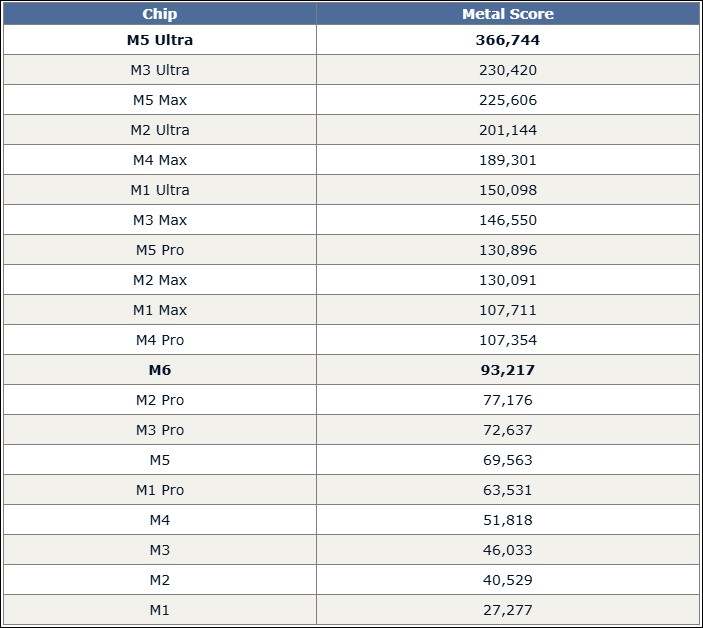
in Geekbench 7’s Metal benchmark in progressM5 Ultra set the highest record with 366,744 points. Metal is Apple’s own graphics API, so this test mainly reflects the chip’s graphics processing capability in the macOS/iOS ecosystem. Compared with previous generations, the M3 Ultra averaged 230,420 points, the M2 Ultra 201,144 points, and the M1 Ultra 150,098 points. The M5 Ultra’s improvement over the M3 Ultra ranges from 41% to 59%, depending on the individual test submission.
In addition, the M5 Ultra’s OpenCL score is roughly on par with the NVIDIA GeForce RTX 4080. However, because Metal is a benchmark exclusive to the Apple ecosystem, this result cannot be directly compared on equal footing with NVIDIA/AMD performance on Windows. To get a fair cross-platform comparison, more neutral benchmark results such as Vulkan are needed. In addition, Geekbench’s GPU tests tend to involve short bursts of thermal demand; for real-world workloads that require sustained full load, such as 3D rendering or video export, sustained performance still needs to be assessed by observing whether the Mac Studio’s cooling design can maintain stable output.
From this ranking, it’s clear that there is a significant performance gap between Ultra-class and Max-class chips. The M5 Ultra’s score of 366,744 is 62% higher than the M5 Max’s 225,606, mainly because the Ultra series uses UltraFusion technology to package two Max chips as one, doubling the number of GPU cores. In addition, the M5 Max’s own Metal score of 225,606 is already nearly on par with the M3 Ultra’s 230,420, meaning that the new-generation single-chip flagship has caught up with the previous generation’s dual-chip packaged product in graphics performance.
CPU performance: 36 cores beat 96-core Threadripper
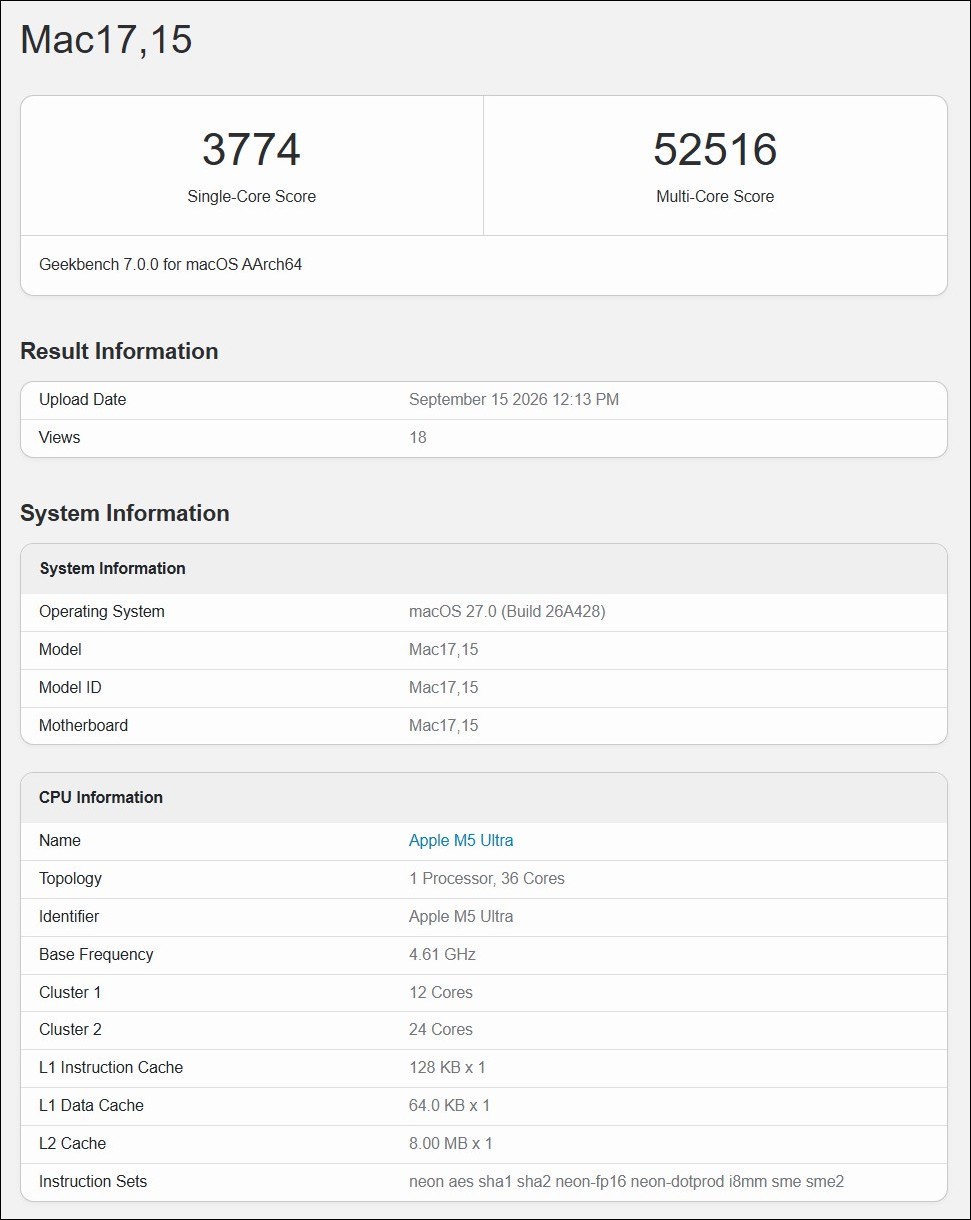
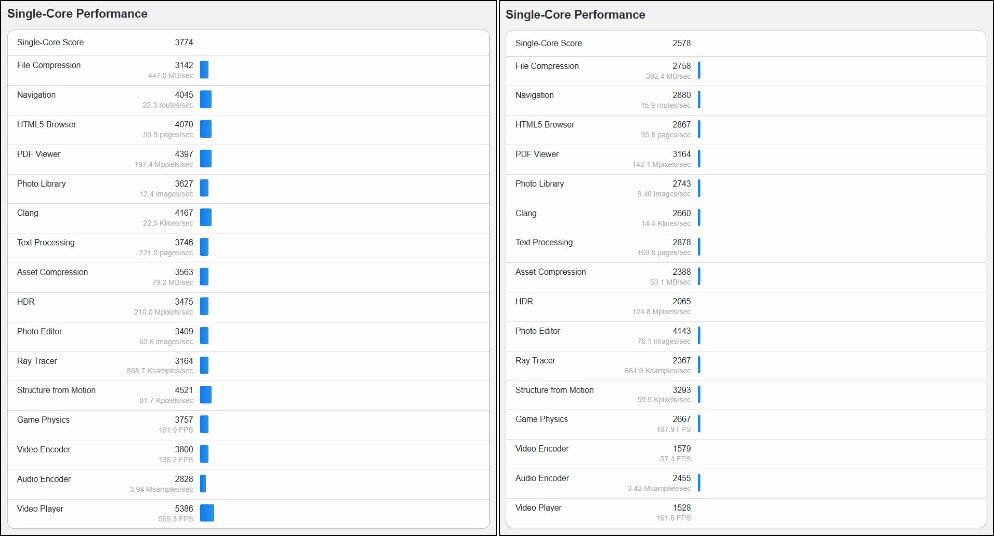
The M5 Ultra’s CPU benchmark score is equally impressive. In Geekbench 7 testIn it, the single-core score is 3,774 points and the multi-core score is 52,516 points. Compared with the M3 Ultra (single-core 2,920, multi-core 39,059), that’s an increase of about 30% and 35%, respectively, broadly in line with Apple’s official claim of “1.25x single-threaded and 1.3x multi-threaded,” and even slightly ahead.
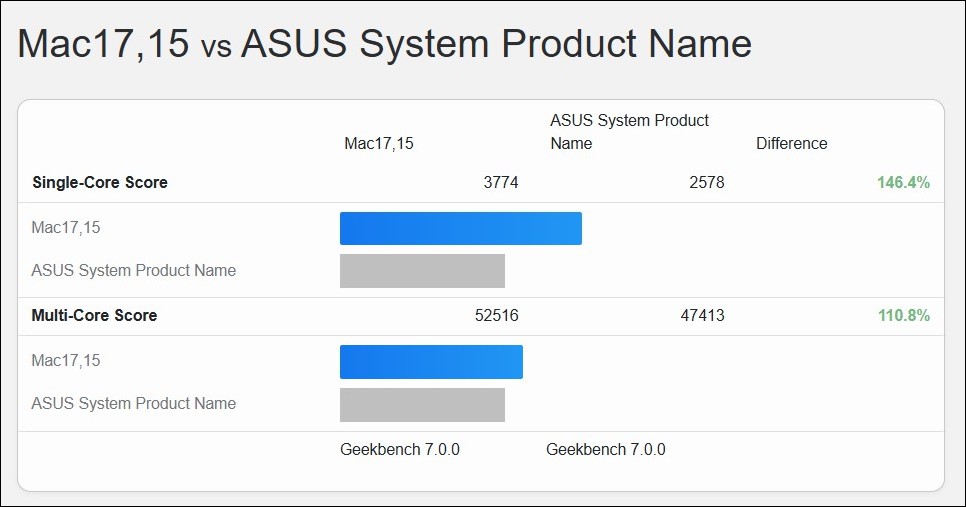
The most notable comparison is AMD’s Ryzen Threadripper PRO 9995WX. This workstation-class processor has 96 cores and 192 threads and a maximum boost clock of 5.40GHz, making it a top-tier product in the x86 camp. In CPU multi-core tests, the M5 Ultra defeated AMD’s 96-core Ryzen Threadripper PRO 9995WX with just 36 cores, scoring 52,516 points versus the latter’s approximately 47,400 points. The M5 Ultra won the multi-core test by a margin of 10.8% using only 36 cores. In single-core testing, the M5 Ultra’s 3,774 points led the Threadripper’s 2,578 points by a huge margin of 46.4%.
However, the M5 Ultra does not hold the upper hand in every subtest. Wccftech notes that in highly parallelized Ray Tracer and Clang compilation tests, the Threadripper 9995WX’s 96-core advantage is fully utilized, leading the M5 Ultra by as much as 58.8%. These types of workloads are characterized by tasks that can be split into a large number of independent small computations, making full use of every available core. But the M5 Ultra’s unified memory architecture instead has an advantage in tasks requiring large amounts of data movement, such as Photo Editor, HDR processing, and Photo Library, because the CPU and GPU share the same memory, eliminating the overhead in traditional architectures of moving data back and forth between system memory and graphics memory. Each architecture has application scenarios it excels at, depending on the user’s type of workload.
Looking at the longer timeline, the M5 Ultra’s multi-core score is 2.25 times that of the original M1 Ultra (23,328 points) and 6 times that of the base M1 (8,582 points). It has been just over four years since the M1 Ultra launched in 2022, and the growth in multi-core performance of Apple’s custom silicon has been quite astonishing.
M6 performance results debut simultaneously.
Besides the M5 Ultra, Apple also announced at the end of August… M6 Benchmark results for the chip have also leaked. The M6 is featured in the new-generation Mac mini and uses a 2nm process. In the Geekbench 7 Metal test, the M6 scored 93,217, 34% higher than the M5’s average of 69,563. On CPU, the M6’s single-core score of 4,071 is even higher than the M5 Ultra’s 3,774, but its multi-core score of 22,783 lags significantly behind due to its lower core count.
M6’s single-core score surpassing M5 Ultra is noteworthy. This suggests Apple achieved significant clock speed or IPC (instructions per clock cycle) gains on the 2nm process; even with fewer cores, the computing efficiency of a single core has entered a new level. However, M6’s multi-core score of 22,783 is still far below M5 Ultra’s 52,516, a 2.3x gap, entirely due to the difference in core count. For multi-core-intensive tasks such as video editing and code compilation, M5 Ultra’s 36-core architecture still has an overwhelming advantage; but for everyday uses like general document work and web browsing, the M6 Mac mini’s single-core performance is already sufficient, and its price is much more affordable.
Conclusion
The benchmark results for the M5 Ultra confirm Apple’s continued leadership in the field of custom silicon. A 36-core chip beats a 96-core Threadripper, and its GPU Metal score is up nearly 60% over the previous generation; these figures are quite convincing on the performance level. However, it must also be pointed out that Geekbench is, after all, only a synthetic benchmark, and performance under real workloads still needs validation from more real-world application scenarios. In In Wccftech’s testingThreadripper can still lead by nearly 60% in highly parallelized ray tracing and compilation tasks, meaning that “having more cores” still has irreplaceable value in specific scenarios.
For professional users who need to do video editing, 3D rendering, or AI inference work within the macOS ecosystem, the M5 Ultra Mac Studio with up to 512GB of unified memory is currently the most powerful Mac desktop option.NT$199,900The starting price is indeed not low, but compared with a PC workstation of the same class, this price is not unreasonable. After it officially goes on sale on September 23, third-party reviews and benchmark data from real-world application scenarios will more comprehensively reveal the true capabilities of the M5 Ultra.
Source: KOCPC Chinese