


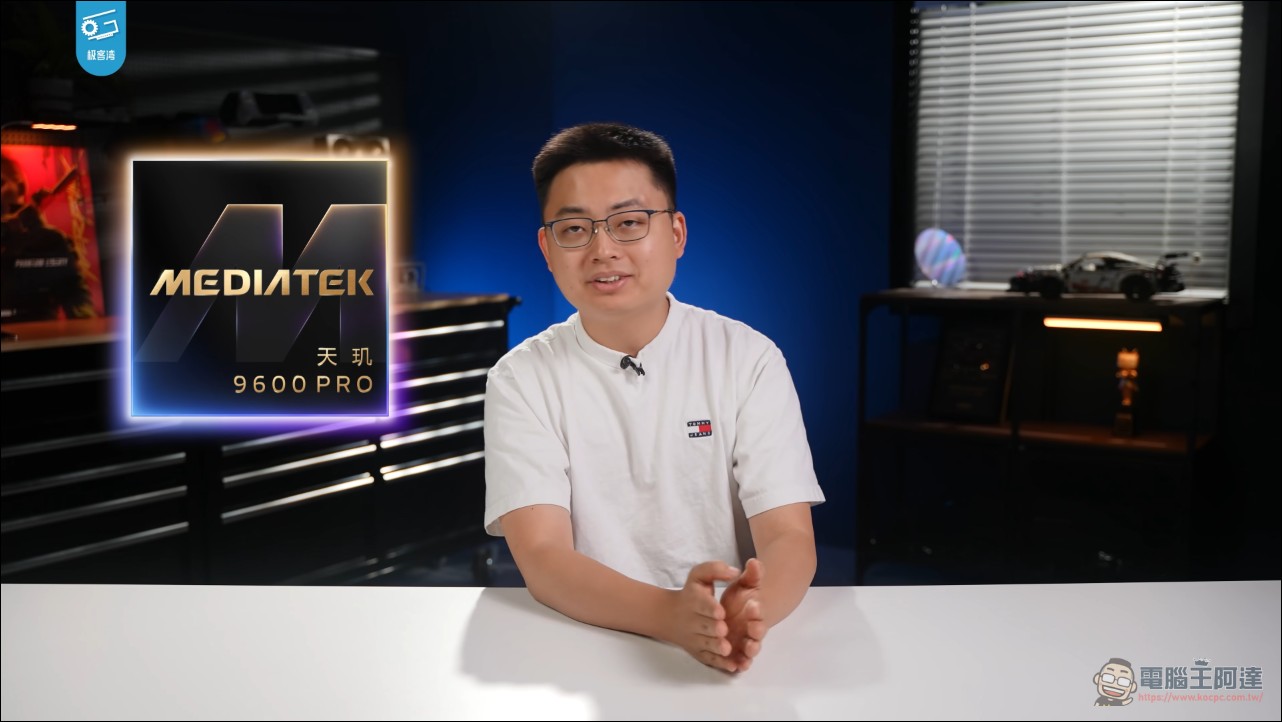
MediaTekOfficially announced on September 15.Dimensity 9600 Pro(Dimensity 9600 Pro), the first smartphone chip mass-produced using TSMC’s 2nm process, has more than 33 billion transistors. The Dimensity 9600 Pro is also MediaTek’s first flagship chip with a “Pro” suffix, representing an architecture-level redesign, not just a process shrink. The density improvements of TSMC’s N2P process also provided room for core configuration adjustments. It will make its global debut with the vivo X500 series. On the same day, the Bilibili tech channel “Geekerwan” obtained an engineering device provided by MediaTek and conducted full performance and gaming tests.
Dimensity 9600 Pro CPU architecture: changed from 1+3+4 to 2+3+3
The Dimensity 9600 Pro’s CPU remains 8-core, but the architecture has changed from the previous-generation Dimensity 9500’s 1+3+4 to 2+3+3. The super core has been upgraded from one C1-Ultra to two C2-Ultra cores, each with 2MB of L2 cache and a peak frequency of 4.55GHz, finally making it a dual-super-core design.
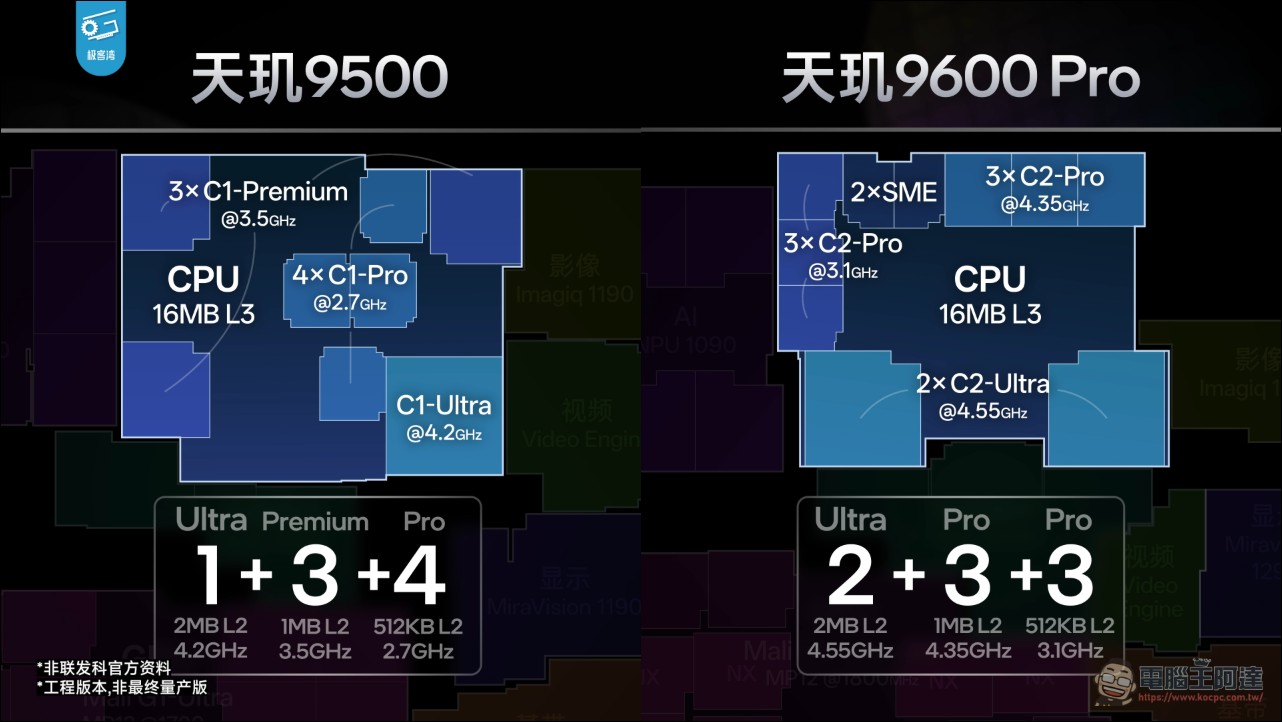
The original Premium big core is no longer used this time; instead, there are 6 C2-Pro cores: 3 of them have 1MB cache and a peak 4.35GHz and serve as performance cores; the other 3 have 512KB cache and up to 3.1GHz and serve as efficiency cores. C2-Pro is just a renamed version of C1-Pro. This adjustment amounts to sacrificing one big core in exchange for an extra super core, targeting scenarios that require high-performance bursts. The CPU also features two SME units, supporting CPU-side AI computing.
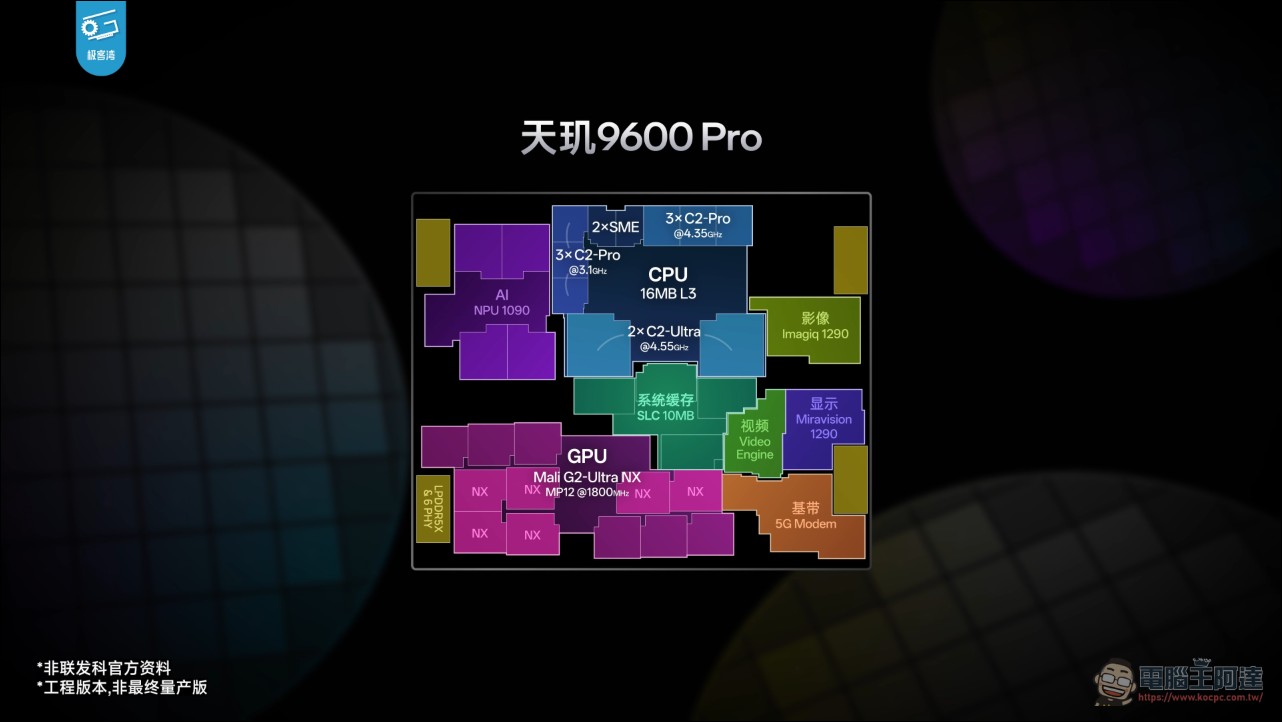
The dual ultra-large-core architecture is MediaTek’s answer to the question of what daily use scenarios require. Most smartphone usage scenarios involve brief high-load transitions (opening apps, loading games), and dual ultra-large cores can more effectively distribute burst tasks rather than concentrating all the pressure on a single core.
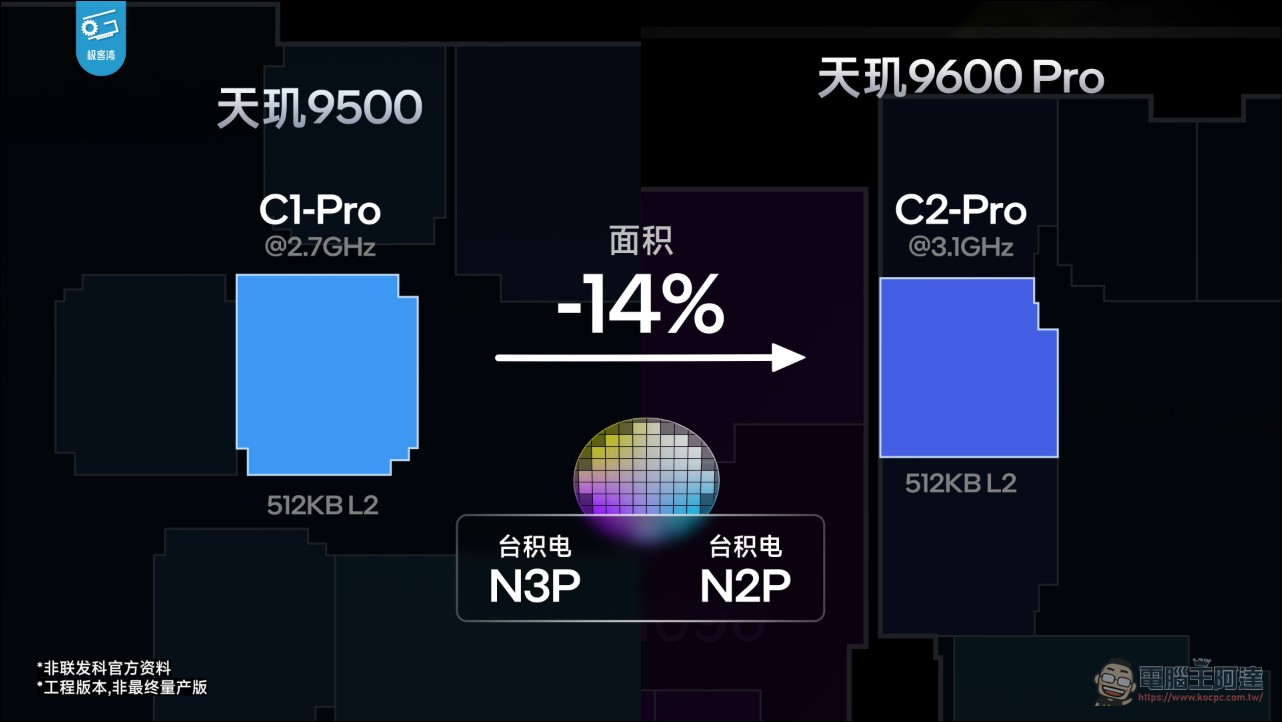
Comparing the area of the C2-Pro efficiency core on the Dimensity 9600 Pro with the C1-Pro on the Dimensity 9500, they are the same core, but the area of a single efficiency core on the 9600 Pro is 14% smaller, confirming that the density of the N2P process has indeed improved. The overall chip area is also smaller than that of the Dimensity 9500.
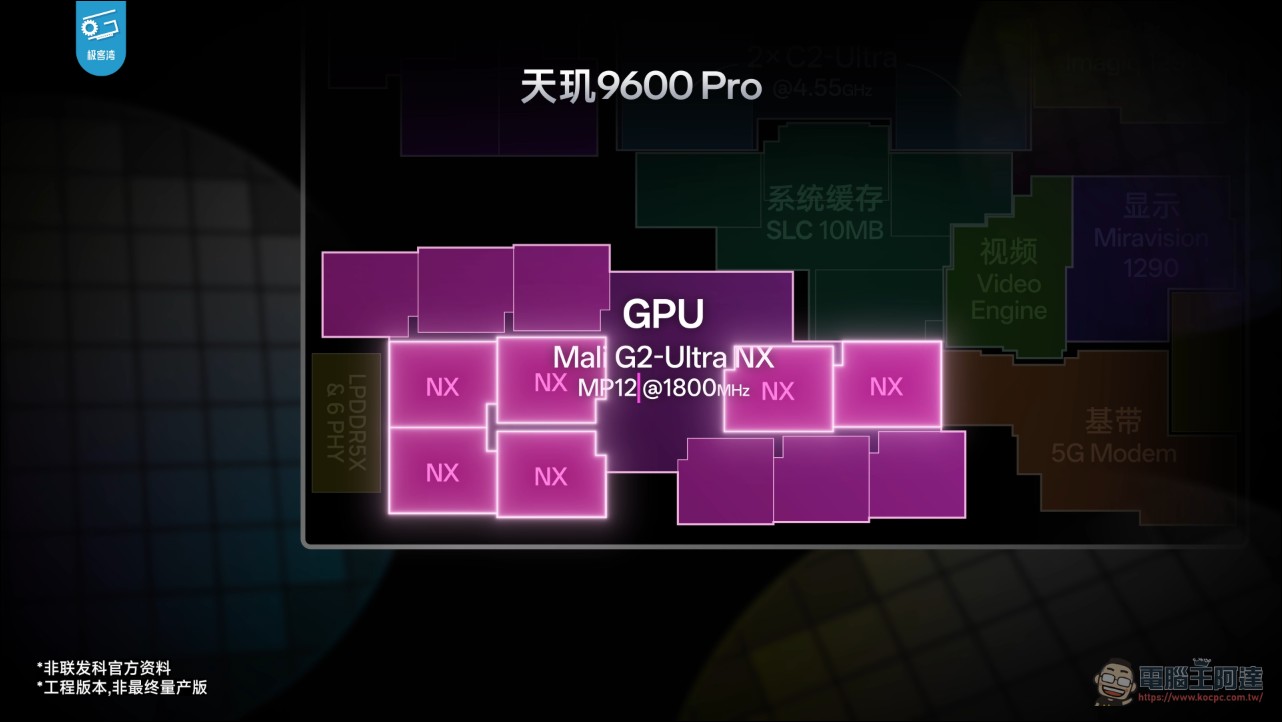
GPU upgrade: Mali G2-Ultra NX, peak 1.8GHz
The GPU switches to Arm’s latest Mali G2-Ultra NX architecture, retaining a 12-core configuration, six of which are NX units that support AI super-resolution and frame interpolation. Peak frequency reaches 1.8GHz, which Geekerwan describes as “a rather absurdly high frequency.” The NPU has also been upgraded to the new APU 1090. Despite the increased density of the N2P process, the NPU area actually increased, meaning this generation of flagship chips is not willing to be outdone in AI.
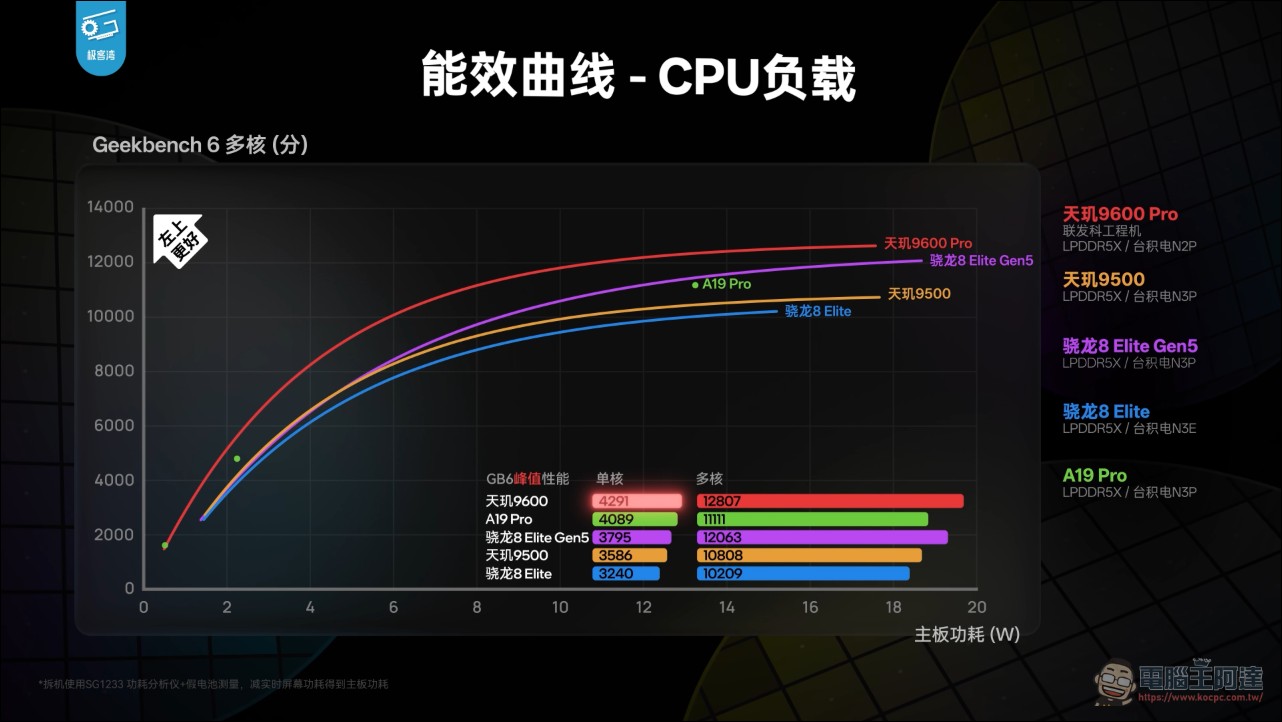
CPU Efficiency Benchmarked: GB6 Single-Core Nearly 4300, GB7 First Test Results Out
Geekerwan tested this engineering unit with GeekBench 6, scoring nearly 4300 in single-core, while multi-core power efficiency “opens up a generational gap,” especially with mid-frequency efficiency, which is more common in daily-use scenarios, leading by a considerable margin. Official GeekBench V6.4 scores are 4276 single-core and 12650 multi-core; compared with the Dimensity 9500’s 3666 / 11014, that’s about a 17% single-core increase and about a 15% multi-core increase.
Geekerwan also ran GeekBench 7 multi-core efficiency for the first time. Since this is the first test on a new benchmark, the processors may not be fully utilized, so the data is for reference only, but the Dimensity 9600 Pro’s lead over the previous generation is larger than in GB6. Official data shows that prime core power consumption is down 37% compared with the previous generation, and multi-core power consumption is down 61%.
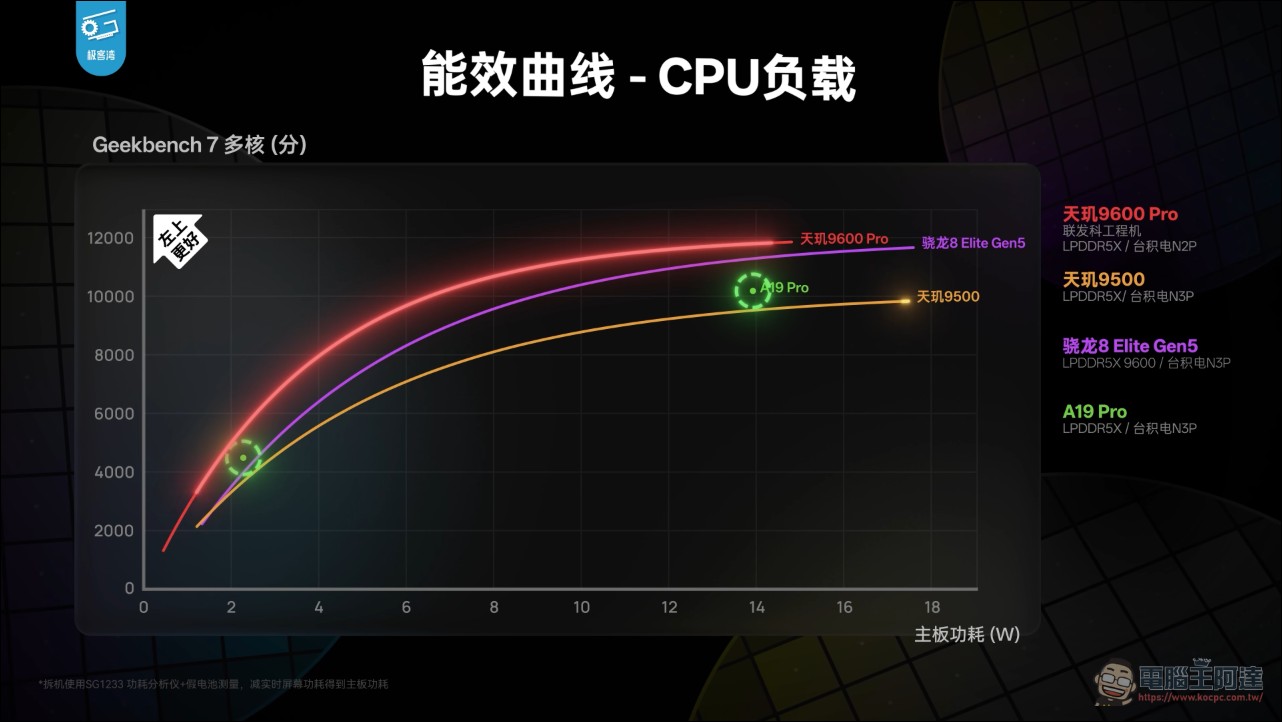
Multi-core power consumption dropping 61% is a very striking figure. This means that under the same workload, the Dimensity 9600 Pro can complete it using only about 40% of the predecessor’s power consumption, directly helping with phone battery life and thermal pressure. The lead in the first GB7 test is even larger, and the new architecture’s advantage is more obvious in more complex multi-core scheduling scenarios.
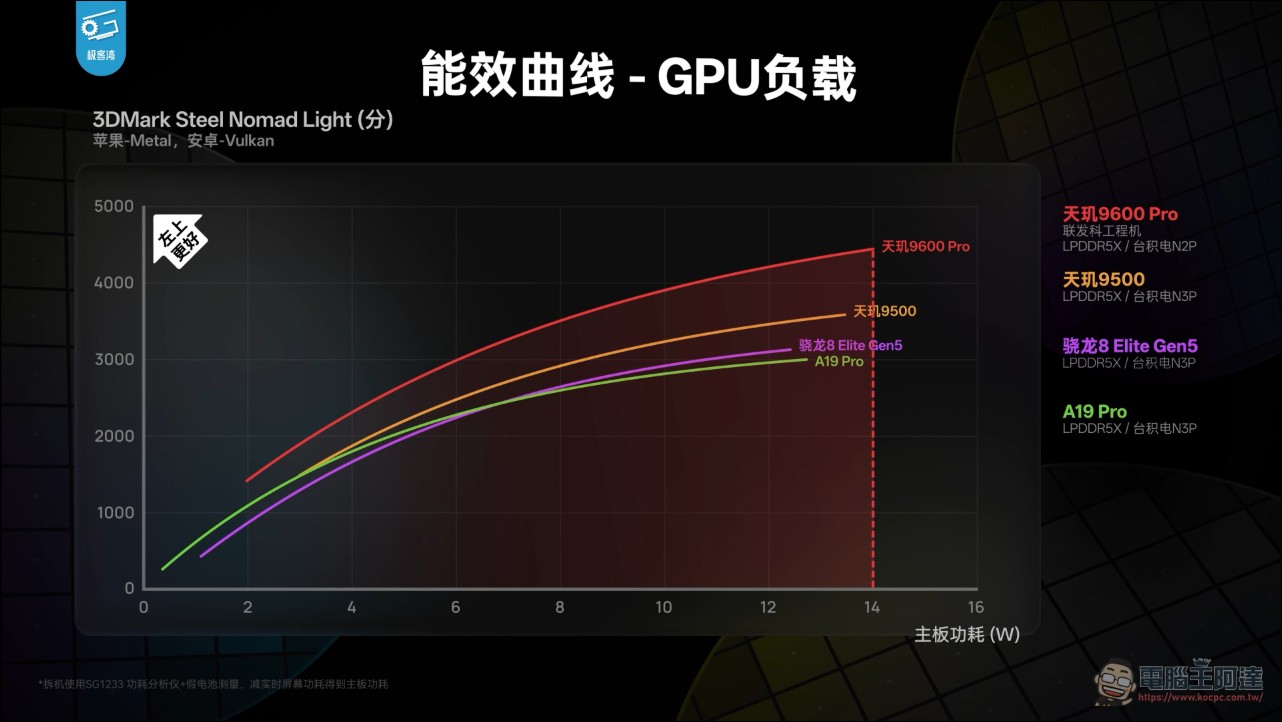
In the 3DMark SNL efficiency test, the peak is close to 4500 points, giving it a sizable power-efficiency lead over the previous generation. Geekerwan said, “I didn’t expect this generation’s GPU to improve so much either.” Considering that the G2-Ultra NX is still a 12-core design, reaching this level at peak is pretty impressive. This GPU shares the same architecture as Xiaomi XRING O3.
Game Benchmark: 30-Minute Stability Across Three Mobile Games
Geekerwan tested three games, all based on a 30-minute benchmark:
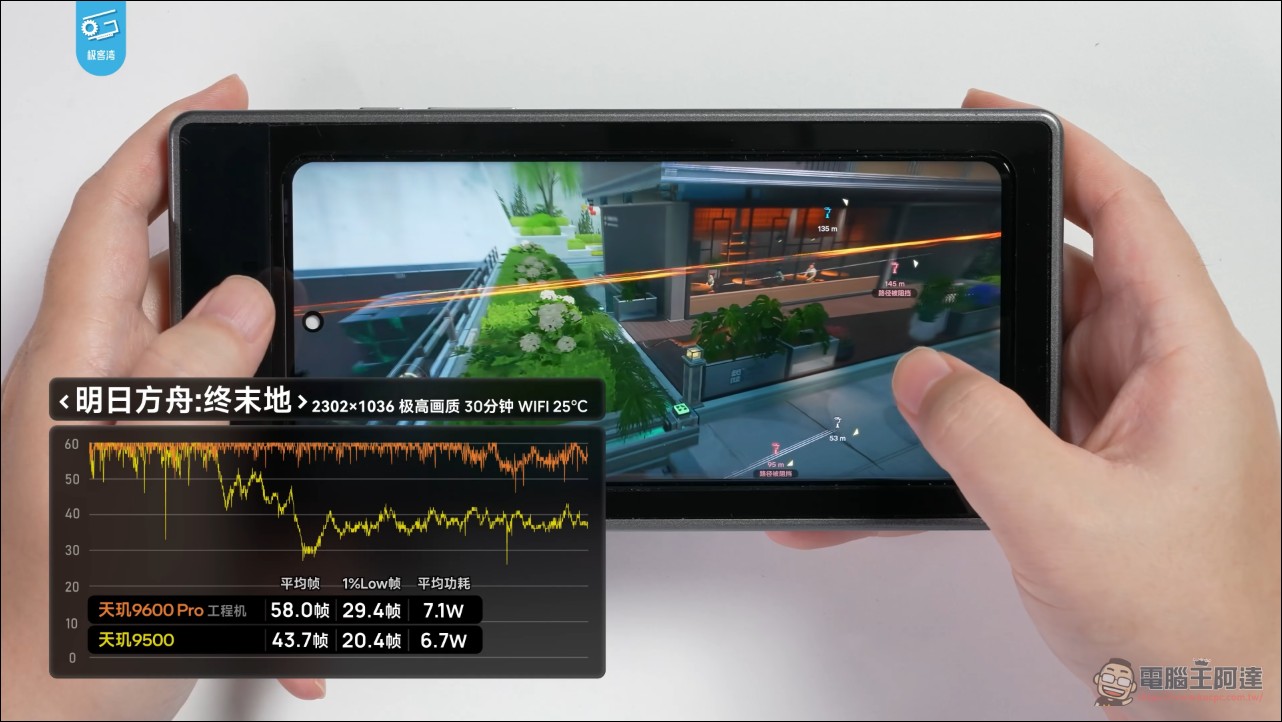
- Arknights: Endfield(1036P max settings, Wuling City map run): 30-minute average of 58 fps, total device power consumption of 7.1W, performing better than Dimensity 9500 models.
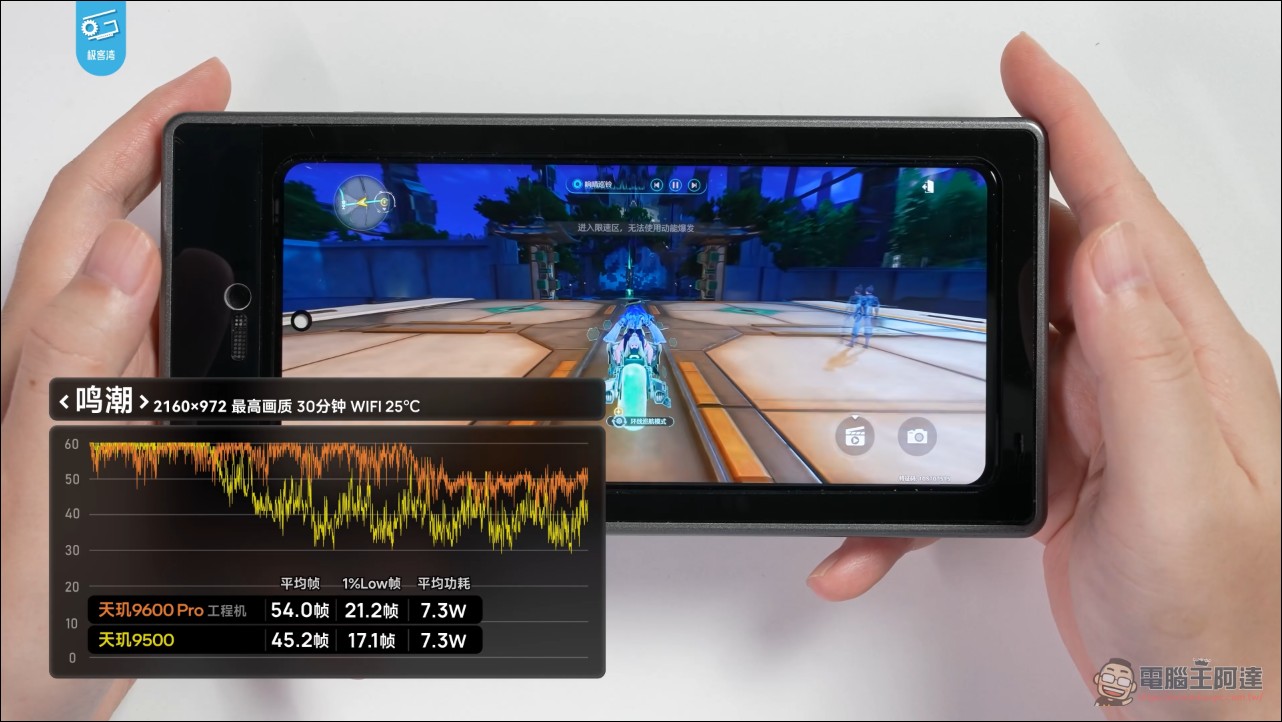
- Wuthering Waves(972P, Xuanfang City motorcycle map run): The stress is much greater than in the previous test scene, but it still averages 54 fps with total system power consumption of 7.3W—a “considerable improvement” compared with the Dimensity 9500.
- Heterocycle(792P, driving in rain): averaged 59.4 fps over 30 minutes with 6.4W power consumption, also smoother than the previous generation
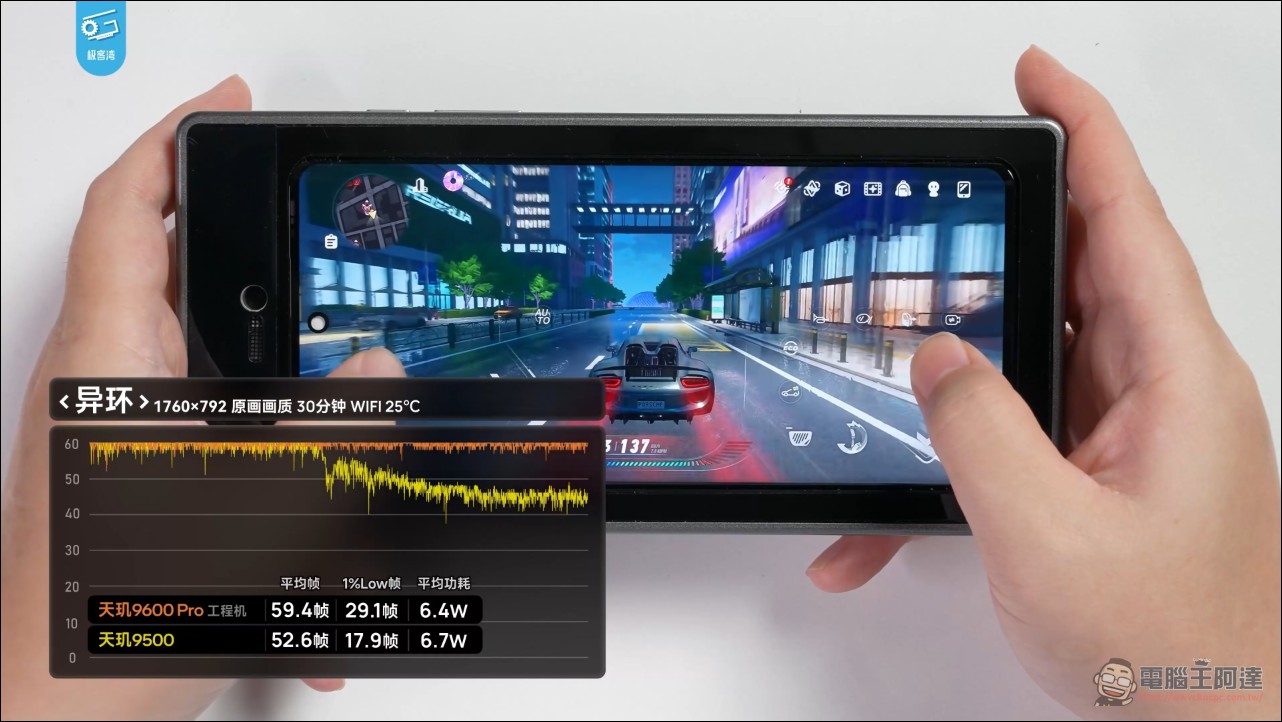
The power consumption of all three games ranged from 6.4W to 7.3W, while frame rates remained stable at 54–59 fps. The Xuanfang City scene in Wuthering Waves was the most demanding test, and the Dimensity 9600 Pro still maintained 54 fps, showing that the GPU’s power efficiency under high load has indeed improved significantly.
NPU real-world test: Prefill 5000+ tokens/sec, paving the way for agents.
Geekerwan tested NPU AI performance with the Qwen2.5-3B model, reaching a Prefill speed of 5000+ tokens per second, about a 50% improvement over the previous generation engineering prototype. Official data shows INT4 compute capability doubled, peak performance increased by 51%, and tokens generated per watt increased by 55%. It is also equipped with an ultra-efficient NPU that supports ultra-low-power always-on sensing, reducing power consumption by 40%. Decode speed is roughly the same as the previous generation, also around 42 tokens per second, with power consumption dropping from 7W to 6.2W. Geekerwan analyzed that Prefill speed directly affects an Agent’s waiting time when reading instructions: “The faster Prefill reads, the shorter the wait, which is arguably preparing early for the Agent era.”
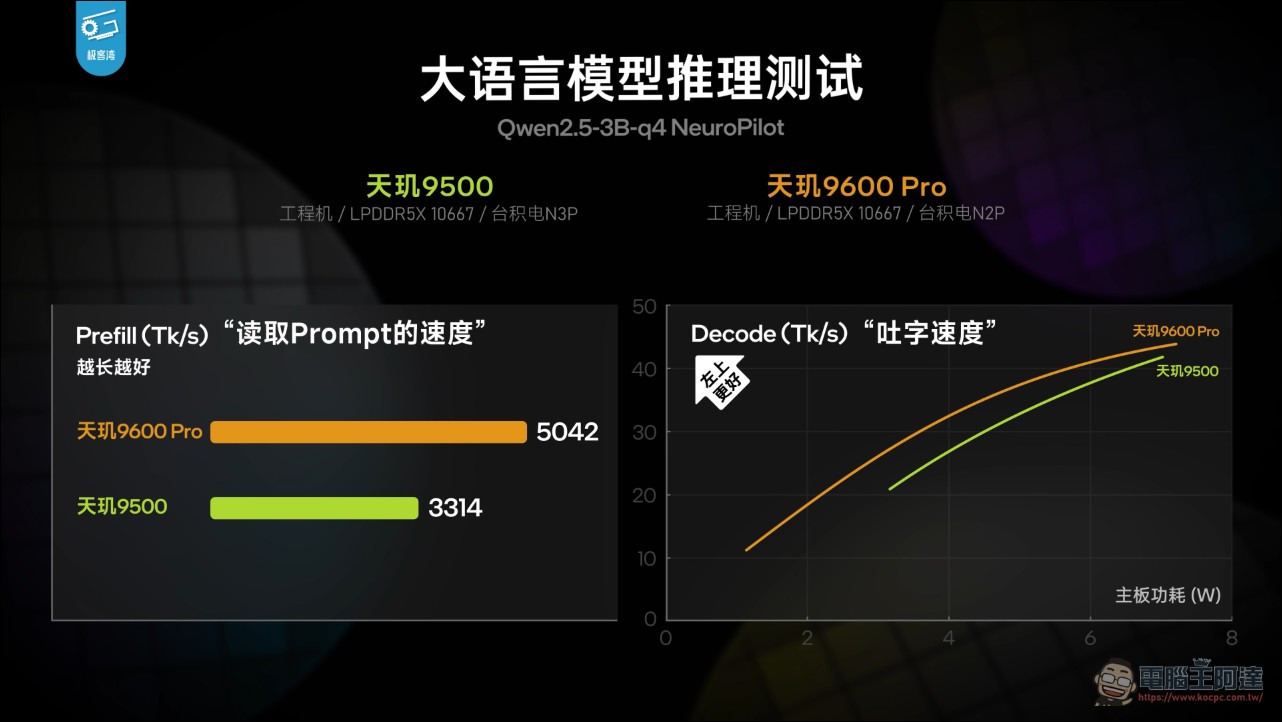
Prefill improved by 50% while Decode remains unchanged. This direction of progress is clear: MediaTek is preparing for on-device Agents. An Agent needs to quickly understand user commands (Prefill), but the speed at which it generates responses (Decode) is limited by the model itself, and there is only so much a chip can do. The ultra-energy-efficient NPU’s always-on sensing capability also lets a phone continuously monitor the environment to trigger the Agent even in standby, which is the hardware foundation for being “always ready.”
If you’re interested in the details, you can watch the video below; it still hasn’t gone live on YT yet:
Conclusion: A Solid Stepping Stone to 2nm
Geekerwan concludes that MediaTek’s stepping stone into the 2nm era is relatively steady and pragmatic: it did not pursue exaggerated scale expansion, and the chip area actually shrank. Against the backdrop of rising memory prices, maintaining smartphone price competitiveness requires controlling costs while delivering steady performance upgrades: the CPU switches to a dual ultra-large-core architecture, the GPU upgrades to the stronger G2-Ultra NX, and the NPU packs enough compute for the Agent era.
Source: KOCPC Chinese