


Former OpenAI researcher Diogo Almeida, who has been described as having “co-invented ChatGPT,” yesterday (September 15) ended two years of secret development and officially unveiled his new company, TypeSafe AI, and its first “System One model,” Jev. The company also announced it had raised $40 million (about NT$1.3 billion) in seed funding led by DCVC. The “co-invention” Almeida refers to is his participation in the InstructGPT research: the 2022 paper established RLHF (reinforcement learning from human feedback), and RLHF is the key training method behind ChatGPT and subsequent conversational models. Now the problem he wants to solve is: why have models with superhuman conversational abilities never brought about a large-scale automation revolution? His answer is to instead design a model that “doesn’t talk.”
What Is Jev: No Conversation, Only Decisions
Jev is not a chatbot,It does not produce text at all.Developers send structured program state and questions (e.g., “Is this customer asking for a refund?”) into the model, and Jev selects an answer from predefined options, returning a type-safe structured decision with a calibrated confidence score; the software can set thresholds, automatically executing when confidence is high and handing off to human review when confidence is insufficient. The company calls such models “machine-native,” and the original tweet described this as “composable intelligence fully optimized for decisions.”
After co-inventing ChatGPT, I kept asking myself: why have superhuman chat models not led to AGI?
I’ve spent the last 2 years in stealth building a new way to train models (RLCD), and a new type of frontier AI model that we are releasing today: Jev
• 20-200x faster
• 40-400x… pic.twitter.com/JSybNG2BKJ— Diogo Almeida (@CompleteSkeptic) September 15, 2026
The official documentation lays out a comparison of use cases by “who should use which model”: the LLM handles generating content and conversation, while Jev handles judgment. For example, in a customer service system, Jev first determines the intent of the incoming message and whether a refund is requested, and then the large language model handles the wording of the reply; each time the agent executes a step, Jev checks whether it has deviated from the task or touched files it should not modify. The image attached to the tweet also shows an example decision tree for cybersecurity incident response, breaking the alert down into a dozen or so yes/no and scored questions; after Jev answers them in batches, code decides whether to close, queue, notify the user, or block the source of the attack.
The gains aren’t free: Jev can’t generate text
Comparing Jev vs LLMs side-by-side makes the trade-off clear
Fun fact: replacing sequential computation with parallel is the same way Transformers leapfrogged RNNs pic.twitter.com/ockGnenCPP
— Diogo Almeida (@CompleteSkeptic) September 15, 2026
The gap in speed and cost comes from the architecture: outsiders speculate that Jev is an encoder-only Transformer, replacing the text decoder with a classification head, so there is no “output token” process. This explains two selling points: output is always free, and a single request can process hundreds of outputs in parallel with latency under 100 milliseconds. The training method has been switched to a new RLCD (Reinforcement Learning for Calibrated Decisions), aimed at making confidence scores align as closely as possible with the true accuracy rate, rather than catering to human preferences.
The officially announced figures
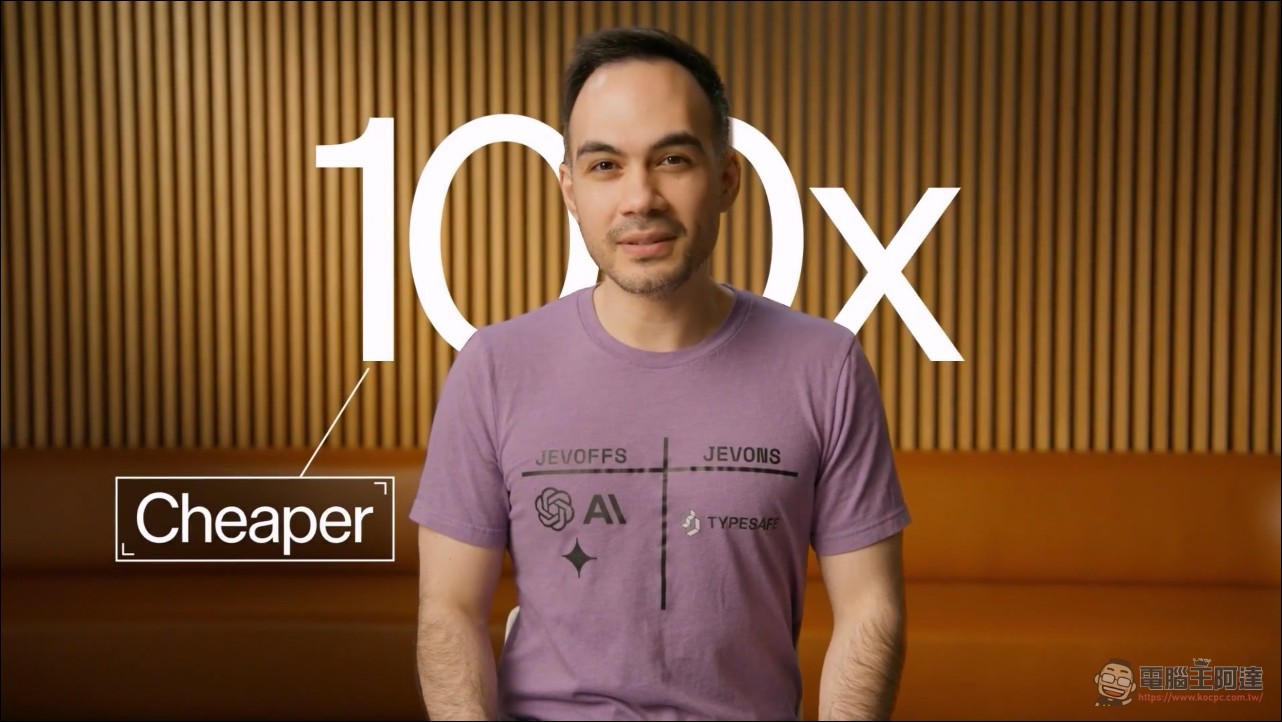
TypeSafe’s pricing is $42 per billion input tokens (about NT$1,365), which works out to about NT$1.4 per million tokens; output tokens are completely free, and it officially claims they are “free forever.” A set of sample data on its official website shows that Jev costs $0.000081 and takes 0.114 seconds to execute a single workflow, while a typical LLM costs $0.013880 and takes 8.566 seconds, so it claims to be 193.6 times faster and 444.6 times cheaper.
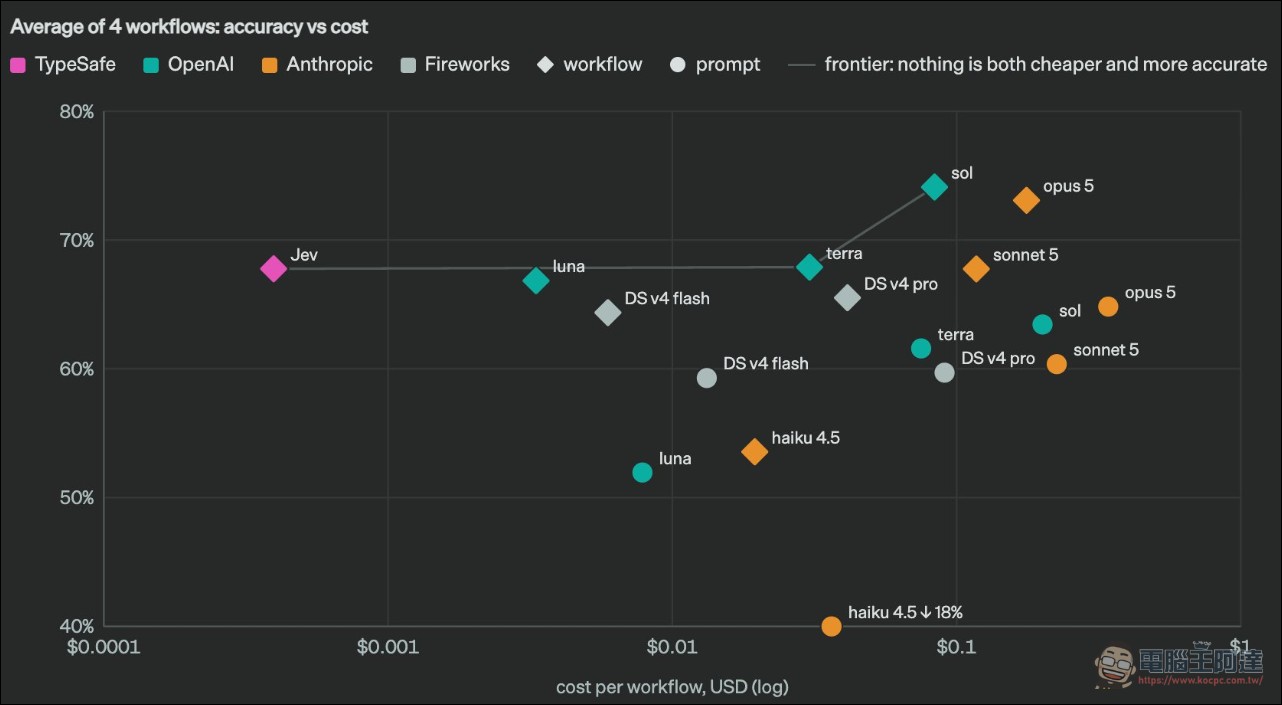
In an in-house evaluation of four workflows, Jev had an accuracy of about 68%, with a cost of about $0.0003 per workflow; OpenAI’s terra and Anthropic’s Sonnet 5 had similar accuracy (about 68%), but their costs were between $0.04 and $0.1, a difference of two orders of magnitude. Opus 5, with the highest accuracy (73% to 74%), cost about $0.2 to $0.4 per workflow. In another demo video, Jev played the game Doom at about 10 calls per second, costing about $7 per hour (about NT$228).
We love how this doomo doomonstrates real-time intelligence and what can be doone with code + AI!
~10 calls/sec = ~$7/hour pic.twitter.com/nlffKxGzCB
— Diogo Almeida (@CompleteSkeptic) September 15, 2026
Background: The Relationship Between RLHF and ChatGPT
Diogo Almeida is a former OpenAI researcher, and his publication record shows he is listed among the authors of “Training language models to follow instructions with human feedback” (InstructGPT). TypeSafe’s co-founders also include Erik Gafni and Sasha Sheng.[6]Almeida argues that although RLHF has produced extremely powerful conversational models, it also brings problems such as overconfidence, mode collapse, and insufficient reliability, making large language models always require human intervention; Jev’s design direction is precisely to avoid conversation and turn AI into reliable, testable software components.

The name “System One” comes from the dual-process theory in psychology, corresponding to humans’ intuitive, immediate first thinking system, as opposed to the deliberative System Two. TypeSafe’s product philosophy is to let models handle fast intuitive judgments, leave the logic that requires slow reasoning to traditional code and large language models, and then combine them through a “code plus AI” approach. In the launch-day Q&A, the founder also emphasized that he believes most enterprise automation needs “reliable intelligent judgment,” not another chat interface.
Restrictions and Community Skepticism
The officially acknowledged limitations are equally clear: Jev cannot generate text, its sequential reasoning ability (e.g., mathematics) is only around GPT-4 level, and “abandoning strings” is a major flexibility trade-off for existing applications. After release, Hacker News’sdiscussion threadWith 1,495 points and over 400 comments, opinions are split: some praise the potential of the confidence score and the price, while others question the “frontier model” label, the overly vague evaluation methodology, and the claim that it “won’t hallucinate,” because types not being wrong doesn’t mean the answer can’t be wrong.
The two most frequently raised doubts in the discussion are these: First, officials said they deliberately did not publish standard benchmark results and only provided workflow evaluations of their own design; skeptics argue that if the scores looked good, they would have been published long ago. Second, the slogan “20 to 200 times faster and 40 to 400 times cheaper” uses “System One tasks” as its basis for comparison, and such tasks are Jev’s home turf to begin with; comparing it with general-purpose models on speed and cost is like comparing a customized tool with a Swiss Army knife on a single function. Some developers also pointed out that similar parallel batch classification approaches already have precedents in the open-source world; Jev’s breakthrough lies more in turning this technical route into a product and driving the price down so low.
Conclusion
Putting Jev back into its positioning, it looks more like the “cheapest, fastest high-quality decision classifier”: suitable for judgments among fixed options such as customer support triage, agent tool routing, and cybersecurity incident classification, rather than replacing general-purpose models that can write code and chat. It currently uses a waitlist system, with official access only opened to some developers, so outsiders cannot independently test it for now. If the official numbers hold up to replication, its impact on the cost structure of automation is real; as for the phrase “the shortest path to an AI economic revolution,” that will probably have to wait until more people get API access to test before it can be verified.
Source: KOCPC Chinese