


OpenAI’s official developer account posted on September 11, urging all developers using agentic tools such as Codex and ChatGPT to re-examine the skills, AGENTS.md, and task prompts they have written, and simultaneously published a blog post titled “Rethinking skills and prompts for GPT-6 Astra.” This advice came at just the right time. GPT-6 Astra is OpenAI’s flagship model launched on September 3. OpenAI claims it is the smartest and most “obedient” model, surpassing its predecessor GPT-5.6 Sol on benchmarks for computer use, coding, and scientific reasoning, and its cybersecurity capabilities were rated “Critical” for the first time. However, the reminder the company gives in the blog post runs counter to intuition: the stronger the model, the fewer instructions developers should stack up.
OpenAI officially recommends slimming down GPT-6 Astra Skills and AGENTS.md.
Why do old instructions hold back new models?
Eric Provencher of OpenAI’s Developer Experience team noted in the article that over the past year, people accumulated a large number of instructions to guide models toward desired outcomes: perhaps skills, perhaps AGENTS.md, or perhaps prompts for each task. These files did help, but after switching to GPT-6 Astra, many supports that were once necessary have now become obstacles instead.
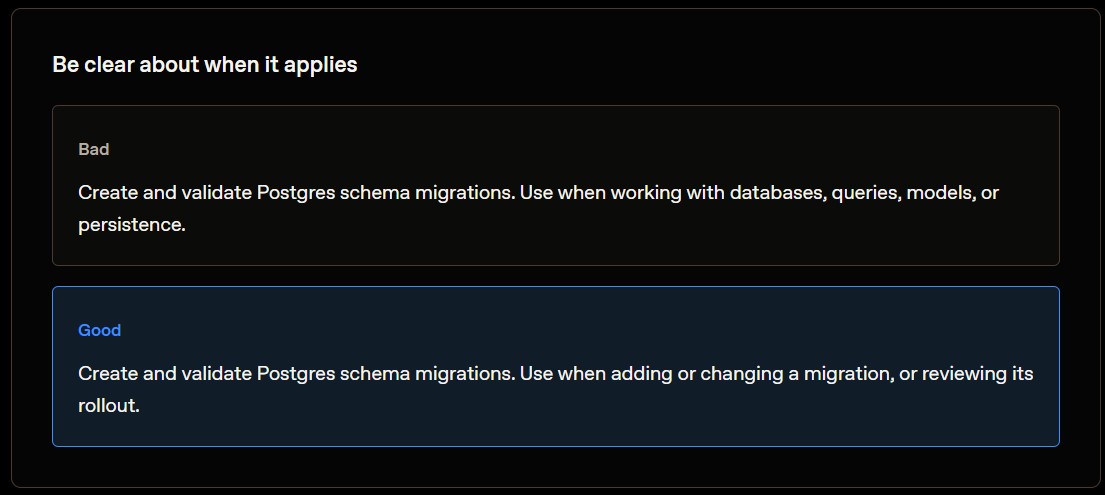
The problem starts with the descriptions of skills. Each skill comes with a name and description, and all of this text is loaded into the model context so it can judge when to use the skill. But many people write descriptions that are too long, and once too many skills are loaded, Codex starts truncating descriptions to save space, so the model sees less information and has a harder time choosing the right skill. Worse, descriptions may contradict one another or overemphasize when they apply, causing the model to load a bunch of guidance it doesn’t need at the moment, wasting context space and bringing it closer to the compression threshold sooner.
Official recommendation: three principles for rewriting skills
The blog distilled three rewriting principles. First, the skill description should be as short as possible, but it must clearly state when to use it. The article gives an example: a description that reads “Use when working with databases, queries, models, or persistence” (Use when working with databases) will cause the model to trigger it for any database-related work; changing it to the clear “Use when adding or modifying a migration, or reviewing a migration going live” makes the trigger timing precise.
Second, make good use of “progressive disclosure.” Reading a skill itself consumes context, so for a skill that contains multiple workflows, the root document should act only as a router, listing a brief index and placing details in supporting documents and scripts, so the model can read more deeply when needed rather than loading everything all at once.
Third, stop writing skills as exhaustive recipes. Models have become much better at handling semantic ambiguity; approaches that once relied on detailed steps for stable output now instead limit what models can do. The article also notes that skills in a repository affect other developers’ agents, and different models are suited to different levels of instruction strength. Guidance designed for Sol or Luna may be overly restrictive for Astra.
AGENTS.md: From “reading everything every time” to “reading on demand”
The guidelines in AGENTS.md also need to be updated. In the past, models needed to be explicitly instructed to “read architecture.md, database.md, and deployment.md before every edit,” but for Astra, requiring it to read entire documents just to fix a typo only burns context and slows things down. The official recommendation is to switch to context-based guidance: for architecture questions, see architecture.md; for schema changes, see database.md; and when preparing to deploy, see deployment.md—letting the model decide for itself what to read.
Another common outdated instruction is “always run tests after finishing.” Previous-generation models needed encouragement to run tests and check results, but GPT-6 Astra already does this automatically, so the same instruction now leads to unnecessary tests. However, official guidance also notes that Astra is cautious by nature and sometimes stops midway to wait for confirmation. In such cases, you can explicitly authorize in AGENTS.md a workflow you have verified as safe—for example, allowing the local test suite to run automatically and fix failing items on its own, without needing to ask for approval at every step.
Decision Boundaries and the Definition of “Done”
Regarding authorization boundaries, the official guidance offers a subtle reminder: if you previously wrote strong “ask before acting” instructions to prevent the model from overstepping its authority, you should reconsider after switching to Astra. Astra is OpenAI’s model currently most aligned with user intent, with noticeably better judgment; it acts only after confirming safety. Old rigid boundary language may make it overly conservative and stop where you would actually be happy to let it continue.
By contrast, Astra is less sure about when to stop; it often finishes a first implementation and then comes back to wait for review, even though there is still work it could do. The solution is to define what “done” looks like before the task begins: if the task includes getting the implementation running, checking the results, and fixing failures, write those steps into the request; if you want it to keep exploring, also explicitly state the scope and endpoint of that exploration. At the end, the official post suggests that the new model is a good opportunity to clean up project instructions, and you can even turn it around and ask Astra to audit the various files in your project for you according to the standards in this article.
Community Response and API Changes
This article resonated in the developer community. A roundup post appeared on Reddit’s r/codex board that same day. Some people condensed the official guidance into prompts that can be pasted directly into AGENTS.md, while others shared a custom openai-docs skill that automatically inspects a project and applies model and prompt changes suited to Astra. The discussion also highlighted major changes to the official API: parameters such as temperature, top_p, and top_logprobs are no longer supported, and tool calling has moved to the Responses API.
Before blaming GPT-6 Astra, read its prompting guide
byu/Icy_Piece6643 incodex
There are also voices questioning the timing: as demand for Astra surges, OpenAI has suspended new subscriptions to its $200-a-month Pro plan starting September 10, though existing users are unaffected. Some Reddit users have also complained that usage limits are strict, with even light use burning through most of the weekly quota; others set Sol as their default model and manually switch to Astra only when needed, as a compromise to avoid usage pressure. Meanwhile, OpenAI is also gradually bringing Astra into ChatGPT Work, Codex, and the API, expanding enterprise applications.
Conclusion
Switch to GPT-6 Astra, and the most important thing developers should do is re-examine the “density” of their existing instructions. The core message the official team has repeatedly conveyed is simple: descriptions should be precise, files should be read on demand, and boundaries should be left to a model with better judgment. Tearing down the scaffolding that has piled up for half a year may be the first step to letting Astra show its strength. If you have no clue at all, toss this article or the original text to Astra and it will sort it out.
Source: KOCPC Chinese