


Since MiniMax H3 After the current most powerful open-source AI video generation model was released, professional AI video generation tasks finally have a chance to move from the cloud to local hardware, which has made choosing local hardware a rather important field of study. Recently, a YouTuber overseas tested the two open-source video generation models LTX 2.5 and MiniMax H3 locally, conducting a comprehensive comparison of generation speed and quality using an Apple M5 Max (running the MLX framework), an NVIDIA RTX 4090, and an RTX 5090. The results surprised many: in speed, the RTX 5090 pulled nearly 4 times ahead of the M5 Max, but in some respects, Apple’s performance had its own distinctive strengths.
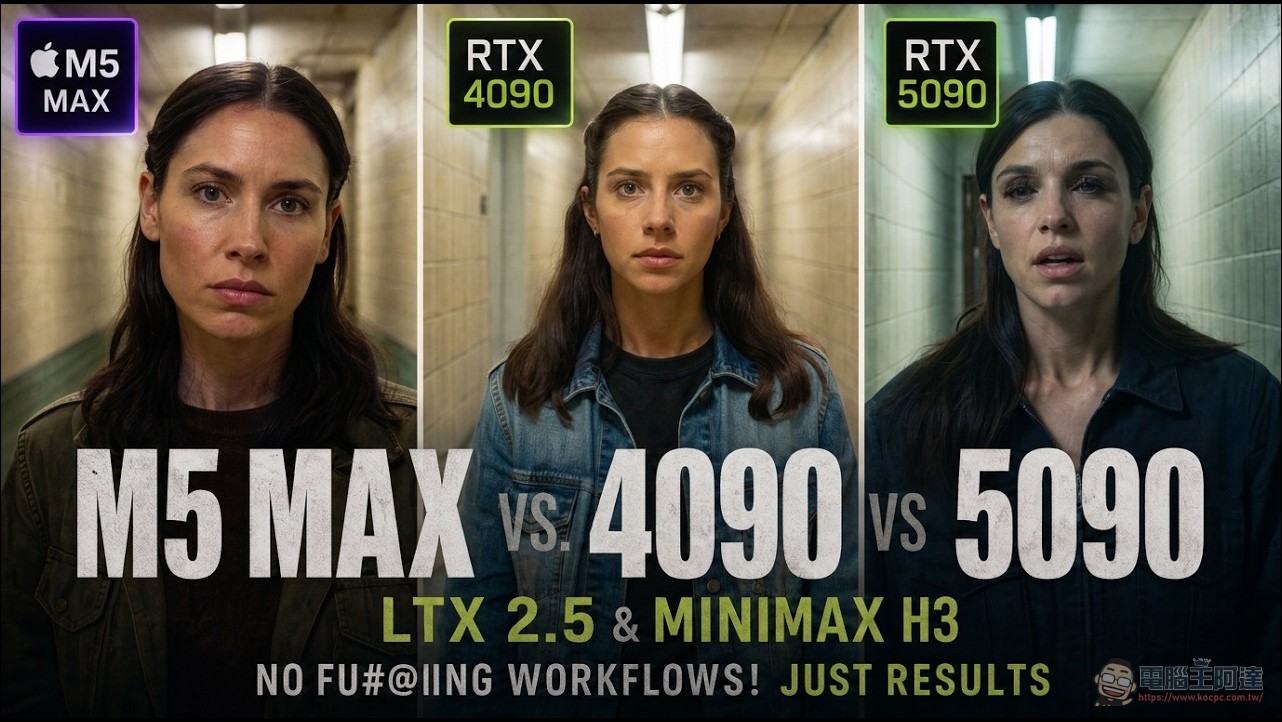
Local Open-Source AI Video Generation Models: LTX2.5 and MiniMax H3
First, a brief introduction to the two local open-source AI video generation models in this test: Lightricks’ LTX 2.5 is an open-source DiT-architecture video model that supports native 4K and 50fps output; while the H3 model released by Chinese AI company MiniMax at the end of July 2026 focuses on 2K resolution, video generation up to 15 seconds, and built-in stereo audio. Both models are open-source AI video generation models that can run on local consumer-grade hardware, and in terms of quality, speed, and buzz, MiniMax H3 is currently the most popular.

Test Platform and Hardware Specifications
The video’s creator used three platforms for testing. On the Apple side was a 16-inch MacBook Pro equipped with an M5 Max chip, running models through Apple’s own MLX machine learning framework, with 48GB of unified memory. On the NVIDIA side were gaming laptop configurations with an RTX 4090 (16GB VRAM; Aorus 17x) and an RTX 5090 (24GB VRAM; Lenovo Legion 7i), respectively.
M5 Max is Apple’s flagship chip launched in 2026, featuring a Fusion Architecture dual-die packaging design, with two 3nm dies combined via TSMC’s SoIC-mH 2.5D packaging technology, sharing a unified memory pool. According to Skorppio’s analysis, the M5 Max’s GPU includes dedicated matrix multiplication hardware (Neural Accelerator) for the first time, and the 40-core GPU can deliver about 70 TFLOPS of FP16 compute, with memory bandwidth reaching 614 GB/s. By comparison, the RTX 5090 has about 380 TFLOPS of FP16 compute and 1,792 GB/s of memory bandwidth, giving it more than a 5x raw compute advantage and more than double the memory bandwidth.
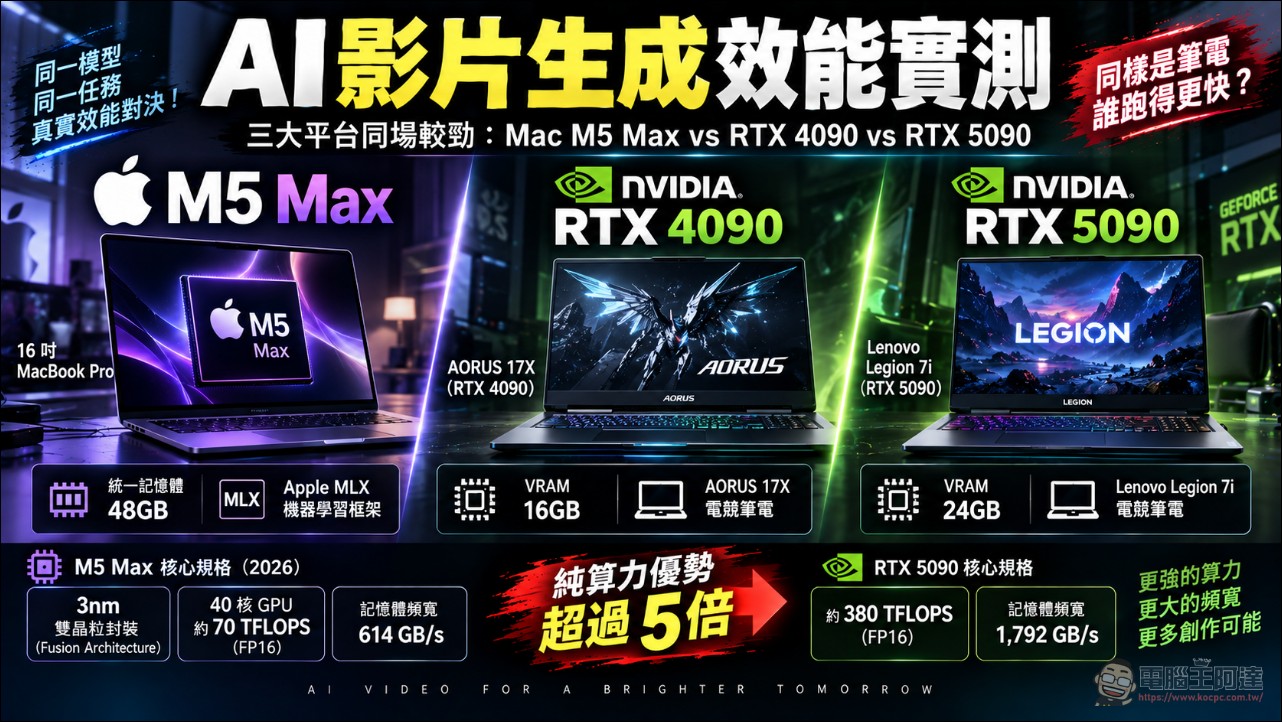
The gap in hardware specs gets amplified in compute-intensive tasks like video generation. AI video generation is different from LLM text inference: it requires massive tensor computation to handle pixel prediction for every frame, and memory bandwidth and compute throughput directly determine generation speed. The M5 Max’s 128GB unified memory has an advantage in large-model inference, but video generation models usually don’t exceed 32GB, which gives NVIDIA’s high-bandwidth VRAM the upper hand instead.
LTX 2.5 Generation Speed Comparison
In standard tests for the LTX 2.5 model, the gap is very clear. Take a 5-second video clip as an example: the M5 Max took 164 seconds, the RTX 4090 took about 90 seconds, while the RTX 5090 needed only 57 seconds—making the 5090 nearly 3 times faster than the M5 Max.

The video ran several tests, including an orientation test: the M5 Max took 215 seconds, the 4090 took 168 seconds, and the 5090 took only 65 seconds. The author said bluntly, “That’s crazy.”
However, when the video length is extended to 10 seconds, the gap narrows. The M5 Max takes 169 seconds, while the 4090 takes 153 seconds, so the two are already close. The author explains that this is because longer videos require more memory. In this scenario, the M5 Max’s 48GB unified memory starts to come into play, whereas the 4090 has only 16GB VRAM. Once it exceeds that, data must be transferred to only 32GB of system memory, and the speed drops significantly.
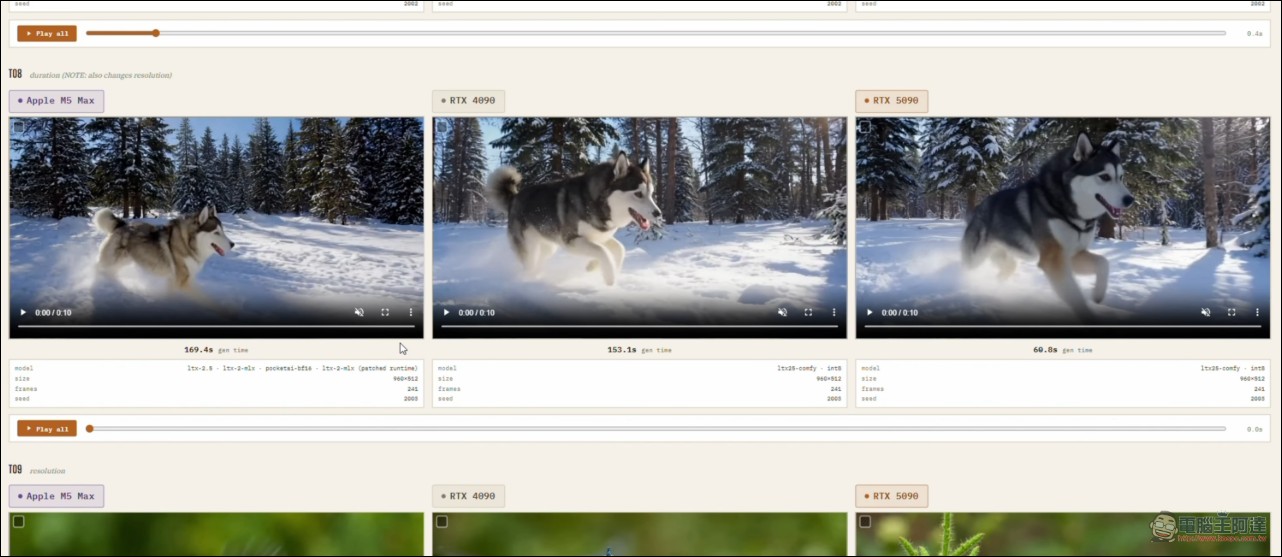
Resolution testing (changed from 512P to 896P) also shows a similar trend: higher resolutions likewise require more memory, and the gap between M5 Max and 4090 narrows further, but the 5090 still leads by a wide margin thanks to its 24GB VRAM and higher bandwidth.

These data clearly reveal a pattern: when the model and data size can fit entirely into VRAM, NVIDIA’s high-bandwidth advantage translates into a huge speed gap. But when tasks require more memory, the M5 Max’s unified memory architecture becomes a buffer. This is similar to the “VRAM cliff” phenomenon in large language model inference, except that memory requirements for video generation are usually within 24GB, making it hard for the M5 Max’s 128GB unified memory advantage to be fully utilized.
MiniMax H3 Model and Audio Quality
After switching to the MiniMax H3 model, the results are even more interesting. H3 is a general-purpose multimodal generative model released by MiniMax in late July 2026, capable of generating 2K videos up to 15 seconds long and supporting native stereo audio. The video’s creator notes that with enough inference steps, H3’s image quality can surpass LTX 2.5, but performance at default steps is unstable. (Editor’s note: really, it mainly depends on how you pair and configure it.)
In audio generation tests, the sound quality produced by the M5 Max was “substantially noticeably better,” while the sound generated by the RTX platform seemed “tinny,” as if it needed more processing time. Even more surprisingly, in H3 audio generation speed, the M5 Max was even slightly faster than the RTX 4090, which also surprised the author.

The video also tested the lip syncing feature. LTX 2.5 can produce good lip syncing results on all three platforms, and the 5090 took only 55 seconds to complete a 5-second lip syncing video. The lip syncing quality of the H3 model is not as stable as that of LTX 2.5, and the author believes this is due to insufficient steps.
In reference image generation tests (using 2 or 4 reference images), the three platforms showed clear differences in output style. The MLX model on the M5 Max tended to produce compositions different from those of the NVIDIA platform, and the author said, “I almost prefer the M5’s composition,” but there were occasionally issues with “liquefaction” or “blurriness” in the details.

Differences in audio quality may be related to how the MLX framework implements the H3 audio module, and Apple’s unified memory architecture may deliver better latency performance when handling lighter-weight computations like audio. The differences in composition style, meanwhile, reflect subtle differences between MLX and CUDA in numerical precision and computation paths: even when using the same model weights, different ordering and precision handling in floating-point operations can lead to differences in the final generated image.
If you want to see the video generation results of these three hardware devices, you can go straight to the video below; I’ll start playback directly from the test section:
The Reality and Ideal of Local AI Video Generation
At the end of the video, the author expressed his core goal: to break free from dependence on online subscription services (such as Kling and other cloud-based video generation platforms) and complete the creative work entirely locally. He admitted that H3 is currently the local solution closest to Kling’s quality level, but “has not yet fully reached it.”
From an industry perspective, the barrier to local AI video generation is dropping rapidly. LTX 2.5’s official documentation states that local execution requires CUDA 13.2 or later and an NVIDIA GPU with at least 32GB VRAM. Meanwhile, MiniMax H3 has been released on Hugging Face with open weights, so anyone can download and run it, and the community even already has solutions that work with 8GB VRAM.
For recommendations on choosing different hardware, the video’s data gives a clear signal: if you’re after speed, the RTX 5090 is currently the fastest option among consumer-grade hardware; if your budget is limited, the RTX 4090’s 16GB VRAM is still enough for most 5-second video generation tasks; while the M5 Max is suitable for users who already own a MacBook Pro, occasionally need local generation, and also value large-model inference capabilities (Editor’s note: The comparisons in this video are all on laptop devices. In theory, NVIDIA’s desktop performance would be better than the test results, and this M5 Max configuration in the MacBook cannot represent the performance of the M5 Ultra either.)。
In this comparison, the M5 Max’s disadvantage mainly comes from the special demands of video generation: it requires extremely high memory bandwidth to handle pixel computations for each frame, and this happens to be a strength of NVIDIA GPUs. In other AI tasks such as large language model inference, the M5 Max’s unified memory architecture may instead be a decisive advantage. The hardware choice depends on the type of task you do most often.
Source: KOCPC Chinese