


Solid-state batteries can greatly reduce the risks of spontaneous combustion and leakage, and are regarded as a cross-sector energy technology that every major player is competing to master. As the world’s largest producer of lithium batteries and electric vehicles, China officially announced the national standard for “solid-state batteries” in July 2026, not only ending the past marketing chaos of interchangeably using “semi-solid-state” and “quasi-solid-state,” but also seeking to continue leading the next global battery generation.
What is China’s national standard for solid-state batteries? Can solid-state batteries replace liquid batteries? Here is an explanation and summary:
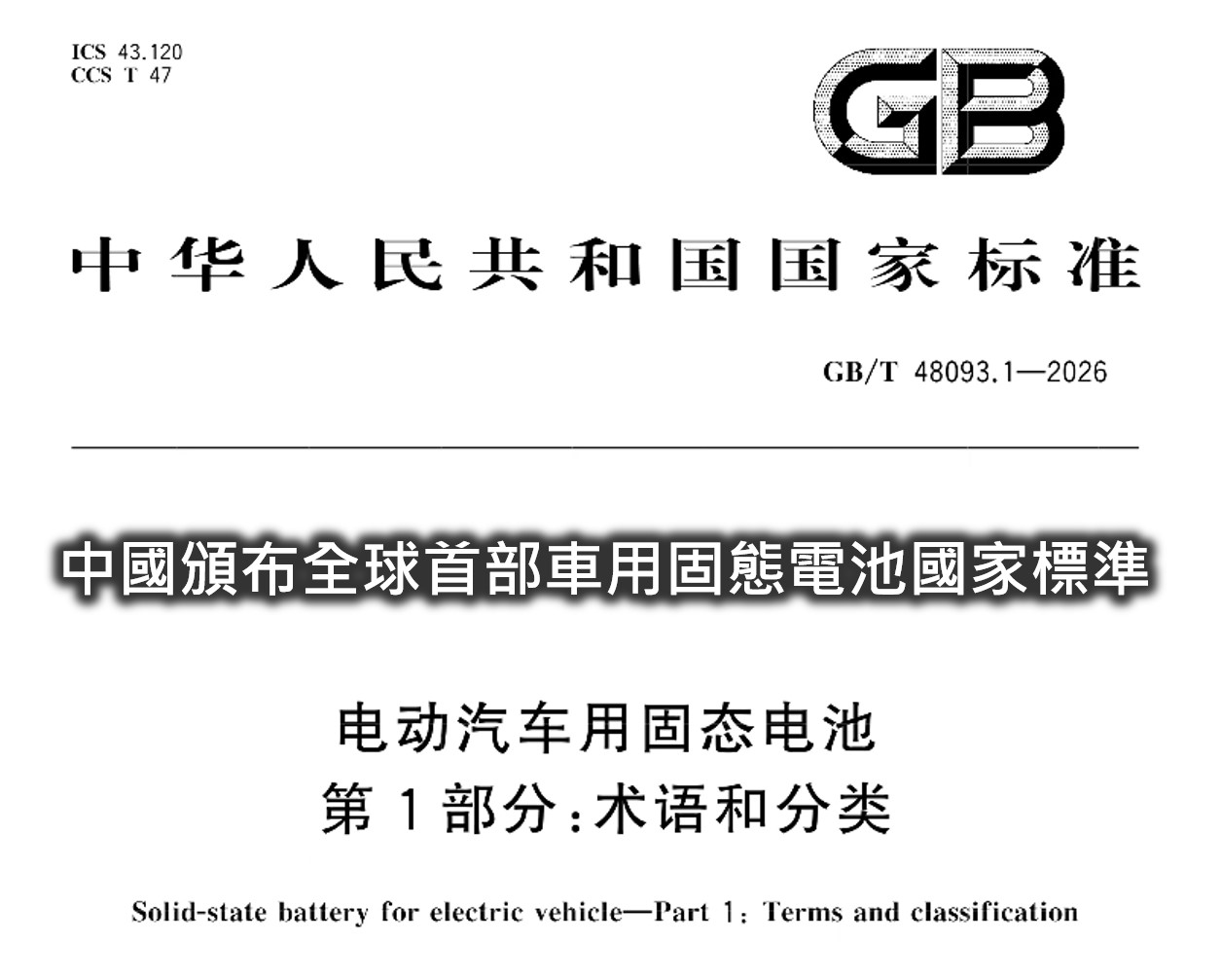
1. China’s national standards for solid-state batteries:
Due to the risks of spontaneous combustion and leakage associated with traditional liquid lithium batteries, solid-state batteries have become a star product in energy technology applications, from vehicles and electric scooters to construction machinery, unmanned vehicles, humanoid robots, and energy storage systems, and are regarded as the most important technology for the global next-generation energy ecosystem.China currently accounts for more than 70% of the global battery materials market and about 60% of global electric vehicle sales. To continue leading the global solid-state battery industry, it has not only announced an exemption from consumption tax for solid-state batteries from September 1, 2026 to December 31, 2028, providing a consumption tax exemption at the policy level to accelerate industrial deployment, but also officially announced in July 2026 the first national standard for solid-state batteries. The standard aims to end the market confusion over concepts such as “semi-solid-state” and “quasi-solid-state,” and to provide a unified technical benchmark for global solid-state battery testing specifications and mass production standards.
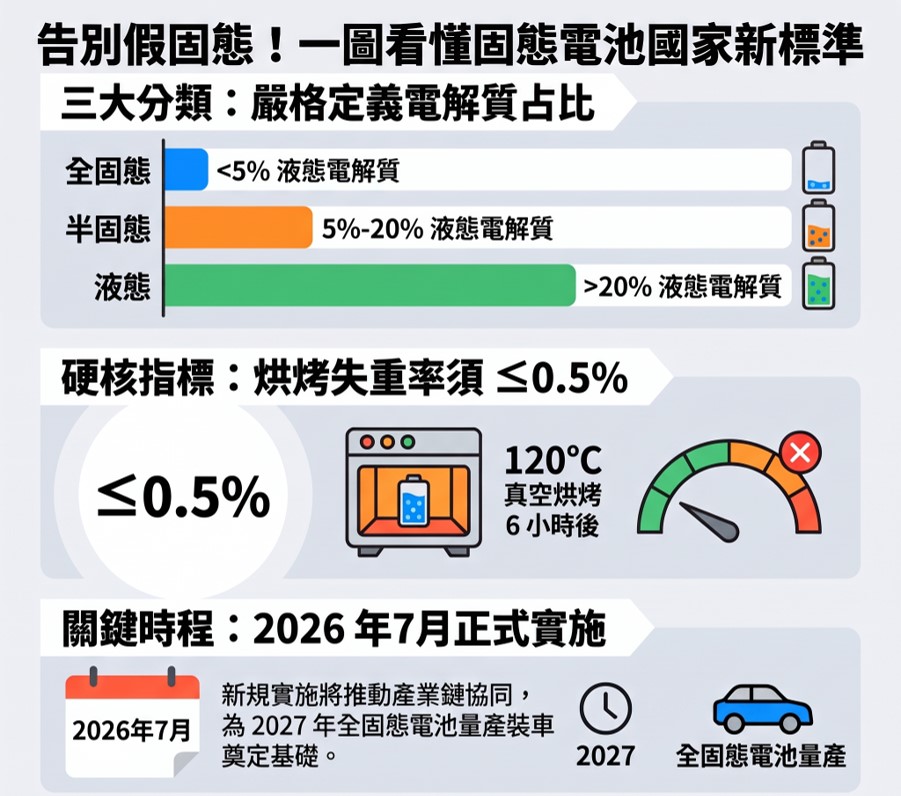
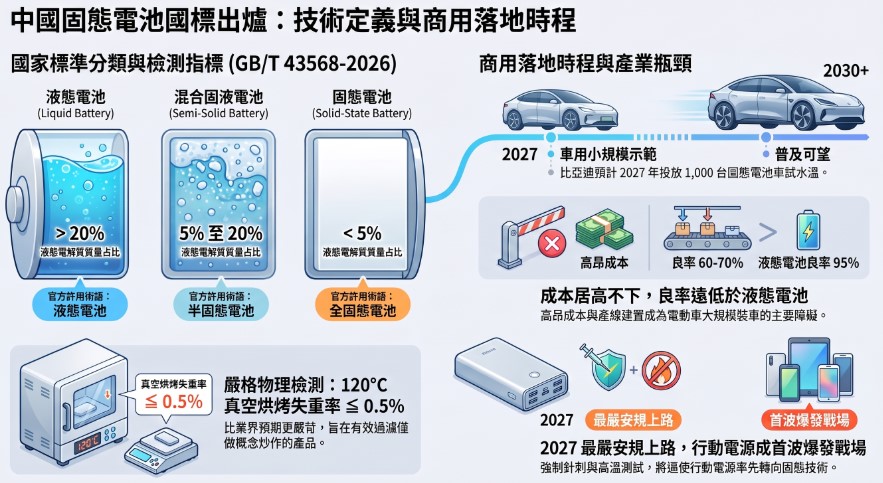
According to the “…” issued by China.Solid-state batteries for electric vehicles — Part 1: Terminology and classification(GB/T 43568-2026), which defines an all-solid-state battery by standard as “liquid electrolyte mass proportion < 5% and the battery’s weight loss rate shall be ≤ 0.5%,” with the core definitions and classifications as follows:
A. Battery classification:
a. Liquid battery:
Liquid electrolyte accounts for >20% by mass.
b. Hybrid solid-liquid battery (permitted term: semi-solid-state battery):
The liquid electrolyte accounts for 5% to 20% by mass.
c. Solid-state battery (permitted term: all-solid-state battery):
Liquid electrolyte mass percentage < 5%.
B. Physical testing indicators:
Weight loss rate requirement: after vacuum baking at 120°C for 6 hours,The battery’s weight loss rate should be ≤ 0.5%.。
C. Other segmentation dimensions:
Beyond electrolyte ratios, the classification is further refined into [electrolyte chemistry] (sulfide, oxide, polymer, halide, or composite electrolytes), [conducting-ion type] (solid-state lithium-ion batteries, solid-state sodium-ion batteries, etc.), and [application scenario] (high-energy and high-power types).
2. Can solid-state batteries replace liquid batteries?
Because China’s official definition and determination methods for automotive solid-state batteries are adopted this timeSpecific physical testing metrics, through high-temperature and vacuum testing to measure the content of volatile components inside batteries, it explicitly stipulates that the proportion of volatile components in solid-state batteries must be below 0.5%, which is stricter than the 1% previously expected by outsiders; the industry believes that Chinese authorities intend to effectively filter out products that are merely conceptual hype.
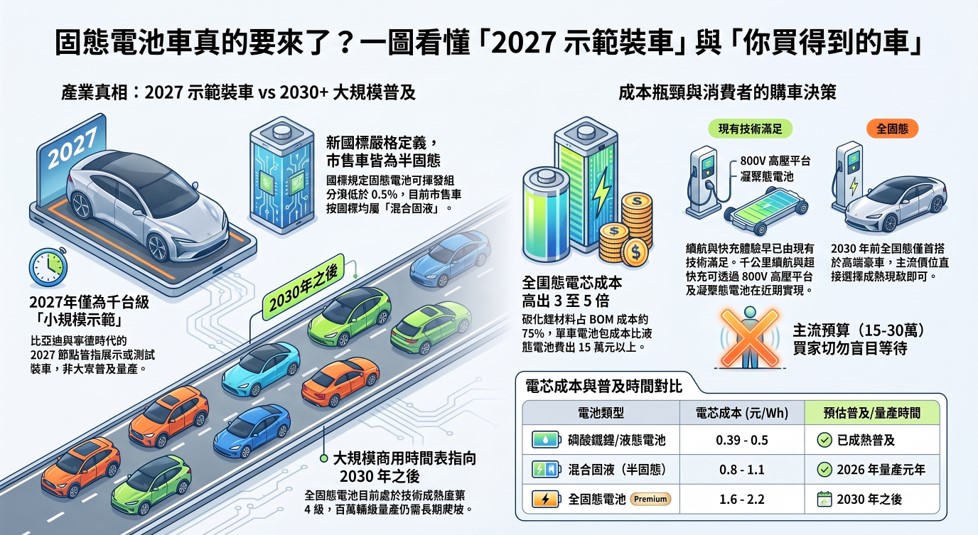
Currently, BYD in ChinaIt has announced that it will lead the industry in launching the first vehicle model equipped with all-solid-state batteries in 2027, and stated: “The first batch is expected to deploy 1,000 vehicles. This new battery has a high energy density of 400Wh/kg and can not only provide a range of over 1,200 kilometers but also offers excellent resistance to extremely low temperatures and safety characteristics.” 2027 has already been regarded by the industry as the key inaugural year for the commercialization and small-scale mass production of all-solid-state batteries.
BYD sells 400,000 to 500,000 electric vehicles a month—why will only 1,000 units be equipped with solid-state batteries in 2027?
BYD said: “The solid-state battery’sThe cost is too high (several times that of liquid batteries).,The yield rate (60% to 70%) is far lower than that of liquid batteries (around 95%)., production line construction and capacity ramp-up take time.”
Although China has finalized its standards for all-solid-state batteries, technical and engineering bottlenecks and persistently high cost pressure remain. In 2027, all-solid-state batteries will only be introduced into electric vehicles as small-scale demonstrations. CATL Chief Manufacturing Officer Ni Jun and Yu Qingjiao, Secretary-General of the Zhongguancun New Battery Technology Innovation Alliance and Chairman of the Battery 100 Association, both independently said that it will take at least five years (2030) for all-solid-state batteries to become widespread. In other words, 2027 is only a key milestone for small-batch market launch of all-solid-state batteries; true large-scale commercial vehicle integration and widespread adoption are expected only after 2030.
Although there are still many variables in the adoption of all-solid-state batteries for electric vehicles, both China and Taiwan have confirmed that they will implement the strictest-ever power bank safety standards in 2027 (China: GB 47372-2026; Taiwan: CNS 62133-2). Under the new standards, the battery cells used in power banks must pass a rigorous nail penetration test (requiring that, in a fully charged state, a 4 mm diameter steel nail be driven vertically through the cell at a speed of 20±1 mm per second), meet more stringent thermal abuse test conditions (changed to placement at 135°C for 60 minutes), and undergo a newly added lithium plating detection test after long-term cycle aging.
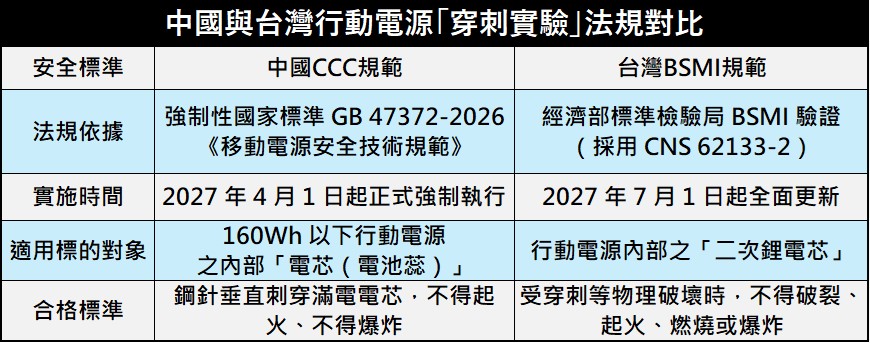
Under this new standard, power banks that currently mainly use liquid lithium batteries will inevitably switch to semi-solid-state batteries (solid-liquid batteries) or all-solid-state batteries. In other words, the battleground for large-scale mass production of semi-solid-state and solid-state batteries will first be in the global yearThe market size is approximately The US$15.2 billion to US$20 billion portable power market has emerged and is gradually expanding into electric vehicles, electric scooters, unmanned vehicles, humanoid robots, and energy storage systems.
Source: KOCPC Chinese