


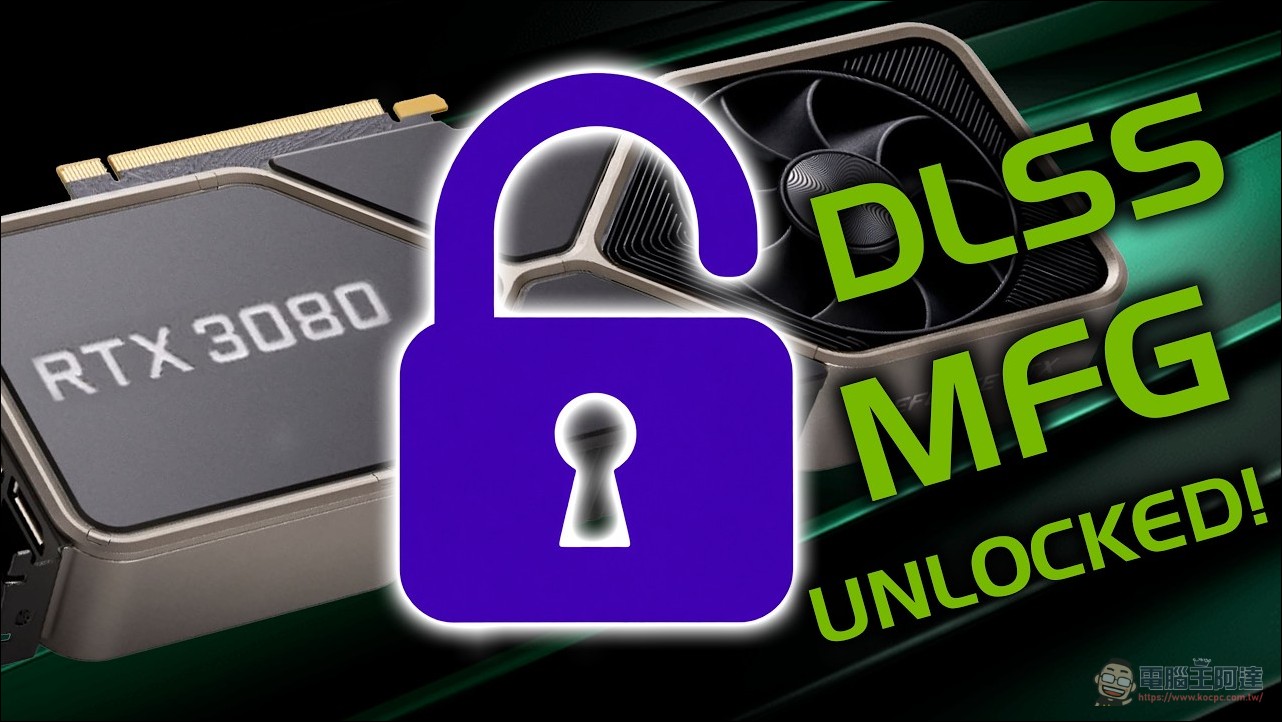
NVIDIA restricts DLSS Multi Frame Generation (MFG) technology to its latest GeForce RTX 50 series graphics cards, but that restriction has now been broken by a community expert. Developer sdli1995 published an open-source project on GitHub called “dlssg_for_sm86,” successfully enabling NVIDIA’s native DLSS Multi Frame Generation on GeForce RTX 30 series cards based on the Ampere architecture, with support for up to 4X frame generation. In testing, it even integrated the not-yet-fully-rolled-out DLSS 5 technology. NVIDIA has consistently emphasized that MFG requires the fifth-generation Tensor Cores and hardware Flip Metering support in Blackwell, and even RTX 40 series can only use the newer frame generation model. Now this project lets RTX 30 users also experience Multi Frame Generation, making it a highly talked-about topic for gamers still weighing an upgrade.
dlssg_for_sm86 Breaking Limits: Directly Porting the Official Runtime
In the past, to achieve frame generation on older graphics cards, most approaches involved translating DLSS into an alternative based on AMD FSR Frame Generation. While this method could generate frames, image quality and compatibility often fell short of native DLSS. dlssg_for_sm86 takes a different route: it directly ports NVIDIA’s official DLSSG runtime to the Ampere architecture, fully preserving the original neural network models and pipeline, allowing RTX 30 series graphics cards to bypass native restrictions. The RTX 30 series still has a large number of users today, with multiple Ampere cards consistently ranking high in the Steam Hardware Survey, making this port practically meaningful for that group of users.
According to the “dlssg_for_sm86” developer documentation, the project operates by embedding the original DLSSG runtime along with a companion backend. Players simply need to place version.dll (or winmm.dll if there is a load conflict) and the configuration file dlssg_sm86.ini next to the executable that actually handles rendering to activate it—no external launchers such as Python or PowerShell are required.
How It Works: Proxy and Embedded Runtime
This module does not simply spoof the GPU model. It plants a proxy agent in the same directory as the game executable, redirecting the game’s frame generation calls to a modified DLSSG 310.1 runtime, and provides an SM86-compatible backend for RTX 30. The Ampere architecture can use precompiled SM86 cubin kernels, or PTX code that is JIT-compiled by the driver. The MaxGeneratedFrames setting in the configuration file adjusts the reported number of generated frames. Setting it to 3 means up to 3 extra frames per real frame interval, i.e., up to 4X multi-frame generation. The actual number generated is still determined by the game; this setting does not force the game to enable 4X, nor does it add options to the game’s menu.
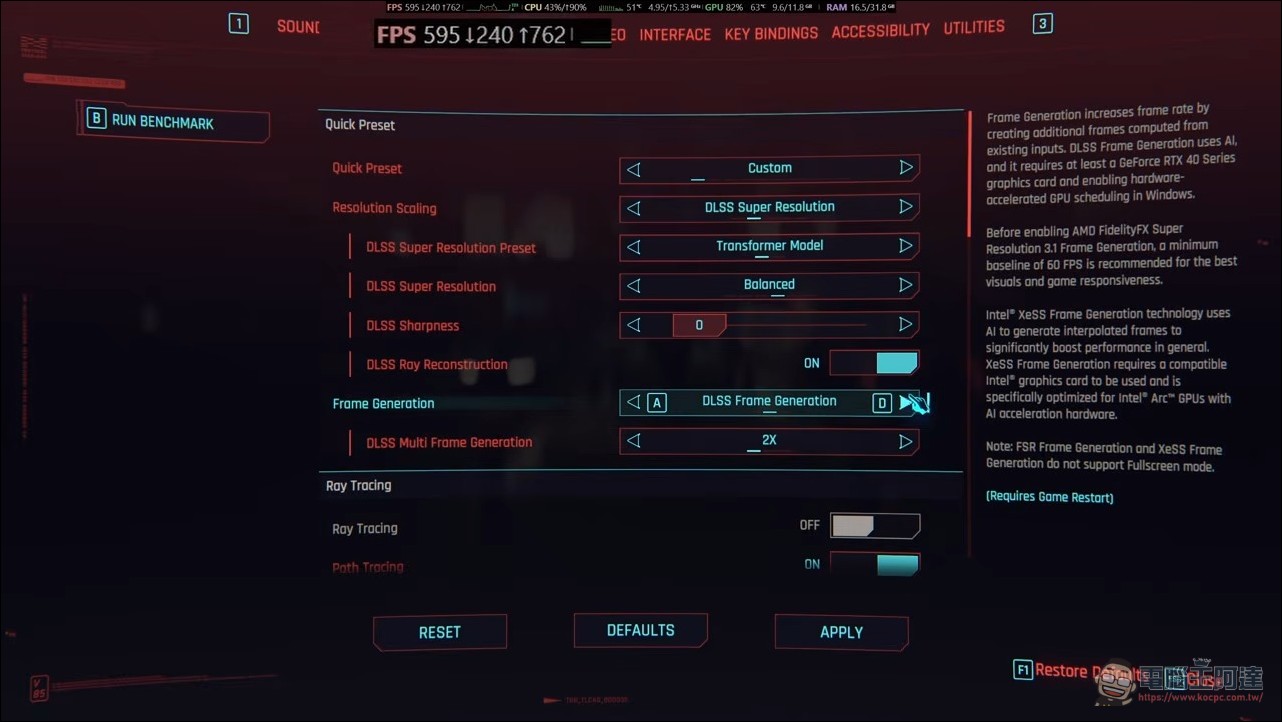
This port is feasible because of the architectural changes in DLSS 4. Starting with DLSS 4, NVIDIA removed the dependency on the hardware optical flow accelerator and switched to an AI-based optical flow model, which made it possible to port the new DLSSG pipeline to the Ampere architecture. The developer also offers both PTX and Cubin core format options, and the RTX 3080 Ti is automatically recognized as SM86, so default settings work properly. On first run, the proxy extracts companion files to a cache directory under %LOCALAPPDATA%, validates them, then loads; subsequently it reuses the cache, and corrupted files are automatically restored. After modifying the config file, you need to fully exit the game and restart for changes to take effect—there is currently no hot-reload feature.
Measured data
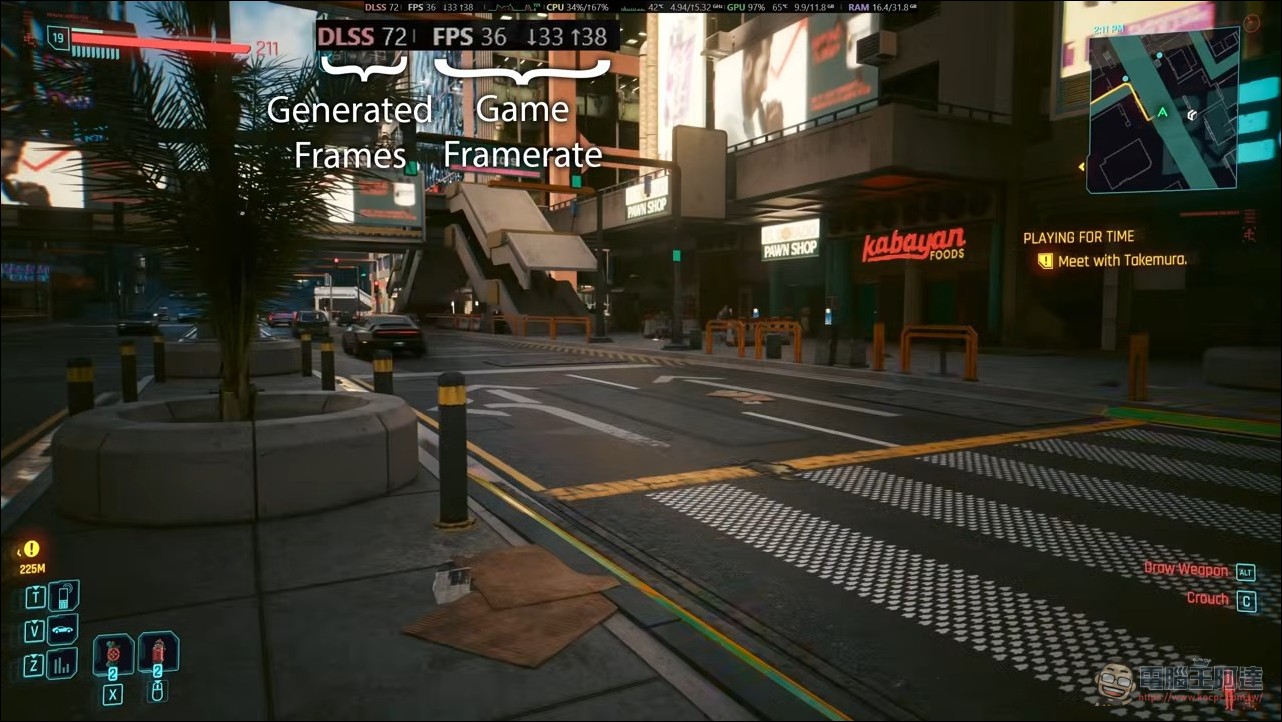
According to the author’s real-world testing, using a GeForce RTX 3080 Ti and manually switching to 2X or 4X mode noticeably improved game frame rates. In Black Myth: Wukong, the frame rate was around 50 FPS with frame generation turned off; enabling 2X raised it to 80 FPS, and 4X mode reached about 150 FPS. Another test ran Cyberpunk 2077 with full ray tracing and DLSS 5 on an RTX 3080 12GB: native was roughly 35 FPS, 2X increased it to 60 FPS, and 4X reached about 100 FPS.
Based on the test results, 2X mode roughly doubles the frame rate, while 4X mode pushes it to around three times the native rate—a fairly significant improvement. An RTX 3080 12GB user also uploaded a gameplay video of Cyberpunk 2077, confirming that DLSS 5 works properly on RTX 30-series cards. Beyond these two titles, the community is gradually testing compatibility and stability on more games.
Differences from the RTX 50 and things to note
Although running Multi-Frame Generation on the RTX 30 can greatly boost performance, it still falls short of the RTX 50 Blackwell architecture in system latency, energy efficiency, and frame smoothness. NVIDIA officially limits MFG to RTX 50, citing Blackwell’s fifth-generation Tensor Cores and hardware Flip Metering, and this porting effort does not prove that the RTX 30 can match Blackwell’s latency and efficiency.
NVIDIA has stated that hardware Flip Metering can make the visuals produced by multi-frame generation more stable, a hardware feature that Ampere lacks, so the performance on the RTX 30 still has a noticeable gap compared to the RTX 50. Judging from the actual footage, while the frame rate numbers do increase, the overall experience with DLSS 5 still falls short of native 80 FPS. Developers have also committed to continuing optimization for multi-frame generation support on the RTX 30. Additionally, this kind of mod is an unofficial modification, and using it in online games or games with anti-cheat protection enabled carries risks, so it is recommended to avoid it.
The Background of the Community Migration Craze
The emergence of dlssg_for_sm86 continues the community’s recent trend of porting DLSS 5 to older graphics cards. As early as late August, mod author Uncle Burrito used RenoDX 4.5 to get DLSS 5 working on RTX 40 and RTX 30 series cards, with support for multi-frame generation. Now dlssg_for_sm86 goes a step further, bringing multi-frame generation to RTX 30 by building directly on the official DLSSG runtime. Community discussion around these ports continues to gain momentum, with many players sharing test results on X. NVIDIA has not yet responded officially to these ports, but the community has long called for support on older cards, and these projects have prompted renewed examination of whether the hardware requirements for MFG are truly insurmountable. For players still on RTX 30, these projects also mean their graphics cards still have room to extend their performance.
dlssg_for_sm86 – GitHub
Conclusion
For players still holding onto RTX 30 series graphics cards, multi-frame generation is no longer exclusive to the RTX 50. dlgss_for_sm86 accomplishes the port while preserving the original model and pipeline, bringing it closer to the native experience than previous FSR-based conversion approaches—but whether it can be used stably in everyday gaming still depends on future compatibility and performance. For developers, this also serves as a technical validation: as long as the original model and pipeline are preserved, hardware architecture limitations are not insurmountable. The next question is whether NVIDIA will soften its stance on MFG support for older cards.
Source: KOCPC Chinese