


Arm today (September 8) at its Arm Everywhere China annual conference held in Shanghai officially launched the second-generation mobile terminal computing subsystem, CSS for Mobile 2, unveiling the brand-new C2-Ultra CPU and Mali G2-Ultra NX GPU in one go, squarely targeting the era of Agentic AI and AI-native graphics computing. This platform is Arm’s most complete AI-native computing solution to date, and is also the first product to integrate a dedicated neural accelerator into a Mali GPU, taking mobile AI graphics processing capabilities up a full generation. Arm has also abandoned the Lumex brand identity adopted just last year, returning to a naming approach centered on CSS.
Arm Shanghai unveils CSS for Mobile 2: C2-Ultra CPU and Mali G2-Ultra NX make their debut
C2 CPU cluster: CPUs transform from compute cores into AI orchestration engines
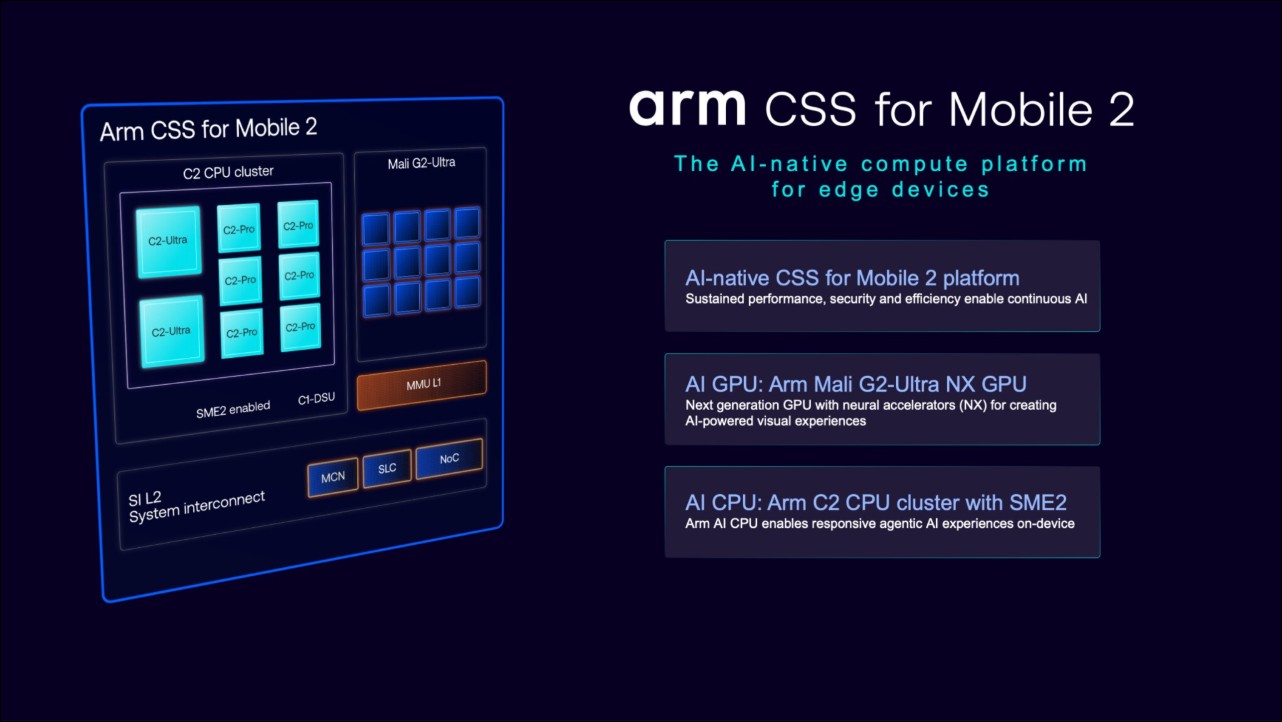
At this CSS for Mobile 2 event, Arm unveiled a brand-new C2 CPU cluster featuring a modular design that includes Arm’s most powerful mobile CPU core to date, the C2-Ultra, an efficiency-focused C2-Pro, and two SME2 (Scalable Matrix Extension 2) units. In the official press release, Arm Vice President Chris Bergey stated that AI is evolving from executing single tasks to managing complex workflows, and the CPU’s role is no longer just a compute provider but the orchestration engine of the entire system, responsible for maintaining context, scheduling workloads, coordinating various tasks, and ensuring AI agents remain highly responsive throughout reasoning, planning, and execution.
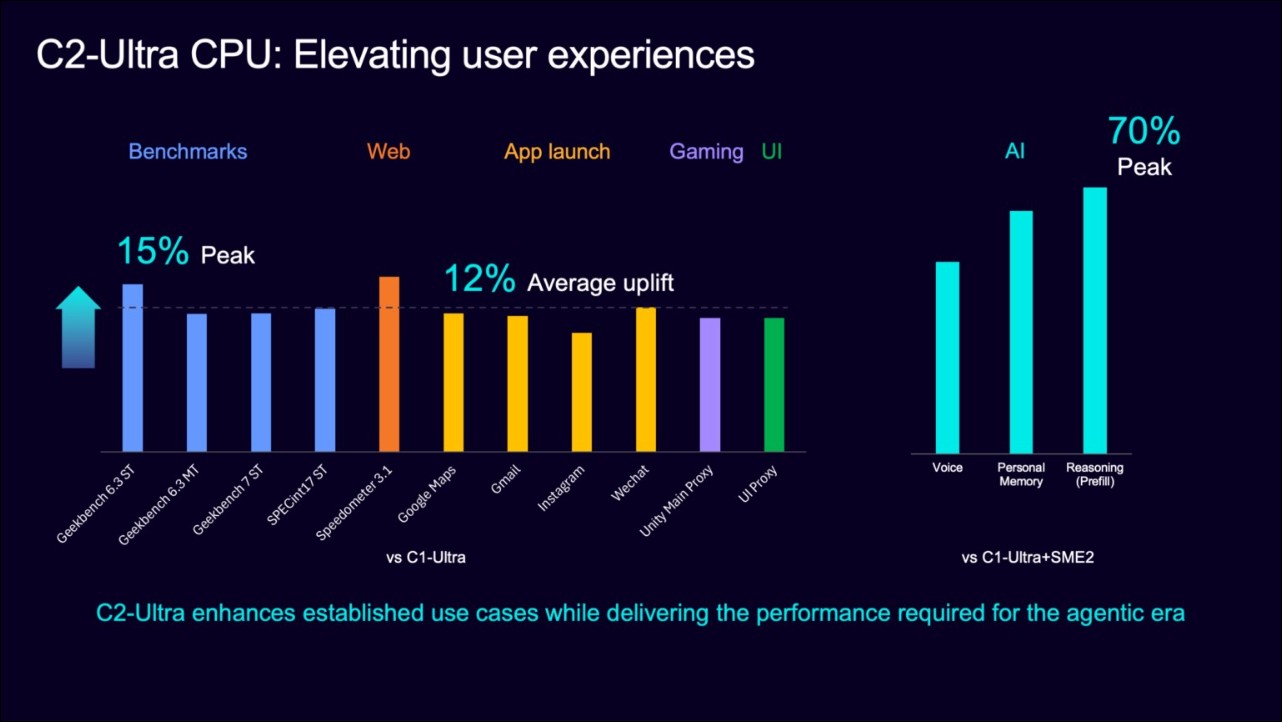
Compared to the previous-generation C1-Ultra, the C2-Ultra delivers up to 1.7x higher AI performance, 15% higher single-thread performance, 12% higher multi-thread performance, and 15% faster web browsing, while reducing power consumption by up to 38% at the same performance level.
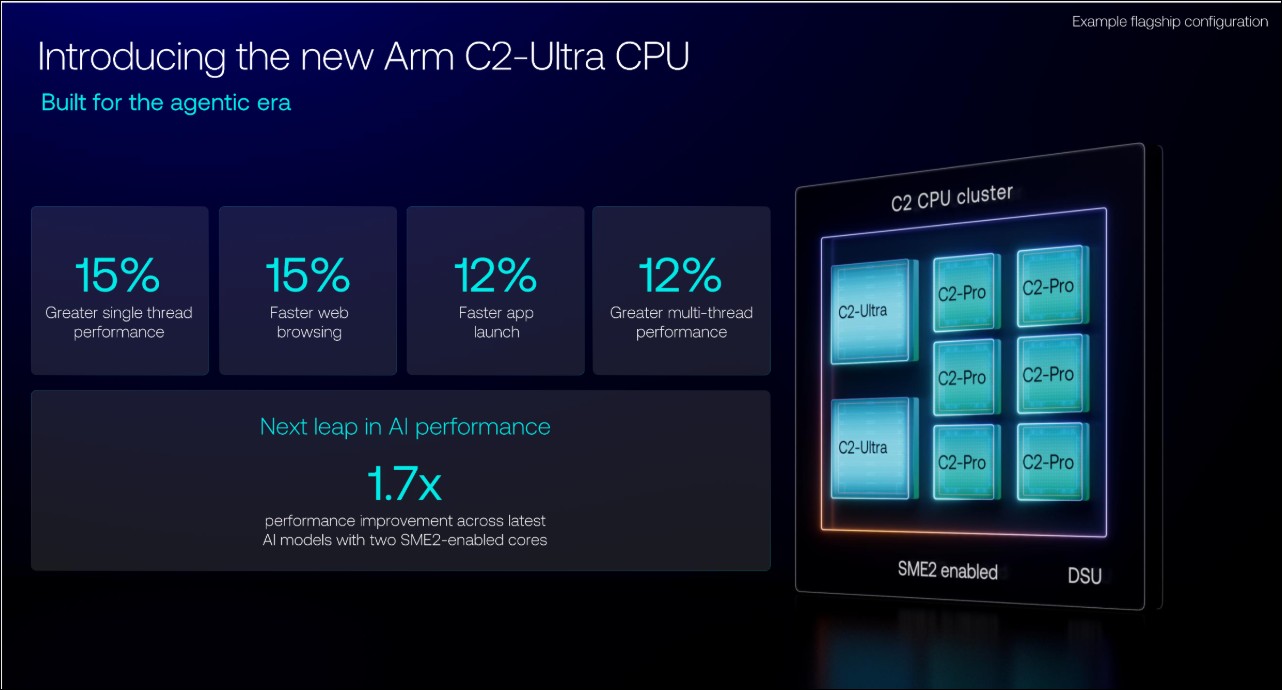
The doubled SME2 configuration is the key to this upgrade. In the flagship configuration, SME2 compute power is doubled, enabling the latest small language models to run up to 70% faster. In tests of agentic workflows covering speech processing, memory retrieval, reasoning, app execution, and web browsing, the C2-Ultra configuration with dual SME2 architecture is 24% faster than the previous-generation C1-Ultra.
The SME2 ecosystem is also expanding rapidly. The technology is now enabled on multiple flagship Android and iOS smartphones, with Alipay, Google AI Edge Gallery, OPPO, and vivo all building applications around SME2. Alibaba’s Qwen-Audio family from Tongyi Qianwen has also demonstrated how Arm CPUs and SME2 can efficiently run voice generation models on-device.
Mali G2-Ultra NX: The First Mali GPU with Integrated Neural Accelerator
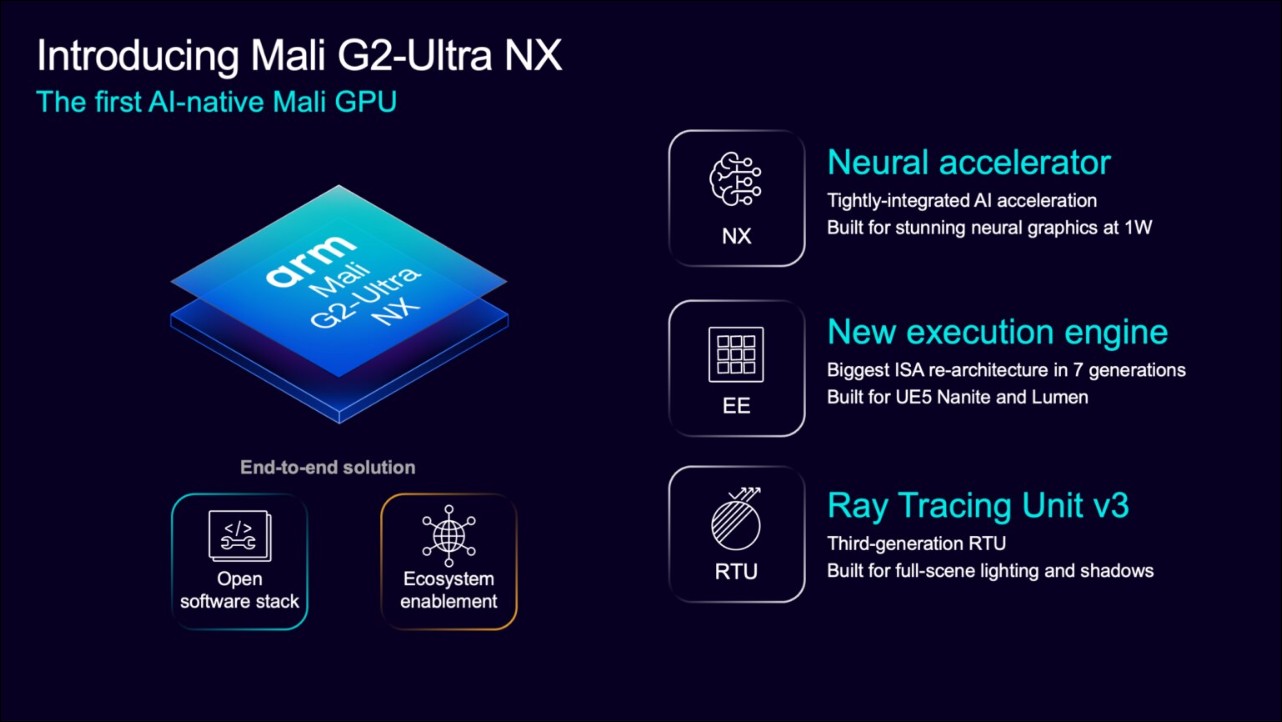
Mali G2-Ultra NX is Arm’s first AI-native Mali GPU and the “industry’s most advanced mobile GPU.” Its biggest breakthrough is integrating a dedicated neural accelerator directly inside the GPU’s shader cores, enabling neural graphics processing and traditional rendering to execute in the same pipeline, greatly reducing the latency and power consumption of data movement between different chip blocks.
Deyan Lazarov of Arm’s GPU product team revealed in an interview that this chip took two and a half years to develop, with the core goal of enabling mobile developers to fully utilize compute-intensive technologies such as ray tracing.
Arm designed three core technologies around this neural accelerator:
– NSS(Neural Super Sampling)Restore high-resolution images from low-resolution rendering, such as upscaling from 540p to 1080p.
– NFRU(Neural Frame Rate Upscaling)Generate intermediate frames to improve the display frame rate, for example, boosting 30FPS rendering to 60FPS output.
– NSSD(Neural Super Sampling and Denoising)Combining image quality enhancement with ray reconstruction denoising, an advanced solution for ray-traced scenes.
In the Neural Dawn tech demo co-developed by Arm and Sumo Digital, the combination of NFRU and NSSD delivers up to a 4x improvement in energy efficiency and reduces external memory traffic by up to 70%. Lazarov cited an example where the previous-generation Mali GPU could only run Neural Dawn at 40FPS at full tilt, and just 15FPS under normal conditions; the Mali G2-Ultra NX, by contrast, easily hits 60FPS.
Besides neural rendering, the Mali G2-Ultra NX also brings significant upgrades to its performance hardware. It uses a redesigned execution engine, representing the biggest instruction set change in seven generations of Mali architecture, with the register count doubled to give complex shaders more room to execute. In traditional non-AI gaming performance, it improves by up to 14% over the previous generation, with overall benchmark scores up 24%.
Ray tracing hardware has also been upgraded to the third generation, adding hardware support for Opacity Micromaps, which enables more efficient processing of complex semi-transparent geometry materials without the additional computational cost associated with traditional ray tracing techniques. Arm stated that the adoption rate of ray tracing in mobile gaming is growing rapidly, with an increasing number of mobile games beginning to incorporate this technology.
Comparing Nvidia DLSS 5: Arm Takes the Open Approach
Arm’s approach to AI graphics technology is clearly different from Nvidia’s. Lazarov emphasized that Arm’s neural networks use a convolutional design, which is fundamentally different from generative AI. The neural networks do not create content out of thin air but precisely reconstruct images based on training data. This design allows Arm’s networks to be publicly shared—all NSS, NFRU, and NSSD models have been open-sourced on GitHub and Hugging Face.
Developers can take Arm’s network model and retrain it for their own game’s unique art style, ensuring that the AI upscaling produces visuals exactly as the developers intend. Lazarov stated directly: “Nvidia’s DLSS is not open—it’s proprietary, closed, and a black box. You have no idea what’s happening inside. You can’t retrain it for your own game. But ours is open and customizable.”
Another key difference is mobile-first. Arm’s technology was designed from the outset with the power, bandwidth, and thermal constraints of mobile devices in mind. Lazarov said: “DLSS simply can’t run on a phone—even with software support, it would instantly blow past your power budget.”
Gaming Ecosystem: Tencent, NetEase, and Unity Fully Integrated
At the launch event, Arm also showcased the progress of its AI-native graphics technology. Leading game engines and studios are integrating Arm Neural Technology into their development pipelines, including MagicDawn from Tencent Games’ Central Technical Department and Unity China’s Tuanjie Engine. Arm currently offers a dedicated plugin for Unreal Engine and plans to expand to other game engines.
In gaming, NetEase’s Where Winds Meet is expected to launch a version with NSS technology this year; Tencent’s Arena Breakout Infinite has demonstrated NSSD technology; Infold Games’ Infinity Nikki is currently integrating NSS technology. Lazarov stated that for existing games already on the market, integrating Arm’s AI-native graphics can be completed in as little as three months.
Terminal product timeline: MediaTek takes the lead
Devices equipped with CSS for Mobile 2 will begin appearing over the coming weeks, with MediaTek expected to be first to launch its flagship Dimensity 9600 platform, likely featuring a configuration of 2 C2-Ultra cores paired with 6 C2-Pro cores and dual SME2 units. Samsung’s Exynos 2700 is expected to follow in early 2028, while Qualcomm is also anticipated to unveil the Snapdragon 8 Elite Gen 6 and Snapdragon 8 Elite Extreme Gen 6 later this month. On the Apple front, the A20 Pro chip is widely expected to debut alongside the iPhone 18 Pro series and iPhone Ultra.
Because Arm’s neural rendering technology allows phones to render at low resolution and low frame rate, then enhances image quality via AI, it gives phone manufacturers new design flexibility. Chris Bergey said in a media briefing: “If we can deliver an excellent 540p, 30FPS experience that lets you use a smaller battery, then you can achieve a smaller device size, and even lower-cost devices.”
Conclusion
Arm’s product cadence this time is quite clear: CSS for Mobile 2 is no longer just an iteration of CPU and GPU, but a system-level redefinition of an AI-native mobile computing platform. From the CPU serving as the orchestration engine for agentic AI, to the GPU with built-in neural accelerators enabling AI graphics rendering, Arm is laying down a complete AI computing infrastructure for flagship phones beyond 2027. For end consumers, faster AI assistant responses, smoother ray-traced graphics in mobile gaming, and longer battery life will be the most direct experiences delivered by this architectural overhaul.