


The U.S. Department of Homeland Security (DHS) in the Federal Register on October 20Publish an announcementannounced that the products and services of Chinese AI startup DeepSeek (Hangzhou DeepSeek Artificial Intelligence Co., Ltd.) would be fully excluded from federal civilian agencies’ information systems and procurement. The order makes two cuts: the first cut targets procurement, prohibiting civilian agencies from purchasing any DeepSeek-related products and services; the second cut targets existing stock, requiring existing DeepSeek products to be removed from government information systems. The most damaging part is one sentence in the order: even “third-party products and services developed using DeepSeek implementations” are included in the removal and purchasing ban. This effectively expands the ban from one company to the entire derivative ecosystem: any service built on top of DeepSeek models is covered by the prohibition.
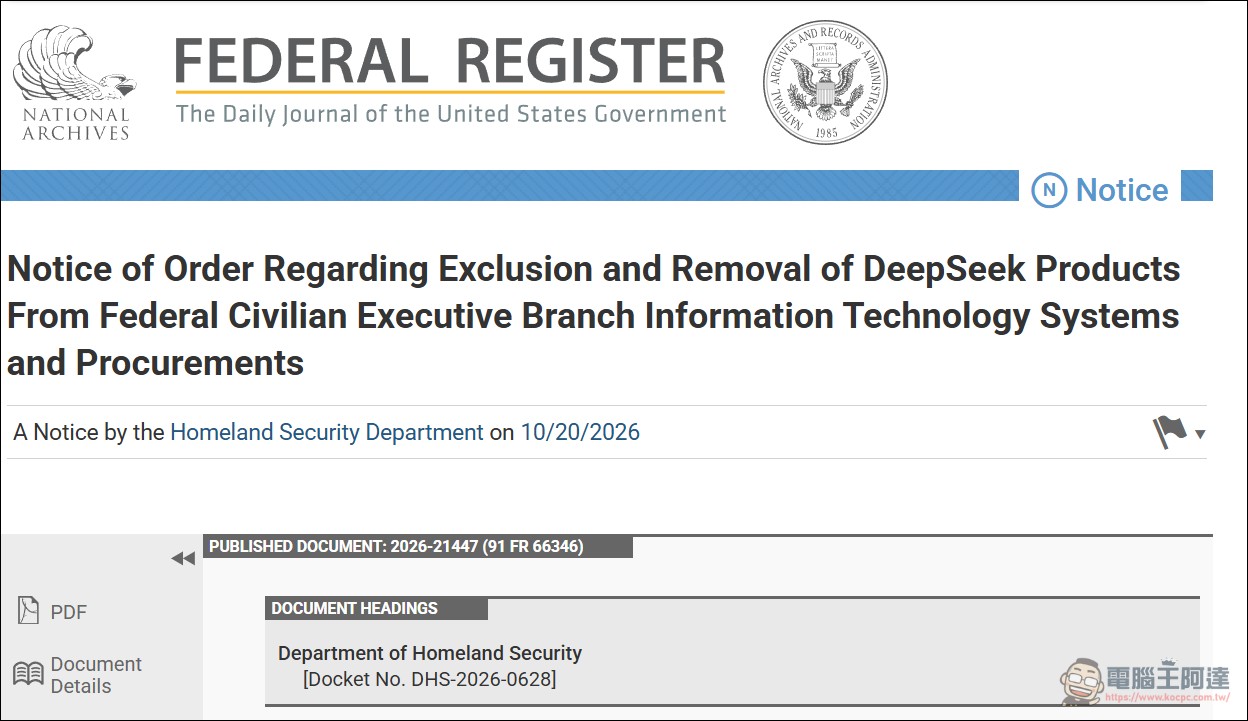
What did the command write?
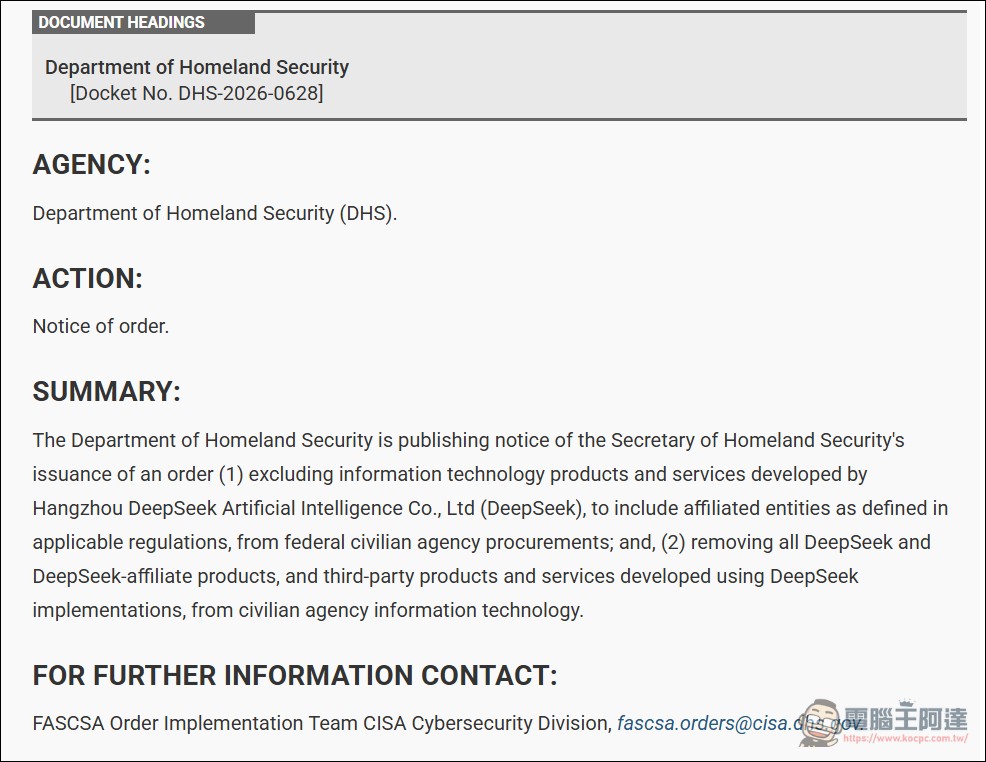
The official title of the notice is “Notice of Order Regarding Exclusion and Removal of DeepSeek Products from Federal Civilian Executive Branch Information Technology Systems and Procurements,” Docket No. DHS-2026-0628, scheduled for publication in the Federal Register on October 20. The official summary explicitly lists two things:
- Exclude ProcurementExclude information technology products and services developed by DeepSeek and its affiliates from federal civilian agency procurement.
- Remove existing inventory: Remove from the information systems of civilian agencies all products of DeepSeek and its affiliated enterprises, as well as third-party products and services developed using DeepSeek.
There’s a detail about the timing: this order was signed back in July, but DHS didn’t make it public until October 20. Its scope is limited to civilian executive branch agencies—that is, ordinary administrative agencies; the military and intelligence community are outside this order’s reach, as those are governed by a separate set of regulations.
Official reason: data flow and the model itself
The reasons DHS gave have two layers. The first layer is data: officials are concerned about how DeepSeek handles user data; under China’s legal framework, sensitive information of U.S. government users could potentially be obtained by Chinese authorities. The second layer is the model itself: DHS also specifically cited concerns that DeepSeek’s models have security vulnerabilities.
In other words, the authorities’ concerns have two layers: whether data will leak out, and whether the model itself can be trusted. For a model family whose open-source weights are running everywhere, allegations about model reliability have broader implications.
Background: From the Old Law to the Distillation Controversy
This is not the first heavy blow the United States has dealt to DeepSeek. Legislation passed in December 2025 had already restricted its use in intelligence and national security systems; this order expands the restrictions to federal civilian agencies, covering both new procurements and existing systems.
Another front is the model distillation controversy. A September report accused DeepSeek and five other Chinese AI companies (including Alibaba and Moonshot AI) of large-scale use of model distillation techniques to extract information from U.S. AI systems. OpenAI previously told the U.S. Congress that it had observed suspected attempts by DeepSeek to distill its models; Anthropic also said it had found unauthorized attempts by DeepSeek and other Chinese AI labs. The underlying backdrop of the whole matter is the U.S.-China technological rivalry, with AI the main battleground in the two countries’ contest for technological dominance.
Scope boundaries: Who is not affected?
The order’s scope is clearly stated: federal civilian agencies’ information systems and procurement. This means state governments, private companies, academic institutions, and individual developers are not directly bound by the order; DeepSeek’s open-source weights can still be downloaded, self-hosted, and used for research in the U.S. private sector. What is banned is the government’s door, not the market’s road. As a result, the bite of this “third-party implementation” clause falls mainly on procurement: it will spread upstream into the private sector along the supply chain, and to win government contracts, vendors will likely proactively remove DeepSeek from their products.
Why is the “third-party implementation” clause so deadly?
Writing the ban at the level of “third-party products and services developed using DeepSeek” is a first in the AI industry. The nature of open-source models is that they get used for secondary development: enterprises take the weights and self-host them, startups use them as a foundation and package them into products, and developers use them to build coding tools. DeepSeek recently open-sourced its own coding application, DeepSeek Harness, touting that “all capabilities are plugins,” and it shot to 36,000 stars in a day—a typical example of this kind of ecosystem diffusion. As long as the underlying layer is DeepSeek, no matter how polished the upper-layer packaging is, federal civilian agencies cannot use it.
For federal agency IT procurement, this clause raises the complexity of supplier audits by an order of magnitude: vendors must declare that they do not use DeepSeek, and must also explain whether any layer of their entire tech stack is underpinned by a DeepSeek implementation. For the open-source community, this also sets a precedent: a model’s “lineage” will become a compliance issue in government procurement. DeepSeek has had no shortage of recent developments: its API pricing has moved from the lowest in the world to tiered pricing, and the V4 series continues to expand its product line (API price increase、V4 releasehave all tracked), these business arrangements now effectively amount to zero in the U.S. government market.
Summary
The signal from this order is clear: the U.S. defense line against Chinese AI has been upgraded from “banning specific apps” to “banning model lineage.” With the rhythm of signing in July and publicizing in October, set against the backdrop of the distillation dispute, officials have framed it in homeland security logic from start to finish; China’s response has also been consistent, namely safeguarding the rights and interests of its domestic companies. What is worth watching next is implementation: how agencies inventory “third-party implementations,” how suppliers clear themselves, and whether it will affect the willingness of ordinary U.S. AI startups to use Chinese open-source models.
Source: KOCPC Chinese